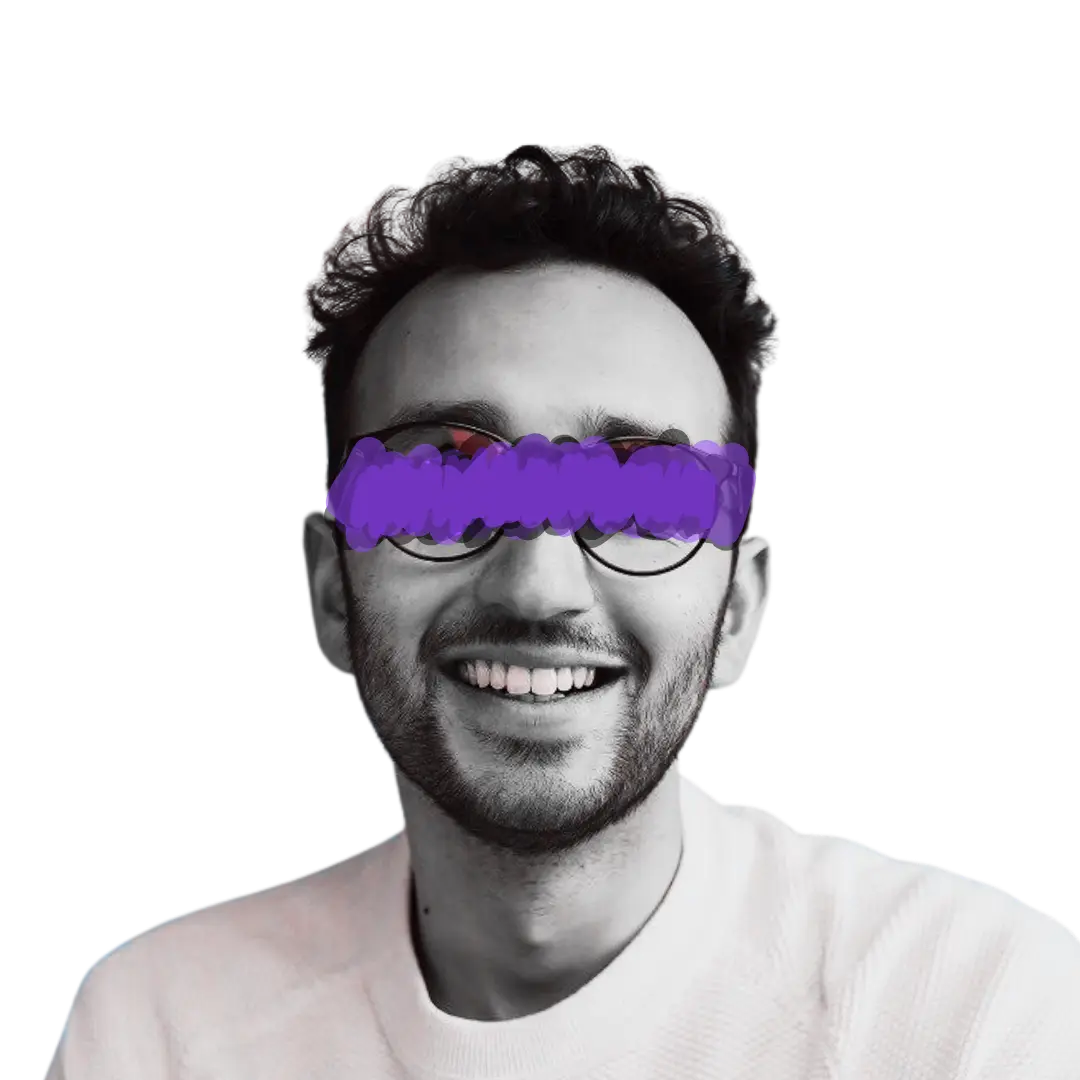
"A man always has two reasons for doing something — a good reason and the real reason. Whenever people ask me why I do YouTube, it's always that. Do I want to say it's because I enjoy helping people, or the real reason — social status, prestige, money. I like being recognized in the streets. It's kind of cool. I think it's a bit of both."
That's Ali Abdaal being more honest than most creators will ever be. Five million YouTube subscribers, a New York Times bestselling book, a multimillion-dollar business empire, and he'll tell you straight up that prestige is part of what drives him. But the interesting part isn't the success. It's the pattern underneath it, one that started when he was six years old, telling adults he wanted to be a neurosurgeon without knowing what it meant, just because the word sounded impressive.
That six-year-old is still running the show. He just has better vocabulary now.
TL;DR: Why Ali Abdaal is an Enneagram Type 3
- Achievement as identity: From childhood, Ali's self-worth was tied to grades and rankings. He admitted that at school, "my whole identity was tied to coming top of my year" and without that, he felt "not being valuable as a human being."
- Strategic shapeshifting: When his headmaster called him robotic and passionless, Ali didn't question whether he wanted medicine. He treated it as a presentation problem. He picked up magic, started volunteering, and rebuilt his persona to match what was needed.
- The validation engine: When asked what he'd do if no one ever saw his work, Ali said flatly: "If you said to me do everything you're currently doing but hit delete instead of hit publish on the videos, I wouldn't do them."
- The teacher's heart (2-wing): His gravestone answer isn't "successful entrepreneur." It's "good father, good husband, and inspirational teacher." He chose teaching over saving lives in a values exercise and has been tutoring since age 13. His 2-wing is where his warmth lives.
- Prestige as gravity: Ali openly ranks career moves by legitimacy. Med-tech startup feels "legit," bestselling author is "fair play," but YouTuber triggers the anxiety. Even his mother uses prestige as leverage to talk him back into medicine.
What is Ali Abdaal's Personality Type?
Ali Abdaal is an Enneagram Type 3 (The Achiever)
Enneagram Threes carry a deep, often unconscious belief that they are only as valuable as their accomplishments. This isn't garden-variety ambition. It's a fundamental wiring that says: without achievement, I am nothing. Threes read what the world rewards and then become exactly that. They adapt, optimize, perform, deliver. Often the most impressive person in any room.
The cost is real. When your worth is tied to what you produce, rest feels dangerous. You're not relaxing; you're falling behind. The goalpost never stops moving.
You can see this in Ali. A six-year-old saying "neurosurgeon" to impress adults. A teenager reverse-engineering his breakout YouTube video. A doctor who left medicine because he couldn't shake the feeling of being replaceable. The same internal engine, running on one question: Am I enough yet?
Ali Abdaal's Upbringing
Ali was born in Karachi, Pakistan in 1994. When his parents divorced (he was about two), his mother moved the family to Lesotho in southern Africa. In 2003, she relocated again to the UK, bringing Ali, his younger brother Taimur, and their grandmother. The goal was education.
His mother's story matters here. She grew up in Pakistan and dropped out of school at seven. She took six years out of her medical training to live in Africa, a detour Ali believes she sees as a mistake that set her family back compared to peers who followed the traditional timeline. For her, the equation was simple and survival-based: prestigious career equals security. "When you grow up in the sort of environment that I did," Ali explained on Steven Bartlett's Diary of a CEO ("How To Finally Stay Productive," Aug 2021), "whereby parents and doctors, all of my mom's friends were doctors... there are so few viable careers, doctor, lawyer, or engineer. You don't even realize that other jobs even exist."
A lot of Threes learned early that love and approval came with conditions. You perform, you get noticed. You don't, and the room goes quiet. The message doesn't have to be spoken out loud. It arrives through what's celebrated, what's noticed, what makes the adults' eyes light up. For Ali, that message was clear from the start.
"Growing up I very much had the identity of being the kid who got really good grades," he told Paul Millerd on the Pathless Path podcast. "That was what my entire identity was focused around."
He wasn't exaggerating. At school, he described feeling like "a weedy nerd kid, slightly bullied, getting grades and stuff but not really having anything, not being valuable as a human being beyond the fact that I was generating A-stars in exams." Strip away the grades, and what was left?
For a developing Three, that question is terrifying. So you make sure the grades never stop.
Ali Abdaal's Rise to Fame
Ali attended Westcliff High School for Boys, earned straight A-stars, then got into Cambridge to study medicine. He graduated first in his class. But the conventional path was never quite enough.
At thirteen, he lied about his age on PayPal to start freelancing graphic design for $5-10 jobs. "Oh my god I'm making money on the internet," he recalled. "This is incredible." At eleven, he and friends created the "United Intelligence Agency," a website teaching lock-picking, karate, and hacking. The instinct to teach and build was already there.
Threes often live on two tracks at once. There's the path everyone can see (in Ali's case, the brilliant medical student) and then there's the side project that reveals what actually excites them. His university yearbook entry from 2015 read: "to make money from a tech startup while being a plastic surgeon on the side."
YouTube started in 2017 as content marketing for his medical school admissions business. Strategic, not spontaneous. He had dreamed of YouTube since 2009, wanting to be a music cover artist, but the actual channel launch was calculated. He planned his breakout "how to study for exams" video as his 100th video, reasoning he needed 99 practice videos to execute it well. It ended up being video number 81. He later cited Tim Ferriss as a major influence: the question "What would this look like if it were easy?" became one of his default operating principles.
That's the Three brain at work. Reverse-engineer the result, build the system, execute.
The channel exploded. By the time he graduated, he had 100,000 subscribers. He spent two years as a junior doctor in the NHS, including during COVID, while his YouTube channel grew exponentially in the background. In January 2022, he left medicine for good.
But the decision wasn't clean. And that's where it gets interesting.
Ali Abdaal's Personality: The Inner Architecture
Ali names his own patterns with real precision. He's clearly done the introspective work. But self-awareness and freedom from a pattern are two different things.
The Prestige Calculator
Every Enneagram Three carries an internal prestige ranking system. A social hierarchy where careers, achievements, and life choices are stacked against each other. Most people have a vague sense of this. Threes have a detailed spreadsheet.
Ali has described his explicitly. On the Pathless Path podcast, he mapped it out: leaving medicine for a med-tech startup? "Those guys are legit." For a bestselling book? "That's fair play." For YouTube? That's where the discomfort starts.
"The reason I'm attached to the doctor identity is because of the status and the prestige," he admitted, "and my perceived fear that if I'm not a doctor and quote 'just a YouTuber' that that is not good enough and it's not like legit enough."
The word "just" is doing enormous psychological work in that sentence. The Three's core fear compressed into four letters: without the right label, I am nothing.
The Shapeshifter
Threes have an uncanny ability to read what an environment rewards and then become that. It's not manipulation. It's closer to a survival instinct. Threes genuinely become skilled at whatever they turn their attention to, partly because they're willing to reshape themselves to fit what's needed.
When Ali's headmaster told him at sixteen that he seemed "robotic and passionless" about medicine, Ali's response is textbook Three. He didn't question whether he actually wanted medicine. He treated it as a presentation problem: "Okay cool, if I want to get into medicine I need to show myself as being a more charismatic enthusiastic sort of dude. Therefore I'm going to start asking questions in class and start volunteering for random things."
He even picked up magic as a tool for seeming more impressive: "I was like, oh my god I can become a magician and that's really freaking cool but that will also help me be more confident and charismatic, which will help me get into med school."
At university, the transformation was deliberate. "I wasn't particularly outgoing or particularly charismatic or particularly confident," he told Chris Williamson on his Deep Dive podcast. "I decided, you know what, I'm going to make an active decision to change myself to become someone who's more confident and more charismatic."
Many people drift into personality changes. Ali engineered his.
The Validation Engine
The most revealing moment across Ali's interviews comes from the Pathless Path conversation. Paul Millerd asked what he'd do if money didn't matter and no one could see his work.
Ali didn't hesitate: "If you said to me do everything you're currently doing but hit delete instead of hit publish on the videos, I wouldn't do them."
He continued: "If I were to write and then throw it in the bin, that would feel not satisfying at all. So I think that element of publication is a big part of what brings me satisfaction."
That's the Three's relationship with validation, right there. The work needs an audience. Not because Ali is shallow, but because for Threes, the feedback loop is where meaning lives. Creating into a void isn't creating at all.
The Emotional Disconnect
Enneagram Threes are part of the Heart Center (types 2, 3, and 4), which means their core issue is around identity and feelings. But Threes are weirdly cut off from their own feelings. They're the Heart type most disconnected from their own heart.
Ali named this plainly on the Diary of a CEO: "I've got friends who genuinely feel in their hearts if there is suffering in the world, and I don't genuinely feel in my heart when there's suffering in the world. But I know intellectually that I should care about this thing." His solution? Donate 10% of income to charity. A rational, systematic response to an emotional gap.
When his housemate once asked "how do you feel?" about a $6,000 monitor purchase, Ali found the question "baffling." Feelings get processed through intellect. Action gets taken based on what "should" be felt rather than what is felt.
This pattern runs deeper than purchases. After his wedding and honeymoon in Costa Rica, Ali told his brother Taimur on the Not Overthinking podcast that marriage felt "nice to have gotten it out of the way." He expressed gratitude when seeing unmarried friends struggling with dating apps: "it's pretty tough out there... I feel lucky to have that sorted." Marriage as a solved problem. A domain optimized and closed.
Even his honeymoon reveals the pattern. When his wife Izzy went snorkeling, Ali opted for tennis drills instead. He genuinely puzzled over why nature doesn't interest him: "I don't really get the whole looking at animal thing... given the choice between snorkeling and just sitting there on the balcony reading a book, I would rather sit there on the balcony reading a book."
This isn't coldness. It's the Three's operating system. Experiences get evaluated by what they produce: skill development, content ideas, measurable improvement. Passive absorption of beauty doesn't register on the spreadsheet.
The Teacher's Heart: Ali's 2-Wing
If the prestige calculator is Ali's shadow, teaching is his soul.
On the Diary of a CEO, Ali made a confession that clearly cost him something: "I prefer teaching medical students than actually practicing as a doctor. And realizing that teaching is more of a value for me than saving lives, I was like, okay cool, this makes sense. I can now get on board with that and not feel bad about it."
This is where Ali's Enneagram 2-wing shows up strongest. Twos are the helpers, driven by a need to be needed, to make others' lives better. In a Three, this doesn't look like self-sacrificing service. It shows up as a deep pull toward teaching, mentoring, and making excellence accessible.
Ali has been tutoring since age thirteen. He started a YouTube channel partly to teach study techniques at scale. When he did a gravestone exercise with a life coach, the answer wasn't "successful entrepreneur" or "bestselling author." It was "good father, good husband, and inspirational teacher." Notice: "inspirational teacher," not "someone who understood himself" or "someone who lived authentically." Even his deepest aspiration is audience-dependent.
What makes Ali's teaching genuinely effective and not just another performance: he makes complex things feel achievable. His study technique videos, his productivity frameworks, his book all share a quality of "if I can do it, so can you." That's the 2-wing at work. A pure Three might hoard their methods as competitive advantages. Ali's instinct is to systematize them and hand them out.
His company mission statement struggle captures both sides. Ali and his team spent four hours trying to articulate what they do. His private thoughts were "I want to have fun, I want to make money, I want status and prestige," but "you can't put that in a mission statement." They landed on: "We help people do more of what matters to them." The Three wanted prestige. The 2-wing insisted on helping.
Can a Three Just Have Fun?
Ali's idea of fun is revealing: "singing Disney songs and playing board games until two o'clock in the morning with the pizza takeaway, rather than something that a more macho alpha type person would be." When Steven Bartlett advised him to never change who he is for a partner, Ali engaged deeply and seemed relieved to have permission to keep these interests.
But the more interesting question is whether Ali can sustain a hobby without optimizing it.
He's played guitar for ten years without much improvement. After watching skilled musicians jam at Burning Man, he said he wanted to "get better at guitar and try my hand at drawing and actually stick to it." He also wants to get into camping, set up an optimal studio, and explore photography and filmmaking. The pattern is enthusiasm for new possibilities combined with difficulty sustaining depth in any single pursuit.
This is the Three-Seven dynamic at work. There's a strong Type 7 energy in Ali: the breadth-over-depth impulse, the gear obsession ("imagination is the limit rather than the bank account when it comes to buying new tech now"), the tendency to stay in the research-and-anticipation phase where everything feels exciting. He browses PC cases he'll never build. He watches hours of gear reviews about cameras he doesn't need.
His brother Taimur pushes back on this, asking whether watching gear reviews is a waste of time. Ali's reflexive response: "It depends on what your goals are." Taimur explicitly calls this out as avoidance of taking a real position. Ali is comfortable being a consultant on methods but uncomfortable being a philosopher on meaning.
The question for Ali is whether the guitar will ever just be a guitar. Something he does badly and happily, with no audience, no optimization framework, and no content strategy attached. For a Three, that kind of purposeless play might be the hardest achievement of all.
The Three's Paper Trail: What Achievement Looks Like From the Inside
Feel-Good Productivity: Rewriting His Own Rules
In 2023, Ali published Feel-Good Productivity. It hit the New York Times and Sunday Times bestseller lists, sold hundreds of thousands of copies, and got translated into 35+ languages. The core thesis — that positive emotions drive sustainable productivity better than discipline and grinding — was essentially Ali processing his own Three pattern publicly.
"Motivation clearly isn't enough," he wrote. "And telling people to simply 'feel more motivated' isn't just unhelpful, it's potentially harmful."
A man whose entire life has been driven by achievement wrote a book arguing that the key to productivity is feeling good first. That's Ali's evolution made visible. A Three who recognized that the hustle-at-all-costs model leads to burnout and started building an alternative. Whether the alternative is genuinely different or just a more sophisticated optimization strategy — that's the part he hasn't answered yet.
Ali Abdaal's Struggles and Growth
The Identity Crisis of Leaving Medicine
Ali's exit from medicine is the most psychologically revealing chapter of his story. It wasn't a dramatic quit. He described driving home from his last day as a doctor and thinking, "This should feel different than it does, and it really felt like nothing." He later reflected: "99% of the work was done before that final day." The actual departure was anticlimactic because the psychological shift had already happened in pieces.
The real struggle was the identity question: "Do I really want to become that guy who leaves medicine where there's a shortage of doctors during a global pandemic to become an influencer making videos on the internet?" Notice what haunts him. Not "Is this the right decision?" but "How will this look?"
His mother still uses prestige as leverage. "Often if I'm having conversations with my mum," Ali shared, "she'll try and talk me back into doing medicine again, and one of her bargaining chips is 'oh but think about the prestige.'" He even admitted to a thought experiment that he described as sounding "really weird": he sometimes asks himself whether his decisions would change if his mother were dead. "And it does shift the equation."
One rational argument haunted him: the counterfactual. "I could never quite get over the counterfactual that if I wasn't in that position someone else would have done it instead." For a Three who needs to feel uniquely valuable, being replaceable is unbearable.
The Goalpost That Never Stops Moving
Steven Bartlett confronted Ali with a powerful observation: "If you'd told [past you] 'you're going to have two million subscribers on YouTube, hundreds of thousands of followers on Instagram' — that person would have had a stroke. And here you are... the past version of yourself told you'd be happy when you got here, but you're not."
"I feel like what I'm currently doing is not quite good enough because our team is inexperienced or because I suck at being a manager or because I suck at being a leader," Ali admitted. "The more I compare, the less good I feel about the stuff that I've done."
This is the core Enneagram Three trap. Success doesn't cure the feeling of insufficiency. It just raises the bar. The comparison set shifts from medical school classmates to millionaire YouTubers, and the internal metric recalibrates. "Enough" is always just out of reach.
The Burning Man Crack
Something shifted at Burning Man in 2024. Ali and his wife Izzy attended with a camp of about 40 people, 35 of whom were engineers from Google, SpaceX, and similar companies. The camp had been running since 2006, with a permanent storage unit in Nevada. Organized, methodical, professional. Ali fit right in.
Then his fame meant nothing. "I mentioned to someone that I was a YouTuber," Ali recalled, "and they thought that meant I worked at YouTube. That's the sort of crowd." For someone whose identity is partly built on being recognized, suddenly being nobody is a real test.
What got to him wasn't the parties or the art. It was the impermanence. Everything at Burning Man is built to be destroyed. Elaborate structures, art installations, camps, all torn down or burned at the end of the week. Ali made a vulnerable, unprompted connection to his own life on the Not Overthinking podcast: "Everything arises and then fades away and that's okay. Trying to cling on to things, like the fame that I currently have on YouTube... that's sort of somewhat counterproductive."
For a Three whose entire operating system is built around building, accumulating, and achieving, admitting that clinging to success is counterproductive is a real crack in the armor.
He also took his longest break from work in seven years during this period. Three full weeks without opening his laptop, spanning the wedding, honeymoon, and Burning Man. For someone who's been grinding since age eleven, that's significant. Though he admitted he still consumed content and journaled about ideas, because "that's just life." A Three's floor of disengagement is most people's productive workday.
What did he come back wanting? Not another business milestone. He wanted to get better at guitar. He wanted to try drawing. He wanted to take hobbies "more seriously" after watching skilled musicians jam around the campfire and campmates build elaborate DIY projects. These are small desires. But for Ali, wanting something that doesn't have a metrics dashboard attached to it might be the biggest shift yet.
The Brother Dynamic
Ali and his younger brother Taimur co-host the Not Overthinking podcast, and their dynamic reveals something important about how Ali operates.
Taimur plays the role of the person who won't let Ali get away with surface-level answers. When Ali deflects a values-based question with his signature "it depends on what your goals are," Taimur explicitly pushes back, calling it avoidance of taking a real position. When Taimur pitched a business idea (a subscription service that ships microphones to podcast guests), Ali systematically dismantled it on TAM, margins, and logistics. He's direct with his brother in a way that reveals his sharp business instinct and his comfort being the authority in the room.
They share the same high-pressure upbringing. Both grew up under the same maternal expectations, both ended up in the creator economy. But Ali is the achiever, the optimizer, the one whose name is on the channel. Taimur occupies a different space. More philosophical, more willing to sit with questions that don't have frameworks attached. The interplay between them shows Ali at his most unguarded. When you can't perform for your brother, the person who saved over your Pokemon Blue file and has seen every version of you, the mask slips a little.
Ali Abdaal's Legacy and Current Work
Ali married Dr. Izzy Sealey in 2024, moved to Hong Kong, and is expecting his first child. He's already approaching community-building in Hong Kong the same way he'd grow a YouTube channel: posting on Instagram for "inbound leads," organizing dinners for "creatory type people" and "entrepreneur type people" separately. Relationships organized by category and utility. The Three never fully clocks out.
He's co-founded Sparkle Studios, building productivity apps. His podcast Deep Dive debuted at #1 in Education on Apple Podcasts. The metrics keep accumulating.
But the most interesting question about Ali Abdaal isn't what he'll accomplish next. It's whether the thing he said he wanted on his gravestone, "good father, good husband, inspirational teacher," will eventually outweigh the prestige calculator that has driven him since he was six years old.
The signs of evolution are there. He's writing about feeling good rather than just producing more. He's admitting that clinging to fame is counterproductive. He described his life philosophy with unusual directness: "One view of the meaning of life is that it's simply about enjoying the passage of time, and hobbies help us enjoy the passage of time." For someone who has measured time by output for his entire adult life, that sentence is quietly radical.
"I think that coming at something from a place of 'I'm already enough but I want to be better,'" he said, "is very different to 'I am insufficient unless I achieve this.'"
That distinction, between healthy striving and desperate proving, is the whole game for Enneagram Threes. Ali can name it. The question is whether he can live it.
How Ali Abdaal's Personality Reads for the Rest of Us
Most people have some version of Ali's prestige calculator running in their heads. You've probably hit a goal you thought would make you happy, then immediately started planning the next one. At some point you've weighed whether to be yourself or perform a version that lands better.
Ali makes this tension visible because he's unusually honest about it. He'll tell you the real reason alongside the good reason. He'll admit that without an audience, the work loses its meaning. He'll map his own prestige hierarchy out loud and then laugh at how absurd it is.
That honesty is what makes him worth studying. Not because he's figured it out, but because he's figuring it out in public, with five million people watching. And the question he's wrestling with is the same one the Enneagram puts in front of every Three: Can you believe you're enough before the world confirms it?

What would you add?