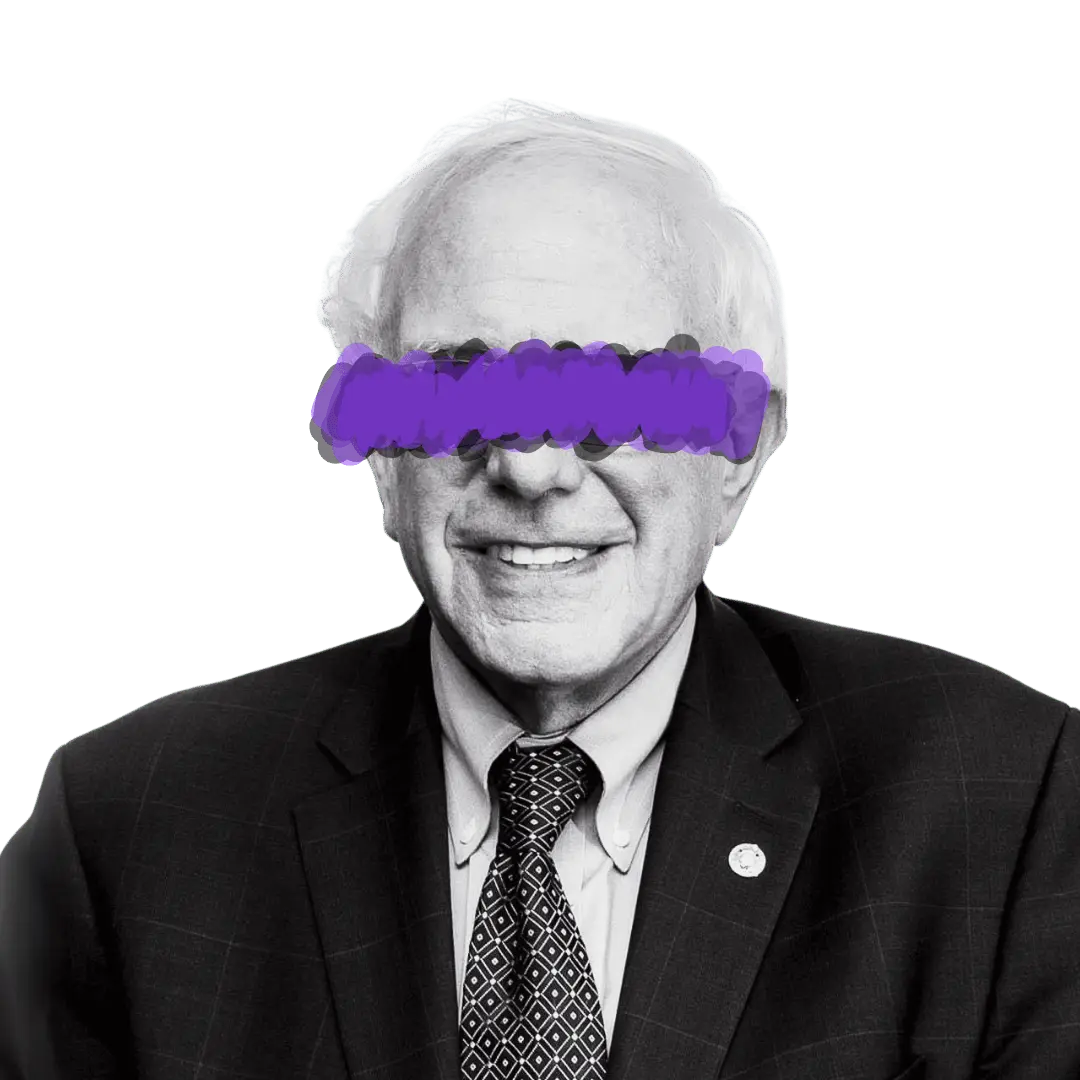
"I don't really give a damn about money. I drive a car that's 11 years old."
Bernie Sanders has been giving the same speech for over forty years. The numbers change. The billionaires multiply. But the core message — that the economy is rigged, that working people are getting crushed, that the rich have too much and the rest don't have enough — has not moved one inch since he was a broke carpenter running for governor of Vermont on a third-party ticket in 1972.
His critics call this stubbornness. His supporters call it consistency. Both are missing what's actually happening.
Sanders doesn't repeat himself because he's stubborn and he doesn't repeat himself because he's consistent. He repeats himself because the world still hasn't corrected the thing he sees as wrong, and something inside him — something wired into his nervous system long before he ever stood at a podium — physically cannot stop pointing at it.
That something has a name. Not idealism. Not socialism. Not even conviction in the usual political sense.
It's a moral compass that doesn't have an off switch.
TL;DR: Why Bernie Sanders is an Enneagram Type 1
- The Internal Courtroom: Sanders operates with an unrelenting inner standard of what is right and wrong — and channels it outward into decades of the same crusade
- Anger as Fuel: His core emotion isn't passion or idealism — it's a controlled, slow-burning anger at injustice that he's alchemized into political endurance
- The Childhood Wound: Growing up watching his parents argue about rent money in a Brooklyn apartment installed a moral certainty about economic fairness that has never wavered
- The Consistency Paradox: What looks like political strategy is actually something far more personal — a man who cannot look at a broken system and stay quiet about it
The Rent-Controlled Apartment on Kings Highway
Bernie Sanders was born in 1941 in a three-and-a-half-room rent-controlled apartment on East 26th Street and Kings Highway in Brooklyn. His father Eli had arrived from Poland in 1921 at seventeen — no money, no English, no safety net. He became a paint salesman, traveling the five boroughs with sample cases. His mother Dorothy was a stay-at-home mom from a family of Jewish immigrants.
They always had enough for rent and food. Never for anything else.
"My experience as a child, living in a family that struggled economically, powerfully influenced my life and my values," Sanders has said. "I know where I came from, and that is something I will never forget."
But the specific texture of that childhood matters more than the broad strokes. His brother Larry, six years older, remembers that their parents' arguments were almost always about money. "We grew up feeling loved and secure — except in matters of money," Larry told Slate. "It was the issue on which their parents had arguments, and they didn't really know whether they'd have the rent the following month."
Picture that. A kid in Brooklyn, lying in bed, hearing his parents fight about whether they can make the next month's payment. Not about whether to buy a boat. About whether they can keep the apartment.
That kid grew up to spend sixty years talking about one thing.
The Athlete Nobody Expected
Young Bernie wasn't the angry politician in miniature. Larry describes him as "much less like that as a child. If anything he was on the quiet side." But he had two things: intellectual confidence — "in class he was frequently the kid with his hand in the air" — and surprising physical talent.
He won a borough championship on his elementary school basketball team. At James Madison High School, he became track captain, racing with seniors as a sophomore and winning. On their block in Brooklyn, "being an athlete at that time conferred status," Larry said. It was how Bernie gained acceptance — not through money, which they didn't have, but through effort and performance.
The quiet kid who earned his place by outrunning everyone. That pattern has a longer half-life than anyone in Brooklyn could have predicted.
The Loss That Installed the Mission
Dorothy Sanders had rheumatic fever as a child. The long-term damage to her heart caught up with her when Bernie was in high school. She underwent two heart surgeries. The second one failed.
She was forty-six. Bernie was eighteen.
"Losing one's mother at the age of eighteen was very, very difficult," Sanders has said, in the understated way he talks about anything personal.
He graduated from Madison High School and enrolled at Brooklyn College. After one year, he left. He wanted to get away from Brooklyn entirely — away from the apartment, the neighborhood, the absence.
What he carried with him was something he couldn't leave behind: the knowledge that his mother's death was connected to money. To access. To a healthcare system that didn't treat a paint salesman's wife the same way it treated everyone. When he joined Congress in 1991, the first bill he introduced was a measure to encourage states to institute universal healthcare.
The boy who lost his mother became the man who won't stop talking about healthcare. Not as a policy position. As a debt.
The Decades Nobody Was Watching
After Brooklyn College, Sanders transferred to the University of Chicago. This is where the quiet kid from Kings Highway first put his body where his mouth was.
In 1962, he led a protest to desegregate a Howard Johnson's restaurant. In August 1963 — days before the March on Washington — he was arrested in Chicago for protesting the installation of "Willis Wagons," portable classrooms deployed to Black neighborhoods so that white schools wouldn't have to integrate. He chained himself to other protestors. He was charged with resisting arrest. He was fined twenty-five dollars.
He was twenty-one years old, and he had already identified the pattern that would define his life: something is wrong, someone needs to say so, and if nobody else will, he'll do it himself.
Then came the wilderness years.
After graduating from Chicago, Sanders moved to Vermont in 1968. For the next thirteen years, he worked as a freelance writer, a carpenter, a youth counselor, a Head Start preschool teacher, a psychiatric hospital aide, and a filmmaker for the American People's Historical Society, where he made no-frills documentaries about poverty.
He ran for office four times with the Liberty Union Party between 1972 and 1976. He finished a distant third each time. Nobody cared. Nobody was listening.
He kept talking anyway.
Ten Votes
On March 3, 1981, Bernie Sanders won the Burlington mayoral race by ten votes.
Ten votes. Against a five-term Democratic incumbent. Running as an independent socialist in a small New England city.
He was thirty-nine years old. He had been saying the same things for a decade to rooms that were mostly empty. And he won by the margin of a large dinner party.
What he did as mayor matters less here than what the victory reveals about the man. He didn't win because he changed his message. He didn't win because he softened his edges or learned to play nice with the Democratic establishment. He won because he kept showing up, kept saying the same thing, and eventually enough people in one small city decided he was right.
That's not political strategy. That's a moral compulsion that happens to occasionally intersect with electoral math.
What is Bernie Sanders' Personality Type?
Bernie Sanders is an Enneagram Type 1
People see a stubborn old socialist who won't update his talking points. But the real engine isn't ideology — it's a moral inner voice that cannot stop correcting what it perceives as wrong.
Enneagram Type 1s are wired with an internal standard that never dims. Every action, every system, every institution gets measured against it. The standard isn't "good enough" — it's "right." And the gap between what is and what should be produces a slow-burning anger that Type 1s rarely call anger. They call it frustration. Concern. Urgency.
Sanders calls it "the issues."
Here's the evidence:
- The forty-year monologue. A locked moral compass doesn't drift with polling data. Sanders has been saying the same thing since Nixon was in office — not because he's lazy, but because the verdict has never changed. His staff describe a man who eats meals on the move, in planes and cars. Rest feels like permission to stop correcting the thing that's wrong.
- Anger expressed as policy. "What we are seeing now is real frustration," Sanders says, using the word "frustration" the way Type 1s always do — as a socially acceptable container for something much hotter. Watch him speak. The jabbing finger. The leaning forward. The tension in his shoulders. His body is doing what his words won't: expressing the fury underneath the policy language.
- The deflection from self to principle. On the Lex Fridman podcast, when asked about himself, Sanders said: "Everybody talks about themselves. It's not about me." That's not humility. That's a Type 1 who genuinely believes his personal story is irrelevant compared to the moral problem he's trying to solve.
The 1w2 wing — "The Advocate" — explains why this isn't just internal perfectionism but an outward crusade. His standards don't stay private. They extend to the entire economic system of the United States, and he will teach you about them whether you asked or not.
The Eight-and-a-Half-Hour Sermon
On December 10, 2010, Bernie Sanders stood on the floor of the United States Senate with nothing but a glass of water and began talking.
He talked for eight hours and thirty-seven minutes.
He was protesting a bipartisan tax deal that extended Bush-era tax cuts for millionaires and billionaires. He spoke without a script about corporate greed, income inequality, and the decline of the middle class. He read letters from constituents. He cited statistics. He repeated himself — because that's what he does.
The Senate server crashed from the volume of people trying to watch online. Millions followed the stream. The phones in his Vermont and Washington offices rang until they couldn't ring anymore.
And then the Senate voted 81-19 to pass the tax deal anyway.
By every measurable standard, the filibuster failed. The bill passed. Nothing changed.
Sanders' reaction was characteristically defiant. He told NPR: "You've got to wage the fight before you compromise. You've got to take the case to the American people. And we didn't do that." He framed the failure not as his own, but as the Democratic Party's failure of will. This is how a Type 1 processes defeat — not as evidence they were wrong, but as evidence the world hasn't caught up yet.
He published the speech as a book. It became a bestseller. His strategist Jeff Weaver later said the filibuster "brought Bernie Sanders to the notice of millions of Americans who didn't know who he was" and laid the groundwork for his 2016 presidential campaign. The "failure" became arguably the most important moment of his career.
This is the central paradox of his life. The man who has been right about income inequality for four decades — who warned about oligarchy before it was fashionable, who was talking about climate change before most politicians could spell it — has won almost none of the legislative battles he's fought. The economy got more unequal. The billionaires got richer. The healthcare system stayed broken.
And he kept talking. At 83, he's on a "Fighting Oligarchy" tour with Alexandria Ocasio-Cortez that has drawn over 261,000 people across the country. A Denver rally drew 34,000 — larger than any event during either of his presidential campaigns.
The world hasn't changed. He hasn't changed. And the gap between those two facts is where the real story lives.
"They Say I Can Be Nasty"
There's a version of Bernie Sanders the public doesn't see. The one who admits he can be "grumpy" and "nasty" and a "real son of a bitch." The one whose staff had to beg him to let cameras follow him trick-or-treating with his grandchildren — because he genuinely didn't understand why anyone would care about that when they could be talking about the minimum wage.
That rigidity has cost him. Congressman Barney Frank — one of the most progressive voices in the House for decades — told the Los Angeles Times in 1991, just months after Sanders arrived in Congress: "Bernie alienates his natural allies. His holier-than-thou attitude — saying in a very loud voice he is smarter than everyone else and purer than everyone else — really undercuts his effectiveness." Frank later added that Sanders had spent "25 years with little to show for it" because he was "very wary of compromise and of accepting less than you want."
It wasn't just Frank. When Sanders chaired the Senate HELP Committee in 2023, an aide to a fellow Democrat told Axios flatly: "He doesn't work with folks." Democrats on his own committee complained he pushed bills without seeking their input.
This is the shadow side of the Type 1 moral engine. The same mechanism that produces sixty years of unwavering conviction also produces a man who can make his allies feel like they're never quite principled enough to stand next to him.
"I'm not very interested in talking about myself," he has said, which is both true and revealing. Type 1s frequently mistake their own emotional needs for distractions from the work. The work is the point. The self is just the vessel doing the work.
His wife Jane — who grew up fifteen blocks from him in Brooklyn, though they didn't meet until decades later in Vermont — describes their relationship simply: "We're best friends, and we've been colleagues, and now we're husband and wife, and grandparents together, and parents."
She is one of his closest advisers. Her desk sits directly next to his in his office. When he wasn't ready for marriage, they took a break — until he realized how much it meant to her and proposed. They married on Burlington's North Beach in 1988 in front of 300 guests and the general public.
He adopted her three children from a previous marriage.
These are the facts of a personal life that Sanders actively resists making public. Not because he's hiding something, but because he genuinely doesn't believe it matters compared to the fact that 87 million Americans are uninsured or underinsured.
The Heart That Failed
In October 2019, Sanders felt chest pains during a campaign event in Nevada. He was admitted to Desert Springs Hospital Medical Center. Doctors found a blocked artery. It was a heart attack.
"My body failed me for the very first time in my life," he told Lex Fridman, years later.
That sentence is a window. For a man who treats his body as a vehicle for moral work — who drives an 11-year-old car and doesn't give a damn about money — the body failing is a betrayal of the mission. Not a health scare. A moral inconvenience.
But lying in the hospital bed, Sanders didn't think about himself. He thought about the people who feel chest pain and stay home because they can't afford the bill. He turned his own heart attack into an argument for universal healthcare — because the moral engine never shuts off, even when it's the engine that's broken.
The Brother Who Cried at the Convention
At the 2016 Democratic National Convention — where Sanders had conceded the nomination to Hillary Clinton — delegates were called to cast their votes state by state. When Democrats Abroad was called, Larry Sanders — Bernie's older brother, now a Green Party politician living in England — stepped to the microphone as a delegate.
Larry announced his vote for Bernard Sanders. Then his voice broke.
"I want to bring before this convention... the names of our parents, Eli Sanders and Dorothy Glassberg Sanders... They didn't have easy lives, and they died young. They would be so proud of what Bernie has accomplished."
Bernie, watching from a skybox, wiped his eyes.
This is the moment that tells you more about Bernie Sanders than forty years of Senate floor speeches. Two orphaned brothers from a rent-controlled apartment in Brooklyn, one of them about to almost become the nominee for president of the United States, and the only thing that cracks the armor isn't the political moment — it's the mention of their parents.
The parents who argued about rent. The mother who died at forty-six. The father who carried paint samples through five boroughs.
"I owe my brother an enormous amount," Bernie has said. "It was my brother who actually introduced me to a lot of my ideas."
The moral compass wasn't self-installed. It was inherited — from an immigrant father who understood what it meant to have nothing, from a mother whose death taught an eighteen-year-old that the system doesn't care about you unless you make it care, and from an older brother who pointed all of that pain in the direction of political thought.
The Mittens, the Folk Album, and the Man Underneath
In 1987, Burlington music producer Todd Lockwood wrote to Mayor Sanders proposing a collaborative folk album. When Lockwood sat down in Sanders' office, the very first thing Sanders said was: "I have to admit to you, right up front, that this appeals to my ego."
Lockwood quickly discovered Sanders could not sing. At all. So he arranged for Sanders to do spoken word over a chorus of thirty Vermont musicians on protest songs like "This Land Is Your Land" and "The Banks of Marble." About 800 copies sold out of 1,000 cassettes produced. Reviews were not kind.
But the album is a window into something real. The themes Sanders spoke about in 1987 — the rich getting richer, the poor getting poorer, the need for participatory democracy — are word-for-word what he says today. He opens the title track with: "In many ways, the world in which we're living today is a very depressing place." He wasn't performing. He was testifying. A Type 1 handed a microphone doesn't try to entertain — he delivers closing arguments.
In January 2021, a photograph of Sanders at Joe Biden's inauguration went viral. He was sitting alone in a folding chair, arms crossed, wearing a brown parka and homemade mittens gifted to him by a Vermont second-grade teacher named Jen Ellis. The mittens were made from repurposed wool sweaters and lined with fleece from recycled plastic bottles.
The image became the most shared meme of the year. Sanders could have ignored it or been annoyed. Instead, he sold sweatshirts featuring the photo and raised $1.8 million for charity.
These moments matter because they reveal what happens when the moral engine idles for a moment. The folk album. The mittens. The trick-or-treating he finally agreed to. These are glimpses of the integrated Type 1 — the version that moves toward the healthy aspects of Type 7, discovering that joy and spontaneity can coexist with moral seriousness.
When asked on the Lex Fridman podcast if he's afraid of death, Sanders said: "No, I'm not afraid of death. What I am afraid of is infirmity."
Not death. Infirmity. The inability to keep doing the work. The body failing the mission again. For a Type 1, the worst-case scenario isn't the end — it's being alive and unable to correct what's wrong.
83 and Still Talking
In June 2025, Sanders sat down with Joe Rogan for nearly two hours. When Rogan asked if he would run for president again, Sanders replied: "I am 83 years of age. I'm not sure the American people will be enthusiastic about somebody who's 100."
He deflected with humor. But he didn't say no. And what happened next was more revealing than the question.
Rogan challenged Sanders on political spending, pointing out that Democratic billionaires had poured $1.5 billion into Kamala Harris's campaign. Sanders didn't defend his party. "You're not going to hear me defending [the] Democratic Party on this issue," he said. "It was Democratic billionaires putting money into Kamala and other candidates as well." Then he pivoted: Citizens United was "maybe the worst decision that the Supreme Court has ever made," and asked what he'd do on day one as president, he said campaign finance reform — government-funded elections where every candidate gets equal money.
That exchange captures something essential. Sanders will criticize his own side as readily as the other because his loyalty isn't to a party. It's to the standard. When Rogan warned him about Trump's lawsuit against CBS, Sanders fired back: "You're walking down a dangerous path. Suing media has the impact of intimidating media" — and told Rogan that he himself could be next.
Then came the line that cuts closest to the bone: "The prevailing religion of oligarchs and corporate world is greed. I want it all, and I don't give a shit if I have to step over you."
That isn't policy analysis. That's moral disgust. The inner voice that was installed in a rent-controlled apartment in Brooklyn, reinforced by a mother's death and an arrest at twenty-one, and fed for sixty years by watching the gap between what is and what should be grow wider every year.
The same moral compass that made him chain himself to other protestors in Chicago in 1963 is the one he's pointing at billionaires in 2025. It has never wavered, because it was never a strategy. It was never a brand. It was never a choice.
He was asked once if he ever imagined he'd become a politician. "Nope," he said. "Not in a million years."
He's right. He didn't become a politician. He became a man standing in a courtroom that only he can see, arguing the same case to a jury that keeps acquitting the defendant, and showing up again the next morning because the verdict was wrong and someone has to say so.
He has been doing this for sixty years and he is not going to stop. At some point you have to wonder: is the system going to break first, or is he?

What would you add?