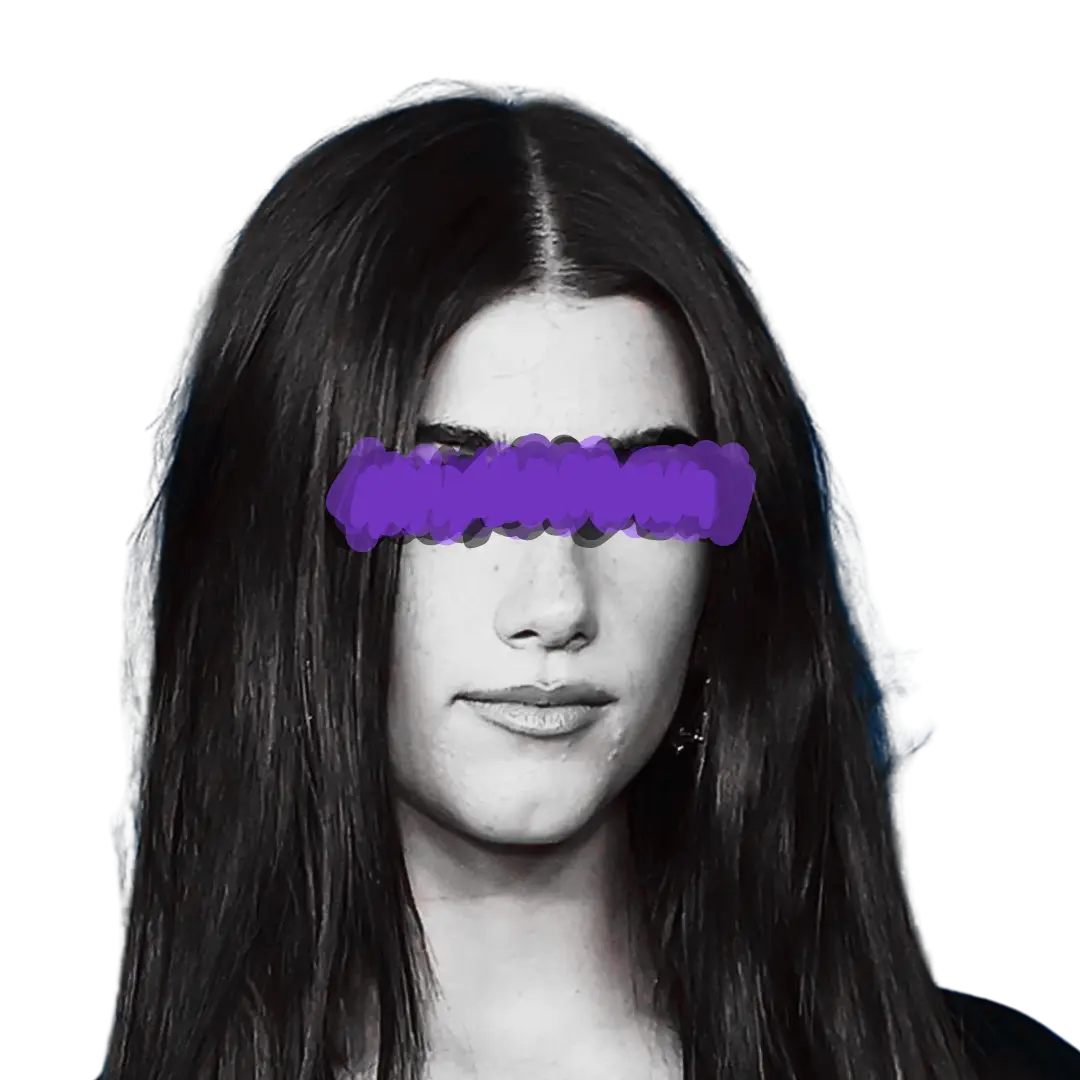
"I'm not even Charli anymore."
She was sixteen. Most-followed person on TikTok. One hundred million people watching. And she was having fifteen panic attacks a day.
The milestone that should have been a triumph was the lowest point of her life. "It got really dark," she told Jay Shetty, "to where I was like I don't even want to be here anymore."
This isn't just another reluctant celebrity story. Every famous person claims they didn't want it. What makes Charli D'Amelio's case psychologically distinct is when it happened: she went viral at fifteen, before she'd formed a stable sense of who she was. The fame didn't interrupt her identity. It replaced it.
"There's Charli D'Amelio, which is who everyone online knows me as," she told Flaunt Magazine, "and then there's the Charli that my friends hang out with, who I feel is my truest self."
Two Charlis. One watched by 156 million people. The other disappearing.
TL;DR: Why Charli D'Amelio is an Enneagram Type 9
- Identity Dissolution: She describes having two selves, "Charli D'Amelio" the brand and the Charli her friends know. During panic attacks, she loses touch with both: "I'm not even Charli anymore." That fragile sense of self under pressure is the core wound of Type 9.
- The Merge: Her career is inseparable from her family. Parents manage the business, sister Dixie collaborates on everything, the reality show centers family dynamics. She even describes her romantic relationships through other people's dynamics.
- Conflict Avoidance Under Fire: When the Renegade credit controversy erupted, she didn't defend herself. She stepped aside and gave credit. When she lost a million followers overnight, she apologized and withdrew. Her instinct is always to restore harmony.
- The Scared Dancer Who Returns: She self-identifies as someone who "always quits when I get nervous" then comes back because "it's in my soul." Retreat and return, the Type 9 cycle of withdrawal and reconnection.
What is Charli D'Amelio's Personality Type?
Charli D'Amelio is an Enneagram Type 9
Enneagram Type 9s fear loss and separation. That fear manifests as a deep need to keep things peaceful, both inside and out. They minimize their own importance. They merge with the identities and agendas of people around them. Under extreme stress, they dissociate. They literally lose themselves.
Most Nines navigate this quietly. Put that psychology inside the most-followed teenager on earth, and the quiet becomes a crisis.
Charli shows clear signs of a 9w1, the One wing adding perfectionistic self-judgment to the Nine's already fragile sense of self. Her sensitivity to criticism, her desire to do the right thing, the internal voice that tells her she's never good enough. That wing explains why she doesn't just absorb negativity; she amplifies it internally.
"I consider myself a normal teenager that a lot of people watch, for some reason," she's said. "It doesn't make sense in my head, but I'm working on understanding it."
That "for some reason" is diagnostic. She's been so busy going with the flow that she hasn't developed a strong sense of her own worth and impact.
The Wound Before the Fame
Charli Grace D'Amelio was born May 1, 2004, in Norwalk, Connecticut. Her mother Heidi was a photographer and former model; her father Marc was a businessman who once ran for the Connecticut State Senate. From age three, Charli trained as a competitive dancer, over fifteen hours per week in ballet, hip-hop, and jazz at studios like The Spot and Just Dance.
But she wasn't the stereotypical performance kid seeking the spotlight. A shy kid spending hours in dance studios. That's the Nine paradox. She could nail a routine with tremendous skill and presence. Put her in an unscripted social situation? Deeply uncomfortable.
Dance gave her a way to express herself without having to assert her personality. She could disappear into the movement.
Then a dance teacher shattered that safety. When Charli was around ten or eleven, an instructor made negative comments about her body. "Words have so much power, especially when it comes to young dancers," Charli later said. "All they want is to have that validation from the people that are teaching them."
Her mother recalled: "It really messed with her head to have an adult teacher commenting negatively about your body because she was muscular and lean. She was tiny, she hadn't developed yet."
That early wound planted the seeds of body image struggles and eating disorders that would intensify under the microscope of internet fame. A Nine who already struggled to value herself was taught that even her body was wrong.
The Accidental Empire
In May 2019, Charli posted a lip-syncing video with a friend. Nothing calculated. She was fifteen, messing around. In July, she posted a duet on the way to dance class. By the time her lesson ended, her followers had jumped from 7 to 2,000.
"There was no way to understand what was happening at the time because it had never happened the way it did on TikTok," she said. "It was just a very weird time."
The explosion accelerated in October 2019 when her dance videos went viral. Her decade of competitive training showed: she could execute trending choreography with a precision that set her apart. But she wasn't creating these dances. She was interpreting them. She excelled at polishing what was already popular rather than pushing original content.
As one dance teacher observed, "It's common for people to do technical things with the energy held inside the body." Charli learned early to push that energy out, connecting with the camera in a way that felt personal. "You gotta be uncomfortable to be comfortable and look good," she explained.
When she and Dixie joined the Hype House content collective in late 2019, Charli's approach was characteristic: collaborate when it made sense, don't fight for the spotlight. But the Hype House was also where she dated co-founder Chase Hudson, her first public relationship, which ended in April 2020 when it surfaced that he'd kissed another creator. The breakup turned into a public spectacle: diss tracks, fan sides, the full internet circus.
The D'Amelios left in May 2020, one month after the breakup. The official line was that the collective had become "more of a business." But the timing tells a different story: staying meant navigating daily proximity to an ex while millions watched. Charli's instinct was the Nine's instinct: leave quietly rather than fight publicly. No callout posts. No drama. She later said she and Chase "really learned from" the experience and grew "together as people, which is why we're so close now." Even the way she processed the breakup, reframing conflict as mutual growth, is textbook Nine.
By the end of 2020, she became the first creator to surpass 100 million TikTok followers. The milestones came fast: Super Bowl commercial, Tonight Show appearance, a Dunkin' Donuts signature drink. But her response to all of it was bewilderment: "I think every day it was kind of waking up and being a little bit confused and wondering, 'But when's it all going to stop?'"
The Disappearing Self
The most psychologically revealing thing about Charli isn't her shyness or her conflict avoidance. It's what happens when the pressure breaks through.
"I'm just this emotional person that doesn't function properly," she's said. "And I get into these, like, really, really bad places, and it's scary for me. I'm not myself, and I don't know what takes over, but it's just so much built up that I'm trying to get out all at once."
She's had panic attacks since third grade, long before fame. But the attention turned a manageable vulnerability into a full-scale crisis. At her worst, fifteen panic attacks a day.
"No matter how many people you have, how many followers, how many friends... I've never felt as alone as I do," she told Avani Gregg. "It's scary, but I need to talk about it."
The isolation makes psychological sense. Nines merge with others to feel whole, but you can't merge with an audience. You can only perform for them. And when the performance becomes your identity, there's nothing left underneath.
She has Pure O (purely obsessional OCD) diagnosed around age eighteen alongside ADHD and trichotillomania. "There are these unanswered questions in your mind that can never be answered," she explained to NOCD. "Some people have 'weird' thoughts like, 'Oh that was weird. I just had a thought about jumping into traffic' and think, 'That's just a symptom of my brain.' People like me become obsessed with the meaning of these thoughts and why they enter our brain when really they don't mean anything. I wouldn't wish it on anybody in the entire world."
The OCD is "very internal," intrusive thoughts, not visible compulsions. For a Nine already prone to losing herself in others' expectations, a disorder that hijacks your inner monologue with questions you can't answer is uniquely cruel.
The Therapist's Daughter
One detail from The D'Amelio Show captures the impossible bind better than anything else.
Charli's therapist told her that his daughter was "a big fan."
Her response: "I appreciate your daughter, but she's not going to help a chemical imbalance in my brain. I think it's weird to bring up that I shouldn't be upset and I'm not allowed to be upset because your daughter's a fan and she should make me happy."
Even in the one space specifically designed for vulnerability, the therapist's office, she couldn't escape being the brand. The person hired to help her see past the persona couldn't see past it himself.
She eventually found therapy that worked, but only because she stopped "holding back" and started "saying everything she's been wanting to say since she was seven."
When the Peacemaker Fights
Here's where the typing gets interesting. Charli isn't always the quiet, accommodating Nine the public narrative suggests.
When Perez Hilton commented "Is this appropriate?" on a video of fifteen-year-old Charli in a bikini, she didn't withdraw. She fired back: "Very fishy that you would say this about me... next time I will be sure to wear my full body snowsuit to the beach!" Then doubled down: "I will continue to post when I feel happy and confident so if me wearing a swimsuit at the beach is a problem well sucks to suck doesn't it."
A fifteen-year-old directly telling an adult gossip blogger to back off. Not the shrinking violet narrative at all.
Then there's the "chemical imbalance" line to her therapist: pointed, direct, and uninterested in keeping the peace.
The pattern that ties it together is one she identified herself: "I'm a very scared dancer and I always quit when I get nervous and I've hated that I do that because I always come back 'cause I love it and it's in my soul."
She retreats from dance, then returns. She retreats from social media, then returns. She retreats from public life, then returns. This isn't the flat "peacemaker" caricature. This is a Nine whose withdrawal is a coping mechanism, not a permanent state, and whose returns reveal what actually matters to her.
The anxiety pen confession fits the same pattern. In 2020, sixteen-year-old Charli was filmed appearing to blow vapor. Fans rushed to defend her, inventing the "anxiety pen" story, a nicotine-free device for calming nerves. Charli never corrected them. For five years, the convenient lie stood.
Then in January 2025, TikTok faced a potential permanent ban in the US. Creators thought the app was disappearing, so they started confessing secrets they figured would vanish with it. Charli posted to her secondary account admitting it was a vape, that she "had no idea where that rumor came from." The ban lasted fourteen hours. TikTok came back. Her confession didn't go anywhere.
Her follow-up video, captioned "Well this is awkward," got sixty-eight million views. She'd accidentally committed to honesty because she thought the platform was dying. But the interesting thing is she didn't delete it when TikTok returned. The Nine who'd let others construct a comfortable fiction for five years found, almost by accident, that owning the truth was easier than maintaining the lie.
Dancing Through It
If fame nearly destroyed Charli, dance kept saving her.
Her Dancing with the Stars partner Mark Ballas offered the most detailed testimony of who Charli actually is behind the camera. His Instagram tribute after their Season 31 victory:
"As shy & timid as she was for those first few weeks, I knew there was something extremely special in there, which became even more apparent after our first performance."
"The thing that impressed me most about you aside from your natural talent & gift was your STELLAR attitude, you worked so hard, put in extra hours, were never on your phone in rehearsal go mode & had total trust in me and all my wild ideas."
Then the detail that matters: "I don't think I heard you complain once, even when your feet were literally bleeding."
Bleeding feet, no complaints. That's not resilience. That's a Nine who doesn't know how to ask for what she needs, even when she's in pain.
In Week 5, Ballas choreographed a contemporary routine about Charli's anxiety. She wore pure white; he was cloaked and painted in black, representing anxiety physically controlling her. He menaced, grabbed, and directed her movements. At the end, she broke free. They earned the first perfect scores of the season.
Before the dance: "I got to my breaking point with social media. This is kind of the first time it doesn't control me."
After: "I just finally feel back in control of my life."
She didn't just perform anxiety. She externalized it. Gave it a body. Then choreographed its defeat. For a Nine who struggles to articulate her own inner experience, that routine said what words couldn't.
Broadway
In October 2024, Charli made her Broadway debut in "& Juliet," a jukebox musical reimagining Romeo & Juliet. She plays Charmion, a dance-heavy ensemble role at the Stephen Sondheim Theatre. Eight shows a week. No algorithms, no comments section, no follower count. Just a live audience that either connects with you or doesn't.
When her agents called with the news, they said: "I think you're gonna want to turn your camera on." She "immediately burst into tears" while home alone, "pacing around her house." A childhood dream, realized through the medium that had always been her refuge.
"It is one of the most amazing and one of the hardest things that I've done," she told Jimmy Fallon. "You push your body and you do things that you think you can't do but you're surrounded by so much love." Then the detail that reveals her Nine orientation: "You perform because you don't know if it's someone's first Broadway show or the only Broadway show they're ever going to go to."
Not performing for herself. Performing because someone in the audience might need it.
In February 2025, a piece of descending set equipment hit Charli on the head during a performance. An audience member reported she appeared knocked out. She walked off stage, was checked by a medic, and returned five minutes later with a visible mark on her forehead. She finished the show.
The scared dancer who always comes back.
Her run was extended twice, through September 2025. Jennifer Lopez wrote her TIME100 tribute: "She's a kindred spirit, maybe because I started out as a dancer too... When Charli dances, she connects." And Charli herself captured the arc: "I was so young when I started doing this, and there were so many paths I could've taken. I'm really happy with how it's turned out. Who would've thought posting on TikTok could help get me on Broadway?"
The Controversies That Shaped Her
The Renegade Credit
The dance that propelled Charli to fame was choreographed by fourteen-year-old Jalaiah Harmon, a Black dancer from Atlanta. As the Renegade spread across TikTok, Harmon's name got lost while Charli reaped the benefits. "I was happy when I saw my dance all over," Harmon told The New York Times. "But I wanted credit for it."
The situation became a flashpoint for how Black creators' work went viral without attribution. When the NBA invited Charli but not Jalaiah to All-Star Weekend, the backlash forced a correction.
Charli's response was characteristic: she didn't get defensive. She posted a video with Jalaiah, credited her publicly, and stepped back. Was it late? Critics argued yes, only after public pressure. But the response itself, non-confrontational, focused on making things right rather than defending herself, reveals the Nine's instinct to restore harmony even at personal cost.
The Dinner That Cost a Million Followers
In November 2020, Charli made faces at a meal prepared by chef Aaron May and asked for "dino nuggets." She also mentioned wanting to hit 100 million followers on her one-year anniversary. The internet decided a sixteen-year-old was ungrateful. She lost over one million followers in a single day.
The chef himself said it was blown out of proportion: "It was my idea. We're in the content business." But the punishment was already delivered.
For a Nine, public rejection triggers their deepest fear: loss and separation, measured in real time by a follower count. Charli's response was to apologize and withdraw, absorbing blame she didn't entirely deserve. She went on Instagram Live crying, calling it "one huge misunderstanding."
A sixteen-year-old asked for chicken nuggets and a million people decided she was ungrateful. The episode demonstrated how the public felt entitled to punish her for not performing gratitude correctly.
Eating Disorder
Content note: This section discusses disordered eating.
"I've been afraid to share that I have an eating disorder, but ultimately I hope that by sharing this I can help someone else," Charli wrote in September 2020.
On The D'Amelio Show, she revealed the full extent: periods of overindulging followed by making herself sick, then extended fasting. The roots traced back to that dance teacher. The internet poured gasoline on the wound.
"When I gained weight people would comment, and when I lost weight, they'd praise me. But at my lowest weight people criticized me for being skin and bones."
The most surprising detail: "I've run into the people that like made me feel so bad since, they're like my biggest fans now."
Who She Is When Nobody's Watching
The private Charli reveals someone actively building a life the public Charli can retreat into.
She finds therapy in cleaning and organizing her space, a way to impose control on a life with "absolutely zero structure." She keeps a dance room in her garage for personal expression that isn't content. She adopted dogs and values the routine of caring for them.
"I feel like I know myself as the person that I see when I wake up in the morning," she told Flaunt, "not the person that's glammed on red carpets."
The Mother Problem
For a Nine who merges with the people closest to her, the D'Amelio family structure creates an interesting bind. Charli's parents aren't just her parents; they're effectively her business partners. Marc and Heidi managed the family brand, starred alongside her in The D'Amelio Show, and made decisions that affected both her career and her childhood.
Heidi has explicitly rejected the "momager" comparison: "We're never going to be their managers, bosses or anything. We're a family; we're the parents and they will always be our kids." And they maintained normal parental expectations: "We don't care how many followers you have. You still have to do the dishes and take out the garbage."
But the boundary between parent and business partner is hard to maintain when your family is the product. Season 3 of The D'Amelio Show exposed the strain: Charli called herself Dixie's "human punching bag," arguments between Marc and Heidi intensified during their joint DWTS appearance, and the cameras captured family tensions that most families process in private.
Charli describes her parents as "definitely my rocks throughout all of this." She means it. But a Nine's "rock" is also the person they're most likely to merge with, to absorb their agenda, their anxiety, their definition of what's right. When your mom is also your manager, the Nine's question of "what do I want?" gets even harder to answer.
Merging in Love
Her relationship with Landon Barker (Travis Barker's son) followed a pattern that makes sense through the Nine lens. They went public in July 2022 after Dixie played matchmaker. They quickly became enmeshed: adopting a dog together, spending time with each other's families. One of their first dates included Landon's dad, his sisters, the whole extended Barker clan.
They broke up briefly in May 2023 after "a huge argument," reconciled weeks later, then split for good in February 2024. The telling detail: Landon announced both breakups publicly. Charli said nothing. He posted on Instagram Stories: "We broke up to focus on ourselves. We are still friends and have so much love for each other." She let his words speak for both of them.
That's the Nine in relationships: merge deeply, withdraw when it gets painful, let the other person narrate the ending. "I don't have to post about my relationships with anyone to prove that they are still in my life."
Her family remains the anchor. Her sister Dixie, once so distant they "didn't talk at all really" for weeks, is now her best friend and fiercest defender.
Where She Is Now
The most significant shift in Charli's life isn't Broadway or her follower count. It's her relationship with the platform that made her.
"I just kind of lost the passion for it," she said on the 2 Chix podcast. "It's extremely difficult to continue posting on a platform where the people that are watching your videos don't actually want to see you and a lot of the feedback is negative."
Her coping strategy is blunt: she stopped reading comments. "I don't really look at that stuff anymore." She's described the change as making things "definitely less extreme," still hard days, but not the fifteen-panic-attacks-a-day crisis of 2020.
On Instagram, she's shifted to vlogs showing "what a Broadway schedule is like," content about process rather than performance, the day-to-day rather than the highlight reel. It's a quieter mode. Less viral, more sustainable. More like the private Charli she's been trying to protect all along.
How It All Comes Together
The story isn't "shy girl becomes famous and struggles." That's true but obvious. The deeper pattern is this: a Nine's core challenge is forming a stable sense of self. They merge with others: with family, with partners, with audiences. They struggle to know what they want independent of what everyone around them wants.
Now give that Nine a hundred million followers at fifteen, before she's had a chance to answer the basic adolescent question of who am I? The fame didn't just make her uncomfortable. It occupied the space where her identity should have been developing.
"I still feel like that same 15-year-old," she's said at nineteen. "I'm still a girl figuring out what do I want to do with my life. Who do I want to be?"
And the dance — always the dance — is how she finds her way back. Not through words or self-assertion but through movement. Disappearing into choreography to reappear as herself.
The scared dancer who always returns.
If Charli could go back and tell her fifteen-year-old self one thing, what would it be? And what would you tell your fifteen-year-old self?
What would you add?