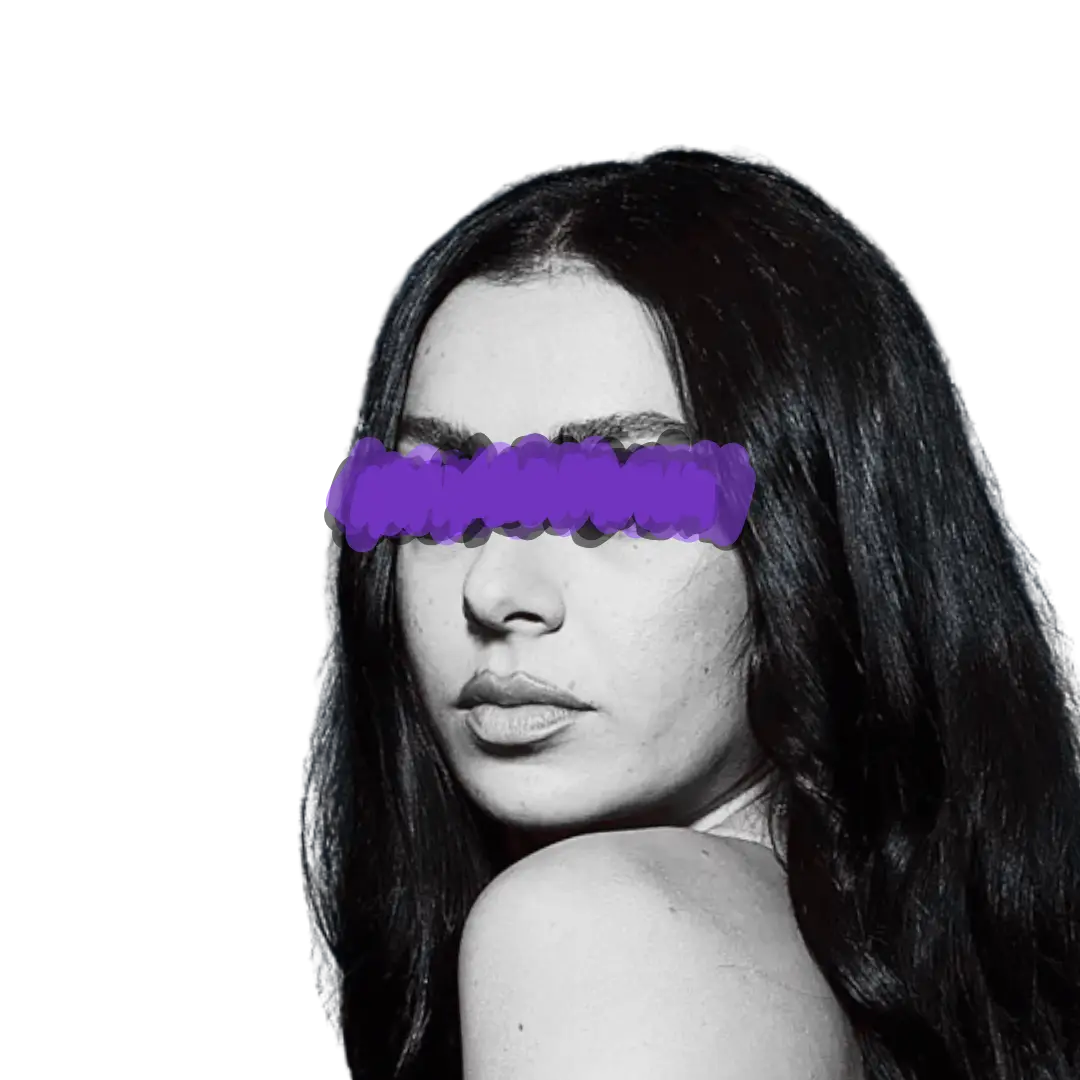
"If I wasn't making things, I don't know what would happen to me."
Before Charli XCX wrote a single song for Brat, she wrote a 50-page brand bible. The font. The artwork. The types of poses. The music video directors. The marketing beats. The rollout cadence. Everything. She called it "the brat manifesto" and distributed it to her team months before recording began. One of its central commandments: "We must cultivate desire, chaos, and destruction."
Then she spent an entire album cycle telling interviewers she works on instinct and vibes. That she likes things "quick and fast and dirty." That she's "over this idea of metaphor and beauty in art."
A.G. Cook, her longtime executive producer and the co-founder of PC Music, described the finished album in a single phrase: "The sound of something fighting itself."
He wasn't just describing the music.
TL;DR: Why Charli XCX is an Enneagram Type 3
- The architect of chaos: She wrote a comprehensive brand manifesto before recording Brat, prescribing every detail of the "messy girl" aesthetic -- then marketed it as spontaneous.
- The shapeshifter: Rave kid, pop songwriter, hyperpop queen, deliberate sell-out, brat icon, actress. Each reinvention looks like artistic freedom. Each is also a strategic repositioning.
- The core wound: "I've always been very embarrassed by myself." Not by a failure. By the self itself. Every persona is built on top of that sentence.
- The 4 wing: Genuine feelings of displacement, self-loathing, and artistic depth give her the raw material. The Type 3 engine converts it all into content.
Two Half-Lives
Charlotte Emma Aitchison grew up in Start Hill, Essex, the daughter of two people who understood reinvention by necessity.
Her mother, Shameera, was born into a Muslim Gujarati Indian family in Uganda. When Idi Amin expelled the country's Asian population in the 1970s, Shameera's family rolled up their money and hid it inside toothpaste tubes to smuggle it out. They made it to England. Shameera became a flight attendant, then a nurse.
Her father, Jon, was a Scottish entrepreneur who started in screen printing and eventually became a talent booker and show promoter.
Charli inherited both sides and belonged to neither.
"I never quite felt like I fit into either world, which I think commonly happens with mixed-race kids," she told Vogue Singapore. "I never felt accepted where I went, whether that was in school for being half-Indian and not blonde, or not fully relating to my Indian self because I was half-white. There was this weird, displaced feeling, where I couldn't quite fit into either place."
She spent weekdays in Start Hill and weekends with her maternal grandparents in Crawley, West Sussex, moving between two cultures, two identities, two half-lives that never added up to a whole one.
So she built a third.
At 14, Charli started performing at Club Cool, an illegal warehouse rave in Shoreditch. Her mother -- terrified, supportive, there -- traveled from Hertfordshire to chaperone while her teenage daughter performed for sweating ravers until sunrise. Picture that image. A worried Indian mother standing in a warehouse rave, watching her daughter find the first place that felt like home.
"I was always very against the idea of needing music to survive," she later told Hans Ulrich Obrist. "But now, the older I get, the more I need music to keep me sane and functioning. It does really help me air out a lot of anger and emotion that I have."
By 16, she had a five-album deal with Atlantic Records. She didn't know who she was yet. She just knew she needed the world to know her name.
Not Cool Enough for Hilary Duff
The song that launched Charli's mainstream career was a rejection letter.
"Boom Clap" was originally written for Hilary Duff. Duff's team passed, saying it "wasn't cool enough for Hilary." Charli was crushed. Then the song landed in the Fault in Our Stars soundtrack, went top ten in 14 countries, and became one of the biggest pop hits of 2014.
"I was still in school," she told The Guardian about her early Atlantic years. "I'd just come out of this weird rave scene, and I wasn't really sure what to make of that. And when I got signed, I hated pop music; I wanted to make bad rap music. I didn't know who I was. I didn't know what I liked."
She got known, initially, as the person who wrote hooks for other people. She co-wrote "I Love It" for Icona Pop and "Fancy" for Iggy Azalea -- both massive hits -- while her own solo albums stalled commercially. The label wanted her to keep replicating "I Love It." She wanted to make music that sounded like the future.
So she found A.G. Cook and the PC Music collective, and pivoted hard. Mixtapes. Experimental hyperpop. Critical adoration and commercial indifference. Pitchfork loved her. Spotify playlists ignored her. She watched from the wings as artists she considered peers played bigger rooms.
"When 'Royals' came out, I was super jealous of the success that that song got, and that Ella got," she told Rolling Stone UK, naming the Lorde rivalry that would simmer for a decade before resolving itself in the most Type 3 way imaginable. "You create these parallels and think, 'Well, that could have been me.' But it couldn't have."
Then came Crash, her fifth and final album under the Atlantic deal. She has been blunt about what it was: a deliberate sell-out. "With this final album, the final album in my deal, I wanted to play into this idea of, 'What if I played the game?'" she told NPR. She hypersexualized herself, used an A&R person for the first time, made the most traditionally pop record of her career. She later said she "didn't feel happy making a more commercial sound."
The fan backlash was so intense she stepped away from social media entirely, posting: "I've been grappling quite a lot with my mental health the past few months and obviously it makes negativity and criticism harder to handle when I come across it." She considered having someone else post tweets for her, "just for a little while, because I can't really handle it here right now."
For a Type 3, the audience is the mirror that confirms the self exists. When that mirror cracked, it wasn't just bad reviews. It was an identity crisis.
Rave kid. Pop songwriter. Hyperpop queen. Deliberate sell-out. Each shift looked like artistic evolution. Each was also a strategic repositioning. And each ended the same way: with Charli already looking for the exit.
What Is Charli XCX's Personality Type?
Charli XCX Is an Enneagram Type 3
Enneagram Type 3s build their identity around achievement. They adapt to whatever the room needs them to be. They fear, more than anything, being seen as worthless -- or worse, being seen as nothing at all.
The evidence for Charli as a 3 is not subtle. It is the entire architecture of her career.
- Identity fused with production. "If I go on holiday for three days I have a breakdown. That's when everything around me is still, and I have time to question everything I've done." Not everything she's been. Everything she's done. For Charli, the doing and the being are the same thing.
- The industry as primary relationship. "The main relationship in my life is the relationship I have with the industry I'm in, and the way it makes me feel. Sometimes it makes me feel incredible and sometimes it makes me feel like nothing." When the mirror reflects back admiration, she exists. When it reflects indifference, she disappears.
- Shape-shifting as survival. Five distinct eras in fifteen years. Each one a new persona, a new aesthetic, a new version of Charli XCX optimized for the current landscape. Taylor Swift reinvents between albums. Charli reinvents between interviews.
- The post-performance audit. After social events: "What have I fucking said? Did I belong in that situation? Did I amplify elements of my personality because I felt that I couldn't be myself? Who even am I?" The question is never "did I have fun?" It is "did the performance land?"
- The competitive drive, openly named. "If you were just chill and happy, you probably wouldn't be working in this industry at the level that I am. There's a competitive nature to this industry, and I think you have to choose how to harness it."
But Charli is not a standard Type 3. Her 4 wing -- the Individualist -- does real structural work. It generates the displacement feelings, the genuine artistic depth, the raw confessional impulse, and the chronic sense that something essential is missing. The 3 core converts all of it into a career.
"I've always been very embarrassed by myself," she told The Face. Not embarrassed by a failure or a specific moment. Embarrassed by the self itself. The entire project of Charli XCX -- every persona, every reinvention, every manifesto -- is a response to that sentence.
The 50-Page Manifesto
Before she wrote a note of Brat music, Charli wrote "the brat manifesto" -- a comprehensive brand bible defining the aesthetic, the marketing, the visual language, the rollout strategy. She shared it with her team. She had the vision locked before a single synth line existed.
Then she went on every podcast and told every journalist that Brat was about spontaneity. That she likes things fast and dirty. That the album was impulsive.
Her collaborators saw the machinery behind the curtain. Producer Finn Keane described how Charli would sometimes prepare "two sets of lyrics to make sure she went for something that was completely right and completely honest." The unfiltered persona was the result of meticulous deliberation.
George Daniel, her husband and Brat co-producer, put it differently: "She's so honest and her instinct is so immediate. It takes her split seconds to know whether something's resonating."
Split seconds. To someone watching from outside, that looks like pure intuition. From inside the 3's wiring, it is pattern recognition honed by fifteen years of reading rooms -- knowing instantly what will land and what won't, because your survival depends on landing.
"Brattiness is a cloak," Charli told Rolling Stone UK. "You're only a brat if you're acting out against something that's made you feel a little bit insecure."
She said it. She named the mechanism. And then she kept wearing the cloak.
The Summer Everyone Turned Green
And then the cloak swallowed the world.
Brat debuted at number three on the Billboard 200 -- Charli's career best -- and hit number one in the UK, Australia, Ireland, and New Zealand. Metacritic gave it a 95, the highest score of any album released in 2024. But the numbers barely capture what happened.
The album cover was deliberately confrontational: the word "brat" in blurry, stretched Arial font on a specific shade of acidic lime green. Charli told Vogue Singapore she "wanted to go with an offensive, off-trend shade of green to trigger the idea of something being wrong." The manifesto had specified that the artwork would be "obnoxious, arrogant and bold."
Then Atlantic launched the Brat Generator -- a website that let anyone create images with custom text in the brat-green style. Over 21 million TikTok videos tied to the brat aesthetic appeared across the summer. A physical wall in Greenpoint, Brooklyn was painted in the signature green and repainted repeatedly with changing messages, livestreamed on Charli's TikTok, turning into a pilgrimage site. The "Apple" dance became one of the year's biggest viral moments.
What the music actually sounded like: warehouse rave at 2 a.m., filtered through a pop star's laptop. Keane described aiming for "something both feeling very slick and shiny, but also completely messy and chaotic" -- achieved through "very simple and minimal sound design" that has "a kind of unfinished feeling to it, but also a boldness and a slickness to it." Revving synths, distorted kicks, vocals that sounded both intimate and industrial. Pitchfork said it promised "to make the Apollonian pop landscape Dionysian again." Slant called it "one of the most relentlessly infectious rave-ups since Katy B's On a Mission." It was Charli's "most aggressive and confrontational record" and, by her own account, her most vulnerable.
Then, on July 21, 2024, President Biden dropped out of the race. The next day, Charli tweeted two words: "kamala IS brat." Within hours, the official Kamala HQ campaign account had rebranded its banner to mimic the Brat album cover -- "kamala hq" in black text on brat green. CNN discussed the tweet on air.
"Did I think me talking about being a messy bitch and, like, partying and needing a Bic lighter and a pack of Marlboro Lights would end up on CNN?" Charli told Vulture. "No."
In November, Collins Dictionary named "brat" its Word of the Year.
She had built the most precision-engineered "spontaneous" aesthetic in pop. And then it outgrew her. The manifesto was built for control. Brat summer was the loss of it.
"I'd been this relatively niche artist, and then had suddenly been opened up to this huge new audience," she told Billboard, "some of whom really connected with me, some of whom only connected with aspects of me, some of whom liked me, but didn't really get me."
The 3 had achieved the ultimate goal -- cultural ubiquity. The 4 wing registered that ubiquity as a new form of being unseen.
Girl, So Confusing
The rivalry with Lorde had simmered since 2013, when interviewers constantly compared the two young women reshaping pop from opposite sides of the world. Charli once got mistaken for Lorde in an interview and played along. The jealousy was real and had been named publicly. But Charli -- in classic 3w4 fashion -- decided to do something with it.
On Brat, the track "Girl, So Confusing" addressed their dynamic directly: the awkward encounters, the competitive undercurrent, the line "Sometimes I think I might hate you / Maybe you just wanna be me." She had tried for nearly a year to get Lorde to collaborate on the song and failed.
So the day before the album dropped, Charli sent Lorde a voice note explaining the song -- prepared, she said, for Lorde to never speak to her again.
Due to time zones, Lorde heard the song before she heard the voice note. Her response was immediate: an apology, and a suggestion for a remix. She texted Charli her entire verse. It took three days to produce.
What Lorde wrote was raw -- about body image struggles, disordered eating, and how her own insecurity had been misread as aloofness. "When I was writing this verse, I was saying these things to her for the first time," Lorde said. "She had opened up a channel between us, and it made me say things that I had never said."
The song ends with Lorde saying "You know I'll ride for you, Charli" and Charli responding "You know I ride for you too." They performed it together at Coachella 2025.
The 3w4 in a single arc: take a real insecurity, convert it into content, risk genuine vulnerability, and end up with a cultural moment that deepens both the art and the relationship. The feeling was real. The conversion of that feeling into a collaborative event was strategic. Both are true.
"I Didn't Feel Like I Was Magical Enough"
In January 2021, SOPHIE -- the pioneering electronic producer who had reshaped Charli's sound and pushed the boundaries of pop -- died in an accident at age 34.
Charli's response was not what you'd expect from someone whose public persona radiates confidence.
"I didn't feel like I was magical enough for this unbelievably magic person," she said. "I feel ashamed for being a coward."
Not "I lost someone I cared about." Not "I'm devastated." Instead: I was not enough. The grief was filtered through a self-evaluation. Even mourning became an assessment of her own worthiness.
The word she chose -- "magical" -- is revealing. She didn't say she wasn't successful enough, or present enough, or reliable enough. She said magical enough. As if there were some essential quality of being that she lacked, something no amount of achievement could manufacture. That gap between what she could do and what she felt she was -- that's the 4 wing talking.
She processed the grief through music. The Brat track "So I" addresses SOPHIE directly. George Daniel, who co-produced it, said the album "almost feels like a love letter to her." When Charli won a BRIT Award, she mentioned SOPHIE in her acceptance speech. She turned the grief into performances. She always does. The question is whether the performing was processing or avoiding, and the answer is probably both.
The Hamster Wheel
"I've been on the same hamster wheel since I was 15," Charli told A Rabbit's Foot in early 2026. "I don't feel the danger with music anymore."
During COVID lockdown, she made the album How I'm Feeling Now in five weeks -- with fans. She announced the project on a public Zoom call and opened the process completely: fans voted on artwork, submitted lyrics during Instagram livestreams, contributed video clips for the "Forever" music video, gave input on which demos to keep or cut. It was documented in the film Alone Together, which captured something her polished interviews never do: the machinery overheating in real time.
Her diary from that period, published in Office Magazine, is the most unguarded window into the 3's internal world:
"I feel like I'm applying so much pressure on myself that everything is crumbling around me. I have constant anxiety in my chest on some days. I am so angry when something doesn't go the way I want it. I am consumed with stress."
The process "exposed deep-rooted issues about herself regarding productivity, overworking, and using these two things as excuses for not confronting her demons."
She knows. She has named the mechanism: work as avoidance. Production as anesthetic. And she kept going anyway.
The fan collaboration was real -- but it was also revealing. She has called social media "like a drug" and described the validation cycle as "this constant chase. And when you get it it's great, and when you don't it's really sad." Then the admission: "For me it's a tool that I kind of have to use. But if I didn't have to use it, I probably wouldn't." By making fans co-creators, she deepened their investment while maintaining final say on every choice. It was genuine openness and brilliant audience-building at the same time. That's the 3w4 condition: the sincerity and the strategy are not opposites. They are the same gesture.
Her relationship with George Daniel -- drummer of The 1975, now her husband -- illuminated a different angle. On the Brat track "Sympathy Is a Knife," she confessed to watching The 1975 play bigger venues and feeling gutted: "Sometimes I'd look onstage and be like, 'Oh my God... I'm never going to play these rooms, ever.'" She told both George and his bandmate Matty Healy about the jealousy. "They were both like, 'Shut up. What are you talking about?'"
The woman whose entire brand is chaotic self-assurance found herself genuinely humbled standing next to her partner's success. She didn't hide it. She put it on the album.
But George also changed her process. "I'm such a bitch in the studio with George," she told Rolling Stone UK. "Because we're obviously so close, you lose everything in terms of the normal studio boundaries." Yet he said of her: "Conviction is always the thing that's paramount. Whatever Charli does there's such a weight behind it." She had previously described all her relationships as imbalanced -- "there was an imbalance, whether it be my personality, or financially, or ego." With George, for the first time, she chose an equal. Someone who operates in the same world, understands the same pressures, and won't be overwhelmed by her.
Then she pivoted to film. Not cautiously. In under two years, she accumulated eight or more film projects -- starring in Pete Ohs' ERUPCJA (where the director called her "unrecognizable" playing a shy British tourist, the opposite of her persona), co-creating a horror film with Takashi Miike, making an A24 mockumentary that became the fastest-selling limited release in the distributor's history.
"I'm in control of every aspect of my music," she told A Rabbit's Foot. "But with cinema, I have to surrender myself to someone else's vision."
Listen to what happened there. Control was not described as a burden. It was described as a loss of danger. What excites her now is the one arena where failure is possible again.
"I've paid the price for some decisions in music and I don't want to do that with film," she said, "because I love film much more than music."
More than music. The thing that has defined her since age 14. The hamster wheel keeps spinning, but the hamster is already running on a different one.
The Sound of Something Fighting Itself
"I'm also just into this idea of lying all the time," she told The Face. "Being really truthful, but also lying. Fuck it!"
A pure Type 3 lies without commenting on it. They adapt seamlessly. The 4 wing introduces self-awareness about the performance, and with that self-awareness comes a kind of tortured meta-honesty: I know I am performing. I am telling you I am performing. Does telling you make it less of a performance, or more of one?
She made a mockumentary about her own life, then said: "The last thing I want is to play a version of myself." She told Vulture she'd be happy "to help prevent democracy from failing forever," then told Billboard "my music is not political." She wrote on her Substack: "Is it performance? Is it truth? Is it lies? Who fucking cares? To me that's the point, that's the drama, that's the fun, that's the FANTASY."
"My biggest goal is to disappear," she said, "for people to not see Charli xcx in my performances."
The most confessional pop star of her generation wants to disappear. The woman who defined a summer wants no one to see her.
"I think the reason I wanted to make music was because I wanted to be cool, really," she told Obrist. "I always just felt like such a loser."
There it is. The rave kid at 14. The five-album deal at 16. The PC Music collaborations. The Crash sell-out. The 50-page manifesto. The Kamala tweet. Eight film projects. All of it -- every persona, every era, every reinvention -- in service of outrunning a single childhood feeling.
She wants to be happy and free. She has said so. But freedom, for Charli XCX, has only ever arrived in the shape of the next project. And she is getting faster.
Disclaimer: This analysis of Charli XCX's Enneagram type is speculative, based on publicly available information, and may not reflect her actual personality type.
What would you add?