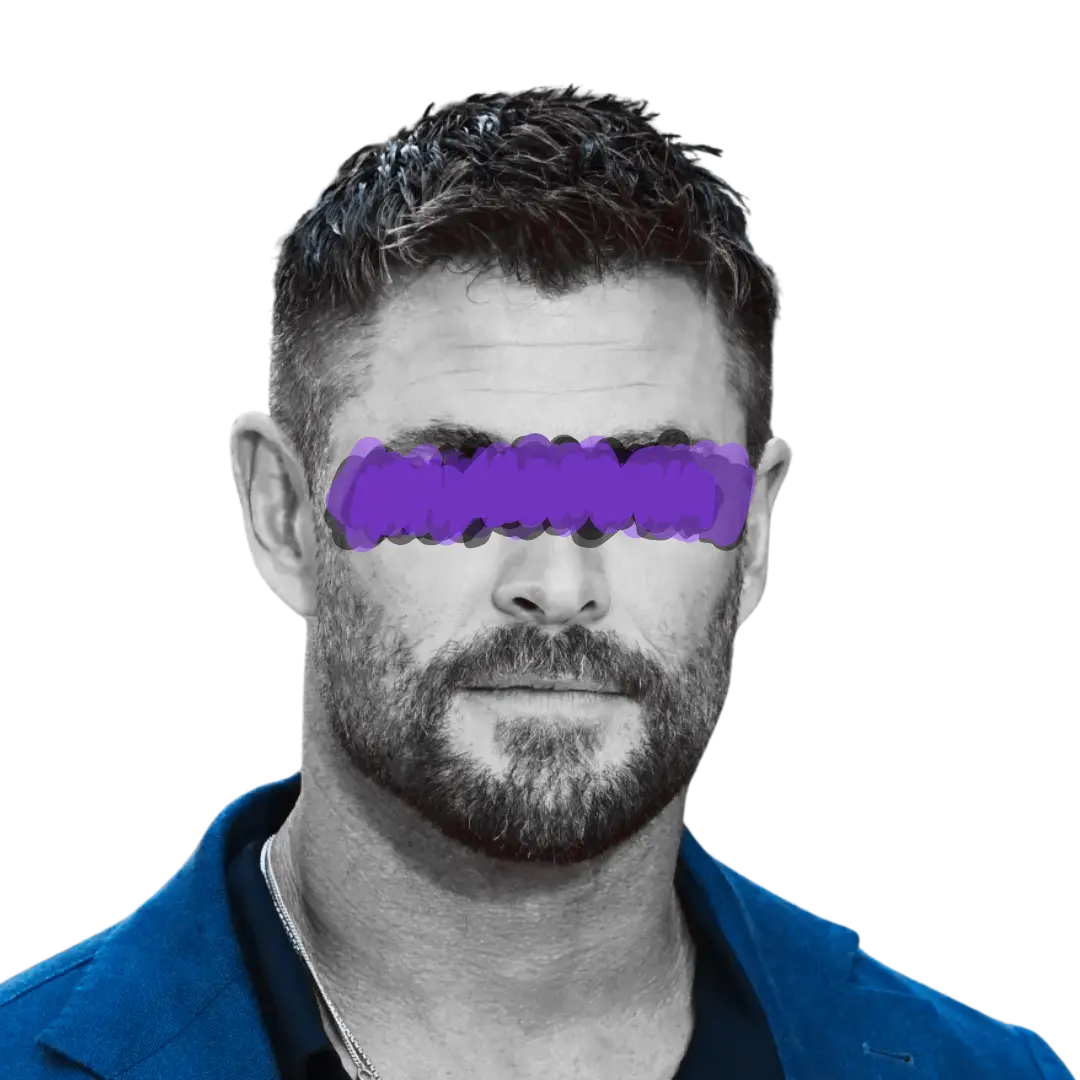
"The character you see in interviews and the presentation of myself over the last two decades working in Hollywood, it's me — but it's a creation too. It's what I thought people wanted to see."
Chris Hemsworth didn't own a pair of shoes for a chunk of his childhood. He was the only white kid in an Indigenous school in Australia's Northern Territory, growing up around buffaloes and crocodiles while his father worked in social services and his mother taught English. The family had no money. No television. No sense that any of this would lead to anything resembling Hollywood.
Forty years later, the boy without shoes plays a literal god. He commands $20 million per film. He has the most symmetrical face in modern cinema and a body that requires 4,500 calories a day to maintain. He is, by every external measure, the man who has everything.
And he has panic attacks.
He has imposter syndrome so persistent that while starring in the highest-grossing film of all time, he was internally thinking: "It's not really happening. You dreamt that. Or they're tricking you."
He built Thor's body. He built Thor's confidence. He built Thor's ease. And none of it was real in the way people assumed. That gap — between the god on screen and the anxious kid still running inside — is what makes Chris Hemsworth one of the most psychologically interesting actors working today. Because in 2022, genetics gave him something he couldn't outrun.
TL;DR: Why Chris Hemsworth is an Enneagram Type 7
- Momentum as medicine: From barefoot Australian childhood to obsessive Hollywood ambition, Hemsworth has been in constant forward motion — chasing the next role, the next body, the next horizon
- The reframe reflex: Even an Alzheimer's risk gene became "another wonderful motivation" within minutes — classic Seven cognitive alchemy
- Constructed armor: Used Thor's godlike confidence as a psychological safety net against deep-seated anxiety and imposter syndrome
- The midlife reckoning: His father's Alzheimer's diagnosis is doing what nothing else could — forcing a man wired for speed to confront stillness
The Barefoot Boy and the Escape Velocity
The Hemsworth household in Australia's Northern Territory was not gentle. Chris's brother Liam once threw a kitchen knife at him during a fight over a toaster oven. The handle hit Chris in the forehead. The brothers fought constantly — fist fights over who sat in the front seat, physical brawling as a default mode of communication. Liam told Conan O'Brien: "That was how we did it in our house — 'Hey, man, good to see you, here's a punch in the face for you.'"
But the violence was playful, survivalist. What was harder was the poverty. On the Jay Shetty podcast in December 2025, Hemsworth described it plainly: "We had no money... I felt that responsibility... to remove that pressure for them from a very early age."
That sense of financial scarcity — the feeling that resources are limited and might disappear — never fully left. Despite enormous wealth, Hemsworth still carries the childhood pattern. "It's going to run out or it's going to be taken away and I won't be able to do that thing," he admitted. A man worth over $130 million, still scanning for the exit.
When the family relocated to Phillip Island in his early teens, Chris discovered surfing. On the Theo Von podcast in February 2026, he was asked what he'd choose if he could wave a magic wand at any career. His answer wasn't acting. "I'd probably choose the surf career. No complaints with the path I've chose. But... I'd rather be doing what these surfers are doing on waves, than what I'm doing. I just sit back, and watch in awe."
But the brothers didn't stop fighting when they stopped being kids. They just changed the weapons. Chris once helped Liam prepare for his Hunger Games audition by reading lines opposite him — playing Katniss. He texted Liam a month before shooting: "It's called Hunger Games, not Eating Games." On Instagram, the trolling became a public art form: for Liam's 32nd birthday, Chris posted shirtless photos with the caption "hopefully this is the year you finally get in shape" and offered him a 10% family discount on his fitness company. Liam retaliated by defacing Chris's Vanity Fair cover.
Beneath the jokes, though, Luke Hemsworth — the eldest — has described a dynamic that's more interesting than simple rivalry: "It's not like we're not critical of each other. But it's criticism designed to take a performance to another level." Three brothers who grew up with nothing, now navigating an industry built to turn siblings into competitors — and choosing, repeatedly, to keep each other honest instead.
How a Soap Star Almost Lost a God
Chris landed a role on the Australian soap opera Home and Away in 2004, playing Kim Hyde across 171 episodes. It was steady work, but it was also a ceiling. Soap actors weren't taken seriously. He knew it. The industry knew it.
Then came Dancing with the Stars Australia in 2006. He placed fifth. Received the lowest score four consecutive weeks. In a 2024 Vanity Fair lie detector test, he admitted he "felt like a fool" — and that he wasn't proud of it. For a guy already battling imposter syndrome, the footage became a kind of evidence locker: proof that he didn't belong. Years later, Kevin Feige told him how close it came to sinking him entirely: "That almost lost me the job. We all saw your audition, we were passing it around the office, and everyone was really into it. And then a few of the girls started Googling your name and up came this dancing video."
There's a Type 7 insight hiding in that near-miss. Sevens process embarrassment by accelerating past it — burying the failure under the next achievement rather than sitting with the sting. Hemsworth didn't pause to grieve the humiliation. He moved to Hollywood.
His first audition for Thor went badly. "My audition sucked," he said flatly. He didn't even get a screen test. A casting director nixed him early. He arrived in the United States around 2009 with the obsessive certainty of someone who had decided his entire life would be shaped by what happened next.
"Once I locked into the idea that I was going to become an actor, it was an absolute obsession," he told Jay Shetty. He called it "escapism" — then caught himself. That word. Escape. The through-line of his entire psychology, sitting right there in his own description of his ambition.
Then his younger brother Liam auditioned for Thor. Liam got further — down to the final five — but was deemed too young. During the Vanity Fair lie detector test, Chris clarified: "We were never neck and neck. It was either I was involved, then wasn't, and he was involved then wasn't, then I was involved." Was he jealous? "A little jealous maybe, but I was excited for him." Chris's manager called back. The older brother exists. He's different now. Give him another shot.
"I just had a different attitude. Maybe I had a little more sort of motivation that my little brother had got a look in and I hadn't."
He got the part. He was 27. The franchise would eventually pair him with everyone from Tom Hiddleston to Scarlett Johansson — but in that moment, it was just a kid from a soap opera who'd been handed the biggest break of his life partly because his little brother auditioned first.
Thor Was Never a Role. It Was a Shield.
Here is the thing about Chris Hemsworth that almost nobody understands until he tells them: the confidence was manufactured.
"I started thinking, 'Okay, no one can mess with me.' Playing a god became a safety net. It fooled people into thinking I was that confident, that certain."
He looked like the most physically invincible person in any room — and he was having panic attacks. His smile seemed effortless while he ran internal calculations about whether people could tell he was terrified.
"I find the scenes where I've had to play charming and confident, the whole time I'm like, 'Yeah, you're a fraud. This looks ridiculous.'"
He wasn't performing confidence as an acting choice. He was performing it as a survival strategy. Thor gave him permission to be big, loud, certain — all the things the barefoot kid from the Northern Territory never felt he had permission to be. And once the camera stopped rolling, the permission evaporated.
"I was in the biggest film of all time at one point, and I'm still having these doubts and these anxieties."
He told Jay Shetty about talking to Anthony Hopkins and Cate Blanchett — actors with decades of Oscars and acclaim — about imposter syndrome. They had it too. "There was deep truth in that. They still had that doubt, but aware of the fact that maybe that doubt was a good thing because it kept you humble, it kept you motivated, it kept you pushing forward."
The doubt became fuel instead of a warning. As long as there was a next project, a next transformation, a next audition — the anxiety had somewhere to go.
What is Chris Hemsworth's Personality Type?
Chris Hemsworth is an Enneagram Type 7
Most people see a golden-boy action hero who won the genetic lottery. The Enneagram reveals something different: a man whose entire career is built on converting pain into forward motion — and who only started questioning the pattern when mortality grabbed him by the collar.
The evidence:
- The reframe reflex. When told he carries two copies of the APOE4 Alzheimer's risk gene — a result that affects roughly 1 in 50 people and can increase risk up to 15 times — his response was almost instantaneous: "It very quickly just became another wonderful motivation to make some changes and arm myself with all the tools to live a healthier, better life." Pain transformed into project within minutes.
- The hedonic treadmill. "Every few years you're kind of, you know, what was the goal at one point quickly becomes the norm, and then you're onto something else." He described this on Theo Von's podcast with the casual precision of someone who has watched himself do it for decades without being able to stop.
- The escape into obsession. From acting ambition to fitness regimes to new projects — every crisis produces not paralysis but acceleration. Career disappointing? Train harder. Marriage strained? Plan an adventure. Father dying? Make a documentary.
- The silence allergy. He described his approach to auditions as a "strange dance" — trying to simultaneously hold "that absolute need and want for it to achieve something great" while "completely let it go and not care." The inability to just sit with wanting. It has to be metabolized into action.
- The constructed persona. "It's me — but it's a creation too." The 7w6 pattern: charm as armor, humor as deflection, energy as a wall between the world and the anxious interior.
Under stress, Type 7s disintegrate toward Type 1 — the perfectionist, the critic. After Thor: Love and Thunder disappointed both audiences and himself, Hemsworth's self-assessment was devastating: "I got caught up in the improv and the wackiness, and I became a parody of myself. I didn't stick the landing." Not frustration. Not blame. Pure self-flagellation. The fun-loving Seven becoming his own harshest judge.
And in security, Sevens integrate toward Type 5 — the observer, the contemplative. Watch Hemsworth in 2025 and 2026 and you see someone moving, haltingly, toward depth. "Living in the questions, not the answers," he told Theo Von. "I think there's a danger in definitives."
He described his own psychology on the Jay Shetty podcast with a specificity that was almost clinical: "Your purpose pulls you, your fear pushes you." He called the interplay between the two "a strange balance with the two extremes" — useful and terrifying in equal measure.
"I'd been trying to muscle and beat things into existence for so long, out of obsession and desperation to build this career, and I was just exhausted," he told Vanity Fair in 2024. "I was worried about everything. Nothing was as enjoyable as it once was, or I had imagined it was."
If I stop moving, they'll see there's nothing underneath. So I don't stop.
He captured the ambivalence of his own fame perfectly in a 2024 interview: "I'm sick of my face. Why isn't it on a billboard? Why are there paparazzi here? Wait, why aren't there any paparazzi here?" The contradiction is the point. The same energy that built the career is the energy that makes contentment feel like death.
Elsa and the North Star of Truth
Hemsworth met Elsa Pataky, the Spanish actress, in early 2010. They married that December — nine months. Three kids followed: India Rose in 2012, twins Sasha and Tristan in 2014.
Before the wedding, Elsa made him promise something specific: "Neither of us would force the other to live in their country, because they were so far apart." Spain and Australia — opposite hemispheres. They'd find somewhere neutral. Then he took her to Byron Bay. She fell in love with it. He broke the promise.
On the SmartLess podcast in February 2026, he called the move the "greatest decision" of his life. "Nothing was shooting there. We were filming kind of everywhere else... you'd come home and paparazzi and all the sort of the trappings of, you know, living in that space." He paused. "Coming home for me is — it feels like a holiday. We have a big farm and horses and motorbikes and surf."
But the marriage wasn't effortless. "The complicated times have been when it's been all work, all kids, and all of a sudden the 'us' in the relationship is sort of non-existent," he told Jay Shetty. "Elsa will be off at work, and I'll be off at work, and then it's chaos with kid time, and so sort of removing ourselves from all of that and just having time for the two of us and making space for each other."
What keeps them together isn't the spark. "There's always that spark and that attraction, but what it comes down to is friendship and companionship at the end. The moment you run out of things to talk about, you lack that curiosity and interest in one another — that's when it's concerning."
He described Elsa with a line that revealed as much about his own psychology as it did about her: "There's an honesty, the north star of truth, that you're going to get with Elsa. I can show something to a bunch of other people, and they might be like, 'Oh, great work,' but Elsa will tell me if it sucks." He added: "It's sometimes dressed up in gentleness from time to time, so that it doesn't shatter my soul, which I appreciate." Elsa's own version is blunter: "I'll tell him, 'That's actually not funny. It doesn't work.'"
A man who built a career on performing confidence chose a partner who refuses to let him perform.
His inner circle follows the same logic. On the Jay Shetty podcast, Hemsworth revealed that his assistant and his trainer — Luke Zocchi, a childhood friend he's known since age five — are his "two best mates." He travels with a core crew of five or six people he's known for over fourteen years. He assumed this was normal until he noticed how many people in his position don't have it. "Many people in the highest positions live in an isolated, lonely existence without true friendships around and groups of people who remind them who they really are."
For a Type 7, this is survival architecture. Sevens need people who knew them before the persona — people who can see through the charm and the energy and say, as Elsa does, that doesn't work.
The Gene, the Father, and the Thing You Can't Outrun
In 2022, while filming the National Geographic docuseries Limitless, Chris Hemsworth learned he carries two copies of the APOE4 gene — one from each parent. The variant is associated with significantly increased Alzheimer's risk. Only about 2% of the population carries both copies.
His first response was textbook: reframe.
"It very quickly just became another wonderful motivation to make some changes."
But the second response came slower, in a Vanity Fair interview, with more weight: "There was an intensity to navigating it. Most of us, we like to avoid speaking about death in the hope that we'll somehow avoid it. We all have this belief that we'll figure it out. Then to all of a sudden be told some big indicators are actually pointing to this as the route which is going to happen, the reality of it sinks in. Your own mortality."
"The idea that I won't be able to remember the life I've experienced, or my wife, my kids, is probably my biggest fear."
Not the loss of his career. Not the loss of his body. The loss of his memories. For a man who had spent his life racing toward the next experience, the cruelest possible threat was the erasure of every experience he'd already had.
Then his father Craig was diagnosed with early-stage Alzheimer's.
"It's so easy to take our parents for granted," he told The Guardian in February 2026. "I feel I've been so busy I haven't spent as much time with my dad as I would want to and there was the diagnosis."
He described Craig on Theo Von's podcast with painful tenderness: "He's a legend." Then, more carefully: "Stress for him — training in the gym, solving a crossword puzzle — great. But not finding his keys, losing things, and then beating himself up about it."
That detail. The crossword puzzle versus the keys. The distinction between the challenges that make Craig feel alive and the lapses that make him feel like he's disappearing. Only someone watching very closely — someone who has stopped running long enough to actually see — would articulate it that precisely.
"Another wonderful motivation to make some changes and arm myself."
"The idea that I won't be able to remember my wife, my kids, is probably my biggest fear."
In November 2025, he released A Road Trip to Remember, a documentary where he takes Craig on a motorcycle trip across Australia, using reminiscence therapy to stimulate fading memories. He called it "a love letter to my father." He said it "empowered him for a period, and stimulated memories that were being taken away from him."
Even facing his father's cognitive decline, the instinct was to move — to get on the bike, to cross the country, to turn grief into a project. But something had shifted. The project this time wasn't about escape. It was about staying.
Dementus and the Career That Finally Fit
For a decade, Hemsworth circled the same frustration: Thor was the meal ticket, but it wasn't the work.
"Sometimes I felt like a security guard for the team," he said about his early MCU roles. "I would read everyone else's lines, and go, 'Oh, they got way cooler stuff.'"
Then George Miller cast him as Dementus in Furiosa: A Mad Max Saga. The role was everything Thor wasn't — unhinged, charismatic, grotesque, free. Reviewers called it a "career-best performance." One critic wrote he was "the most impressive actor to emerge from the MCU."
"By far the best experience of my career, and something I feel the most proud of," Hemsworth said.
His father Craig has a cameo in the film. The son who worried he hadn't spent enough time with his father found a way to put him on screen, permanently recorded, before the memories finished fading.
In 2026, he starred in Crime 101, a crime thriller with Mark Ruffalo — playing an elusive jewel thief. Then came the announcement that he'd return as Thor in Avengers: Doomsday, but with a different energy: "He does feel like one of the elders. He's 2,000 years old or something, so we tried to play into that more than we had before." He's letting the god age. That's new.
The Midlife Reckoning
"My appetite for racing forward has really been reined in," he said in early 2026. "I've become more aware of the fragility of things. You start thinking, 'My dad won't be here forever.' And my kids are now 11 and 13. Those nights where they'd fight over sleeping in our bed — suddenly they're not happening anymore."
Hemsworth is 42. Something is changing — not dramatically, but the frequency has shifted.
"I'm at that sort of point where I'd love to step away on one hand and do a little soul searching," he told Theo Von.
"Suffering comes from denial of our inevitability of death," he said in another interview, with the seriousness of someone who has recently discovered this isn't a bumper sticker.
"You don't know love without loss. And yet we spend so much time trying to either figure out the answer or avoid suffering. Yet the joy and the love and the loss are one and the same thing."
"My self-worth doesn't rest upon all of those exterior things any more," he told The Guardian. Then, quietly: "Though I still have to remind myself."
His mother helped. She made parallels between his experience and her teaching career, helping him see that his suffering wasn't special — it was human. "I've gotten much better at not egoically thinking that my experience is somehow separate, different, or unique," he said.
Everyone carries the same weight. His just came with better lighting.
The Question He's Living Inside
Now his father is actually disappearing. And Hemsworth is discovering something that 4,500-calorie days and 4 AM gym sessions never taught him: that the memories he's terrified of losing are only available if he's present enough to make them.
"Doing an episode on death and facing your own mortality made me go, 'Oh God, I'm not ready to go yet,'" he said after filming Limitless. "I want to sit and be in this space with a greater sense of stillness and gratitude."
The question he's living inside now — the one Alzheimer's asked and his father's crossword puzzles keep repeating — is whether a boy who started running from poverty at age ten can finally learn to stay.
Disclaimer: This analysis is speculative, based on publicly available interviews and information. Chris Hemsworth has not publicly identified with any Enneagram type. This is one lens among many for understanding personality.
What would you add?