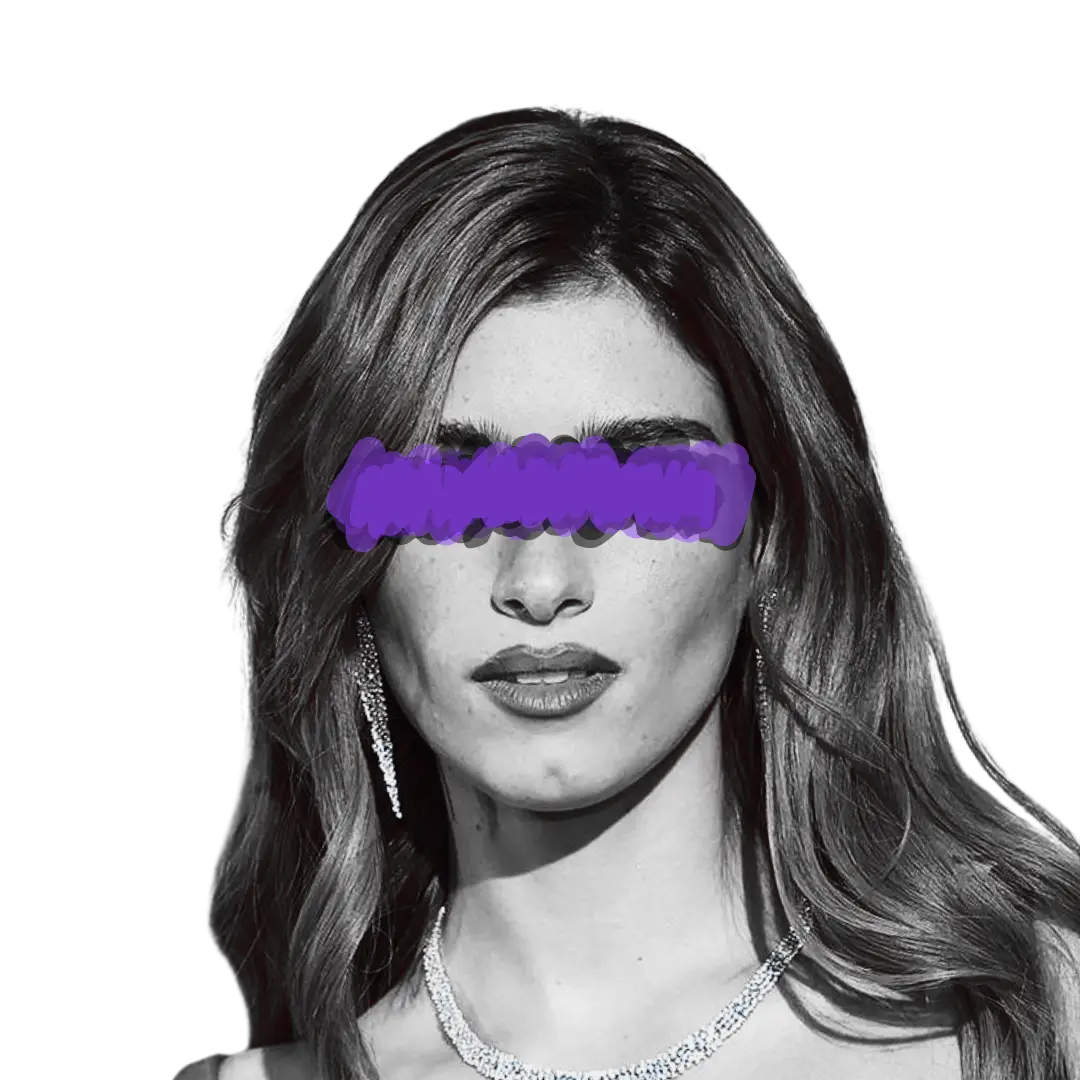
"I just feel guilty for being alive sometimes, for something I can't control."
That's not the kind of thing you expect from someone with 35 million TikTok followers. But Dixie D'Amelio isn't what she appears to be. Behind the sarcastic humor and deadpan delivery is someone who spent her entire rise to fame questioning whether she deserved any of it.
While her younger sister Charli D'Amelio became TikTok's golden child, Dixie carved out a different path. Not the polished performer. Not the natural star. Something messier, more complicated, and harder to look away from.
TL;DR: Why Dixie D'Amelio is an Enneagram Type 4
- Identity through contrast: Dixie has always defined herself in opposition to her sister: the "other" D'Amelio, the older one who didn't dance, the one who went viral second. The search for a self that exists independent of Charli has been her central project.
- Emotional intensity: From psychogenic seizures triggered by anxiety to a PMDD diagnosis, Dixie experiences emotions at an extreme level. She doesn't just feel sad. She feels like she shouldn't exist.
- Creative as coping: Her music isn't about hits; it's therapy. "I connect every song to part of my life," she says. Type 4s use art to process their inner emotional landscape.
- Feeling fundamentally flawed: "I was a person who I did not like. I was not myself." The Type 4's core wound is feeling defective — like everyone else received something at birth that you somehow didn't.
- Envy of what comes naturally to others: Watching Charli succeed effortlessly while struggling to find her own lane reveals the Type 4 pattern of feeling that others have something you lack.
What is Dixie D'Amelio's Personality Type?
Dixie D'Amelio is an Enneagram Type 4
Enneagram Type 4s are called "The Individualist," but the name undersells it. 4s don't just want to be different. They feel different — and not in a way that flatters them. More like everyone else got an instruction manual for life that they somehow missed.
Where others feel disappointed, a 4 feels devastated. Where others feel happy, a 4 wonders why they can't feel that happy. There's always a gap between what they experience and what seems to come easily to everyone else.
Most 4s trace this back to childhood. Something felt off in the family system — not abusive, necessarily, just misaligned. Like the frequency was slightly wrong. That feeling doesn't go away. It just finds new objects to attach to.
For Dixie, those objects are Charli, her mental health, and her music. She doesn't just create content. She works through her existence via content.
Dixie D'Amelio's Upbringing: The Other Sister
Dixie Jane D'Amelio was born on August 12, 2001, in Norwalk, Connecticut. Her father Marc ran for Connecticut State Senate as a Republican and worked in the apparel industry. Her mother Heidi was a model turned personal trainer. On paper, an all-American suburban upbringing.
But the sibling dynamic was complicated long before TikTok existed.
"We hated each other, like absolutely hated each other," Dixie revealed on The Drew Barrymore Show. "All of middle school, until we got into high school together."
Three years older than Charli, Dixie was entering high school while her sister was still in middle school. Different worlds. Different friend groups. Different pressures. The sisters would go weeks without speaking. Not from busy schedules. From genuine disconnection.
Dixie told the Madhappy podcast that a "competition of mental health" prevented them from truly understanding each other. They were both struggling, but neither knew how to reach across the divide.
When Charli started attending the same high school, something clicked. "Then we became best friends," Dixie explained. "She would come with me to every party on the weekend. It just came out of nowhere."
But before that reconciliation came sophomore year. And everything fell apart.
The Breaking Point
During her sophomore year, Dixie's anxiety became so severe that she developed Psychogenic Nonepileptic Seizures (PNES), her body's physical response to psychological distress. She describes feeling "shaky" in class one day, asking a friend to help her walk to her mother's car, then falling to the ground in a seizure.
She was hospitalized. Put on five months of bed rest. Transferred schools. Developed a stutter. Couldn't have normal conversations anymore.
"I was a person when I was at my old school who I did not like," Dixie later shared. "I was not myself, because I had so much anxiety and everything going through my brain at the time where I couldn't even have a proper conversation with anyone."
Feeling fundamentally broken. Watching others live normal lives while you can't access that same ease. This happened before she had any followers to blame it on.
Parents Who Didn't Understand (At First)
Marc and Heidi D'Amelio didn't initially know how to help their daughter.
"I've been dealing with things my whole life with mental health," Dixie explained on The D'Amelio Show. "It wasn't easy. It was even harder to try to explain to my parents who just didn't get it. They didn't understand mental health."
Her parents grew up in a generation that didn't have language for this. You pushed through. You didn't talk about feeling like you wanted to disappear.
Credit to Marc and Heidi: they recognized their limits. As Heidi put it: "This is bigger than what we know what to do as parents. I'm not going to try to fix my car because I don't know how. I'm going to take it to a professional. And I feel like the same about therapy or mental health."
They took Dixie to doctors. They sat beside her during panic attacks that were later filmed for the reality show. They learned alongside her.
"With my parents' help and them taking me to doctors and making sure I'm eating the right food and working out and just having them to talk to has been so helpful," Dixie shared. "It really helped to start my journey in a positive way."
Dixie D'Amelio's Rise to Fame: Second Place by Default
Dixie didn't seek TikTok fame. She was already on Instagram when Charli started posting dance videos in late 2019. When Charli exploded to become the most-followed person on TikTok, Dixie got pulled into the slipstream.
She became famous for being Charli's sister.
For a Type 4 already struggling with identity, this was both opportunity and crisis. How do you find yourself when the world only sees you as an extension of someone else?
Dixie's approach: lean into what made her different. While Charli perfected choreography, Dixie posted deadpan humor and sarcastic commentary. While Charli stayed carefully polished, Dixie showed her rough edges.
"With Charli and I, we never really had competition, because I would always do my own thing and she would always do hers," Dixie explained. But the comparison was inevitable. For someone prone to envy and self-doubt, it cut deep.
The Music Pivot
In June 2020, before signing any deal, Dixie released her debut single "Be Happy." The song wasn't typical pop. It was a surprisingly honest exploration of depression — and it hit.
The production is intentionally upbeat and peppy, creating an ironic contrast with lyrics about not being able to feel happy. That juxtaposition — hiding darkness beneath a bright surface — landed because it named something real about how many young people actually cope.
By August 2020, she'd signed with L.A. Reid's HitCo Entertainment. "Be Happy" hit the Billboard Canadian Hot 100, accumulated over 100 million YouTube views, and earned RIAA Gold certification.
What followed was deliberate emotional exploration:
- "One Whole Day" (with Wiz Khalifa) tackled overthinking and spiral thoughts
- "Psycho" (featuring Rubi Rose) peaked at No. 25 on US pop charts, embracing the "crazy" label people assign to emotional women
- "F***boy" was a direct response to relationship drama, released during her messy breakup period
In June 2022, she dropped her debut album "A Letter to Me," 15 tracks created with Jenna Andrews and Stephen Kirk (who produced BTS's "Butter"). One standout: "Who I Am" features a voicemail from her grandmother. "My Grandmother has been such a huge influence on me growing up," Dixie explained.
But she was honest about the process: "The first album was a very commercial experience for me. I did everything the way I was told, even if it was a cheesy breakup song."
That tension — between what she wanted the music to say and what the industry wanted it to sell — is the Type 4 predicament in a label deal. The art wants to be personal. The business wants it palatable.
Dixie D'Amelio's Relationships: What They Reveal
The pattern in Dixie's relationships tracks exactly what you'd expect from a Type 4 navigating early fame. Not the timeline — the emotional logic underneath it.
Griffin Johnson was the first public relationship, forged while filming Attaway General in early 2020. It lasted weeks past the official start before collapsing into public accusations of cheating. What's telling isn't that it ended badly. It's how Dixie responded: she posted the receipts. The apology text. The proof. For a Type 4 already prone to feeling dismissed, the instinct was to make the emotional reality undeniable. To force the world to see what she saw. The relationship lasted months. The public dissection lasted longer.
Noah Beck was different. Two years. Documented on The D'Amelio Show. Genuine mutual regard, by all available evidence — when it ended in late 2022, Noah described it as "knowing that we were in it together." That kind of relationship does something specific to a Type 4: it becomes part of the identity structure. Who you are while you're in it. Which means losing it isn't just loss. It's disorientation.
The brief Coachella 2023 reconciliation rumors, the eventual settling into single life, the career pivot to fashion that followed — these aren't incidental. Type 4s use relationships as mirrors. Both of Dixie's major ones reflected something back that she then had to figure out how to carry alone.
Dixie D'Amelio's Personality: The Patterns Behind the Persona
The Guilt Complex
"I just feel guilty for every single thing I do, for every opportunity I have," Dixie admitted on The D'Amelio Show. "I broke down the other day. I was like, 'Would I be doing more people a favor if I wasn't here?'"
This isn't attention-seeking. It's the Type 4's shadow: the deep belief that you're fundamentally unworthy, that your existence is somehow a burden. Type 4s often struggle with feeling like they take up space they don't deserve.
Dixie followed up: "I'm not trying to...for sympathy or anything, I just want to be real. That's how I'm feeling."
That need to be "real" while simultaneously fearing judgment is the Type 4 tightrope walk.
The Humor as Defense
Watch any Dixie video and you'll notice the delivery: dry, deadpan, slightly detached. This isn't just a style choice. It's a coping mechanism.
"I'm using comedy to deal with my feelings," she admitted.
The problem? Sarcasm doesn't translate in 15-second clips.
"Some people say I might have like an attitude or like I'm rude and I get it because I do come off that way sometimes," Dixie explained on the Spout podcast, "but I'm very sarcastic."
The podcast host told her she was "so nice in person," calling her a "bright light," the opposite of her online persona. Dixie acknowledged the disconnect: "The problem I need to work on is my sense of humor is very sarcastic, which does not come across on the internet."
Type 4s often develop ironic or self-deprecating humor as armor. If you make fun of yourself first, no one else's criticism can hurt as much. The persona becomes a shield between the real self and the public one.
But Dixie's armor keeps getting mistaken for aggression.
The PMDD Diagnosis
In October 2022, Dixie revealed she'd been diagnosed with Premenstrual Dysphoric Disorder (PMDD), a severe form of PMS that causes extreme emotional and physical symptoms.
"Basically, extreme anxiety, depression, losing the will to live and a lot of irritability and anger," she described. "I didn't know that you weren't supposed to want to die every month before you got your period."
For someone already prone to emotional intensity, PMDD amplified everything. But the diagnosis also gave her something Type 4s often crave: a name for the thing. Proof that the difference she'd always felt wasn't invented.
Building an Empire Beyond Charli's Shadow
Despite her struggles, Dixie has built something separate from her sister.
She's the third highest-earning TikTok creator, behind only Addison Rae and Charli. Forbes named her the second highest-paid TikTok star in 2022 with $11.5 million in earnings. She co-founded Social Tourist, an apparel brand with Hollister. She and Charli launched Be Happy Snacks, which landed a distribution deal with 7-Eleven.
But the recent pivot tells the real story.
In September 2024, she signed with WME and IMG Models, signaling a serious move toward high fashion. She's walked for major houses. Appeared in campaigns for Balenciaga, Valentino, and Chopard. Made her Cannes Film Festival debut in 2024.
The D'Amelio Show was cancelled in 2024. Dixie explained it was a mutual decision: she wanted "to figure out how to balance my work life a little bit more."
Translation: she's choosing her own path now.
Dixie D'Amelio's Controversies: When the Mask Slipped
The Dinner Disaster (November 2020)
The D'Amelio family posted a YouTube video called "Dinner with the D'Amelios" featuring their personal chef. Dixie gagged at the food, ran outside to throw up when served escargot, and the internet erupted.
Critics called her ungrateful, entitled, bratty. Charli lost a million followers. The family was "canceled."
Dixie's response revealed her Type 4 processing: "The way I come across is bratty, ungrateful, things like that. At the end of the day, when you're unhappy with your own life, you don't care about anything."
She wasn't defending the behavior. She was trying to explain the internal state that led to it. Type 4 to the core: focusing on the emotional truth behind the action.
The Trisha Paytas Fallout
During the dinner fallout, Trisha Paytas (a controversial YouTuber) piled on with criticism of the D'Amelio family. Dixie's response backfired spectacularly.
She posted a TikTok of herself dancing to a resurfaced audio clip of Trisha rapping the N-word, essentially using Trisha's past racism to deflect from her own criticism.
The internet wasn't having it. Dixie quickly apologized, acknowledging it was the wrong approach regardless of how hurt she felt. But the damage was done.
The Pattern
These incidents reveal a Type 4 pattern: when attacked, the instinct is to expose the attacker's flaws rather than simply apologize. It's not strategic. It's emotional. The feeling is: "You think I'm bad? Look at what you've done."
But the internet doesn't grade on a curve.
The Public Perception Struggle
"It just makes me feel like I don't deserve anything," Dixie said about online criticism. "I'm trying to do everything I can to better myself and it just gets worse."
The thing that stung most? The perceived double standard.
"Everyone else can show emotions and talk about things and everyone supports them, but anytime I talk about literal sh*t I've been through it doesn't matter."
Type 4s often feel uniquely misunderstood. Their pain gets dismissed while others get sympathy for similar struggles. Whether or not that's accurate, it reinforces their sense of being different.
Dixie D'Amelio Today: A Different Kind of Evolution
The Sister Situation
She and Charli no longer live together. "They need their own space," Dixie explained on a livestream.
Recent speculation about a rift surfaced in May 2025. Dixie was noticeably absent from Charli's 21st birthday celebration in New York. She didn't post a public birthday message, despite doing so in 2024 for Charli's 20th. Fans noticed the sisters rarely appear on each other's Instagram anymore.
No confirmation of a falling out exists. Maybe they're simply living more independent lives with different social circles. But for two sisters whose entire public identity was built together, the distance is notable.
What She Actually Does
Beyond the fashion campaigns, Dixie keeps busy with cooking (she's described herself as a foodie), gaming with cousins and close friends, and fitness following her mother's influence.
Her style evolution has been dramatic. She's tried long hair, short hair, platinum blond, a shaved head, and currently rocks a mullet. "When it comes to hair, I'm open to anything," she's said.
Her old friendships have shifted. She and Addison Rae were once inseparable. Fans noticed cooling in that friendship, speculating about drama. The Hype House and Sway House connections have faded as content houses became less central to TikTok culture.
Her pivot to fashion suggests she's building a different kind of network now.
The Growth
The shift is notable. Early Dixie content was reactive: responding to hate, defending herself, processing pain publicly. Current Dixie seems more settled.
"Being able to focus on my mental health and feel better that way, I've seen such a huge change in my life and just how I am as a person," she shared. "I've seen the difference from when I'm mentally healthy versus not. When I'm healthy, I could read a comment and it doesn't mean anything to me."
That's Type 4 growth. Moving from overwhelming emotional reactivity toward something more grounded. The identity crisis doesn't disappear. It just becomes manageable.
The Psychology of Sibling Shadow
What makes Dixie's story more than a fame narrative is the specific injury at the center of it. Not fame itself. The timing.
Dixie was already struggling with PNES, stutter, panic attacks, five months of bed rest — before TikTok existed. She had already developed an intense, fragile relationship with her own identity before anyone was watching. Then Charli exploded. And suddenly Dixie's private psychological project became a public comparison.
Type 4s feel this particular dynamic harder than most because their identity is already shaky ground. Watching someone close to you succeed easily, at the exact moment you're questioning whether you deserve to exist, doesn't just sting. It confirms the fear. Maybe they got something you didn't. Maybe that's just how it is.
The music, the deadpan humor, the PMDD disclosure on camera — these aren't failed attempts to compete with Charli. They're a different game entirely. Charli built a following through precision and appeal. Dixie built one through friction and exposure. "Be Happy" connected with millions not because it was polished but because it named something most pop music refuses to touch: the experience of performing okayness while not being okay.
The May 2025 birthday silence is the sharpest recent data point. No post for Charli's 21st. No explanation. For two women who built their entire public identity as a unit, that absence says something the algorithm won't tell you. Maybe they've finally become separate people.
That's the Type 4 destination, if there is one. Not happiness. Not resolution. Just enough separation from the person you were cast as "other than" to figure out what you actually are. Dixie got famous in her sister's slipstream. She's been clawing toward her own weather ever since.
Disclaimer: This analysis of Dixie D'Amelio's Enneagram type is speculative, based on publicly available information, and may not reflect her actual personality type.
What would you add?