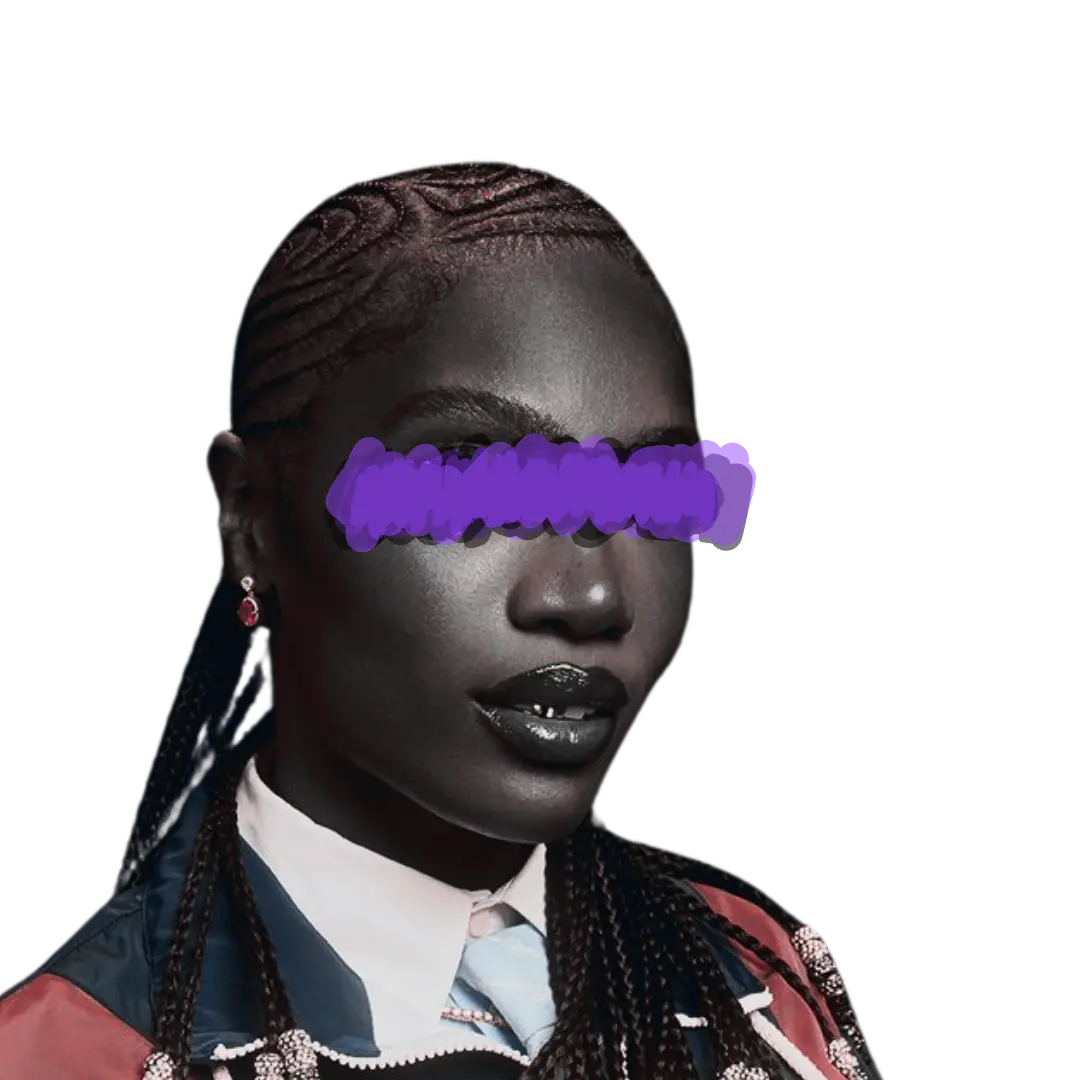
"She likes exposing something that's meant to be hidden. She just thinks outside the box, and she likes being vulnerable, and she likes showing things that you're not meant to show."
— Sam Woolf, Doechii's stylist
Doechii wears face tape on the red carpet. Not tucked under her hair like everyone else — out in the open, the adhesive strips catching the light, the beauty trick that's supposed to be invisible made deliberately, defiantly visible.
Most people see a fashion statement. But it's more than that. It's a philosophy made physical: show what you're supposed to hide. Name what you're supposed to bury. Perform what should stay private.
And yet — she keeps her girlfriend's identity completely secret. No name. No public sightings. When asked her biggest dating red flag on Hot Ones Versus in March 2025, she answered with two words: "A straight man." The internet erupted. She didn't flinch.
This is the contradiction that makes Doechii impossible to look away from. She will expose the seams of her anxiety in a top-10 hit. She will hyperventilate through a panic attack at the end of a song and leave it in the final mix. She will thank God and sobriety in a Grammy speech and then tell Billboard she used to love "day-drinkin' and Hollywood drugs." But her private life stays locked in a vault.
She shows everything. She hides everything. And the line between the two is the most interesting thing about her.
TL;DR: Why Doechii is an Enneagram Type 7
- The diary entry that saved her life: At 11, bullied to the point of a suicide attempt, she wrote "I am Doechii" in her journal — not a stage name, but a psychological survival mechanism that rewired her entire identity.
- The constant reinvention: Styles, sounds, personas, sexuality labels — she refuses to be pinned down. "I'll never lock myself down to one particular style. It's not me. It never will be me."
- The pain-to-art pipeline: Every wound gets transformed. Bullying became "Yucky Blucky Fruitcake." Addiction became "Denial Is a River." Anxiety became a top-10 hit and a mental health resource hub.
- The introvert who performs as a hurricane: "As much as I seem social, I'm really an introvert." She starts every morning with tea, stretching, meditation, and a poem — quiet scaffolding for a loud persona.
"I Am Doechii": The Diary Entry That Built a Person
In sixth grade in Tampa, Florida, Jaylah Ji'mya Hickmon was getting bullied so badly she wanted to die.
Not the casual cruelty kids inflict on each other. Something more systematic. "Being dark-skinned was just brutal," she's said. "I got bullied a lot for being Black, from my Black peers." In third grade, a boy the same color as her pushed her off the bleachers, spat in her face, and called her a "Black bitch." "Something about that experience traumatised me, because he was the same colour as me and said that. It took me years to unpack the self-hate that he had at that time."
By age 10 or 11, she attempted suicide.
It didn't work. And in the aftermath came a thought that reframed everything: "I'm gonna kill myself and then I'm gonna be the only one dead. The bullies aren't gonna be with me, and everything they said is not coming with me either."
A wave of clarity. Then defiance. Then: "F*** that. I'm not going for that."
She went to her diary and wrote three words: I am Doechii.
Not a stage name — that came later. This was a psychological act. She wrote a new person into existence on paper, someone who wouldn't accept what Jaylah had been accepting. "Jaylah might've been getting bullied but I decided Doechii wouldn't stand for that shit. My whole attitude was different. It stuck."
The next day, she went to school wearing a tutu.
No explanation. No gradual transition. A bullied 11-year-old in a tutu — the most absurdly visible, vulnerable, defiant garment she could have chosen. It was the first performance of a self she hadn't fully become yet. A costume for a character she was still writing.
Six Days a Week in That Church
The reinvention didn't happen in a vacuum. There was scaffolding.
Doechii grew up in a single-parent household in Tampa, raised by her mother Celesia Moore. Her father, local rapper Snatcha Da Boss, was present musically but not domestically — baby Jaylah banging on drums "before she could even walk," sitting on his lap while he wrote songs. In "Black Girl Memoir," she would later vow to be "everything my father was not to me." He describes their bond as "deeper than rap." The truth is probably both things at once.
Her mother told her she was the most beautiful girl in the world every single day. "I'd leave that home environment with so much confidence," Doechii has said, "and then I would go to school and get bullied a lot."
Daily whiplash. Built up at home, torn down at school. Built up, torn down.
And then there was church. Six days a week. She performed as a dancerette in a Christian marching band, sang gospel music, absorbed the rhythms and ritual. "All of my artistic values and training came out of my church." A pastor prophesied that she would "touch millions of people with her gifts." She was eleven.
But the same institution that gave her structure and purpose also rejected a core part of who she was. "I grew up in the church, which is not to say that every religion denounces being gay, but it wasn't accepted in the religion that I was in, in my environment." She always knew she was queer. She just couldn't say it yet.
So she was a hoodrat and a theater kid. Into rock music and gospel. A dark-skinned girl doing ballet and tap and gymnastics in the hood, "which made her a target and forced her to learn how to defend herself." Every identity she carried seemed to contradict the one next to it.
She was already learning the skill that would define her career: holding multiple selves at once.
The Swamp Princess Learns to Record
At Howard W. Blake High School for the arts, Doechii made a decision: "Nobody's gonna know who I am or where I'm from. I can be gay, I can be weird, I can sing, I can listen to rock music... I can be myself."
She went full throttle. Fashion experiments, a brief gospel girl group, Tampa's underground music scene. Then a friendship with an artist named Taylor cracked everything open: "I thought you had to be a superstar to record. I didn't know there were home studios. She had one and that changed my whole life."
Soon she was skipping school to record in a friend's bedroom. Her first SoundCloud track, "El Chapo," showcased the genre-defying range that would become her signature. "After that, it was over."
After high school, reality hit. She bounced between jobs — fired from retail, fast food, a library. She failed an audition for The Voice in New York. Rather than defeat her, being stuck in Brooklyn became its own adventure. She couch-surfed, worked at Zara, played small venues.
Back in Tampa, she self-released her debut EP. Then came "Yucky Blucky Fruitcake" — a playful, diaristic celebration of every "weird girl" trait she'd once been punished for. *"Lisa Frank lipstick on my eyes / Weird girl activity, Black b***h nativity..."* She knew it was "corny... very cake pop." That was the point. She was deliberately making her shame into a party.
In 2021, the song went viral on TikTok. Millions of users posted glow-up transformations — from awkward kid to confident adult, from closeted to proudly queer. Doechii had transformed her deepest wound into a dance trend. Labels started calling.
Most came with a pre-packaged plan. Top Dawg Entertainment came with a question: What's your vision?
She signed in March 2022 — the first female rapper in TDE's history. Moosa Tiffith, the label's president, said: "Hearing Doechii I knew immediately this woman is a star. Her talent is boundless, fluid and authentic."
What is Doechii's personality type?
Doechii is an Enneagram Type 7
Most people see a chaotic creative force — genre-hopping, persona-shifting, the rapper who once danced so hard at a Billboard event she flew out of her shoe and kept going. The public reads her as pure kinetic energy, a human firework.
But the real engine is something quieter: a mind that learned, at age 11, that pain could be alchemized into something else. That the worst moments don't have to stay worst moments. That if you move fast enough, think creatively enough, reframe relentlessly enough — you never have to be trapped.
The fear of being trapped. That's the core of it.
Enneagram Sevens carry a particular wound: the belief that if they stop moving, if they let the pain catch up, it will swallow them whole. So they generate — options, experiences, reinventions, escape routes. Not because they're shallow, but because they learned early that generating is how you survive.
Look at the evidence:
- The reframe reflex. Her suicide attempt became "a blessing in disguise." Bullying became evidence of her power: "Nobody's ever called me a Black bitch when I was depressed or sad." Every wound gets transformed into fuel. This isn't denial — it's the Seven's core superpower, the ability to metabolize pain into forward motion.
- The constant reinvention. Hip-hop, R&B, pop, house, punk, soul — she's tried everything, often in the same track. "I'll never lock myself down to one particular style. It's not me. It never will be me." She wants music that "feel[s] like rap, but still be fun, but tell a real story and have a very clear message... I want people to shake their asses but also cry a little bit." Everything at once. Why choose?
- The one-hour rule. She sets a timer when writing lyrics. Whatever comes out in sixty minutes is final. "I have to move quickly because if I don't move fast enough, doubt will come in and it'll slow me down." This is a Seven outrunning the inner critic — using speed as a tool against paralysis.
- The introvert confession. "As much as I seem social, I'm really an introvert and I like to be by myself." Her morning ritual: tea, stretching, meditation, a poem. Quiet scaffolding for the explosion that follows. This is a Seven who has learned what she needs to keep generating — not more stimulation, but enough stillness to generate from.
The complexity is in the growth. A young Seven runs from pain. An immature Seven numbs it with substances. A maturing Seven — and this is where Doechii is now — learns to sit with pain long enough to make something honest from it, then gets up and keeps moving.
"I Have the Right to Suck Right Now"
Her creative process reveals more about her psychology than any interview answer.
She doesn't like studios. "People in the studios are smoking weed... there's just this pressure to be a rapper. But when I'm home, I feel like I'm Jaylah... I don't feel pressure to perform." She prefers to "write in parks, go to different restaurants and get inspiration, or visit a museum." Or: "drink a glass of wine at night and cry, and record by myself when nobody's around."
Before each session, she does a breathing exercise — three deep exhales, physically pulling negative energy out of her chest. "I'm imagining that I'm pulling out any negative self-thoughts, any negative energy, or anything that's built up."
Then the timer starts. One hour. No over-editing.
"I have the right to suck right now. I have the right to not say something that's cool, the right to be vulnerable, to be corny, whatever."
She found Julia Cameron's The Artist's Way in the garbage while walking down the street. She completed an 11-week series following the book, documented it on YouTube, and credits it with breaking her writer's block. "Now I know for a fact that my creativity is limitless."
She treats songs like diary entries: "Just say what it is — say what happened, honestly." And: "Not every time, but sometimes the best music that I create is a conversation with me and God. It's almost like another form of prayer."
She keeps every journal she's had since fifth grade. "I've always said to myself, 'One day, I want to write a book.'"
This is the thread that connects everything. The diary entry at 11. The journal entries that became "Denial Is a River." The morning poems before speaking to anyone. The Instagram bio edit to come out as lesbian. Every major identity transformation in Doechii's life has been mediated through the act of writing something down.
She doesn't simply become. She writes herself into becoming.
Denial Is a River (And Sobriety Is the Shore)
After signing with TDE and moving to Los Angeles, the pace of Doechii's life accelerated past what her coping mechanisms could handle.
"I was not an addict," she told Rolling Stone. But she also acknowledged liking "day-drinkin' and day parties" and doing "Hollywood drugs." She was relying on "a source outside of myself" to create. "When you rely on a source outside of yourself to create something, you're not creating from an authentic place, because you're not yourself."
The song that came out of this period — "Denial Is a River" — is the most psychologically revealing track in her catalog. Built around a therapy session where her therapist alter-ego leads her through a breathing exercise, it ends with Doechii hyperventilating in a panic attack. She left it in. "It was very scary for me to be that vulnerable, which is why I think that I made it funny; so that it could be a bit easier to process the darkness of that record."
Humor to process darkness. Making the scary thing funny so you can look at it. This is the Seven's signature defense — not suppressing the pain, but reframing it into something bearable. Comedy as a survival tool.
She got sober. Quit tobacco, alcohol, caffeine — everything.
"Over time, you outgrow things, you outgrow patterns, you outgrow different habits that no longer serve you. Where I am now, sobriety is serving me, and I'm creating from a different place — I have no outside influence besides me and my thoughts. It's like I'm experiencing a different type of high, a high on just life."
Her Grammy-winning mixtape Alligator Bites Never Heal was the product. "My project sounds like it does because it's coming from me, it's not coming from liquor, it's not coming from a party environment, it's coming from me sitting down, being barefoot in my studio, balling my eyes out."
At the ceremony, she thanked God: "I dedicated myself to sobriety and God told me that I would be rewarded and that he would show me just how good it can get."
Then she performed.
A mid-air split during "Catfish." A conveyor-belt treadmill during "Denial Is a River." Dancers dressed as clones in schoolhouse Thom Browne costumes. Billboard called it the night's best performance. The choreography won an Emmy.
The Year the World Caught Up
What followed the Grammy was not a victory lap. It was an avalanche.
"Anxiety" — a song she'd originally self-released on YouTube in 2019, sampling Gotye's "Somebody That I Used to Know" — hit number 9 on the Billboard Hot 100. Her first top-10 single. It spawned a TikTok dance challenge that generated 2.8 million videos. She launched a mental health resource hub called "Anxiety Is Watching Me," turning her biggest vulnerability into infrastructure.
Billboard named her Woman of the Year — only the second female rapper to receive the honor, after Cardi B. She beat out Doja Cat, Nicki Minaj, Megan Thee Stallion, and others for Best Female Hip Hop Artist at the BET Awards, then used her acceptance speech to do something no one else at the ceremony did: call out the President.
"There are ruthless attacks that are creating fear and chaos in our communities in the name of law and order. Trump is using military forces to stop a protest." She asked the audience to consider "what kind of government it appears to be when every time we exercise our democratic right to protest, the military is deployed against us." She called for support for "all oppressed people, for Black people, for Latino people, for trans people, for the people in Gaza."
At the Met Gala — her first — she arrived in custom Louis Vuitton, a cream monogrammed blazer with Bermuda shorts, gold grills, an afro, an unlit cigar. When a viral video caught her tersely telling her team "Give me another umbrella, now" to keep the look hidden before the reveal, she responded on Instagram: "God forbid a girl needs more umbrellas."
She narrated Nike's Super Bowl commercial — their first in 27 years. It generated over 66 million Instagram views in 24 hours. She featured on JENNIE's "ExtraL" and A$AP Rocky's Don't Be Dumb. She closed out 2025 by surprise-releasing "girl, get up" with SZA — a direct response to the industry plant accusations that had trailed her all year. "All that industry plant shit wack... Y'all wanna believe I'm on drugs and forsaken / They won't credit me, so they blame it on Satan."
Her Live from the Swamp Tour sold out in minutes. She opened for Kendrick Lamar in Australia. She performed a surprise duet with Lauryn Hill at Jazz in the Gardens — the artist whose Miseducation was the first full album she ever listened to.
"The feeling that I have when I listen to The Miseducation of Lauryn Hill is the same feeling I want some other Black little girl to have when she listens to me," she's said. "And in order for her to have that feeling, I have to talk about my feelings."
At the 2026 Grammys, "Anxiety" won Best Music Video. Two Grammys. Two VMAs. A BET Award. An Emmy. Billboard Woman of the Year. A sold-out tour. A top-10 hit. All in twelve months.
"A Straight Man"
Doechii's relationship history reads like a series of increasingly honest self-revelations.
At 18, she was dating a guy who wasn't supportive of her music. "He was just like, 'That's not cool.'" She stopped writing. Then she heard SZA's Ctrl. "It literally gave me the courage to break up with him. She inspired me to be vulnerable through my music in a way that I didn't think I could be."
Later, the relationship that became "Denial Is a River" — she discovered her boyfriend was secretly seeing another man. She pulled directly from her journal entries for the lyrics. When asked about it on The Breakfast Club, she said she had no problem dating bisexual men: "Let me know what it is up front." The issue was deception.
When 032c magazine pointed out she'd dated both a narcissist and a psychopath, she shrugged: "I guess I have a type."
She has a girlfriend now. "Yeah, it's wonderful." Beyond that, nothing. Total privacy.
"I always knew that I was queer, and I was bisexual. I didn't really feel comfortable talking about it, because nobody around me was gay... It's not like I was hiding it — but I also wasn't fully embracing it."
In February 2026, she added one word to the bio of her personal Instagram account: lesbian.
No announcement. No press tour. Just a word, written in a bio. The same way she wrote "I am Doechii" in a diary fifteen years earlier. Quiet acts of self-definition that change everything.
Confidence as Construction
Here's the thing most people miss about Doechii: the confidence is real, but it wasn't free.
"I've always had belief in myself and have always known who I am, but I didn't have the confidence to carry out who I was publicly. It's taken me years to develop myself into the woman that I am, and to get to sit in an interview and say that I'm the best and I'm that girl, it took a lot of falling down. It took a lot of getting beat up. It took a lot of crying and being depressed, and until I couldn't be depressed no more, and I'm tired of feeling sorry for myself."
What She Says Out Loud
"I always knew I was that girl. I always knew I was dope as fuck."
What She Admits Later
"It took me a long time to like my art. I kept making it, but I always thought that it was fucking corny. I hated it."
She made it anyway. That's the part that doesn't fit the surface-level Type 7 reading — the one that says Sevens are all effortless optimism and sunny dispositions. The truth is messier. She worried constantly. She overrode the worry: "I have moments where I am worried, and I'm like, 'Maybe I should dial it back because that's a little too honest,' but I don't give a fuck because I know that in the end, it's going to pay off more for me to be real."
The worry and the override, simultaneously. Always.
"I choose to document my imperfections because I believe that they are perfect. The most human. It goes back to being obsessed with my existence, just existing. It doesn't have to be resolved. I don't always have it together, and I still really love that part."
The Girl Who Bought a House
At the 2026 Grammy red carpet, Doechii said something that didn't make most headlines.
"I'm in a different headspace. I just bought my first home, my priorities are kind of different now. I'm focused on home life, I'm focused on beauty, I'm focused on womanhood."
A home. For someone who spent a decade in constant motion — couch-surfing in Brooklyn, bouncing between jobs in Tampa, building a career in LA — buying a house is not a real estate transaction. It's a psychological statement.
She also described her upcoming debut album: "A lot of genre-bending... super fun." Music ranging "from gospel artists to hip-hop to rock and roll." Live instrumentation. And then: "I wanted to focus more on singing than rapping. I wanted more musicality in my songs."
Even in stillness, she's generating the next thing. The morning tea, the poem before she speaks to anyone, the breathing exercise to clear her chest. She's building a life that looks less like a Seven in flight and more like a Seven who has discovered what the Enneagram calls integration — the move toward depth, toward staying, toward the focused intensity of being fully present in one place.
"The only moment that exists is literally right now," she said. "I realized, 'OK, in this moment, if now is all that exists, do I really want to be scared right now?' No. Bitch, I want to make a great song, and I want to have fun."
She told the crowd at her Grammy speech: "I know there is some Black girl out there. So many Black women out there that are watching me right now. I want to tell you, 'You can do it. Anything is possible. Don't allow anybody to project any stereotypes on you that tell you that you can't be here, that you're too dark, or that you're not smart enough, or that you're too dramatic, or you're too loud. You are exactly who you need to be, to be right where you are.'"
Eleven-year-old Jaylah wrote a new name in her diary because the world was trying to kill the girl she actually was. Twenty-seven-year-old Doechii bought a house and added "lesbian" to her Instagram bio because the girl she actually was finally had the ground to stand on.
The constant reinvention hasn't stopped. It's just that now, for the first time, it looks less like running and more like building. And the diary — the one she's kept since fifth grade, the one that held the original three words that saved her — is still open.
Disclaimer: This analysis of Doechii's Enneagram type is speculative, based on publicly available information, and may not reflect the actual personality type of Doechii.
What would you add?