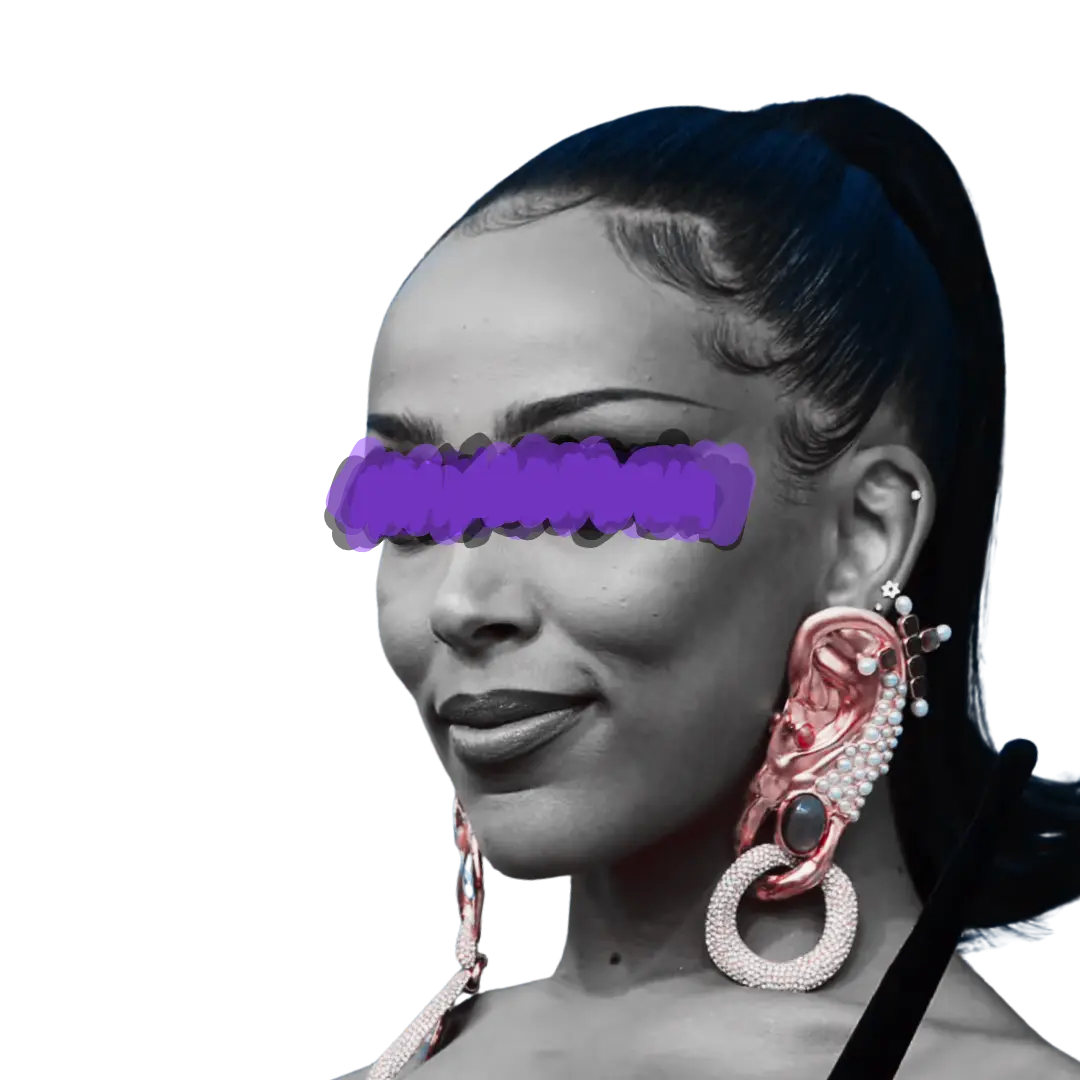
"I feel free."
250,000 fans unfollowed Doja Cat after she told them their "Kittenz" fandom name was "silly" and they needed to "get a job." Most artists would panic. Apologize. Doja celebrated.
This is a woman who created a viral hit about being a cow in 12 hours, shaved her head and eyebrows on Instagram Live while fans screamed about her mental health, then responded to accusations of Satanism by leaning harder into demonic imagery.
Doja Cat is an Enneagram Type 7 who has turned unpredictability into an art form, chaos into chart-topping success, and her refusal to be owned by anyone into her defining characteristic.
TL;DR: Why Doja Cat is an Enneagram Type 7
- Spontaneous Creation: "Mooo!" was written and filmed in 12 hours as a "joke", classic Type 7 playfulness that accidentally launched her career.
- Constant Reinvention: From pop princess (Planet Her) to aggressive rapper (Scarlet) to emotional pop (Vie), she refuses to be boxed in: the Type 7 fear of limitation in action.
- Freedom Over Fame: When fans unfollowed her, she felt "free." Type 7s fear being trapped by expectations more than they fear losing popularity.
- Escapism to Artistry: Dropped out of school, spent all day on the internet teaching herself music. The classic Type 7 pattern of following stimulation wherever it leads.
- Stress Response: Her 2022 Paraguay meltdown ("everything is dead to me, music is dead") shows Type 7 disintegration to Type 1, harsh self-criticism when escape routes close.
- Growth Path: Regular therapy sessions and the introspective Vie album—where she solo-wrote every track—show healthy Type 7 integration toward Type 5 depth and self-understanding.
What is Doja Cat's Personality Type?
Doja Cat is an Enneagram Type 7
Enneagram Type 7s are called "The Enthusiasts." They chase experience, possibility, and freedom with relentless energy. Their core fear? Being trapped in pain, boredom, or other people's expectations.
Watch Doja's career and you'll see Type 7 patterns everywhere:
- Spontaneous creativity: Creating "Mooo!" in half a day because it seemed fun, with no thought of commercial success
- Genre-hopping freedom: Pop, rap, R&B, disco, Afrobeats, industrial, funk—she refuses to be categorized
- Reframing pain as possibility: Turned fan backlash into artistic liberation
- Resistance to ownership: Her theory on parasocial relationships—"I'm not real to them... they take ownership"—reveals the Type 7's deep need for autonomy
- Escape into stimulation: Dropping out of school to spend "all night and day" on the internet making music
What makes Doja fascinating: she's a Type 7 with a strong 8 wing (7w8). This gives her the confrontational edge that most playful 7s lack. She doesn't just run from constraints, she fights them. Doesn't just shave her head, she shaves her eyebrows too, just to prove she can.
The 7w8 combination produces artists who are both playful and aggressive, spontaneous and powerful. When cornered, they attack.
The Hindu Commune Kid Who Taught Herself Everything
Amala Ratna Zandile Dlamini was born into an unconventional household. Her father, Dumisani Dlamini, is a South African actor from the Broadway production of Sarafina!. Her mother, Deborah Sawyer, is a Jewish-American graphic designer with an interest in Hinduism, hence Doja's Sanskrit name meaning "immaculate jewel."
The wound that shaped her: Dumisani left.
"He abandoned us," Doja has said. "He left the United States years ago, citing homesickness." She barely knows him. Her mother raised five children largely alone.
For a developing Type 7, an absent parent crystallizes a core belief: you can't count on others for fulfillment. You have to create your own joy.
The family briefly lived in a Hindu commune in the Santa Monica Mountains. Young Amala learned Bharatanatyam dance and breakdancing, absorbing Erykah Badu, Fugees, and Jamiroquai from her mother's playlists.
Then came the internet.
After dropping out of school, Doja spent "all night and day" browsing the web, discovering eBaum's World and Myspace culture. She downloaded beats from YouTube and taught herself to sing, rap, and produce on GarageBand. All from her bedroom floor.
Classic Type 7 self-education: following curiosity wherever it leads, turning isolation into exploration, refusing formal structures for self-directed discovery.
The Biracial Identity Question
Doja and her brother were the only mixed-race kids in their predominantly white Oak Park neighborhood. "I looked different. My hair was different," she's recalled. "People were very racist and very rude and unhinged and weird."
Her brother teased her for not having Black friends. She wanted to flat-iron her hair. The absence of her South African father left a gap she could see everyone else fill.
When critics later claimed she had "no Black influence" in her life, she pushed back: "Growing up on the land, it was all Black energy. My family was Black. My mum was the only real white influence in my life. It's easy to make assumptions about people you don't know."
At the 2025 Met Gala celebrating "Superfine: Tailoring Black Style," Doja spoke with new clarity: "It's really empowering and important for me personally to be able to express myself and my Blackness, and what it means within the history of America."
Her Jewish heritage through her mother's Lithuanian-Jewish lineage adds another layer. She wasn't raised observant, but she identifies as Jewish while also drawing from the Hindu spirituality of her ashram childhood.
This multiplicity mirrors the Type 7's resistance to singular definition. Why be one thing when you can contain multitudes?
From SoundCloud Teenager to Viral Meme Queen
At 16, Doja started uploading songs to SoundCloud. At 17, "So High" caught Kemosabe Records' attention. She signed with RCA.
Her debut album Amala dropped in 2018 to crickets. Critics ignored it. Charts ignored it. Another promising artist fading into obscurity.
Then came a cow costume.
August 2018. Doja was on Instagram Live with about 60 fans, goofing around, making cow puns. Someone sent her a beat sample. Within 12 hours, she'd written, recorded, and filmed "Mooo!" entirely by herself, using a green sheet from childhood tacked to her bedroom wall and Photo Booth's green screen effect.
"It was a joke," she's said. "A throwaway."
Five million views in two weeks. Chance the Rapper, Katy Perry, and Chris Brown shared it. The label that had been ignoring her started paying attention.
The Type 7 superpower: turning play into productivity, accidental experiments into career-defining moments. While other artists strategize their next move, 7s stumble into success by following what excites them in the moment.
The Sound: What Makes Doja Actually Different
Most personality analyses miss this: Doja Cat is genuinely, technically exceptional.
She's a soprano with a range spanning D3 to G6, over three octaves. But it's not the range that makes her distinctive. It's what she does with it. She switches between singing and rapping mid-verse with a fluidity that makes the transition feel inevitable. Vocal fry, falsetto, intentional rasp, vibrato: all deliberate tools.
Forbes' Bryan Rolli nailed it: "Doja Cat's aloof, irreverent, chronically online persona masks a tireless work ethic; she sings better, raps faster and dances harder than many of her peers, all at once."
Her engineer Rian Lewis: "She produced all her own vocals from inside the booth with impeccable precision and intention. Every harmony, every massive stack, every backing vocal in a character voice, those are all her ideas, 100%."
The Alchemist, one of hip-hop's most respected producers, offered the ultimate co-sign: "Doja Cat can really rap."
When critics dismiss her as "not a real rapper," she fires back with her influences: "I came up listening to backpack rappers... Busdriver, Aesop Rock, Quasimodo, Doom, the Captain Murphy project, Atmosphere. These rappers shaped part of how I write."
Wale defended her publicly: "Doja Cat one of the best rappers out male or female alien or otherwise. Anybody that raps for real... can listen to her raps and can clearly see she is a rapper." Vince Staples co-signed: "Talk to these n***as Wale."
The debate about her legitimacy is itself a Type 7 phenomenon: she refuses to stay in one lane long enough for people to categorize her. This infuriates those who need artists to pick a box.
The Funniest Person in Pop
"Mooo!" wasn't an accident. It was a preview of Doja's actual superpower: being genuinely, uncontrollably funny.
At the 2022 Grammys, she nearly missed accepting her award because she was in the bathroom. She ran breathlessly to the stage and told the audience: "I have never taken such a fast piss in my whole life." Backstage: "A woman ran into the bathroom and grabbed me by my wrist, yanked me out, and I've never been pulled so strongly in my life."
At the 2023 Met Gala, dressed as Karl Lagerfeld's cat Choupette, she stayed completely in character during her Vogue interview with Emma Chamberlain. Every single question answered with meows only. Sixteen million TikTok views.
When Elon Musk locked verified users from changing their Twitter names, Doja's was stuck on "Christmas." She begged him publicly to let her change it. He did. She immediately changed it to "fart."
After two tonsil surgeries, she reassured fans by posting a video of herself rapping Nicki Minaj's verse from "Bottoms Up." Still recovering. Completely on-brand.
Her self-interview video, styled after "The Eric Andre Show," featured her blood-covered "Scarlet" alter ego discussing devil worship and the Illuminati while she asked herself absurd questions.
What she craves in life: "Chocolate, sex, and vape."
Long-term goals: "Probably putting on pants. Now that will shock people."
PAPER Magazine described her as "just as ostentatious and provocative IRL as she is online, prone to punctuating her sentences with theatrical facial expressions, sweeping hand gestures and the occasional devil-may-care eye roll."
She's admitted where the humor comes from: early internet chat rooms where "people would pick on me and use horrible, horrible language... So I became the person who would make offensive jokes and do things sort of out of the box."
For Type 7s, humor isn't decoration. It's armor. The ability to transform any situation into play is both their gift and their defense mechanism.
The Visual Artist They Don't Talk About
Doja Cat doesn't just make music. She directs it.
Nominated for "Director of the Year" at the BET Hip Hop Awards 2024 alongside Nina McNeely. Her visual involvement goes far beyond most artists.
For "Paint the Town Red," she designed three original paintings, then co-directed a video recreating them. She plucks out her eyeball watching it fall into hell, cozies up with death, sways with the devil, rides a gigantic green creature through the sky.
"I need to be involved as much as possible with every single music video that I do," she's said. "One of my passions, secretively or not, is that I want to be a music video director. Maybe not for other people because I'm selfish, but for myself."
The "Streets" video came together in four days after the TikTok "Silhouette Challenge" made the song viral. She paid direct homage to the fan-created phenomenon. A rare artist who treats internet culture as collaboration rather than appropriation.
Her makeup transformations are their own art form. The 2023 Met Gala feline tribute. The 2024 Met Gala "enchanted tears of joy" with glitter streaming down her cheeks. The Schiaparelli look: 30,000 hand-applied ruby-red Swarovski crystals covering head to toe, five hours to apply.
Each era gets its own visual universe. Planet Her: alien futurism. Scarlet: blood-stained horror with shaved head, red contact lenses, demonic imagery. Vie: 1980s glamour, referencing George Michael's "Freedom! '90."
Her stylist Brett Alan Nelson: "She's always messing with the idea of beauty norms. Ever since she's shaved her head she's felt this freeing energy... that you don't have to follow what other people think beauty is."
For Type 7s, visuals aren't separate from music. They're another dimension of stimulation, another canvas for reinvention.
The Transformation: From Pop Princess to Demon Queen
Hot Pink (2019) and Planet Her (2021) established Doja as a mainstream pop star. "Say So" hit #1. "Kiss Me More" with SZA won a Grammy. Billboard ranked her #24 on the "Top 100 Women Artists of the 21st Century."
Then something shifted.
August 2022: Doja shaved her head on Instagram Live. Then her eyebrows. Fans panicked, comparing her to Britney Spears' 2007 meltdown.
Her response: "I'm rich, I'm fine."
She later explained: "I feel like I was never supposed to have hair anyway. I don't like having hair. I never liked having hair. I cannot tell you one time since the beginning of my life that I've ever been like, 'This is cool.'"
The deeper reason connected to Type 7's need for freedom: "I remember feeling so fucking exhausted with working out, wearing wigs, and they would be getting tacky from moisture and sliding off my head while I'm doing this incredibly strenuous thing. I was more concerned with how I looked than what I was doing."
Her 2023 breast reduction and liposuction announcement was equally unapologetic: "Got my t*tties done... 4 days into recovery. Feels ok." She reduced to a 32C because "some of my tops don't fit the way I want them to." No shame, no hedging. Practical bodily autonomy.
When Cosmopolitan asked about body dysmorphia, she was candid: "Growing up, I definitely had body dysmorphia. Without a doubt... I started really growing and I never really thought I looked good in a lot of the stuff I wore."
But what looked like a breakdown was actually a Type 7 transformation. She was bored with the image that made her famous. The pop princess aesthetic felt like a cage. So she burned it down.
The Scarlet era emerged from the ashes.
"I have a lot of pent-up feelings and anger," she told Jack Harlow. The album's aesthetic turned dark: blood-red makeup, demonic imagery, horror-inspired visuals. When fans accused her of Satanism, she doubled down:
"Your fear is not my problem."
This is the 7w8 in full force: confronting constraint with aggression, transforming criticism into creative fuel, refusing to be trapped in anyone's expectations. Including the image that made her successful.
The Kittenz War and the Parasocial Problem
July 2023: Doja detonated her relationship with her fanbase.
On Threads, she mocked fans for calling themselves "Kittenz," a name they'd used since 2013. "Get off your phone and get a job and help your parents with the house," she wrote. Fan accounts using her real name were "creepy as fuck."
Over 250,000 people unfollowed her.
Her response: "I feel free."
She articulated her theory on parasocial relationships with striking clarity:
"If someone has never met me in real life, then, subconsciously, I'm not real to them. So when people become engaged with someone they don't even know on the internet, they kind of take ownership over that person."
The Type 7's deepest fear made explicit: being owned, trapped by others' projections, losing autonomy to expectations you never agreed to.
Most artists cultivate fan devotion. Doja pushed hers away. The devotion felt like a cage.
The Tinychat Controversy: Type 7 Under Fire
The biggest test of Doja's career came in May 2020. Allegations surfaced that she'd participated in chat rooms with white supremacists and incels.
The accusations were specific: she'd frequented a TinyChat room called "Tea Time," making sexual comments to alt-right users, laughing at racist jokes, using the N-word. A 2015 SoundCloud song called "Dindu Nuffin" resurfaced. The title was a racist slur from 4chan mocking Black victims of police brutality.
#DojaCatIsOverParty trended. The timing was terrible: "Say So" was climbing to #1.
Her initial statement was measured, clearly written with management: "I've used public chat rooms to socialize since I was a child. I shouldn't have been on some of those chat room sites, but I personally have never been involved in any racist conversations. I'm sorry to everyone that I offended."
On the song: "It was written in response to people who often used that term to hurt me. I made an attempt to flip its meaning, but recognize that it was a bad decision to use the term in my music."
Two days later, Instagram Live. The Type 7's characteristic candor: "There's no better apology than me doing what I've always done, being on live, telling you guys my f***ing truth... Recording myself sounding perfectly diplomatic is the biggest f***ing lie I can make to you."
She insisted the chat room wasn't white supremacist: "The narrative that it's a white supremacist chat is absolutely 100% incorrect." The song was "maybe the worst song in the entire world."
Nas referenced the controversy in "Ultra Black": "The opposite of Doja Cat." Her response? Playing the diss track on Instagram Stories, sarcastically saying "I'm so offended," then asking "Have you guys heard 'Fruit Salad' by The Wiggles?"
The Type 7 pattern: when attacked, deflect with humor. When cornered, refuse to stay in the corner.
The controversy didn't destroy her. "Say So" still hit #1. She got eight Grammy nominations the following year. But it revealed something about her early internet years: the chat room culture that shaped her absurdist humor also exposed her to genuinely toxic spaces. The 7's pursuit of stimulation doesn't discriminate between healthy and harmful.
The Dr. Luke Question
The elephant in every conversation about Doja Cat's success: she's signed to Kemosabe Records, Dr. Luke's label.
She signed in 2014, before Kesha's lawsuit made Luke radioactive. As her star rose, so did questions about profiting from association with an alleged abuser.
For years, she avoided the topic. In 2021, Rolling Stone got her to address it:
"I don't think I need to work with him again. I don't think I need to work with him in the future. I know that. I think it was definitely nice of me to work with him."
On his production credits: "There's shit that he's credited for, where I'm like, 'Hmm, I don't know, I don't know if you did anything on that.'"
When asked if she felt the same as Saweetie, who said she'd never work with Luke: "That's not a question I feel really comfortable answering."
She walked back the credit comments weeks later, clarifying through representatives that she had "no firsthand knowledge" of him taking undeserved credit.
The notable follow-through: Scarlet contains zero Dr. Luke production credits. She served as executive producer herself. She kept her word.
The Type 7 pattern: avoidance transformed into action. Rather than engaging with the controversy directly, she just stopped collaborating with him.
When the Escape Routes Close: Paraguay 2022
Type 7s maintain buoyancy by having options. When those options disappear, they crash hard, disintegrating toward Type 1's harsh self-criticism.
This happened publicly in March 2022.
Flooding forced Doja to cancel her Paraguay concert. Fans waited outside her hotel. When she didn't greet them, they criticized her on Twitter. Her response escalated:
"I'm not sorry. I'm not taking pictures again with anybody else after this tour."
Then, the full meltdown:
"Everything is dead to me, music is dead, and I'm a fucking fool for ever thinking I was made for this."
She announced she was quitting music entirely.
Textbook Type 7 disintegration: when escape routes close and reframing fails, the internal critic activates. The free-spirited optimist becomes rigid, harsh, all-or-nothing. "Everything is dead" shows the Type 1 pattern, perfectionism collapsing into despair when reality can't be transformed.
She didn't quit. Type 7s recover quickly because they're experts at finding new possibilities. But the episode revealed the fragility beneath the freedom.
The Vie Era: Type 7 Integration in Action
Something changed after Scarlet.
In 2025, Doja revealed she attends regular therapy sessions. Her fifth album, Vie (French for "Life"), released September 2025, marked a dramatic departure: working with Jack Antonoff for nine tracks, returning to 1980s-inspired funk-pop after four years of darker material.
What mattered most: Doja Cat solo-wrote every single song on Vie. The first female rapper of her generation to write an entire album alone.
"I didn't used to write as myself," she told interviewers. "I used to write as what I thought was appropriate and what I thought was going to be eaten up. But I feel like I'm in another vein of life. I can express myself as me and I have never been so comfortable."
This is healthy Type 7 growth: integration toward Type 5. Instead of constantly seeking new external stimulation, she's diving deeper into singular experiences. Instead of running from pain, she's examining it in therapy. Instead of writing for the algorithm, she's writing for herself.
Vie debuted at #4 on the Billboard 200 with 57,000 first-week units. Critics gave it 78/100 on Metacritic, her highest-rated album. Variety wrote that it "reframes the conventions of 1980s pop without losing herself in the process."
Working with Antonoff was transformative: "He's just been such a wonderful person to work with. It's just been nice to play. I really played through the whole thing."
On how therapy shaped the writing: "This album really grew from my sessions in therapy, and being so gung-ho on being there twice a week. And learning about the human experience and how our brains function subconsciously and consciously."
Her engineer Rian Lewis: "I've never seen anybody work so quickly or confidently. She knew exactly what she wanted to say on the album. She does 100 percent of her own writing. We don't ever work with writers with her."
Lewis described sessions at Harbor Studios in Malibu: "She had a creative output like I've never seen before. It just started erupting. She was sometimes completely writing and finishing three songs a day."
The scattered explorer is becoming a focused artist. One who can sit with vulnerability rather than running from it.
The Collaboration Philosophy
Doja's approach to collaborations reveals another Type 7 pattern: seeking novelty, then pulling back when it feels like obligation rather than play.
The "Say So" remix with Nicki Minaj became historic. First collaboration between two female rappers to top the Hot 100. Both artists' first #1. The remix boosted streaming by 40% and broke the record for longest wait for a first Hot 100 chart-topper (Nicki's 109th charted title).
The Weeknd praised her publicly: "Doja is a star, and has created a unique universe you just want to lose yourself in. She's got such drive and vast creative vision that we will be seeing her impact for a very long time to come."
By 2021, she was pulling back: "I've been trying to be more careful about who I'm collaborating with. I want to be really choosy... Sometimes it's too much collabs and remixes."
Scarlet had zero guest features. A deliberate choice reinforcing her "loner persona." Then Vie brought back SZA for "Take Me Dancing," their reunion after "Kiss Me More" won them a Grammy.
Before Vie dropped, Doja wrote on X: "SZA is the siren of this century and my favorite voice."
The pattern: dive in enthusiastically, pull back when it feels obligatory, return when it feels like genuine play.
The 7w8 in Action: Boundaries and Clapbacks
The 8 wing gives Doja something most Type 7s lack: the willingness to fight rather than flee.
On fans criticizing her Tour Ma Vie production: "I'm not a Broadway act. I'm not your f**king costume monkey. I move at my own pace and break my f**king back out there every night."
On influencer Pablo Tamayo touching her without permission: "Don't touch me and manhandle me when you don't even f*ckin know me."
On critics attacking her weight loss: "I used to be thicc and that's forever going to be your problem. Your problem. Not mine. So you can keep suffering about how my body looks because, b**ch, I'm living my best life."
On fans worried about her mental health after shaving her head: "People think that, for some reason, I'm not well because I don't have hair on my face or on my head. It's just a wild f**king world we live in."
The 8 wing doesn't just protect boundaries. It establishes them loudly, publicly, without apology.
The Psychology Behind the Chaos
The absent father wound is the first thread. Learning early that you can't count on others creates the Type 7 pattern of self-generated joy — if no one's coming to save you, you'd better learn to entertain yourself. Those years "all night and day" on the internet weren't wasted time. They were survival. The digital world offered infinite stimulation to a young person processing family pain, and that habit of following curiosity wherever it leads never stopped.
The meme-to-music pipeline reveals what the father wound produced. "Mooo!" showed that Doja's sharpest creative edge comes from not taking herself seriously. The cow costume wasn't calculated. It was play. And the moment an image starts feeling like a cage — pop princess, demon queen, or anything else — she burns it and starts again. Each era isn't reinvention for its own sake. It's the Type 7 refusal to be trapped in a single identity, even one that's working.
In 2025, Doja admitted her Fortnite addiction "has turned her into a person she doesn't like." That's rare self-awareness for a type that usually keeps moving fast enough to outrun that kind of reckoning. The therapy, the solo-written album, the willingness to name the dark side of constant stimulation-seeking — these are the signs of a 7 who's starting to slow down long enough to see clearly.
What Doja Cat Reveals About Freedom and Creation
Doja Cat embodies the Type 7's gift and curse: the ability to transform anything into play, and the terror of being trapped in anything permanent. That's not a press bio framing — it's the operational logic behind everything from "Mooo!" to the Kittenz war to Vie.
Her career is a masterclass in creative freedom. Refusing genres. Rejecting fan expectations. Shaving off the very image that made her famous. But it's also a study in the cost of constant motion: the meltdowns when escape routes close, the broken relationships left behind, the difficulty sitting with anything uncomfortable.
The Vie era suggests she's learning what all Type 7s eventually discover: depth isn't a prison. Staying with one thing, one relationship, one style, one emotion, can reveal treasures that constant motion never touches.
Doja's doing whatever she wants. Somehow, that's working perfectly.
Disclaimer: This analysis is based on publicly available information and aims to explore Doja Cat's personality from an Enneagram perspective. It's not a definitive assessment but rather an invitation to reflect and engage.
Curious how Doja's Type 7 energy compares to other artists? Explore how Kanye channels similar unpredictable reinvention, or discover the contrasting approach of Billie Eilish, whose Type 4 personality prioritizes authenticity and emotional depth over constant transformation.
What would you add?