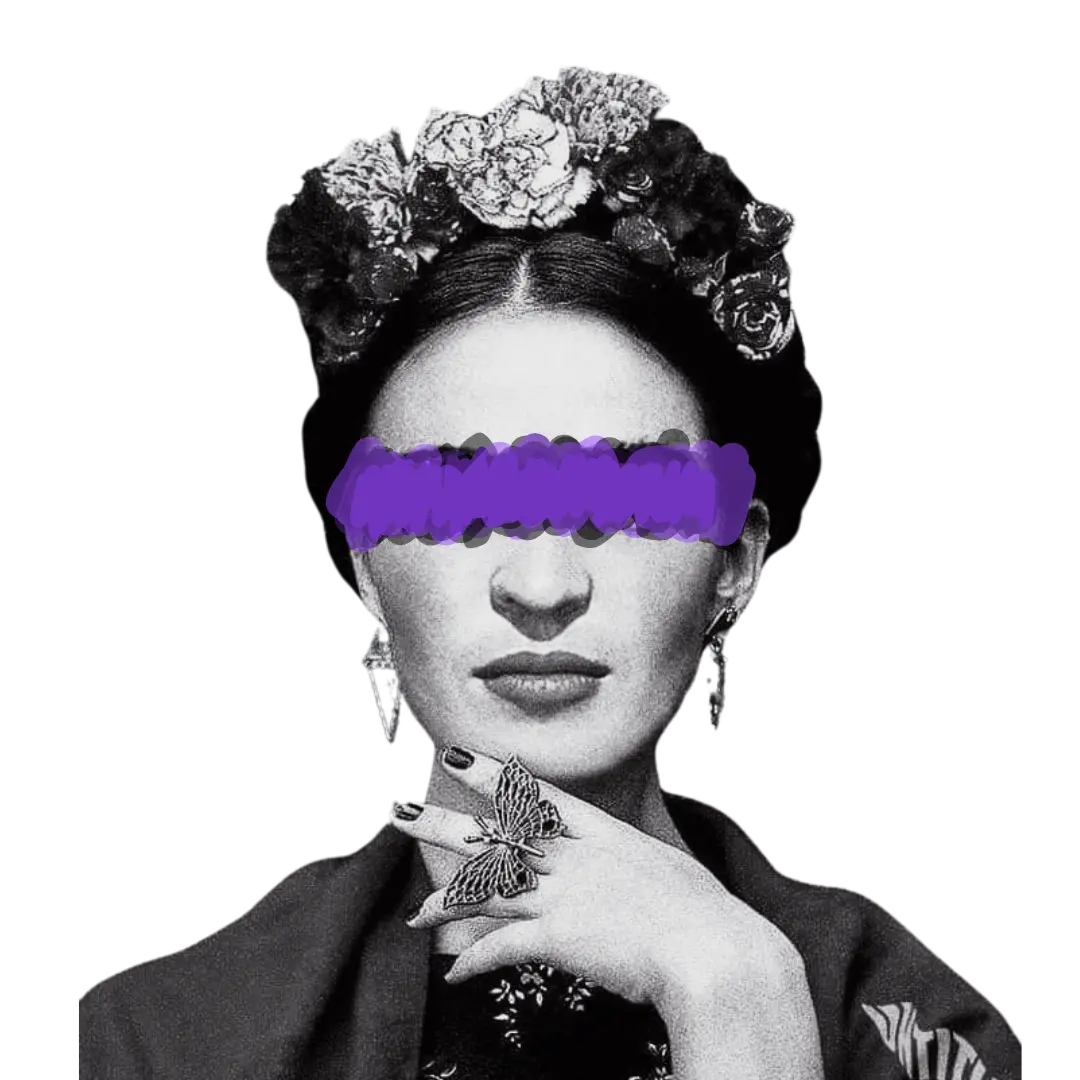
"I wish I could do whatever I liked behind the curtain of 'madness.'"
In 2003, forty-six years after Diego Rivera sealed the room shut, conservators opened a bathroom adjacent to Frida Kahlo's bedroom in La Casa Azul. Inside they found nearly 300 items of clothing: 16 Tehuana blouses, 25 long skirts, corsets painted with flowers and Communist hammers, prosthetic legs decorated with red leather boots and green Chinese embroidery. Each garment had been chosen, modified, or sewn by Kahlo herself. Shoes with built-up heels to compensate for her shorter right leg. Multiple socks layered on her thinner calf. Bells on her boots so people would hear her coming before they could see her limp.
That wardrobe tells you more about Frida Kahlo than any retrospective at the MoMA.
Here was a woman who spent her entire adult life building an elaborate disguise (the flowers, the braids, the unibrow, the Tehuana skirts billowing over a body held together by steel and plaster) while simultaneously creating the most brutally honest self-portraits in the history of art. Paintings where her spine splits open. Where her chest cracks to reveal a shattered column. Where she bleeds on hospital sheets, fully naked, refusing to look away.
She dressed to conceal exactly what she painted to reveal.
That tension between the mask and the mirror, between the woman who couldn't bear to be seen limping and the artist who couldn't stop showing you her wounds, is what makes Frida Kahlo not just a great artist, but one of the most rewarding people to try to understand.
TL;DR: Why Frida Kahlo is an Enneagram Type 4
- The identity architect: Kahlo built one of the most elaborate personal mythologies in modern art, rewriting her birth year, designing her own wardrobe, turning her face into a symbol
- Pain as raw material: She didn't avoid suffering or medicate it away. She turned it into the structural material of her art, making the unbearable beautiful
- The dependency paradox: Fiercely independent in public, she was devastatingly dependent on Diego Rivera in private, cycling between desperate clinging and proud withdrawal
- Authenticity as survival: "I paint my own reality" wasn't an artistic statement. It was how she survived being a woman who felt fundamentally different from everyone around her
The Drawing That Told the Truth
There is a sketch in Kahlo's archive titled Appearances Can Be Deceiving. It shows her body, the fractured spine, the withered leg, the surgical scars, all visible through transparent clothing. The Tehuana dress is there, but rendered as glass. You can see everything underneath.
She drew it for herself. No one was meant to see it.
That drawing is the key to everything. The woman the world saw, draped in embroidered silk, crowned with braided flowers, trailing the scent of Jicky perfume, was a carefully composed self-portrait. And the paintings she made, the ones where she lies bleeding and broken and staring at you without flinching, were another self-portrait entirely. Both were true. Both were performances. And the genius was that she knew it.
Lucile Blanch, who knew Kahlo personally, recalled that "Frida had an aesthetic attitude about her dress." Biographer Hayden Herrera noted she took "special care in choosing each one of her garments, styling herself from head to toe." She didn't just get dressed in the morning. She composed herself the way a painter composes a canvas.
The Girl Who Was Born Twice
Frida Kahlo was born on July 6, 1907, in Coyoacán, Mexico, in the house that would become known as La Casa Azul, the Blue House.
She told everyone she was born in 1910.
Not a mistake. A deliberate revision. She wanted to be born with the Mexican Revolution, to tie her origin story to the country's rebirth. It was the first self-portrait she ever made, years before she picked up a brush: the rewriting of her own history to match the self she was inventing.
The real childhood was harder than any mythology could contain. Kahlo later described the atmosphere in her home as "very, very sad." Her parents' marriage was devoid of love. Her mother, Matilde Calderón y González, was "kind, active and intelligent, but also calculating, cruel and fanatically religious." Both parents were often sick. Frida was the third of four daughters in a household where warmth was scarce and God was strict.
Her father, Guillermo, born Carl Wilhelm Kahlo in Pforzheim, Germany, before emigrating to Mexico at nineteen, was the exception. He saw something in her. When polio struck at age six, leaving her bedridden for months and her right leg permanently withered, it was Guillermo who encouraged her recovery. He had her swim, play soccer, wrestle, all activities unheard of for girls in early 20th-century Mexico. He taught her photography, sharpening the compositional eye that would later define her paintings.
But polio had already done its work. The other children called her Frida pata de palo, Frida peg leg. She learned at six what it meant to be marked. To move through the world with a body that announced its difference before she could say a word.
She compensated by becoming the loudest person in the room. A tomboy. A prankster. One of only 35 girls admitted to Mexico's elite National Preparatory School in 1922, where she planned to study medicine. She joined a group called the Cachuchas: intellectuals, pranksters, politically radical students. She was sharp, funny, profane.
And she was watching. Always watching. The Mexican Revolution had detonated a cultural renaissance, and Frida grew up in the middle of it: a resurgence of indigenous pride, a rejection of European norms, a country reinventing itself. She was soaking in the imagery, the politics, the colors. Everything that would come out in the paintings later.
The fact of her father's European origin would become a problem she solved with scissors. The woman who later became the worldwide symbol of indigenous Mexican identity was half German. And she knew it. She would eventually darken her skin in self-portraits, dress exclusively in pre-Columbian styles, and change her birth year to erase the line between herself and the country she was claiming. The myth-making started early.
She just didn't know it yet. She was going to be a doctor.
The Crash That Made the Painter
On September 17, 1925, it was raining. Frida was eighteen. She and her boyfriend Alejandro Gómez Arias boarded a bus after school, got off to search for an umbrella she'd lost, then boarded a second bus. More crowded. Wooden-framed.
The driver tried to pass an electric streetcar. The streetcar crushed the bus against a street corner.
"It was a strange crash," Kahlo told biographer Raquel Tibol. "Not violent but dull and slow, and it injured everyone, me much more seriously."
An iron handrail tore through her pelvis. She later described it as "the way a sword pierces a bull." Her spine fractured in three places. Her collarbone shattered. Her pelvis broke in three places. Her right leg fractured in eleven places. Her right foot was crushed. Her shoulder dislocated. Three ribs snapped.
Several passengers died. Frida did not.
She lay in a hospital bed, encased in a full-body plaster cast, for months. Her mother hung a mirror above the bed so she could see herself. Then she hung a specially made easel that allowed Frida to paint while lying flat on her back.
"I paint myself because I am so often alone," Kahlo would later say, "and because I am the subject I know best."
That sentence has been printed on a million tote bags. But in context, it is devastating. She wasn't choosing solitude as an aesthetic. She was flat on her back, immobilized, staring at the only face available. She became her own subject because she had no other option. The mirror her mother hung was practical, not poetic. But the girl looking back at herself, broken, alone, marked for life, decided that if this was all she had, she would look harder than anyone had ever looked before.
She finished her first self-portrait in 1926. She would go on to paint 54 more. Out of 143 total paintings, 55 were self-portraits.
"I never painted dreams," she said. "I painted my own reality."
The Tin Saints
The kind of art Kahlo made, and why it looked nothing like what the European art establishment expected, came directly from the walls of Mexican churches.
Retablos, or ex-votos, are small devotional paintings on tin, made by anonymous folk artists to thank a saint for miraculous survival. They are tiny. They are flat. No Western perspective, no depth. They depict suffering with matter-of-fact directness: broken bones, bleeding, disaster. And at the bottom, a painted text banner explains what happened.
Kahlo collected hundreds of them. She and Diego hung them throughout the Casa Azul. And when she began painting, she adopted their formal language almost wholesale. She painted on small sheets of tin and copper. She used the flat, frontal composition. She depicted her own broken body with the same unflinching directness the retablo artists used for theirs. She even borrowed the text banners. Several of her paintings include painted ribbons with inscriptions, exactly like ex-votos.
Her painting Retablo (1943) is the most literal example: a genuine ex-voto of her 1925 bus accident, painted on tin, complete with an inscription thanking the Virgin for her survival. But the influence runs through everything. Henry Ford Hospital on its metal sheet with its floating symbolic figures (the fetus, the snail, the pelvis) is a retablo with saints replaced by organs. My Birth includes a portrait of the Mater Dolorosa weeping on the wall above, and a blank banner at the bottom where the explanatory text would go, left empty because the event is beyond words.
This was a political choice as much as an aesthetic one. When the European Surrealists tried to claim her, she could point to a tradition that predated them by centuries. She wasn't painting the unconscious. She was painting ex-votos. The saint and the supplicant just happened to be the same person.
What is Frida Kahlo's personality type?
Frida Kahlo is an Enneagram Type 4
The core wound of the Enneagram's Type 4, the Individualist, is the feeling that something essential is missing. Everyone else received a wholeness that somehow never arrived. The response goes two directions: an obsessive search for authentic identity, and the transformation of suffering into meaning.
Most people see Frida Kahlo as the patron saint of suffering, a woman who endured unimaginable pain and turned it into art. And that's true. But the deeper pattern isn't pain-to-art. It's the feeling of being incomplete and the lifelong project of building a self to fill the gap.
Kahlo didn't just paint her injuries. She painted herself obsessively: her face, her body, her clothes, her animals, her dreams, her miscarriages, her loneliness. Every canvas was another attempt to answer the same question. Who am I, really? Not what happened to me. Not what I look like. Who am I underneath all of it?
"I used to think I was the strangest person in the world," she wrote, "but then I thought there are so many people in the world, there must be someone just like me who feels bizarre and flawed in the same ways I do."
That sentence could be the Type 4 anthem. The simultaneous isolation and desperate hope that someone out there shares the same wound.
The evidence runs deeper than art:
- The self as life's work: Most artists paint subjects. Kahlo painted herself, 55 self-portraits out of 143 paintings. The subject wasn't narcissism. It was the Type 4 compulsion to keep answering the question "who am I?" and never being satisfied with the answer
- The envy of wholeness: Her desperate desire for children she could never carry. Her clinging to Diego despite knowing he would betray her. The longing for a body that worked, a love that stayed, a life that didn't require constant reconstruction
- The refusal to be ordinary: Adopting retablo painting on tin when the art world wanted oil on canvas. Dressing in Tehuana when Mexico City women wore Parisian fashion. Darkening her skin in self-portraits when her father was German. Every choice maximized distance from the conventional
- The withdrawal into inner worlds: When the external world became unbearable, she retreated into her art, her diary, her animals, the private cosmology of La Casa Azul. That's where Type 4s always go when the outside world gets too loud
What the world saw
"I don't give a shit what the world thinks. I was born a bitch, I was born a painter, I was born fucked."
What she wrote to Diego
"I love you more than my own skin, and that, though you may not love me in the same way, you still love me somewhat. Isn't that so?"
Under stress, Type 4s shift toward the shadow side of Type 2, abandoning their fierce independence for desperate clinging, performing for approval, sacrificing authenticity for any scrap of connection. This was Kahlo with Diego. The public defiance dissolved into private need. Every time.
In growth, Type 4s move toward Type 1, channeling their emotional intensity into principled action and disciplined practice. This was Kahlo the Communist, the political activist who joined rallies and marched for Guatemala even when her body was failing. The woman who turned her wardrobe into a political statement. Not just concealment, but a declaration of who she was and where she came from.
The Elephant and the Dove
Frida Kahlo's mother called the marriage "like an elephant and a dove."
Diego Rivera was 42, famous, enormous. A muralist of global reputation with a belly like a Buddha and a history of affairs that was already legendary. Frida was 22, slight, limping, nobody. They married in 1929.
"There have been two great accidents in my life," Kahlo wrote. "One was the trolley, and the other was Diego. Diego was by far the worst."
The line reads as a joke. It wasn't.
Rivera had affairs constantly. Models, assistants, patrons, anyone. The worst was Cristina, Frida's own sister. That betrayal produced one of Kahlo's most violent paintings: A Few Small Nips (1935), depicting a woman stabbed repeatedly on a bed, the attacker standing over her with a knife. The title is ironic. It came from a newspaper report of a man who murdered his girlfriend and told the judge, "But it was just a few small nips."
Frida painted the blood spilling off the canvas and onto the frame.
She responded to Diego's affairs by taking her own lovers, men and women both. Sculptor Isamu Noguchi. Revolutionary Leon Trotsky. She was openly bisexual. Several women were among her lovers, though some frequently cited names like Georgia O'Keeffe and Josephine Baker remain debated among historians. In a time when any of this could destroy a reputation, she didn't seem to care.
But she always went back to Diego.
"I think that little by little I'll be able to solve my problems and survive," she wrote in her diary during one of their separations.
They divorced in 1939. They remarried in 1940. This time they lived in two separate houses connected by a bridge. The architecture was honest: close enough to reach each other, separate enough to survive.
Diego described her work as depicting "a series of masterpieces without precedent in the history of art" that "extolled the feminine characteristics of resistance, honesty, authenticity, cruelty and suffering. Never before had a woman depicted on canvas such agonized poetry."
He understood her art better than he ever understood her.
Gringolandia
Between 1930 and 1933, Kahlo followed Diego to San Francisco, Detroit, and New York while he painted murals for American institutions. She hated almost every minute of it.
She called the United States "Gringolandia" in her letters. She wrote to her friend Dr. Leo Eloesser: "I don't particularly like the gringo people. They are boring and they all have faces like unbaked rolls." To another friend: "High society here turns me off and I feel a bit of rage against all these rich guys here, since I have seen thousands of people in the most terrible misery without anything to eat and with no place to sleep."
This was the Depression. She was a Communist married to a man painting murals for capitalists. The contradiction ate at her.
Detroit was the worst. The miscarriage at Henry Ford Hospital in July 1932. The industrial landscape that made her feel like she was living inside a machine. She responded by painting My Dress Hangs There, one of her only works that isn't a self-portrait. It shows her Tehuana dress hanging empty on a clothesline between two pillars in a New York cityscape. One pillar is topped with a toilet, the other with a sports trophy. Her body is missing from the dress. She had already mentally left.
The American years did something important to her art. Before leaving Mexico, her paintings mixed European and Mexican influences. After returning, she committed fully to the retablo tradition, to Mexican color palettes, to indigenous visual vocabularies. The alienation of Gringolandia made her Mexican identity less an inheritance and more a choice, an argument she made with every brushstroke against everything she'd seen.
The Children She Painted Instead
The bus accident didn't just break her body. It broke her future.
The iron handrail that pierced her pelvis left scar tissue in her uterus, a condition now recognized as Asherman's syndrome. She could conceive but could not carry. At least three pregnancies ended in miscarriage. One, in Detroit in 1932, caused severe hemorrhaging that nearly killed her.
She painted Henry Ford Hospital from her bed: herself lying on a hospital mattress, connected by red veins (not umbilical cords, but veins, as if the losses were part of her circulatory system) to a fetus, a snail, a pelvis, a medical device. Her body is small and naked. The bed floats in an empty landscape. There is no floor. There is no sky. Just her, bleeding, suspended in nothing.
She painted My Birth the same year. A woman giving birth to herself, a sheet pulled over the mother's face as if she's dead, a portrait of the Virgin of Sorrows on the wall above, weeping for something that can't be saved.
Nobody was painting this. Not in 1932. Not for decades after. It would take generations before another young woman, someone like Billie Eilish, would make her pain the public's problem with the same unflinching directness.
She kept animals instead. Spider monkeys, parrots, cats, indigenous hairless Xoloitzcuintli dogs. They filled the rooms of La Casa Azul. They sat on her lap while she painted. They appeared in painting after painting, held in her arms like infants, perched on her shoulders, staring out at the viewer with the same unblinking intensity as their owner.
"I am that clumsy human," she wrote, "always loving, loving, loving. And loving. And never leaving."
The Wardrobe as Manifesto
The Tehuana dress was more than concealment. It was an argument.
Kahlo adopted the traditional clothing of the Isthmus of Tehuantepec, a region of Mexico known for its matriarchal society, where women controlled the markets, the finances, and the public life. The choice carried political weight. It was an assertion of indigenous Mexican identity during a period of cultural revolution, a rejection of European fashion norms, and a specifically feminist alignment with women who held power.
"I've learnt so much here and I'm more and more convinced it's only through communism that we can become human," she wrote during a stay in the United States, where she felt alienated by capitalism and racism.
She joined the Communist Party of Mexico as a teenager. She painted hammers and sickles on her medical corsets. Lenin, Stalin, and Marx appeared in her diary alongside self-portraits and love letters to Diego. Her political commitment wasn't an accessory to her art. It was woven into every choice she made: what she wore, who she loved, how she presented herself to the world.
And when she wasn't painting, she was organizing. Union rallies with Diego. Anti-imperialist protests. Hosting Leon Trotsky when he fled Stalin's purge (and then sleeping with him, because Frida Kahlo did not separate the personal from the political).
Even her famous unibrow was a statement. Women in 1930s Mexico were expected to pluck, to smooth, to minimize. Frida emphasized. She darkened the hair between her brows with pencil, making it more prominent in paintings than it was in photographs. André Breton, the French Surrealist, described her art as "a ribbon around a bomb." He could have been describing her face.
He wanted to claim her for Surrealism. She refused. "Really I do not know whether my paintings are surrealist or not, but I do know that they are the frankest expression of myself."
She didn't belong to his movement. She didn't belong to anyone's movement. She belonged to herself, and that was both her greatest achievement and her deepest source of pain.
The Bed in the Gallery
By 1950, Frida Kahlo had endured over thirty surgeries. Her right leg would eventually be amputated below the knee. The pain had long since outrun any treatment. By her final years, she was drinking brandy before breakfast and relying on Demerol injections that her doctors tried and failed to regulate. The woman who had built her entire artistic identity around making pain visible was now experiencing the kind that produced no art. Only need. Her late paintings show it: the brushwork looser, the compositions less controlled, the precision of her earlier retablo-influenced work dissolving into something more desperate.
She spent more time in bed than out of it.
In 1953, photographer Lola Álvarez Bravo organized what would be Frida's first solo exhibition in Mexico. Think about that: her first in her home country. She'd had exactly one previous solo show, at the Julien Levy Gallery in New York in 1938. In 1939, the Louvre bought her painting The Frame, making her the first Mexican artist in the collection. But in Mexico itself, she was still known primarily as Diego Rivera's wife. Now her doctors said she couldn't attend the show. She was bedridden, possibly dying.
She had her four-poster bed moved from La Casa Azul to the gallery.
She arrived by ambulance. Attendants carried her on a stretcher through the crowd and placed her in the bed, which had been positioned in the center of the exhibition, surrounded by her paintings. She held court from the pillows, laughing, drinking, greeting every guest who came to pay respects.
The guests were stunned. Some wept. Here was the woman who had painted herself broken on canvas after canvas, now lying broken in the middle of her own show, and somehow still performing. Still composing the image. Still making sure that the way people saw her was exactly the way she wanted to be seen.
Even lying down, she was directing the frame.
"I am not sick," she wrote in her diary. "I am broken. But I am happy to be alive as long as I can paint."
There was another side to those years that doesn't fit the suffering-genius myth. Starting in 1943, Kahlo taught at La Esmeralda, Mexico's national art school. Her method was anti-academic. "I cannot teach you painting because I don't know how to paint myself," she reportedly told her students. "I can only teach you to be honest." She dragged them out of the studio to paint in markets and working-class neighborhoods. When her health forced her to move classes to the Casa Azul, most students dropped away. Four stayed. They became known as Los Fridos, and several, including muralist Fanny Rabel and painter Arturo García Bustos, went on to real careers of their own. Amid the surgeries and the brandy and the declining brushwork, she was still building something beyond herself.
The Woman Nobody Knew
Here is the uncomfortable truth about Frida Kahlo: almost nobody cared while she was alive.
She completed roughly 200 paintings. She sold very few. She was financially dependent on Diego. When asked to identify herself during their American tour, she reportedly said, "I am the wife of the master mural painter." The art establishment didn't ignore her. They just couldn't see past her husband.
After her death in 1954, she disappeared almost entirely. For twenty years, she was a footnote in Diego Rivera's biography.
The resurrection began in the late 1970s. Chicana feminist artists in the US rediscovered her as a symbol: a Mexican woman who painted unapologetically about the female body, sexuality, miscarriage, and pain. The feminist art history movement, sparked by Linda Nochlin's 1971 essay "Why Have There Been No Great Women Artists?", created scholarly demand for exactly this kind of recovery. The queer community claimed her too: openly bisexual, defiantly authentic, a figure who had lived outside every boundary. Then Hayden Herrera published her biography in 1983, and the dam broke.
By the 2000s, Fridamania was a full-blown industry. Her face appeared on tote bags, shot glasses, Barbie dolls, a line of tequila. In 2021, her painting Diego y yo sold at Sotheby's for $34.9 million — the most expensive Latin American artwork ever auctioned.
The irony would have made her furious. She painted hammers and sickles on her medical corsets and died a committed Communist, and now her face sells tequila. The woman who rejected European frameworks got turned into a consumer product. Art historian Oriana Baddeley has called Kahlo's image "a floating signifier," attachable to feminism, queer rights, anti-capitalism, disability rights, Mexican nationalism, precisely because the actual politics have been flattened into iconography.
The deeper irony is more interesting. The woman who spent her entire life feeling unseen, who felt fundamentally different, who painted herself over and over trying to answer the question of who she was, became the most seen artist in the world only after she was gone. It's the ultimate Type 4 vindication: the person who always knew she was different, finally proven right, too late to enjoy it.
The Last Word
After the amputation, Frida wrote in her diary: "Feet, what do I need you for, if I have wings to fly?"
She died on July 13, 1954, at the age of 47. The official cause was pulmonary embolism. Some biographers suspect suicide. Her final diary entry reads: "I hope the exit is joyful — and I hope never to return."
Eight days before she died, she finished a painting of ripe watermelons, cut open, red and wet, set against a bright blue sky. She inscribed two words on the flesh of the largest slice, in capital letters:
VIVA LA VIDA.
Long live life.
A woman who spent thirty years painting her own suffering chose to end with an affirmation. A woman who made brokenness beautiful left behind a still life (the only genre she'd mostly avoided) of fruit that is whole, ripe, bursting with color. A woman who built the most elaborate personal mythology in modern art signed off with the simplest possible statement.
Her coffin was draped with the hammer and sickle. Diego Rivera said her death was the worst day of his life. He died three years later.
The sealed bathroom in La Casa Azul held her wardrobe for another forty-six years. When they finally opened it, they found the costumes of a woman who had spent her life assembling a self to cover what was missing, and then painting what was underneath so the rest of us could see it too.
Every act of concealment was also an act of exposure. Every act of honesty was also a performance. And the genius was that both were true at the same time.
What would you add?