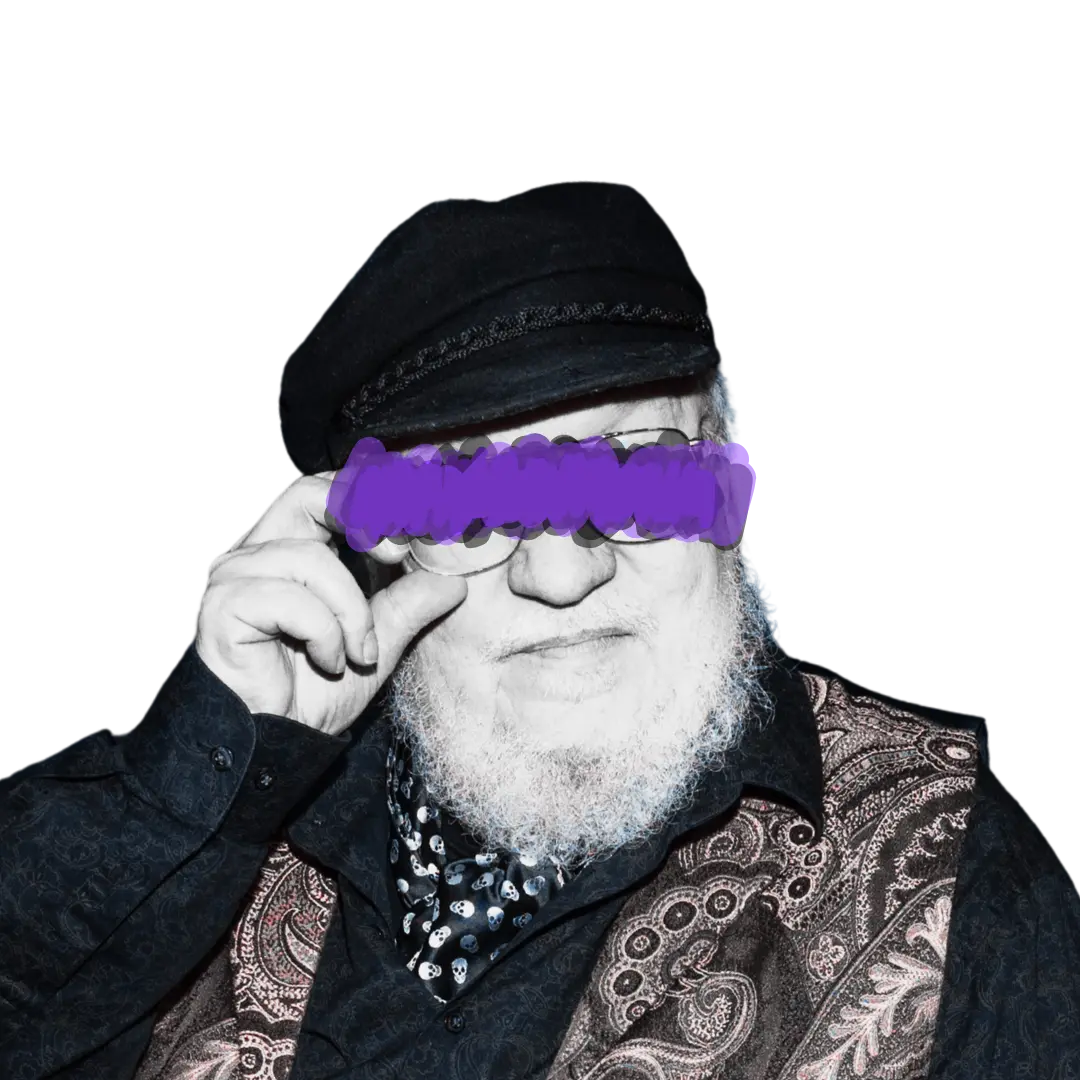
"I don't write when I travel. I don't write in hotel rooms. I don't write on airplanes."
Thirteen years. That's how long fans have waited for The Winds of Winter. But what if I told you the delay isn't about laziness or writer's block—it's about the fundamental architecture of George R.R. Martin's mind?
The 76-year-old creator of Westeros has called his unfinished magnum opus "the curse of my life." Critics mock him. Fans despair. Yet behind the frustration lies a psychological pattern that explains not just why he can't finish, but why he created something so extraordinarily detailed in the first place.
Understanding Martin requires understanding how a lonely boy in a Bayonne housing project turned pet turtle deaths into his first epic saga.
TL;DR: Why George R.R. Martin is an Enneagram Type 5
- The Investigator's World-Building: Martin's obsessive attention to historical detail—family lineages, heraldry, geography, climate—reflects the Type 5's need to understand systems completely before acting. He researches medieval history, the Wars of the Roses, and Hadrian's Wall with academic rigor.
- Knowledge as Security: Growing up poor in Bayonne without a car, Martin's "world consisted predominantly of First Street to Fifth Street." Books became his escape and his power. The 5's core fear of being helpless or incompetent drove him to build a universe where he controls every variable.
- Withdrawal Under Stress: When overwhelmed by fame and obligations, Martin retreats. He cannot write on planes, in hotels, or around people. He needs isolation—the classic Type 5 response to feeling depleted by the external world.
- The Perfectionism Trap: Type 5s struggle with releasing work because they never feel they know enough. Martin's revisions spiral into rewrites because each detail opens new rabbit holes of research. The more he knows, the more he realizes he doesn't know.
- Detached Observation: Martin creates morally complex characters by observing human nature with clinical fascination rather than emotional investment. He famously said trying to please everyone is "a horrible mistake"—the 5's preference for truth over harmony.
What is George R.R. Martin's Personality Type?
George R.R. Martin is an Enneagram Type 5 (The Investigator)
The Enneagram Type 5 is characterized by an intense desire to understand the world, a tendency to withdraw to protect their energy, and a fear of being overwhelmed by the demands of others. They are the archivists, the researchers, the people who believe that knowledge is the ultimate form of security.
For Martin, this manifests in his legendary world-building. A Song of Ice and Fire isn't just a story—it's an ecosystem. He created detailed genealogies spanning thousands of years, invented languages, mapped political systems, and developed climate patterns that follow logical rules. This is the Type 5 brain at work: if I understand everything about this world, I control it.
But the 5's greatest strength becomes their greatest weakness. The same need for comprehensive knowledge that produced Westeros also makes completing it nearly impossible.
The Boy From Bayonne: Where the Pattern Began
George Raymond Martin was born on September 20, 1948, in Bayonne, New Jersey, to a longshoreman father and a mother whose family had lost everything in the Great Depression.
His world was small—literally. "First Street to Fifth Street," he recalls, "between my grade school and my home." They didn't own a car. They never went anywhere. For a Type 5 child, this physical limitation became psychological liberation.
Without the outside world, Martin created inner worlds.
His pet turtles—kept in a toy castle—became the first inhabitants of his imagination. When they died (as turtles frequently did), young George decided they must be murdering each other in "sinister plots." This dark interpretation of turtle mortality was his first epic fantasy.
He began selling monster stories to neighborhood children for pennies, with dramatic readings included. The pattern was set: withdraw into imagination, build complex worlds, emerge to share them on his own terms.
The Comic Book Kid Who Became a Master
While other boys played sports, Martin devoured Marvel Comics. He later credited Stan Lee as his greatest literary influence—"even more than Shakespeare or Tolkien."
This might seem surprising until you understand what comics taught him: ensemble casts, interconnected storylines, the slow burn of character development across issues and years. The Marvel Universe was a Type 5's paradise—a coherent system where every character had a history, every event had consequences, and a dedicated reader could map the entire architecture.
At Marist High School (an all-boys Catholic prep school that meant "hardly speaking to a girl for four years"), Martin captained the chess team and discovered he had no gift for languages despite struggling through Latin and French. His mind worked differently—not in grammar and conversation, but in systems and patterns.
He graduated valedictorian despite these struggles, a testament to the Type 5's ability to master domains through sheer intellectual persistence.
The Wilderness Years: Hollywood and Heartbreak
Martin sold his first story in 1970 at age 21. By the early 1980s, he'd won multiple Hugo and Nebula Awards—the science fiction world's highest honors. Two Hugos in a single night (1980) was a rare feat.
Then came Hollywood.
He worked on CBS's revival of The Twilight Zone and the cult favorite Beauty and the Beast. The money was good. The creative control was nonexistent.
His first marriage to Gale Burnick (1975-1979) ended in divorce. "It was a great, fun wedding, one of the best," he later wrote. "The marriage not so much... Our wedding song was 'Bridge Over Troubled Water.' Maybe we should have taken that as a clue."
The television industry ground him down. Showrunners rewrote his scripts. Studios demanded changes. For a Type 5 who needs control over his creative domain, this was torment.
So he retreated.
In 1991, Martin stepped away from Hollywood and began writing something no one could take from him. Something so vast, so detailed, so fundamentally his that no executive could simplify it into a pitch meeting.
He began writing A Game of Thrones.
Inside Martin's Mind: The Isolation Principle
Understanding Martin's writing process reveals the Type 5 operating system in real time.
He writes on a DOS computer running WordStar 4.0—software from 1987. No internet. No distractions. No possibility of his computer "trying to be smarter than me."
This isn't eccentricity. It's deliberate isolation.
Martin has stated explicitly: "I don't write when I travel. I don't write in hotel rooms. I don't write on airplanes." He needs to be home, undisturbed, to access the mental space where Westeros exists.
"Through most of my life nobody did bother me," he's noted, "but now everyone bothers me every day."
Fame shattered the conditions that made his work possible.
The Type 5's core fear is being overwhelmed—having their limited energy depleted by the demands of the external world. Martin's success created exactly this nightmare. Interviews, conventions, television productions, travel, emails, obligations—each one a drain on the finite reservoir he needs for writing.
The Curse of Perfectionism
"Writer's block isn't to blame here," Martin has admitted. "It's distraction."
But there's more to it than distraction. The Type 5's need for comprehensive understanding creates a perfectionism trap.
Martin tends to get "wrapped up in revising previous work" rather than moving forward. Each revision opens new questions. Each detail demands more research. The Wars of the Roses suggest new political dynamics. A historical climate pattern reveals a flaw in his fictional seasons. An inconsistency in eye color haunts him.
He's called each manuscript "King Kong, the monkey on my back."
The longer he stays away from the keyboard, the more his "doubts and disorganization grow into serious performance anxiety." He begins to believe he's no longer capable of writing anything worth reading.
This is the Type 5's integration/disintegration pattern playing out. Under stress, 5s move toward the scattered, anxious qualities of Type 7—starting new projects, avoiding the hard work of finishing. Martin's blog posts about the Jets and Giants, his involvement in video games, his television projects—all can be understood as the 5 fleeing from the overwhelming task at hand.
The Jean Cocteau and the Search for Home
In 2013, Martin purchased and reopened the Jean Cocteau Cinema in Santa Fe, New Mexico. The historic single-screen theater, originally opened in 1976 and closed in 2006, became his pet project.
This might seem like another distraction. In fact, it's deeply consistent with Type 5 psychology.
The 5 seeks to create controlled environments where they can engage with the world on their own terms. The Jean Cocteau—with its bookstore, its author readings, its curated film selections—is Martin's real-world castle. Unlike Hollywood, he controls it. Unlike Westeros, it exists in physical space where he can see people enjoying what he's built.
It's also in Santa Fe, where he's lived since 1979 with his second wife, Parris McBride (married in 2011, though they originally met in 1975). Far from New York publishing. Far from Los Angeles studios. Far from everyone who wants a piece of him.
The HBO Wars: When the World Invaded Westeros
Martin's relationship with Game of Thrones reveals the Type 5's nightmare scenario: watching others control your creation.
He was involved heavily in the early seasons, writing episodes and consulting on adaptations. Then, gradually, he was "kept out of the loop."
"I had no contribution to the later seasons except, you know, inventing the world, the story and all the characters," he's said with bitter irony. When asked why he was shut out, his response was pointed: "You'd have to ask Dan and David."
Martin wanted 10-13 seasons. The showrunners wanted to end it in 8. He flew to New York to meet with HBO's CEO, begging for more episodes. He lost.
The rushed final seasons became one of television's most controversial endings. Martin watched his life's work distorted by commercial pressures—the exact scenario he'd spent decades trying to avoid.
His subsequent disputes with HBO over House of the Dragon—including a since-deleted blog post warning of "larger and more toxic butterflies to come"—show a man still fighting for control over a universe that's grown beyond his grasp.
What the Waiting Reveals
At 76, Martin has admitted he may never finish the books. "Maybe they're right," he's said of critics. "I don't know."
This honesty is devastating but clarifying. The Type 5's relationship with time is complicated. They live so deeply in their mental worlds that external deadlines feel arbitrary. The story will be done when the story is done—or it won't be done at all.
Martin has written approximately 1,100-1,200 pages of The Winds of Winter, with 400-500 pages remaining. After 13 years.
The math suggests either completion is possible or that the remaining pages will take another decade. For fans, this is agony. For Martin, it's the only way the work can exist: complete in his mind before it emerges onto the page.
The Legacy of the Investigator
George R.R. Martin changed fantasy literature forever. Before A Song of Ice and Fire, fantasy was largely Tolkienesque—good versus evil, clear heroes, ultimate redemption. Martin introduced moral ambiguity, consequence, and the uncomfortable reality that good people die and bad people prosper.
This perspective is pure Type 5. The Investigator observes human nature without romantic illusion—much like fellow mystery author Agatha Christie, another Type 5 who built intricate puzzle-worlds. Martin has said he was "pleased to have created morally ambiguous characters" and describes dealing with moral ambiguity "quite naturally."
His influence extends beyond books. Game of Thrones proved that fantasy could be prestige television. His work on Elden Ring brought his world-building to video games — a collaboration with FromSoftware that produced one of the best-selling games in history, the mythology written before Martin knew what the game mechanics would be. His theater supports independent cinema. His Wild Cards anthology series, which he's been editing since 1987, gave other writers a shared universe to explore — a system he designed to have room for everyone's ideas, but with his hand on the architecture.
Whether or not The Winds of Winter ever arrives, Martin has already built something that will outlast him: a universe where actions have consequences, power corrupts without exception, and the most dangerous thing in any kingdom is a mind that understands how it really works.
George R.R. Martin isn't lazy. He isn't blocked. He's an Investigator whose greatest strength — the compulsive need to understand everything — has become the very thing preventing completion.
The boy who turned turtle deaths into political intrigue never stopped building that castle. He just made it so detailed, so comprehensive, so real that he may never find his way out.
Perhaps that's the most fitting ending for the architect of Westeros: trapped in a world of his own making, knowing that the only way forward is to accept imperfection — the one thing his mind cannot do.
Disclaimer: This analysis of George R.R. Martin's Enneagram type is speculative, based on publicly available information, and may not reflect the actual personality type of George R.R. Martin.

What would you add?