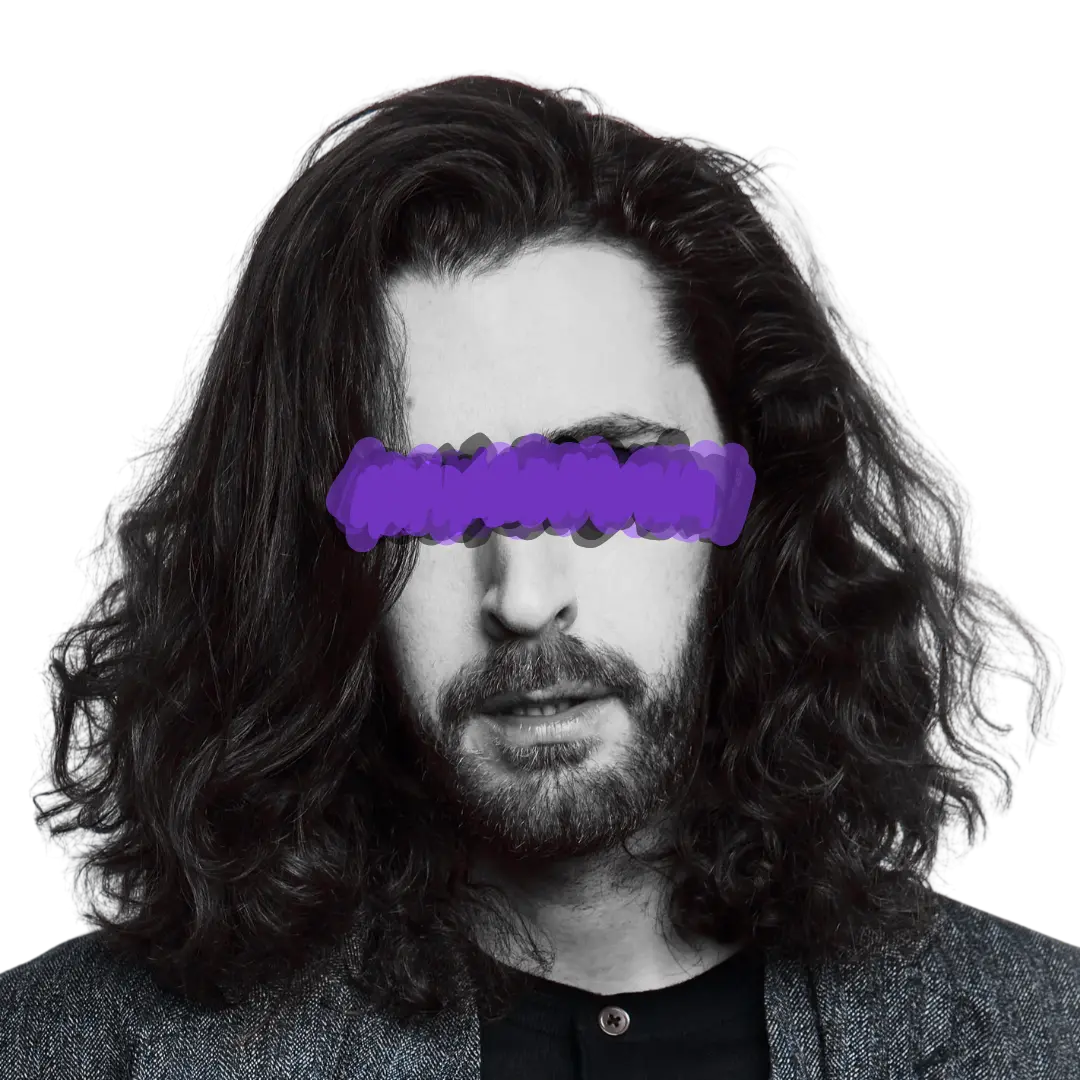
"If you can say something beautiful in a very terrible way — I was always drawn to that."
The night "Take Me to Church" went viral on Reddit in 2013, Andrew Hozier-Byrne was 23 and recording in his parents' attic in Bray, County Wicklow. He hadn't engineered the moment. He'd made a song that felt true to him and released it independently, the way you'd release something you needed to get out — not because you expected it to travel. Then it did. Within weeks, the shy Irish kid who missed making breakfast and keeping bees was watching strangers film themselves weeping to his song in supermarkets.
That disorientation — art made in deep solitude suddenly belonging to millions — is the most revealing thing about Andrew Hozier-Byrne. Not the Billboard charts. Not the Grammy nod. The fact that when it happened, his first instinct was confusion. "I'm still trying to get my head around it all," he said. "I haven't really processed it yet."
Type 4s make work in the interior and are genuinely unsettled when the exterior world claims it. The song was finished. It had done its job. Why was everyone else still holding it?
TL;DR: Why Hozier is an Enneagram Type 4
- Deep Emotional Processing: Hozier spends up to a year writing a single song, sitting with emotions until they're perfectly expressed. This is classic Type 4 behavior — refusing to release something until the feeling is exactly right, not merely good enough.
- Identity Through Art: "My duty is to make music," he says. His sense of self is inseparable from his artistic output — Type 4s don't just make things, they locate themselves in what they make.
- Melancholic Beauty: His attraction to "saying something beautiful in a terrible way" reveals the Type 4's characteristic embrace of bittersweet emotions and finding meaning in darkness.
- Intellectual Depth (5 wing): His incorporation of Dante's Inferno, W.B. Yeats, and complex literary themes shows the 4w5's need to intellectualize and make meaning from emotional experience.
- Activist Conscience (Integration to 1): His vocal support for LGBTQ+ rights, reproductive rights, and Palestinian liberation shows healthy Type 4 integration, channeling emotional depth into principled action.
What is Hozier's Personality Type?
Hozier is an Enneagram Type 4 (The Individualist)
Enneagram Type 4s are known as "The Individualist" or "The Romantic." They are driven by a need to understand themselves and find their unique identity. Type 4s often feel fundamentally different from others and seek to express this uniqueness through creative endeavors.
What makes Hozier such a compelling example of this type is how completely he embodies both its gifts and its struggles. His music isn't just entertainment. It's an excavation of the human soul, filtered through an emotional lens calibrated for depth rather than accessibility.
The Core Fear: Type 4s fear having no identity or personal significance. Watch Hozier recoil from celebrity culture: "Truth be told, I'm not all that comfortable with celebrity culture. That was always something that baffled me, the obsession over fame." This isn't false modesty. It's a Type 4's genuine bewilderment about why anyone would chase external recognition when the real excavation happens somewhere private.
The Core Desire: Type 4s want to find themselves and their significance, to create an identity from their inner experience. Hozier's entire artistic mission reflects this: "When I write songs, I try to remove myself a little bit. Obviously they're very personal to me, but it feels easier if I feel like I'm writing characters."
This creative distance, processing deeply personal material through artistic characters, is classic Type 4 behavior.
Hozier's Upbringing: A Foundation of Depth
Andrew John Hozier-Byrne was born on March 17, 1990, near Bray in County Wicklow, Ireland. His childhood was shaped by two powerful forces: music and hardship.
His father John was a local banker by day but a jazz and blues drummer by night, filling young Andrew's world with the sounds of John Lee Hooker, Muddy Waters, and Tom Waits. His mother Raine was a visual artist who would later design his album covers. Both parents had been raised Catholic but converted to Quakerism, raising Andrew in that faith tradition.
Then, when Andrew was six, his father underwent spinal surgery. The complications left him wheelchair-bound, and for years afterward, the family struggled financially while his father was unemployed.
"It changed all of our lives," Hozier later reflected. "It changed his life, it kind of ruined his life in a big way."
That's Type 4 bedrock. Suffering witnessed early, beauty still present. No way to pretend life is simple after watching your father's life split in two at six years old.
Young Andrew grew up in the Irish countryside near the village of Delgany, surrounded by nature and his parents' record collection. He taught himself guitar at 15. Songs followed shortly after — which is to say, the tools came first and he already knew what he'd use them for.
Rise to Fame: The Reluctant Star
Hozier's path to stardom was anything but calculated. After singing in his school choir and joining the Irish choral ensemble Anúna (from 2007-2012), he enrolled at Trinity College Dublin to study music education.
He would never finish. After missing exams to record demos for a music label and being refused a year's deferral, he chose music over academia.
In 2013, he released "Take Me to Church" independently, recording it in a makeshift attic studio in his parents' home. The song drew on his frustrations with the Catholic Church's treatment of LGBTQ+ people, wrapped in the language of religious ecstasy.
"Growing up in Ireland, the church is ever present, and a lot of the feeling in the song stems from frustration with its hypocrisy and political cowardice," he explained.
The music video, depicting violence against a same-sex couple in Russia, went viral. Suddenly, the introverted Irish songwriter found himself thrust into global fame.
"I'm still trying to get my head around it all," he admitted at the time. "It's been a very steep learning curve... I didn't expect this, and I haven't really processed it yet."
This discomfort with sudden success is deeply Type 4. While Type 3s might strategize their rise and Type 7s might embrace the adventure, Type 4s often feel almost suspicious of external validation. Their identity comes from within, so what does mass popularity really mean?
Personality Quirks, Habits, and the Type 4 Mind
The Year-Long Song
Perhaps nothing reveals Hozier's Type 4 nature more clearly than his songwriting process.
"It could take me a year to write a song. It could take a year and a half," he revealed. He describes it as "some sort of process of elimination, sort of trimming off the shoots that ultimately might fail and kill the whole plant."
His former girlfriend Loah described watching him "go up to their attic room and spend nine hours on the same thing every day."
This isn't perfectionism in the Type 1 sense. It's the Type 4's need to get the emotion exactly right, to capture the precise shade of feeling they're trying to express.
The Observer Who Watched
"I spent a lot of time watching people growing up, trying to decipher the person behind the person."
This quote reveals the 5 wing influence on Hozier's Type 4 core. The 4w5 (sometimes called "The Bohemian") combines the emotional depth of the 4 with the intellectual curiosity of the 5. They don't just feel — they analyze their feelings. They don't just create — they study the nature of creation itself.
This explains Hozier's attraction to literature and poetry. When the pandemic hit, he didn't just sit with his feelings — he dove into Dante's Inferno, eventually structuring his entire third album around the 14th-century poem.
The Introvert Who Performs
"By nature I'm an awkward person, I'm a gangly introvert."
Hozier's stage presence creates what observers call "an unintentional juxtaposition": this shy, contemplative man delivering powerful performances to screaming crowds.
He's open about his discomfort: "I'm not quite used to being seen through the eyes of fans yet. Being met with squeals and screams, I haven't gotten used to that. I hate nightclubs, and I get fed up very quickly in crowded rooms."
When touring, he misses making breakfast. Irish cream. Honey from his bees. The solitude of his own kitchen. These aren't quirky celebrity details — they're the specific conditions under which a Type 4 stays oriented. Strip away the private rituals and the interior life starts to fray. He returns to Bray whenever he can, to friends who knew him before the song, because that's where the self he's working from still lives.
Love as Death and Rebirth
Hozier's views on love reveal the romantic intensity typical of Type 4s:
"I found the experience of falling in love or being in love was a death: a death of everything. You kind of watch yourself die in a wonderful way, and you experience for the briefest moment, if you see yourself for a moment through their eyes, everything you believed about yourself gone. In a death-and-rebirth sense."
This isn't hyperbole for Hozier. It's lived experience. Type 4s often experience emotions at a depth that others find overwhelming. Where some might describe falling in love as "exciting" or "wonderful," a Type 4 processes it as ego death and spiritual transformation.
Major Accomplishments
The strange arc of Hozier's success mirrors his psychology. "Take Me to Church" — written alone in an attic about institutional hypocrisy, not commercial ambition — became Diamond certified in the US and hit #2 on the Billboard Hot 100. He didn't engineer that. He made something that felt true and looked away.
Then in 2024, "Too Sweet" became his first #1 in Ireland, the US, and the UK, making him the first Irish artist to top the Billboard Hot 100 since 1990. Worth noting: it happened a decade after his debut, after three full albums of artistic deepening, not at peak buzz. Type 4s tend to build slowly, investing in the work rather than the moment, and the compounding eventually shows.
A Grammy nomination for Song of the Year followed. Then the TIME 100 Most Influential People list in 2025, where Noah Kahan described him as an artist who sounds "like he must be from a different time, or a better world." That phrase probably landed harder with Hozier than any chart position — it's the compliment that describes what he was trying to do.
He also won the Ivor Novello Award for Song of the Year and an HMMA Award for "Blood Upon the Snow" in God of War: Ragnarök — a Type 4 ending up soundtracking a mythological underworld was, perhaps, inevitable.
Controversies and Criticisms
The Israel-Palestine Stance
At a 2024 concert in New York, Hozier expressed solidarity with Palestinians affected by the conflict in Gaza. While most of the crowd cheered, some attendees walked out, with one yelling "f--k you Hozier" before leaving.
Hozier has consistently taken political stances in his music and public appearances, stating: "I am a politically motivated person, and that will come through in the music."
The Girlfriend Drama
When fans discovered his relationship with model Hana Mayeda in 2024, some began harassing her on social media. Old photos showing her participating in a "smudging" ceremony (burning desert sage, an Indigenous practice) resurfaced, leading to accusations of cultural appropriation.
Later, viral screenshots allegedly showed her liking problematic posts on social media. Mayeda issued a statement calling the screenshots "fabricated" and affirming her support for "trans rights, and justice, freedom and liberation for the Palestinian people."
Hozier himself posted asking fans to leave his girlfriend alone, calling the speculation "baseless, insensitive, and disrespectful."
The "Take Me to Church" Religious Backlash
The song's critique of organized religion drew criticism from religious communities. MTV and VH1 initially refused to play the music video.
Hozier has maintained his position: "I'm not religious myself, but my issue is with the organization. It's an organization of men — it's not about faith."
Hozier's Legacy and Current Work
The Unreal Unearth Era
Hozier's third album, Unreal Unearth (2023), represents his most ambitious artistic statement. Structured around Dante's Inferno, each song corresponds to a circle of Hell, transforming pandemic isolation into mythological journey.
"I didn't want to write songs that were about a lockdown," he explained. "I didn't want to write songs that were about the pandemic."
Instead, he found in Dante's 700-year-old poem a framework for exploring universal human experiences of loss, longing, and transformation.
The album includes his first songs sung in the Irish language — another act of reclamation and identity assertion that speaks to his Type 4 nature.
Activism and Values
A Type 4 integrating toward 1 stops turning inward and starts looking outward — the emotional depth gets converted into principled action. You can track that arc clearly in Hozier's work. The "Take Me to Church" video used violence against a same-sex couple in Russia not as provocation but as documentation of what institutional hypocrisy actually produces. "Cherry Wine," featuring Saoirse Ronan, brought intimate partner abuse into a song soft enough that people didn't see it coming until they did. "Swan Upon Leda" landed within weeks of Roe v. Wade being overturned — mythology pressed into the service of something urgent. "Nina Cried Power" was an explicit act of lineage-claiming, invoking Nina Simone and Bob Dylan and everyone else who proved that a song could be a form of witness.
This is what healthy Type 4 integration looks like. Not just feeling things deeply in private. Using that depth as fuel.
"You grow up and recognise that in an educated, secular society, there's no excuse for ignorance," he says. "You have to recognise in yourself, and challenge yourself, that if you see racism or homophobia or misogyny in a secular society, as a member of that society, you should challenge it."
The Ongoing Tour
The Unreal Unearth tour has stretched across 2023-2025, with over 83 performances across 72 cities in North America alone. A deluxe version of the album, Unreal Unearth: Unending, was released in December 2024, including the new song "Hymn to Virgil."
"It's whatever catches you at the moment," Hozier says of his inspiration. "Maybe verbalizing a feeling to yourself in your head that you usually wouldn't, or what you're doing or looking at in that moment. Turning the everyday into words. Or a thought or feeling you're almost shocked to admit to yourself."
That last clause is the whole thing. The feeling you're almost shocked to admit. That's where the Type 4 lives — not in the polished emotion that's safe to share, but in the raw material just before you've decided what to do with it. Most people suppress that and move on. Hozier goes up to the attic and stays until he has a song.
The fact that millions of people recognize themselves in what comes back down says something important — not about Hozier's universality, but about how much of their own inner life most people never say out loud. He's not speaking for humanity. He's just willing to go first.
Disclaimer: This analysis of Hozier's Enneagram type is speculative, based on publicly available information, and may not reflect his actual personality type.

What would you add?