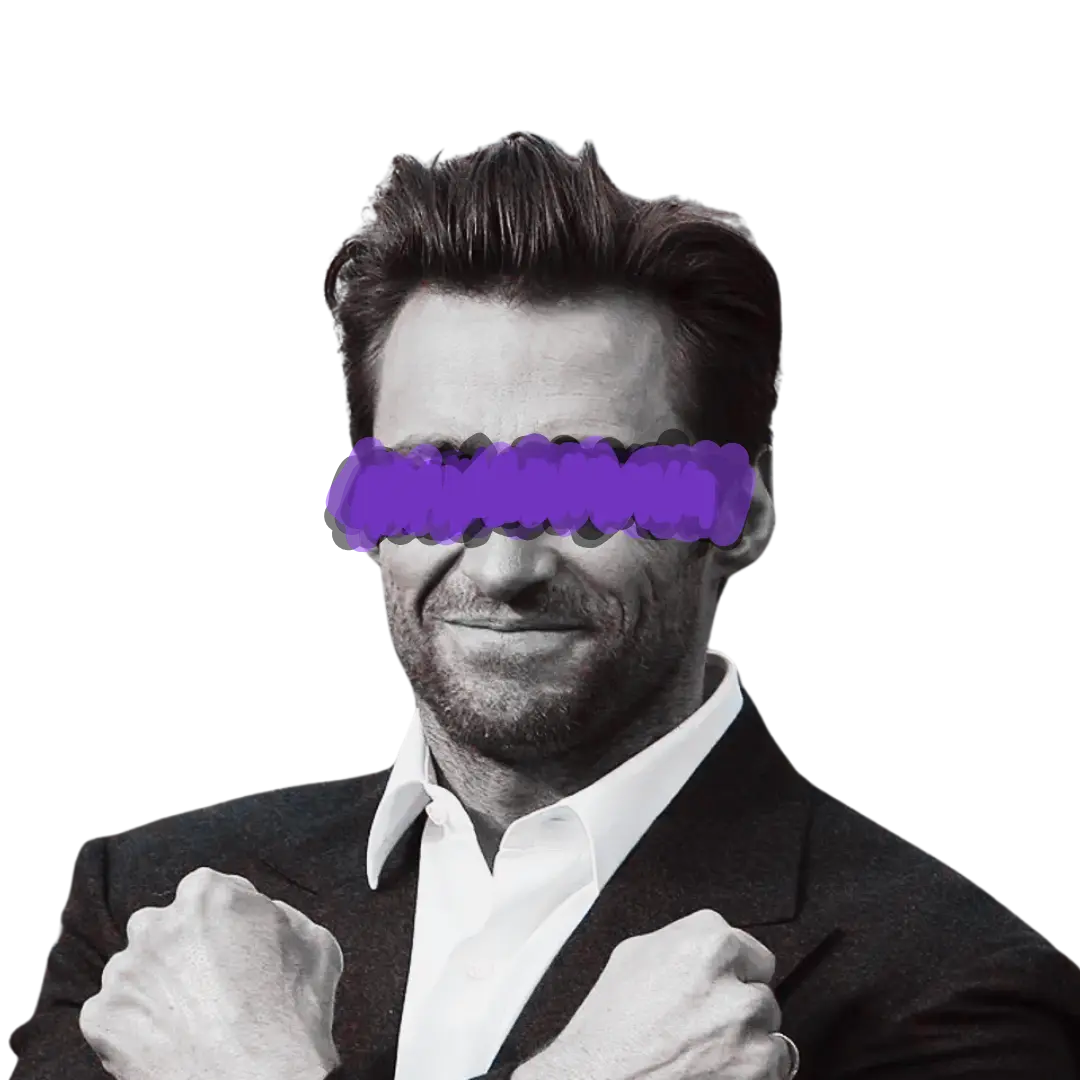
"For many years, I carried a doubt whether there was some kind of wound or damage that would frame my entire life."
Hugh Jackman was eight years old when he came home from school and the house was empty. No note on the table. No explanation. The next day, a telegram arrived from England. His mother was there. She wasn't coming back.
That was 1976. In the fifty years since, Jackman has become perhaps the most universally beloved performer alive — the man who hosted the Oscars and made the audience feel like they were at a dinner party, the actor who played Wolverine for twenty-four years and never once was difficult on set, the guy who stopped a red-carpet interview to greet a former PE student he'd taught three decades earlier. Tom Hooper, who directed him in Les Miserables, said it plainly: "However long hours he works, however much he has to sing, he's always gracious with the crew. He's always a wonderful leader."
Everybody loves Hugh Jackman. The question nobody asks is why Hugh Jackman needs everybody to.
Because there is a gap between the public Hugh Jackman — the warmest man in any room, the one who remembers every name and makes every stranger feel like family — and the private architecture that built him. A boy who couldn't enter his own house alone. A man who, in September 2023, saw his twenty-seven-year marriage end with his ex-wife publicly using the word "betrayal."
The nicest guy in Hollywood has a more complicated story than the niceness suggests.
TL;DR: Why Hugh Jackman is an Enneagram Type 2
- The warmth has a source: Abandoned by his mother at 8, Jackman built a life around making sure no room he enters feels empty
- Rage underneath the charm: A "white rage" in adolescent rugby became the fuel for Wolverine — and the stress pattern of a Two going to Eight
- Philosophy vs. behavior: He preaches the 85% rule and surrender while waking at 3 AM for punishing Wolverine workouts
- The performer's paradox: "All spiritual moments in my life have been on stage" — connection as both calling and survival mechanism
The Boy Who Waited Outside
Christopher Jackman was a Cambridge-educated English accountant who had emigrated to Australia with his wife Grace. They had five children. Hugh was the youngest. And then Grace left.
"There was no one there in the house," Jackman has said. "The next day there was a telegram from England, Mom was there. And then that was it."
It wasn't supposed to be permanent. Grace suffered from undiagnosed postpartum depression after Hugh's birth. She needed to get away. She didn't think it would be forever. Hugh's father prayed every night that she would come back.
"I don't think she thought for a second it would be forever," Jackman reflected decades later. "I think she thought it was, 'I just need to get away, and I'll come back.'"
She didn't come back. The family split — Hugh and his brothers stayed in Sydney with their father. His two sisters went to England with their mother. And the youngest boy in the house developed a terror of empty rooms.
"I used to be the first one home and I was frightened to go inside," he told interviewers. "I couldn't go into the house on my own. I'd wait outside, scared, frustrated."
Picture that for a moment. An eight-year-old sitting on the front step of his own home, afraid to open the door. Not because of what was inside. Because of what wasn't.
Christopher Jackman raised five children alone. He was devout, principled, and emotionally restrained in the way of many English fathers of that generation. His parenting philosophy was radical non-interference: when Hugh was deciding whether to take a job on a soap opera or attend drama school, he asked his father what to do.
"I can't answer that for you," Christopher said. "You have to make your own decision."
When Hugh told him he'd chosen drama school, his father exhaled: "Oh, thank God! I'm so happy you chose that!"
"Why didn't you tell me that?" Hugh asked.
"It was your decision."
Hugh now calls this "an amazing bit of parenting." But there's a quieter read: a father who, having been abandoned by his wife, was careful never to be too needed. A father who withheld advice so he could never be blamed — or credited — for the outcome. A father who loved fiercely but kept his emotional fingerprints off everything.
Hugh absorbed both lessons. From his mother's departure: connection can be ripped away without warning. From his father's restraint: love doesn't always announce itself. The child who carried both of those truths would spend his entire adult life making sure no one around him ever felt alone or unseen.
"My Father taught me to always keep my promises," Jackman wrote on Instagram after Christopher died on Father's Day 2021, at age eighty-four. "Even if it turns out there's a better option or something that will benefit me more. Always be true to your word."
Years later, Jackman reconciled with his mother. She appears on his Instagram now, cooking together. "As I grew older, I gained an understanding of why mum did leave," he has said. "We have definitely made our peace, which is important."
The peace is real. So is the wound. Both can be true.
White Rage and the Diving Board
For four years after his mother left, Hugh held it together. Then adolescence arrived and something cracked open.
"My anger didn't really surface until I was 12 or 13. It was triggered because my parents were going to get reconciled and didn't. All those years I'd been holding out hope that they would." The hope died. What replaced it was fury.
"I'd be somewhere in a ruck in rugby, get punched in the face and I'd just go into a white rage."
He headbutted metal school lockers until they dented. He describes himself at that age as "volatile." But the line that reveals the most comes when he diagnoses the rage with the precision of someone who has spent years in therapy: "Isn't most anger fear-based, ultimately? It emanates from some kind of powerlessness. I was really feeling that."
The anger was real. But underneath the anger was a terrified child who had learned that the world could empty out while he was at school.
What he did with the fear is more interesting than the fear itself. As a boy scared of heights, he went to the school diving boards every lunchtime — the one-meter, the three-meter, the five-meter — and jumped. Not once as a dare. Every single day. He ritualized the confrontation. He turned dread into practice.
"Growing up I was scared of the dark. I was scared of heights. It limited me. I hated it, and that contributed to my anger." So he developed a policy: "If anything comes up and I feel frightened of it, I have to attack it because I know it will creep into other areas of my life and start to take over."
This policy would come to define his career, his body, and eventually his most famous role. Years later, preparing to play Wolverine, he stood in a Toronto apartment at 3 AM taking a freezing cold shower.
"I was halfway through it and I went, 'This is it!' This feeling was so through my body that I wanted to scream but I could not."
He had found the rage. It had been inside him the whole time — the same white rage from the rugby pitch, the same fury of a powerless child, stored in his body for decades. Wolverine didn't require him to invent anger. It gave him a place to put it.
"Aggression is a primal thing and it needs to be exorcised in some way," he said later. "Far better to have it in a controlled violent environment. So in a way playing Wolverine is good therapy."
He played the character across ten films and twenty-four years. The Guinness World Record for longest career as a live-action Marvel superhero. Most people see an actor who got lucky with a franchise. The deeper truth is that a boy with a lifetime of suppressed rage found the one character in cinema who makes fury look like a superpower.
What is Hugh Jackman's Personality Type?
Hugh Jackman is an Enneagram Type 2
The evidence doesn't point to a man driven primarily by achievement or success. It points to someone whose entire life is organized around connection — earning it, maintaining it, and preventing its loss.
"To get down to the quick of it, respect motivates me — not success." That distinction matters. Threes want to be admired for what they've accomplished. Twos want to be appreciated for who they are to people. Jackman has never chased awards or box office with the singular focus of a classic achiever. He's chased the feeling of a room full of people who feel seen.
Consider the evidence:
- Ryan Reynolds, his closest friend in Hollywood, let slip what Jackman is like behind the public faux-feud: "When we are together outside of our public persona taking the piss out of each other, most of our conversations are very vulnerable." When they first met on the set of X-Men Origins: Wolverine in 2008, Reynolds was a relative nobody. Jackman walked straight over: "He gave me a big hug and said, 'Welcome aboard. It's all going to be fine. We're going to make you comfortable,'" Reynolds recalled. Eighteen years later, Jackman describes their friendship as one that "just gets better and better, deeper and deeper." The man everybody thinks they know is actually most himself in private, unguarded vulnerability.
- His stress pattern maps precisely onto the Two's line to Type Eight. Under pressure, the warmest person in the room becomes volatile, controlling, rageful. The white rage in rugby. The cold-shower scream in Toronto. The man who never raises his voice — until something cracks.
- His growth pattern maps onto the Two's line to Type Four: increasing emotional self-awareness, willingness to sit with difficult feelings, therapy as a practice of seeing himself clearly. "Understanding my past and how it's informing my thinking unconsciously — getting to really understand some of the patterns that I was unconsciously just repeating."
The 2w3 wing — what the Enneagram calls "The Host" — adds the showmanship. The Three wing gives Jackman his image-consciousness, his charisma, his ability to hold a stage. But the engine underneath is a Two's engine: the need to be needed, the radar for other people's feelings, the compulsion to fill every room so thoroughly that no one in it experiences what he experienced at eight years old.
"I'm quite an insecure person," he admitted. "Wolverine helped me channel that insecurity into motivation."
An achiever wouldn't frame it as insecurity. An achiever would frame it as drive. Jackman names the wound — and that naming is itself a Two's move: vulnerable, relational, reaching toward connection even in the act of self-description.
Not everyone finds the warmth charming. Jackman has acknowledged that the "nicest guy in Hollywood" label irritates him: "Any label is your enemy," he's said. Director Bryan Singer reportedly yelled at him early in the first X-Men film for being too pleasant on set — "You need to be edgier, you need to be meaner" — and at least one observer has noted that his relentless enthusiasm "treads the line between infectious and exhausting." He knows this about himself. The question is whether the warmth is a choice he makes or a reflex he can't turn off. For a Two, the honest answer is usually both.
Coco the Clown and the Accidental Calling
Before he was Wolverine, Hugh Jackman was Coco the Clown.
He rented the suit. He could juggle three things, poorly. He had no balloon skills. No magic tricks. Fifty dollars a party. A six-year-old once stood up and announced: "Mummy, this clown is terrible, he doesn't know any tricks." At his last party, an eight-year-old yelled "Mom, this clown is crap" and the other children pelted him with eggs.
"50 bucks," he reflected later. "Not worth it."
But the instinct was there before the skill was. A young man drawn not to solitary work but to rooms full of strangers, trying to make them happy. He just hadn't found the right form yet.
The form found him by accident. At the University of Technology Sydney, studying for a communications degree, he needed an elective. A friend told him drama had no exams. "Perfect," Hugh said. "I'm in." His professor cast him as the lead in The Memorandum. Something ignited.
"In that week I felt more at home with those people than I did..."
He trails off. But the sentence doesn't need finishing. He found the room that didn't feel empty.
He was offered a role on Neighbours, the Australian soap opera — quick money, immediate visibility. He turned it down to attend the Western Australian Academy of Performing Arts. His father was relieved. Hugh graduated in 1994 and within a year was cast in Correlli, an Australian TV drama, where he met a woman named Deborra-Lee Furness.
Then came X-Men. He wasn't the first choice. Dougray Scott was cast but dropped out due to scheduling conflicts with Mission: Impossible II. Jackman auditioned, got the role, and nearly got fired five weeks in. He kept going. He would play the character for twenty-four years across ten films.
But the roles that reveal the most about him aren't the Wolverine films. They're the musicals. The Boy from Oz (Tony Award, 2004) — playing openly gay entertainer Peter Allen. Les Miserables (Golden Globe, 2013) — playing a man who redeems himself through sacrifice for a child who isn't his. The Greatest Showman (2017) — playing a man who builds a family out of misfits and gives them a stage.
"The reason I weirdly pretend to be other people — this may sound sort of ass-backwards — but the reason I do it is to actually understand life, humanity, myself, and why we're here."
The pattern is consistent. He doesn't gravitate toward antiheroes, tortured geniuses, or morally ambiguous power players. He gravitates toward men who perform for other people — who use the stage to create belonging. It's not vanity. It's architecture.
The 85% Rule and the 3 AM Wolverine
Jackman tells a story about the sprinter Carl Lewis. Lewis was always last at the forty-meter mark of the hundred-meter dash. But he won. Every time. Because while other runners tensed up and clenched, Lewis stayed relaxed. He let his form carry him. Jackman calls it the 85% rule: run at 85% capacity, and you'll be faster than the person straining at 100%.
And then he wakes up at 3 AM to train.
For Wolverine roles, his routine was punishing: forty-five minutes of low-intensity fasted cardio before sunrise, followed by heavy lifting, followed by an afternoon high-intensity session. Six thousand calories a day. Three hours of total training. Cold showers in Canadian winters. Abstaining from alcohol entirely during Broadway runs. Rating each day on a zero-to-ten scale as personal accountability.
He meditates twice daily. He reads for thirty minutes every morning. He makes his own coffee and his wife's tea. He has a spiritual practice rooted in surrender.
And he cannot stop.
"The world will always need people who are going to do what they love," he says. "But know when enough is enough. More is not always better."
He says this. He doesn't do this. The gap between Jackman's philosophy and Jackman's behavior is the gap between what he knows and what he feels. He knows that relaxation produces better results. He feels that if he stops — if he rests, if he is anything less than extraordinary — someone will leave. The 85% rule is the man he wants to be. The 3 AM Wolverine is the child he can't stop being.
27 Years of Morning Tea
He was twenty-seven. She was forty. He spotted her in the front seat of a car picking him up from the set of Correlli.
"She took off her seatbelt, turned around and put out her hand and took off her sunglasses, and said, 'Hi, I'm Deborra-Lee Furness; nice to meet you.' I remember thinking, 'I like this girl.'"
He developed a crush. He couldn't speak to her. She noticed.
"She said, 'I noticed you haven't talked to me in a week; what's going on?' I said, 'I got a crush on you. I'll get over it; I'm sorry.' She goes, 'Oh? Because I've got a crush on you too.' I never in a million years thought she reciprocated."
The man who performed for millions was terrified of one person's reaction.
They married in April 1996. They tried to have children. Multiple rounds of IVF. Multiple miscarriages. "We struggled, a couple of miscarriages... It's tough and there's a grieving that you have to go through." They adopted Oscar in 2000 and Ava in 2005.
For twenty-seven years, the marriage was central to Jackman's public identity. The guy who chose the older woman. The couple who defied Hollywood. Every morning: he made coffee for himself, tea for her. They read aloud to each other for fifteen minutes. The decision-making framework was simple: "Is this good or bad for our family? If it's bad, we won't do it."
In September 2023, they announced their separation in a joint statement citing "individual growth." It read like a mutual, conscious uncoupling. What followed was messier.
Reports emerged linking Jackman to Sutton Foster, his co-star in the Broadway revival of The Music Man, which had run from 2021 to 2023. Sources told outlets it was "Broadway's worst-kept secret." Foster separated from her own husband around the same time. By early 2025, the two were photographed together publicly.
In May 2025, Furness filed for divorce. Her public statement cut through whatever was left of the joint-statement narrative: "My heart and compassion goes out to everyone who has traversed the traumatic journey of betrayal."
One word in that sentence rewrites twenty-seven years. And it reframes the morning tea, the family decision-making framework, the public image of the guy who chose the older woman and stayed. Not as lies, necessarily — twenty-seven years is too long to be entirely performance. But as something more complicated than the story either of them had been telling.
There is a pattern that people who study personality recognize in the most devoted givers: they give and give and give, and the giving becomes so complete that neither they nor anyone around them can distinguish the giving from the person. "When I met Deb," Jackman once said, "I felt a complete trust with her to be exactly who I am. I don't have to be any other version of Hugh Jackman for her to love me."
But what if "exactly who I am" was itself a version? What if the warmest man in any room had been performing warmth so long and so well that even he couldn't find the seam? That's the shadow territory. Not dishonesty — something more subtle. A person so attuned to what others need that their own needs become invisible, even to themselves.
"Most importantly, it's helping me to be more relational with the people I love in my life," he said of therapy, "and really understanding and living in their shoes and being clear to be able to see them."
He started therapy late. The man who could see everyone else's shoes first had to learn to see his own.
The Father Who Stayed
Oscar and Ava largely disappear from Hugh Jackman's public narrative after the adoption announcements. That's deliberate. He and Furness kept them out of Hollywood events, raised them in New York instead of Los Angeles, and treated normalcy as a parenting strategy.
But the few things Jackman has said about fatherhood reveal the architecture underneath.
"The love I have for my wife is so intense, but nothing prepared me for the love I have for my kids," he told interviewers. "I would jump in front of a bus for them."
That's a common enough sentiment from any parent. What's less common is how transparently he connects his parenting to his own childhood wound. "My kids have so many advantages," he told People. "And I want them to know that they have a responsibility to use those advantages to help others." The boy who came home to an empty house raised children who would never wonder whether someone was coming back.
He describes his parenting philosophy as presence above all: "I believe in letting kids be kids for as long as possible. I do constantly talk to them about giving everything their best and doing the thing you love."
When The Greatest Showman premiered, his daughter Ava told him it was the best movie he'd ever done. She'd also vetoed him recording one of the songs himself — "No, you should lip-sync" — and brought her friends to set specifically to meet Zendaya. He'd never seen her starstruck before. Years later, he said he was "really proud" of both kids for being open about their mental health.
There's a quiet inversion in that detail. A man raised by a father who withheld emotional guidance in the name of independence — who said "It was your decision" when his son needed direction — became a father who actively teaches his children to name what they feel. Christopher Jackman's restraint was a form of love. Hugh's overcorrection is a different form of the same thing.
The Stage as Altar
When Hugh Jackman was thirteen, his father took him to a Billy Graham crusade in Sydney. Thousands of people in a tent, a preacher on a stage, and a boy who had a premonition.
"When I was about 13, I had a weird premonition that I was going to be onstage, like the preachers I saw."
Not a rock star. Not a movie star. A preacher. Someone who stands before a crowd and makes them feel something together. Someone who turns strangers into a congregation.
His father was an evangelical Christian. Jackman describes himself as religious but has distanced himself from his father's denomination: "He takes his religion very seriously and would prefer I go to church. We've had discussions about our separate beliefs. I just find the evangelical church too restrictive."
What he kept from his father's faith is the structure, not the doctrine. Before every Broadway performance, he pauses backstage and prays: "Allow me to surrender." He compares himself to Eric Liddell, the runner in Chariots of Fire who said "When I run, I feel His pleasure."
"And I feel that pleasure when I act and it's going well, particularly onstage. I feel what everyone's searching for, the feeling that unites us all."
He is not performing for applause. He is performing for connection. The stage is where the boy who waited outside the empty house finally gets to be inside a room so full that absence becomes impossible.
"All spiritual moments in my life have been on stage," he has said. "In meditation, I can let go of everything. I'm not Hugh Jackman. I'm not a dad. I'm not a husband. I'm just dipping into that powerful source that creates everything."
There's something extraordinary and something heartbreaking in that. His deepest spiritual experiences happen while performing. And in meditation, he lets go of every identity — husband, father, star. What remains when all those roles drop away? The presence underneath. The self that existed before the telegram arrived from England.
"If you put Buddha, Jesus Christ, Socrates, Shakespeare, Arjuna, and Krishna at a dinner table together," he once said, "I can't see them having an argument."
That's a Two's theology. Not doctrine. Not hierarchy. A dinner table where everyone belongs.
"I'm not someone who's wallowed a lot in my family past," he has said. "I don't feel like a victim. I feel very blessed actually in many ways."
"What I strive for in my life is everything but separation," he once told Oprah. "If I meet someone at a bus stop, I want to really meet that person."
He has been meeting people — really meeting them — for forty years now. On stages and sets and red carpets and in coffee farms in Ethiopia. He cannot stop. And maybe that's the point. The boy who sat outside an empty house decided, somewhere in his body before his mind had words for it, that he would spend the rest of his life making sure no room he walked into was empty again.
At some point you stop asking whether it's generosity or survival. You realize it might be the same thing.
What would you add?