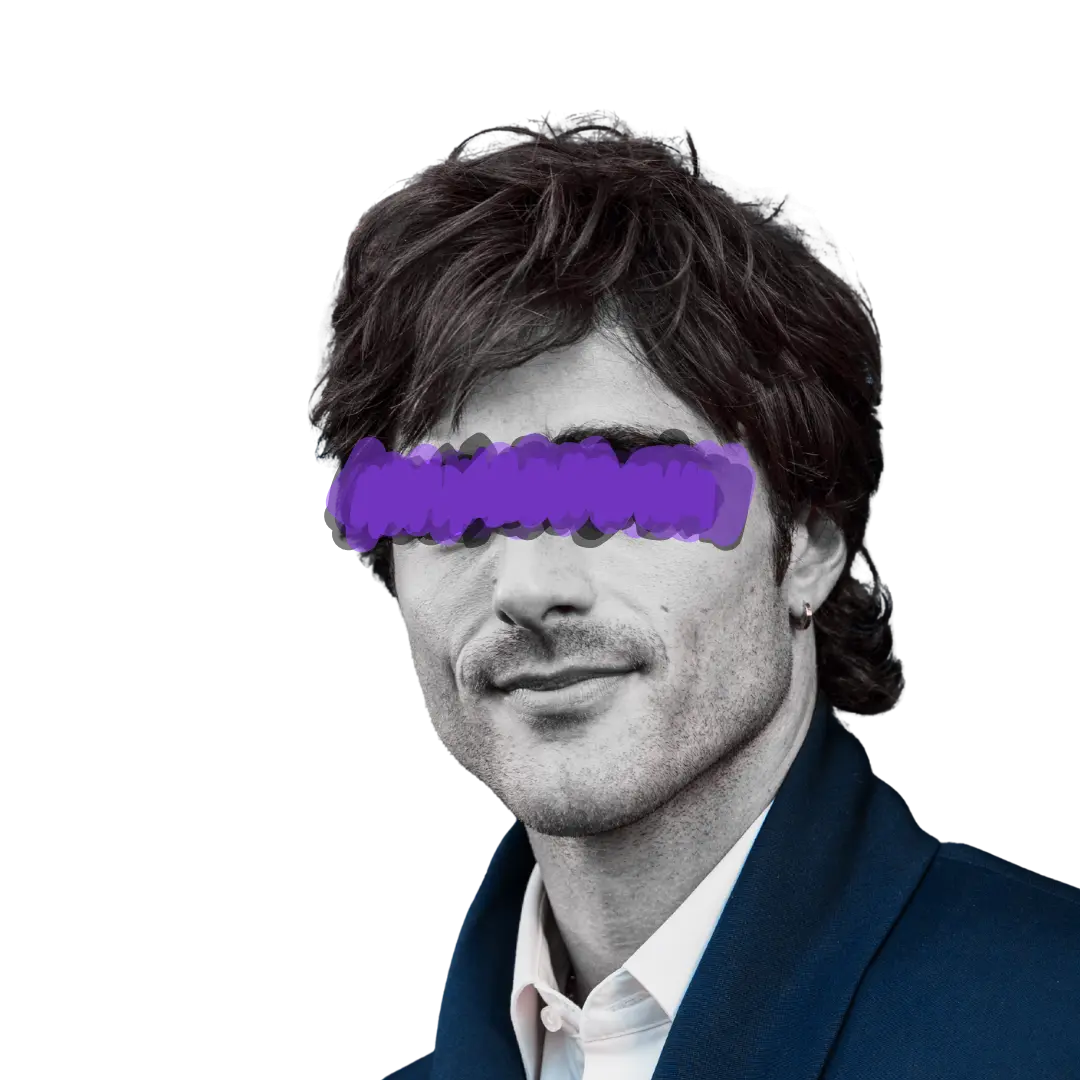
"You feel like an impostor. You're met with this public idea of who you are, and it's never going to reflect who you actually are."
The world decided who Jacob Elordi was before he'd ever said a word. Tall, symmetrical, built like a leading man. The industry looked at him and saw a product. He's spent the last decade trying to burn that image down and start over.
That tension, between the icon the world insists on seeing and the student who just wants to disappear into the work, runs through every career choice, every interview, every role he picks. He played a teen heartthrob and felt dead inside. He was offered Superman and said no. He deactivated his Instagram. Then he sat through ten hours of daily prosthetic makeup to play Frankenstein's creature, a being trapped in a body he didn't choose, desperate to be seen for what's inside.
That's not a random career move. That's a man working something out.
TL;DR: Why Jacob Elordi is an Enneagram Type 4
- The identity crisis is the engine: At 15, a single play changed his entire personality. He's been searching for authentic selfhood ever since.
- He rejects what's handed to him: Commercial success felt like a cage. He walked away from the roles that made him famous, and turned down Superman.
- He gravitates toward misunderstood outcasts: Elvis as a victim of fame. Frankenstein's creature. A haunted POW. Every role mirrors his own tension.
What is Jacob Elordi's personality type?
Jacob Elordi is an Enneagram Type 4
Enneagram Type 4s, often called The Individualists, carry a deep, sometimes painful awareness that they are fundamentally different from other people. Their core fear is having no true identity, no authentic self beneath whatever mask the world asks them to wear. Their core desire is to find that self and express it fully, even when it costs them.
This creates a specific kind of inner life: intense, introspective, and often at war with external expectations. Fours don't just want to succeed. They want the success to mean something. They'd rather fail authentically than win as someone else.
Jacob's 4w5 wing (the intellectual, withdrawn side) shows up not just in the feelings but in how he processes them: through obsessive research, private creative ritual, and a career built around directors who can push him somewhere he wouldn't go alone. The evidence runs through his entire biography.
The Unsettled Boy from Brisbane
Jacob Elordi grew up in Brisbane, Australia, in a working-class household shaped by displacement. His father John emigrated from the Basque Country as a child. Not Spain, the Basque Country, a distinction Jacob has publicly corrected. His grandfather Joaquin fled Franco's dictatorship, worked the sugar cane fields in Australia, and saved enough to bring his mother and eight-year-old son John over. When Jacob's Wikipedia page listed him as "of Spanish descent," he had it changed. He said his grandfather would strangle him if he heard that. That's a family that insists on being identified correctly, on their own terms, not the world's.
His mother Melissa was a stay-at-home parent and school volunteer. He has three older sisters. The family moved to Melbourne when Jacob was 12 so one of his sisters could attend the Australian Ballet School. He lived there for four years, then returned to Brisbane at 16 to finish high school at an all-boys Catholic school. He was athletic, represented Victoria in rugby union and basketball, and was part of a national championship-winning basketball team.
Then he hurt his back playing rugby. And everything changed.
Without sports, Jacob was adrift. He was 15, stuck in a Catholic school system whose rules felt suffocating, and he couldn't articulate why he was so restless. He's described himself as "deeply unsettled" during this period, a kid who sensed that the world as it was being presented to him didn't match what he felt was true.
Australia has a name for what happens to people who stand out: tall poppy syndrome. You can be successful, but you shouldn't be too successful. Go home and your mates will heckle you warmly: "all right, Mr. Hollywood." Jacob has said the instinct helps "check myself to make sure my head is not the size of an air balloon," but also that "sometimes it can be quite crippling, because you don't want to accept any of the praise or good things that come from the work." A 6'5" kid who literally couldn't help but stand out, growing up in a culture that punishes standing out.
That instinct never left. It's the same reflex that made him call The Kissing Booth "ridiculous," deflect every compliment in interviews with a self-deprecating joke, and delete his Instagram without a word. American actors learn to perform gratitude at their own success. Elordi's Australian wiring does the opposite; it makes him flinch. The tension didn't start in Hollywood. It started in Brisbane.
Then his drama class assigned Waiting for Godot.
He didn't understand it. But something cracked open. The absurdity, the emptiness, the strange hope buried inside the futility. It mirrored what he was feeling but couldn't name. "Everything I believed in just went out the window," he later said. "I became an observer. Acting and performance and story became my church."
His personality changed. Not gradually. Overnight. The athlete disappeared. In his place was someone who worked 24 hours a day devouring plays, films, and everything he could find about the craft. A kid who'd been defined by his body suddenly found a world where what mattered was what happened inside.
From His Car to Euphoria
After finishing school, Elordi moved to the United States to pursue acting. The early years were brutal. During one stretch of auditions for what would become Euphoria, he was living out of his car in Los Angeles for about a week or two.
He tells one audition story that reveals everything about how he operates. Asked to perform a scene exactly as written, no improvisation, no interpretation, he felt something shut down. He walked out mid-audition. "I'm not who you're looking for," he told them.
That's not arrogance. That's a person who would rather lose the opportunity than fake their way through it. For a Four, inauthenticity isn't just uncomfortable. It's existentially threatening.
He got Euphoria anyway, starring alongside Zendaya, who would become one of his generation's most recognized faces. And he describes it as a turning point: the first role that demanded everything. "How much can I study? How much can I learn?" he remembers thinking. Playing Nate Jacobs, a violent, manipulative, deeply damaged character, gave him permission to be the actor he'd dreamed of becoming. Not a hero. Not a heartthrob. Something more complicated and more honest.
"You're Dead Inside"
Before Euphoria aired, though, there was The Kissing Booth.
The Netflix teen rom-com made Jacob Elordi a global name overnight. It also made him miserable. He's been unusually blunt about this: "Those movies are ridiculous. They're not universal. They're an escape." When asked about the old Hollywood wisdom of doing commercial work to fund artistic work, he called it "a trap": "You have no original ideas and you're dead inside."
That phrase, "dead inside," is the tell. He wasn't complaining about the hours or the writing. He was describing what it felt like to inhabit a version of himself that wasn't real. The heartthrob image, the shirtless scenes, the teen idol branding. All of it felt like someone else's costume.
"I used to worry a lot about what people thought about me, and about the kind of actor I was because of the movies I'd made," he admitted. "I just felt very corny, and I felt like I had to prove to everyone that I was a serious actor."
This is the Four's central wound: the gap between how the world sees you and who you actually are. For most people, that gap is manageable. For Elordi, it was unbearable.
The Apprentice
What Elordi did next was unusual. Instead of chasing bigger paychecks or franchise roles, he started treating his career like a series of apprenticeships. Each project was chosen not for visibility but for who was directing.
Sofia Coppola for Priscilla. Emerald Fennell for Saltburn. Guillermo del Toro for Frankenstein. Justin Kurzel for The Narrow Road to the Deep North. Emerald Fennell again for Wuthering Heights.
"I'd rather move forward artistically with specificity than mull around and be indirect," he told Esquire.
His descriptions of these directors reveal what he's actually looking for: people who know exactly what they want. About Fennell: "After every take she'll either say 'gorgeous' or 'not.'" About Kurzel: he describes being told "this steak needs to be what breaks you" during a scene, resisting the note, then later admitting the director was right. "There's something amazing that happens when you're wrong," he said.
He even rejected the chance to audition for Superman. "That's too dark for me," he said, meaning not the character's tone, but what it would do to his soul. "I like to make what I would watch, and I get very restless watching those movies."
He was offered the most iconic hero in cinema. He said no because it didn't feel like him.
Playing the Monsters and the Ghosts
Look at the roles Elordi gravitates toward, and a pattern emerges.
Felix in Saltburn: On paper, Felix Catton is everything Elordi was running from: a golden boy, effortlessly beautiful, the person every room orbits around. But Fennell's script did something sharper. Felix is literally consumed by someone's obsession with him; his charisma and beauty become the instruments of his own destruction. Fennell said Elordi "did the most exceptional audition... He really understood that for all of [Felix's] beauty and charisma, he's just sort of a spoiled little boy." Elordi's own read was gentler: "I think he's kind of genuine the whole time, to be honest with you." He played Felix not as an oblivious aristocrat but as someone whose kindness (his instinct to take in strays, to fix people) becomes the thing that kills him. A beautiful person devoured by the image someone else projects onto them. It's the closest any of his roles has come to literalizing his own situation.
Elvis in Priscilla: He didn't play the King the way the world remembers him. He played the man behind the myth: controlling, fragile, suffocating under the weight of his own image. "I didn't want to do him the disservice of playing 'The King' that the world had made," Elordi said, "because that's what hurt him so much. It was my job to not play into his fame but play him as a man who was suffering."
Frankenstein's creature: A being stitched together from dead parts, electrocuted into a life he didn't ask for, rejected by his creator, desperate to be understood. Under ten hours of prosthetics, Elordi delivered what del Toro called "a really naked performance, emotionally so close to innocence that it breaks your heart." He earned his first Golden Globe nomination for it.
Dorrigo Evans in The Narrow Road to the Deep North: A celebrated war hero haunted by memories he can't speak about. Elordi connected the role to his own family: "So much of the work has to happen just in silence, which we're familiar with because of our fathers and grandfathers." His own grandfather carried a dictatorship across an ocean and never made it a story. His father built a quiet life in a new country. Dorrigo's silence isn't abstract for Jacob. It's the language his family speaks. He called the series "probably the thing that I'm most proud of."
And then there's Heathcliff in Wuthering Heights, the role he said scared him most and the film he called his favorite he's ever been in.
The thread connecting these characters isn't just darkness or complexity. Each one is living inside a gap between what the world sees and what's actually there. Elordi keeps finding new ways to inhabit that gap, and each time, the tools get sharper.
When Art Gets Memed
Then there's the question of what happens when the work is taken seriously, but the public response is still about your body.
Saltburn was artistically credible in ways The Kissing Booth never was. Emerald Fennell's film was a genuine provocation, dark, stylish, designed to unsettle. But when it hit streaming, the conversation collapsed into the bathtub scene and the grave scene. GIFs. Memes. Thirst posts. The work became wallpaper for a different kind of consumption.
Elordi's response was revealing. He called the public reaction "slightly prudish" and noted that the film "lived two different lives": one in theaters as a cinematic experience, another on streaming where "it gets looked at through more of a social lens." He watched the film he'd made get disassembled into content, and his take wasn't outrage. It was something closer to philosophical resignation: "When you do serve a film up to the world it does become the world's. Even if your point is lost, maybe it's a nice lesson in letting your point go."
That's maturity. But it's also the Four learning, again, that the world will project whatever it wants onto you, and the only thing you can protect is the private experience of making it. His actual memory of Saltburn? "It felt like our last special summer as a family. The sun was out every day."
How He Builds a Character
Most actors describe their process in vague emotional terms. Elordi describes his like engineering.
His sister danced ballet from age two to twenty-six, performing professionally in Germany. "I've grown up around that kind of movement," he told Gwyneth Paltrow. "It definitely was a reference point for how to use your body." For Frankenstein, that ballet vocabulary became the creature's physical language, the ungainly grace of a body learning itself for the first time.
The voice was assembled from parts, the way the creature was. David Bradley, who plays the creature's teacher, speaks with a Yorkshire accent. Oscar Isaac used a heightened Received Pronunciation. Elordi built the creature's speech somewhere in between, plus "whatever memory he has from a different body part, maybe the way that person sounds." It's a technical choice that doubles as metaphor.
For six months of shooting in Toronto, he isolated himself. Mirrors everywhere in the house. Walking around, muttering, trying movements, calling his sister to ask "do you like this or do you like this?" He cut out personal habits: foods he liked, the way he normally spoke, small comforts that belonged to Jacob rather than the creature. The goal was to feel "foreign in my own environment."
When he first received the Frankenstein script, he was in a creative dead zone, reading screenplays mechanically, nothing sparking. So he turned off every light in his house, lit candles, and read it in the dark. "I had a feeling that I needed to do something to get a spark back," he said. "So I'm not just reading screenplays on my laptop." He knew how he wanted to say the creature's lines before he'd finished the script.
The physical dimension matters too. For a man whose central conflict is being reduced to his body, he keeps radically transforming it. Different physicality for Elvis. Months of deprivation-level conditions for The Narrow Road to the Deep North. And he's explicit about using physical extremes as an acting tool: "Get your body to the extreme point physically, and then he'll say action. And something happens."
His process isn't "be intense." It's: build a world model, strip away everything that belongs to you, then live inside what's left.
The Man Behind the Image
The private Jacob Elordi is almost aggressively unglamorous. And that privacy extends to everything, not just his work, but his relationships.
He dated Zendaya during Euphoria but publicly called her "like my sister." Not silence, but active denial. That's a specific kind of privacy-guarding. Silence leaves room for interpretation. Denial tries to kill the narrative entirely. For a Four, the logic makes sense: if the public gets to name and define the relationship, it stops being yours. The denial isn't dishonesty so much as a refusal to let the most intimate part of your inner life become content. He dated model Kaia Gerber for about a year; they dressed as Elvis and Priscilla for Halloween, a detail that feels almost too on-the-nose for a man who would later play Elvis. In every case, he says almost nothing. The relationships exist in public only through paparazzi photos and unnamed sources.
He paints, but won't discuss what he paints, because he worries that talking about it would "jeopardize what he gets out of it." He photographs everything on set, a habit that started after watching a documentary about Heath Ledger told entirely through Ledger's own photos and Super 8 footage. He reads voraciously: Sartre, Beckett, Joan Didion. He writes in Moleskine journals. He once co-wrote a one-act play. This is the 4w5 wing in daily operation: the emotional intensity turned inward, channeled through intellectual accumulation and private creative ritual. He doesn't just feel things. He builds private systems for processing what he feels.
He calls his favorite part of any job the private research phase ("You're like the detective with the red string") where references multiply until everyday life starts echoing the character. Then you show up to set and fear it was all coincidence. "Why did I study how a cheetah walks?" he joked.
When asked if he collects anything, he said: "Curiosities, the little tickets and weighted things. Little bags of treasure." Small, tactile objects that carry personal meaning, the kinds of things that anchor you to specific moments in time. It's a collector's instinct that isn't about value. It's about memory.
In October 2024, he deactivated his Instagram entirely. No announcement, no explanation. Just gone.
He's spoken about fame in terms that sound less like frustration and more like philosophical opposition: "You feel like an impostor. You're met with this public idea of who you are, and it's never going to reflect who you actually are."
He doesn't want to be seen. He wants to see.
The Flash Points
Elordi's discomfort with the public dimension of fame has occasionally boiled over.
At the Venice Film Festival premiere of Frankenstein, he was caught on camera snapping at a festival handler who was directing him where to stand and pose: "Don't ever tell me what to do." A small moment, the kind most actors would mask with a PR smile.
When paparazzi cornered him in Paris, his response was quiet and direct: "You make it really hard for me to live when you do this."
These aren't the eruptions of a diva. They're the pressure releases of someone who experiences the invasion of his private self as something close to an assault. A radio stunt gone wrong outside his Sydney hotel led to a brief police investigation (no charges filed). Many Type 4s build elaborate internal worlds and guard them fiercely. When that boundary is crossed, the response can be disproportionate, not because they're angry, but because what was violated felt sacred.
How Jacob Elordi Operates Today
In his most recent interviews, Elordi sounds like someone who's made peace with the tension without resolving it.
He's rejected the industry myth that constant output equals commitment. "The worst day on a movie set is still better than the best day in the real world," he said in a 2025 Actors on Actors conversation. Then he paused. "And that's bullshit." He now advocates for breaks, for choosing fewer projects with more care. "There's no rule book that says you need to make three movies every year."
He grounds himself through small, ordinary things: his dogs, his collections of small curiosities, reading plays as a daily practice, making eye contact with strangers and actually listening.
"Talk to someone, look them in the eye and listen," he once said. "Really listen." For a man who fears becoming an island, who knows that isolation is the occupational hazard of his specific kind of fame, that's not advice. It's a survival strategy.
His dual Golden Globe nominations in 2025, for Frankenstein and The Narrow Road to the Deep North, marked a turning point. Peers like Timothée Chalamet had already navigated a similar path from youthful fame to serious recognition, but Elordi's route was more combative, more burned-bridge. The kid who felt "corny" about his early work had been recognized for the kind of acting he'd always dreamed of doing.
But if you expected triumph, you'd be wrong. About the recognition, he said: "There will probably always be an impostor element to acting for me."
Some feelings don't resolve. They just become fuel.
The Creature's Question
Here's what makes Jacob Elordi more interesting than the standard "pretty boy turns serious actor" narrative.
He's not just choosing difficult roles. He's choosing the same role, told through different bodies and different centuries. Felix consumed by a projection. Elvis crushed by a myth. A creature assembled from dead parts and asked to be human. A war hero who can't speak about what haunts him. Each character is a different answer to a question his family has been living for three generations.
His grandfather answered it by leaving the Basque Country. His father answered it by building a quiet life in Brisbane. And Jacob has been answering it since he was 15, unsettled in a Catholic school, reading a play about two men waiting for something that never comes — and feeling, for the first time, that someone had described exactly what it was like to be him.
He's still waiting. He's still working. And maybe the most honest thing about Jacob Elordi is that he's stopped pretending he'll ever arrive.
What would you add?