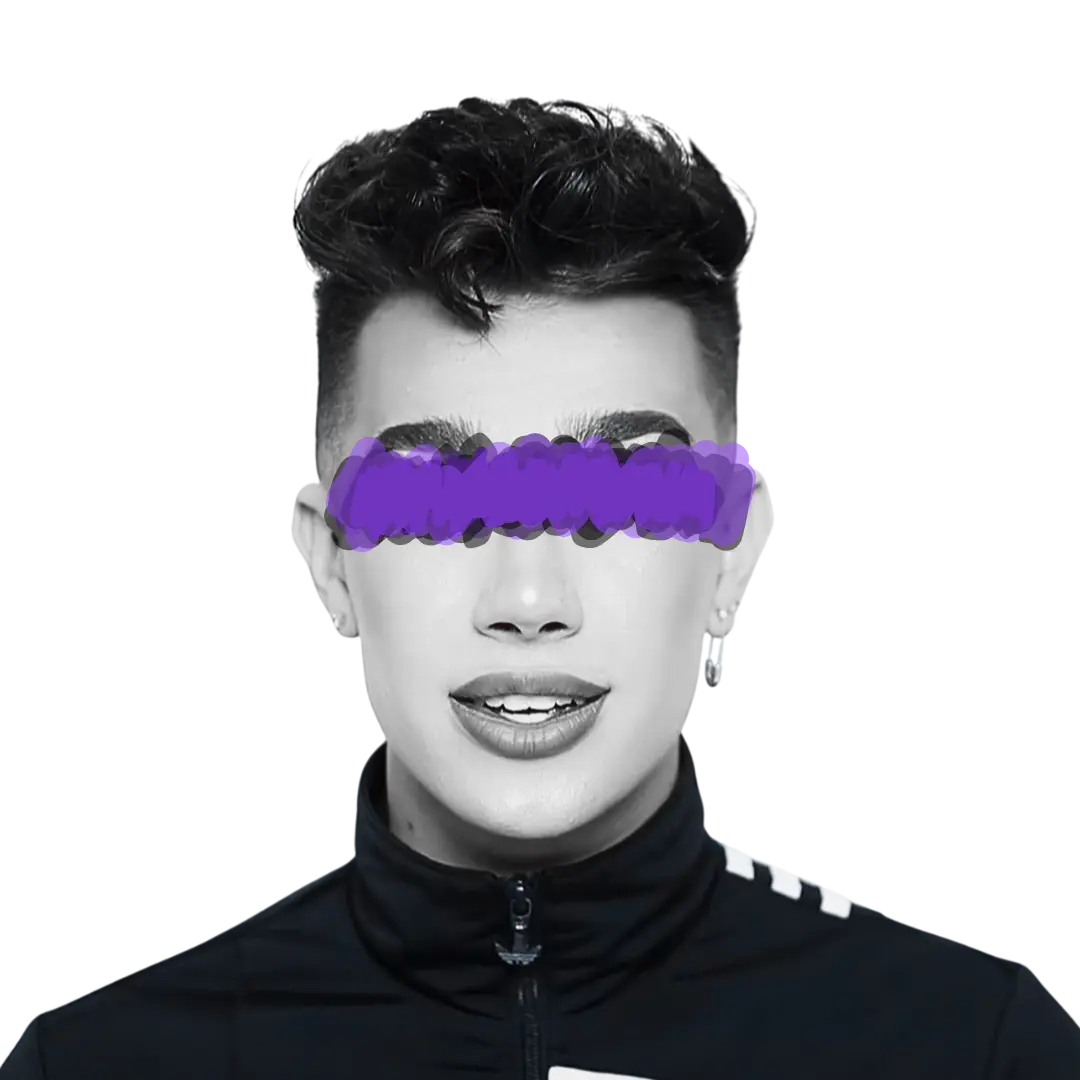
"I allowed myself to be a science experiment for men that were never going to love me back."
In September 2016, a tweet went viral. A 17-year-old boy from Bethlehem, New York had retaken his senior yearbook photo with a ring light and full glam makeup, and the before-and-after images were everywhere. Zendaya approved. CoverGirl came calling. Within months, James Charles Dickinson was a millionaire.
The story became legend: the kid who brought his own ring light to picture day because he wanted his highlights to pop.
There was just one problem. A former friend later revealed that James had edited the photos afterward to make the makeup look more extreme than it actually was. The viral moment that launched a $22 million empire was itself a fabrication — an image of an image.
And that's the most important thing to understand about James Charles. He has been constructing versions of himself since before anyone was watching. He got so good at it that even he may not know where the construction ends.
His friends see it too. They told him, according to a PAPER Magazine interview, that "when you truly figure out how to be yourself, that's when you'll be unstoppable." He's 26. He's been performing since he was 11. The question isn't whether the performance is impressive. It is. The question is whether there's someone underneath it.
TL;DR: Why James Charles is an Enneagram Type 3
- Performance before personhood: Started building an audience at 11, came out at 12, became a millionaire at 17 — the brand outpaced the self.
- Origin myth as construction: Even the viral yearbook photo that launched his career was edited afterward — image-making all the way down.
- The void beneath the image: When allegations cracked his public persona in 2021, his coping mechanisms failed for the first time. "I wanted to kill myself."
- Perpetual reinvention: Beauty guru → competition host → brand CEO → pop singer. Each new version builds on the wreckage of the last.
JaysCoding and the Boy From Bethlehem
Before there was James Charles the beauty mogul, there was an 11-year-old kid in Albany County making YouTube videos about competitive Mario Kart Wii modding.
The channel was called JaysCoding. He posted song covers, graphics tutorials, and videos about the Mario Kart modding community. The content itself doesn't matter. What matters is that an 11-year-old was already seeking an audience — already performing for a camera — before he knew what the performance would eventually be about.
James Charles Dickinson grew up in Bethlehem, New York, population 35,000. His father Skip was a contractor. His mother Christine supported his unconventional interests from the start. When he came out as gay at 12, his parents accepted him completely.
But acceptance at home didn't mean acceptance everywhere. He was one of two openly queer kids in his entire school.
"I did get bullied a lot in high school," he told ABC News. "And personally, I just ignored it... sometimes it is important to stand up for yourself. Sometimes I would clap back and they weren't expecting that."
He never dated anyone in high school. Years later, in a PAPER Magazine interview, he admitted that being out so young in a heteronormative world had left him "underdeveloped as a person." While his straight friends were learning how relationships work, he was learning how to build an audience instead.
There's a detail about the family home that says more than any career milestone. When James's YouTube channel started gaining traction, his father — who had dreamed his son would become an architect or an interior designer — gave up his own basement office so James could convert it into a professional glam room with studio lighting and camera equipment.
Years later, James returned to that house and walked into the basement his father had built for him. "I really didn't think that I'd get emotional today," he said, "but as soon as I walked in and turned the lights on I immediately lost it and started crying."
It was one of the only moments in James Charles's public life where the performance visibly stopped.
How a Friend's Prom Launched a Career
The makeup story has an origin too, and it's less strategic than people assume.
A friend named Callie Noonan was running late for a MAC appointment before prom and asked James — who had never done anyone's makeup — to help. He'd been watching YouTube tutorials from Michelle Phan, Nikkie Tutorials, and Jaclyn Hill obsessively, but he'd never actually applied makeup on someone else.
His condition: "If it looks awful, do not tag me in that Instagram picture."
The result was good enough that word spread. Soon girls at school were asking him to do their makeup for prom, events, dances. He started posting his work on Instagram at 16. The yearbook photo came a year later.
What most people don't know: James Charles is legally blind. He does full-glam makeup looks while barely able to see without corrective lenses. "It really doesn't affect the process that much," he told Seventeen, with the kind of casual deflection that suggests it absolutely does.
A legally blind kid doing professional-quality makeup from YouTube tutorials in a basement studio his contractor father built — that's not the story of a vain influencer. That's the story of someone who would do anything to construct something the world would notice.
The CoverGirl and the Speed of Fame
The edited yearbook photo hit Twitter. Eighty-six thousand likes. Thirty-three thousand shares. Zendaya's seal of approval. Then the email came.
"I was shook," James told ABC News. "I had just started working with a manager at the time, and she was like, 'Hey, we got an email from CoverGirl.'" He paused. "When everyone started congratulating me, I realized, 'Oh, this is... a little bit of a bigger deal than we would've anticipated.'"
At 17, James Charles became the first male ambassador in CoverGirl's history. He shot campaigns alongside Katy Perry. He appeared on Ellen. He was a millionaire before he had a high school diploma.
Before James, men in makeup existed largely in drag or theatrical contexts. He normalized a teenage boy simply enjoying cosmetics as self-expression, and The Guardian's Amelia Tait called his platform "arguably revolutionary."
But the speed was disorienting. By 18, he'd moved to Los Angeles. By 19, he had 15 million followers on two platforms. He was building a media empire while most people his age were figuring out how to do laundry.
He admitted to PAPER that he'd been focused on being "brand and family friendly to make the most amount of AD revenue" rather than being himself. Like Paris Hilton — another Type 3 who built a character so effective it swallowed the person underneath — the brand had eaten the person.
What is James Charles' Personality Type?
James Charles is an Enneagram Type 3
Most people see James Charles as a vain beauty influencer addicted to fame. But vanity and fame-seeking are symptoms, not the engine.
The engine is this: James learned, very early, that being himself wasn't enough. He came out at 12 in a small town where he was one of two openly queer kids. He got bullied. He never dated. The world didn't reward him for being James Charles Dickinson from Bethlehem. It rewarded him for being James Charles the brand — the record-breaking, barrier-smashing, always-camera-ready performance.
Enneagram Threes internalize a devastating lesson in childhood: love is conditional on achievement. You are not loved for who you are. You are loved for what you do, what you accomplish, what image you project. The response is to become the most impressive version of yourself — to construct an identity so polished that no one can see the person underneath.
The evidence isn't in the headlines. It's in the tiny details.
An 11-year-old starting a YouTube channel before he has anything to say. A 17-year-old editing his yearbook photos to make the makeup look better than it was — not because the original wasn't good, but because good wasn't good enough. A teenager whose father literally rearranged the architecture of their home to support the brand. A young man who, when asked about his personality, defaulted to talking about his AD revenue strategy.
The Three's trap is that the construction works. James Charles didn't fail upward. He is genuinely talented — a legally blind, self-taught makeup artist who produced work good enough to land a CoverGirl contract at 17. The talent is real. But when talent and construction fuse this early, the person underneath never gets a chance to develop independently.
Under stress, Threes disintegrate toward Type Nine — they disconnect, withdraw, and go numb. When the 2021 allegations hit, James didn't rage or fight. He sat in his bed, stared at his phone, and felt nothing work. "My coping mechanisms weren't coping," he said. The image-making machine, for the first time in his life, couldn't manufacture a way out.
In growth, Threes integrate toward Type Six — they become loyal, committed to something beyond their own image, willing to be vulnerable rather than impressive. The moments where James Charles is most compelling are the moments where the construction drops: crying in his father's basement studio, admitting he was "underdeveloped as a person," writing a song about being used by men who were never going to love him back.
His wing leans toward Four — the Individualist. You can see it in the a cappella group he joined (Flashback), in his singing ambitions despite widespread ridicule of his voice, in the creative obsessiveness that made him develop Painted for four years before showing anyone. That's a Three with a Four wing — achievement-driven but with an undercurrent of needing to be seen as genuinely creative, not just successful.
A Science Experiment for Men
When James moved to Los Angeles at 18, he was a millionaire with millions of followers and zero experience being loved. LA promised something different. It delivered something worse.
He was excited about exploring romance — about finally having access to a queer community that didn't exist in Bethlehem. But those early experiences "would end in blocks, friend zones, or threats of violence." The men who approached him weren't interested in James. They were interested in what proximity to James could get them.
He spent several years as what he called an experiment — letting men who were never going to love him use his youth and his fame. "Whether it's queer people, trans people, plus-sized people, even people of color, there are so many people that are fetishized or used as an experiment in the bedroom," he told PAPER. He avoided talking about his love life online for years. He doesn't use dating apps — he finds people through Instagram and TikTok, which means every potential relationship is already mediated through the platform that made him famous.
The fame that made him powerful in every other arena made him powerless in the one that mattered most. He couldn't tell who wanted him and who wanted his follower count.
The Week the Performance Broke
In May 2019, his former mentor Tati Westbrook uploaded a 43-minute video titled "BYE SISTER." The immediate trigger was business — James had promoted SugarBearHair, a competitor to Tati's vitamin brand, in exchange for Coachella passes. But the video went further, alleging predatory behavior and manipulation.
James lost three million subscribers in four days. He fought back. His 41-minute response video, "No More Lies," refuted many claims with screenshots and evidence. Subscribers returned. Tati herself later apologized, claiming she'd been manipulated by Shane Dawson and Jeffree Star.
The image held. A dangerous lesson was reinforced: you can construct your way out of anything.
Then came February 2021.
A 16-year-old named Isaiyah posted a TikTok alleging that James had groomed him. More accusers emerged. At least 15 individuals eventually made claims, though the severity and credibility varied enormously. One early accuser later admitted in a TikTok that his screenshots were faked. Another privately apologized to James, telling Cosmopolitan he had lied about his age.
None of that mattered in real time. Morphe cut ties. YouTube demonetized his channel. He was removed as host of Instant Influencer's second season. The empire was crumbling.
But the real damage wasn't professional. It was personal.
"I can't even begin to explain to you how bad that week of my life was," James told Cosmopolitan in 2023. "I was crying myself to sleep every single night. I was sitting there in bed staring at my phone. I wanted to kill myself. I wasn't talking to anybody."
He described reaching for his usual defenses and finding nothing there: "I've always been someone who can cope with heavy stuff and is able to turn his phone off, go see his family and invite his friends over when it all gets too much. With this situation, it was really scary because my coping mechanisms weren't coping. It was the first time where I was like, Oh, fuck. I actually don't know what to do here."
His brother Ian — who had been one of his closest relationships, who had appeared in dozens of videos, who had launched his own modeling career partly through James's platform — stopped speaking to him. For two years, nothing. Complete silence from the person who knew him before the brand existed.
His wider circle tells a similar story. James's known friendships — Emma Chamberlain, Charli D'Amelio, Larray — are almost entirely professional, forged through collaborations and content rather than the kind of slow intimacy most people build in their twenties. He once defended Charli publicly during a backlash; Larray and he trade barbs on Twitter. But when the 2021 crisis hit, "I wasn't talking to anybody." The network built on content couldn't hold the weight of a person in freefall.
In the wreckage, James did something unusual for someone who had spent his entire life constructing images. He sat with the destruction.
"I had to do a lot of thinking," he told Cosmopolitan. "Like, okay, babe, this is your fault. No, you're not a pedophile. No, you're not a fucking groomer. No, you're not a predator. But you made a big mistake."
"I've never been more disgusted in my life than when I found out that that kid was 16 years old," he said. "I was mortified, absolutely mortified."
Painted From the Wreckage
Most people, after a public destruction that severe, disappear. James built.
Development on Painted started around 2019 — meaning he began building the brand during the first controversy, not after it. For four years, while the internet debated whether he deserved to exist, he was formulating products, switching manufacturers when the first one couldn't hit his price point, and refusing to cut corners. "If it wasn't right, I am not putting it out," he told Cosmetics Business.
The structural difference from Morphe matters. That deal was a licensing arrangement — James contributed creative input but didn't own the intellectual property. With Painted, he fully owns the brand. Self-funded, direct-to-consumer, no retail partners. Every dollar of profit is his. Morphe, incidentally, still owes him $2.2 million from their bankruptcy.
He launched Painted in August 2023. The hero product — Create Paints — came in paint tubes designed to look like actual art supplies, $15 each. Brushes made with art brush fibers for detail work, $8 apiece. A full ten-piece Artist's Set for $135. The positioning was deliberate: artists, not consumers. "I got into makeup because I loved art," he told PAPER. "Painting, drawing, being creative. Makeup was how I made myself look cool. It was never just about being pretty."
Then something happened that no amount of image construction could have engineered: a professional makeup artist used Painted's black shade "Ink" on Beyoncé during the Renaissance World Tour. Unpaid. Unsolicited. The product spoke without James's name attached to it — which may be the first time anything in his career has done that.
He told the Saving Grace podcast that he was glad he hadn't launched a brand in 2017, at the peak of his fame. He wanted complete creative control, and the younger version of himself wouldn't have known what to do with it.
The Songs That Dropped the Construction
Then came the music, and with it the most unperformed thing James Charles has ever released.
"Call Me Back," his debut single, dropped in February 2024 — a piano ballad about being ghosted. The lyrics are startlingly direct for someone who has spent fifteen years constructing images:
"We got so close / There was a version of me that would never let go / I hold onto your ghost"
"They always say that boys don't cry"
That last line lands differently coming from someone who built his career breaking gender norms in beauty but still internalized the emotional suppression norms underneath. The chorus pleads for honesty over silence — "If my heart's getting broken, instead of just ghosting, then man up and say what you mean." For a Type 3 who has built every relationship through a screen, the line "What the fuck's wrong with me?" is the inner voice that the performance was designed to drown out.
"Can We Just Be Friends" followed at Coachella in April 2024 — though James told PAPER it was actually the first song he ever wrote. He'd been sitting on the more vulnerable material longer. The lyrics trace the arc of his LA years:
"You said I was beautiful, but your emotions were available"
"You said you'd never done this before, same breath saying you want this for sure. So I said 'can we go to bed?' You said, 'Can we just be friends?'"
The most devastating line: "You promised that I wasn't an experiment." Coming from someone whose entire public life has been a kind of experiment in constructed identity, the word cuts both ways.
He cited Troye Sivan as a major inspiration — another influencer-turned-artist who writes about queer loneliness. Seeing Sivan discuss these experiences publicly was "relieving," James said, because he had "avoided talking about his love life and relationships online" for years. He'd taken vocal lessons from celebrity coach Cheryl Porter, training seriously despite years of internet mockery of his singing. Porter's assessment: "He don't care who says he can't sing. He's going to sing anyway."
The Performance
23 million subscribers. $22 million net worth. CoverGirl. Morphe. Painted. Singles at Coachella. $100,000 single videos. Fifteen years of constructing an image the world would notice.
The Person
In April 2024, James played "Can We Just Be Friends" for his brother Ian on camera. First time together publicly since the two-year silence. Ian commented on the video: "love you endlessly." Three words. No ring light. James, who once told an interviewer he "would like people to like him as a person," cried in a basement his father built and wrote songs about men who ghosted him.
In February 2026, a billboard appeared on a busy Los Angeles street. Ethan Klein — the H3H3 podcast host who'd been feuding with James since accusing him of plagiarizing his wife Hila's Teddy Fresh hoodie designs in 2020 — paid $10,000 to put it up. The text read: "SAY, JAMES, I HEAR YOU TEXT EM YOUNG" alongside a BBC headline about the grooming allegations. Klein had run a design competition among his audience; 523 fans submitted entries. He framed it as accountability: "I'm looking at James Charles rebuild his career, collaborate with mainstream people, and it's all happening again."
The billboard was vandalized within days, covered with a black sheet. Klein had it restored. James said nothing publicly.
That silence matters. This is someone who once recorded a 41-minute response video with timestamped screenshots to refute Tati Westbrook. Someone whose default mode — the Three's default mode — is to construct the counter-narrative, to outperform the accusation. Choosing silence is a break from pattern. Whether it represents growth or exhaustion, it's new.
His social media following remains massive: 23 million on YouTube, 21 million on Instagram, 38 million on TikTok. His net worth has climbed to $22 million. He has survived what would have ended most careers.
But the interesting question isn't whether he survived. It's whether the surviving version is closer to a person or another performance.
The early evidence is mixed. The Painted era shows someone who spent four years building something real — who chose ownership over speed, who wanted to make art rather than just monetize a name. The music shows someone willing to sit in vulnerability, to write "What the fuck's wrong with me?" and release it to the same internet that tried to destroy him. The Ian reconciliation shows someone capable of reconnecting without a camera angle.
His friends told him the truth. When he figures out how to be himself, he'll be unstoppable. He's been performing for fifteen years. The boy from Bethlehem started building faces before he'd built a self. But a brand built on paint tubes instead of ring lights, songs about being ghosted instead of brand deals, and a brother's three-word comment instead of a 41-minute rebuttal — that might be the beginning of something underneath the construction. Or it might be the most sophisticated construction yet. The difference matters, and only James knows which one it is.
Disclaimer: This analysis of James Charles's Enneagram type is speculative, based on publicly available information, and may not reflect his actual personality type.
What would you add?