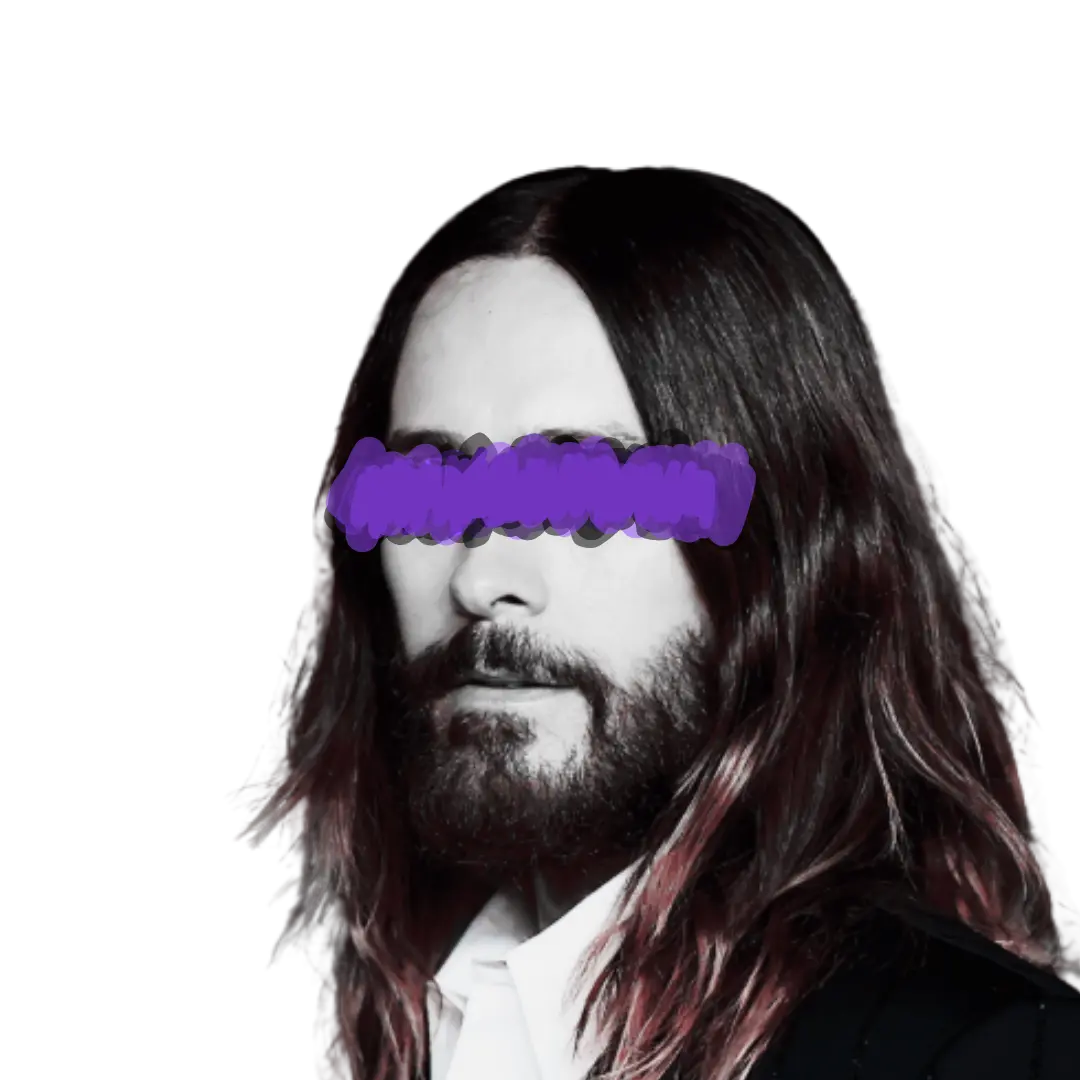
"For me, they're like living, breathing people. I know they're not, of course, but I get attached. It's a shame to never do it again."
Halfway through filming Dallas Buyers Club, Jared Leto was washing off Rayon's makeup in his trailer when something went wrong.
"Man, they did a great job," he thought, studying the gaunt face in the mirror. "I'm looking real sick." He pressed a hot towel to his face, scrubbed again, and looked up. The sickness was still there. He scrubbed harder. Same face. Then he realized: it wasn't the makeup anymore. It was just his face. He had lost so much weight — nearly 40 pounds, down to 114 — that the character's dying body had become his own.
"That was a bit of a surprise," he told Terry Gross on NPR's Fresh Air in October 2013. The understatement is telling. Most actors would call it alarming. Leto called it a surprise, the way someone might note an unexpected color in a sunset. Because for him, the boundary between self and character had never been particularly solid to begin with.
This is the fundamental question of Jared Leto: why does a man with an Oscar, platinum records, and a tech investment portfolio keep disappearing into other people?
The popular answer is "method acting." The real answer is older than that. It starts with an eight-year-old boy in Louisiana whose father died by suicide, whose mother raised him on food stamps and hippie communes, and who learned before he could articulate it that the self you're born with isn't safe — so you'd better learn to become someone else.
TL;DR: Why Jared Leto is an Enneagram Type 4
- The boy who lost his father at 8 and spent a lifetime filling that void through transformation — method acting, rock stardom, tech investing, climbing the Empire State Building with bloody hands.
- The man who can become anyone but struggles to be himself — admits he's "more myself" on stage than anywhere else.
- The artist who fought a $30 million lawsuit rather than let a record label control his authentic expression — then directed a documentary about it under a Dr. Seuss pseudonym about a boy who can't stop producing new hats.
- The outsider who embraces it — told Refinery29, minutes after winning a Golden Globe: "I have always been a bit of an outsider, and I don't think that changes after today."
"A Place That You Escape"
In 1971, in Bossier City, Louisiana, a teenage girl was pregnant with her second child. She was a high school dropout and a single mom. She relied on food stamps and the help of her parents to feed her two boys.
That girl was Constance Metrejon. Her younger son would describe her decades later, clutching an Oscar, as someone who "somehow managed to make a better life for herself and her children. She encouraged her kids to be creative, to work hard and to do something special."
The father was Anthony Bryant. He left the family when Jared was small. Then, when Jared was eight, Bryant died by suicide. At a Cannes press conference in 2014, Leto offered the only public remark approximating his father's departure: "I'll see you kid, just going to the store to get a carton of milk." He said it while flicking a cigarette — performing nonchalance about a wound he was too young to even fully form a memory around.
Enneagram Type 4s often describe a "fundamental wound" — the sense that something essential was taken or was never there. For most, this is metaphorical. For Leto, it was literal. A father who walked out and then died, leaving behind a boy who would spend the next four decades trying on other identities as if searching the racks for one that fit.
Constance responded with remarkable creativity. She joined the hippie movement. She moved the boys to a commune in Colorado for three years. She had been, at one point, an acrobat and trapeze artist in a circus. When Jared was 12, she took them to Haiti, where she ran two medical clinics. They had no television and no money. What they had was art.
"I grew up in an environment of actors, musicians, photographers, artists and different theatrical persons," Leto told Kerrang! magazine. "Through this atmosphere there were not any clear boundaries and straight lines. We were proclaiming a freedom of creation and self-expression."
Haiti left its mark. "It was horrible to see people living in the street, in shacks, and bathing in sewer water," Leto later recalled. "It was unforgettable." But also: "It was a magical time. Could you imagine being a kid in such an exotic place?"
In 1979, Constance married Carl Leto, an ophthalmologist who adopted both boys and gave them his surname. Carl bought Jared his first guitar. But the foundational identity was already locked in: the outsider, the wanderer, the boy without a father who learned that you survive by becoming.
"Louisiana is a place that you escape, not a place that you leave," Leto told James Franco in Interview Magazine in December 2013. He wasn't talking about geography.
What is Jared Leto's Personality Type?
Jared Leto is an Enneagram Type 4 (The Individualist)
Enneagram Type 4s are defined by a core belief that something essential is missing from the self. Other types fear failure, danger, or loss of control. Fours fear something more existential: that they are fundamentally deficient, that everyone else received some instruction manual for being a complete person and they were left out. This drives an obsessive search for identity — through art, emotional intensity, transformation, and the conviction that authenticity matters more than comfort.
The Personality Database shows consensus on Type 4 with a Three wing (4w3). The Three wing adds ambition, polish, and a need for the world to witness the transformation — not just experience it privately.
The typing explains something non-obvious: why Leto's approach to transformation differs from, say, Christian Bale's. Bale's weight loss for The Machinist and weight gain for Vice are acts of discipline in service of craft. The performance is the point. When Bale finishes a role, he goes home.
Leto doesn't go home. He told Collider in October 2013: "A better actor might have been able to let go of the voice, dialect, behavior, movement, and emotional condition and recall them at a moment's notice, but I had to stay as close as possible just so I could do a good job." Read that again. He's not staying in character because he's disciplined. He's staying in character because he can't find his way back.
After winning the Golden Globe in January 2014, a reporter asked how the recognition felt. His answer, to Refinery29: "I have always been a bit of an outsider, and I don't think that changes after today. I don't think that's necessarily a bad thing, either."
An hour after winning the highest recognition in his industry, the man's first instinct was to reassert his distance from belonging. That is a Four.
The Face Under the Makeup
For Dallas Buyers Club, Leto didn't eat. "I stopped eating," he told TheWrap in September 2013. He dropped to 114 pounds to play Rayon, a transgender woman dying of AIDS. He waxed his eyebrows. He never broke character during filming. "Everything had its purpose," he told Collider. "From waxing my eyebrows to losing 30-40 pounds. It all played a part."
What made it different from a stunt was what it cost. His stomach shrank until he could only eat a few tablespoons of food. The weight loss changed "the way you walk, the way you sit, the way you think." And when it was over, letting go was harder than the transformation itself. "It's kind of hard to stop," he admitted. "It takes a little while sometimes."
For Chapter 27, the pattern reversed. He gained 67 pounds to play Mark David Chapman, the man who murdered John Lennon. His method: microwaved pints of ice cream mixed with soy sauce and olive oil, every night. He developed gout, elevated cholesterol, and an irregular heartbeat. By the end of filming, he needed a wheelchair to get around the set. "It took about a year to get back to a place that felt semi-normal." He later tried to talk a friend out of gaining weight for a role, warning: "Just because you can lose the weight doesn't mean the impact it had on you isn't there anymore."
For the Joker in Suicide Squad, the immersion went social. He sent a dead pig to the cast table. Viola Davis recalled the scene: "The henchman came in with a dead pig and plopped it on the table and then he walked out. And that was our introduction to Jared Leto." He later walked some of the more extreme stories back, telling Entertainment Weekly in 2021 that they were "in jest."
Leto doesn't even call it method acting. "I appreciate the term," he told Variety in 2020, "but it's a little cloudy, the definition. And it could also be really pretentious." He prefers "immersive work." The distinction matters. Method acting is a technique you deploy. Immersive work is a way of being. It's the difference between putting on a costume and putting on a skin.
At the 2024 Golden Globes, he parodied himself: "I have been in presenter mode for weeks now. I've been doing research developing my character, incessantly reminding everyone around me to please call me by my character name, dammit." The audience laughed. The joke only works because the real thing is true.
The War for Authentic Expression
In 2008, 30 Seconds to Mars was $1.4 million in debt to their record label despite selling two million albums. They had never received a royalty check.
When the band tried to leave their contract by invoking California's seven-year rule — they'd been signed for nine — EMI sued them for $30 million.
Leto called the number "ridiculously overblown" on MTV. He published an open letter: "Under California law, where we live and signed our deal, one cannot be bound to a contract for more than seven years." His tone was defiant, almost eager. "If you think the fact that we have sold in excess of 2 million records and have never been paid a penny is pretty unbelievable, well, so do we."
The case settled in April 2009. The band signed a new deal with EMI and released This Is War that December. Then Leto did something revealing.
He directed a documentary about the entire ordeal — Artifact, which premiered at the 2012 Toronto International Film Festival, won the People's Choice Award for Best Documentary, and received a standing ovation. But he didn't put his name on it. He credited the direction to "Bartholomew Cubbins."
The name is from a Dr. Seuss story: The 500 Hats of Bartholomew Cubbins. It's about a boy who removes his hat for the king, only for another hat to appear. He removes that one. Another appears. No matter how many hats he takes off, there's always another one underneath.
A man who can't stop producing new identities chose, as his pseudonym, the fictional character who can't stop producing new hats. Sometimes people tell you exactly who they are.
"It gave us the album of a lifetime, the tour of a lifetime, this film, and a greater sense of who we are," Leto told Filmmaker Magazine at TIFF. But for a Four, the question of who we are never actually gets resolved. It just generates the next hat.
10,000 No's
On November 9, 2023, Jared Leto became the first person to ever legally climb the Empire State Building.
He scaled from the 86th floor to the 104th, ascending the building's exterior as the sun rose over Manhattan. It took about 20 minutes. He reached the top with bloody hands — the building's sharp edges had torn his skin open.
"I was more excited than nervous to tell you the truth," he told the Today Show. "But I have to be honest, it was very, very hard. It was a lot harder than I thought it would be. Just the endurance that it took, the stamina that it took, and it was very sharp."
Then he added: "I saw my mother in the window of the 80th floor, and that was a nice surprise."
The teenage girl from Bossier City who crawled out of poverty with food stamps in one hand and two kids in the other — watching her son climb the most famous building in the world through a window 80 stories above the street.
At the top, he and Shannon performed "Seasons." The climb was, officially, a tour announcement. But Leto described it in terms that had nothing to do with marketing: "As a young kid, I wanted to be an artist, and New York was the place that you came to be an artist. And the Empire State Building was always that symbol for me."
He had tried to get permission for years. "We got 10,000 no's before we got a single maybe."
Fours don't climb buildings for publicity. They climb them because the impossible is the only challenge that feels proportional to the void they're trying to fill.
"I've Entered the Grid"
For 15 years, Jared Leto pursued a role in the Tron franchise. He first reached out to Disney around 2010, during the production of Tron: Legacy. When the planned sequel Tron: Ascension collapsed in development, "Jared kept knocking on the door of the studio," according to the film's producers speaking with ComicBook.com. Eventually, screenwriter Jesse Wigutow asked the question that unlocked it: "What if we built a movie around this character?"
Tron: Ares opened in October 2025. Leto played Ares, a sentient AI program who crosses from the digital Grid into the real world and begins developing human empathy. A program learning to feel. A being constructed from code, struggling to understand what it means to be real. The role couldn't be more Four if it were written for him.
"I must have seen the first Tron a couple dozen times growing up," he told People at D23 in August 2024. "When you put on the suit, you feel like a warrior." Jeff Bridges, reprising Kevin Flynn, told The Hollywood Reporter that Leto stayed in character throughout, adding that "the suit weighs 40 pounds" and the immersion came naturally from wearing it.
The film opened to $33 million domestically against a $180 million budget. Deadline projected it would lose over $130 million. Leto had already moved on — to Skeletor in Masters of the Universe (June 2026), to Assassination (a JFK conspiracy thriller opposite Al Pacino and Jessica Chastain), to Lunik Heist for Searchlight.
For a Four, endings aren't failures. They're doorways to the next identity.
The Problem Solver
Most people miss how Leto's business ventures connect to the rest of his personality. They see an actor dabbling in tech and assume vanity.
"Every great deal I've ever done I've chased," he told Fortune in October 2017. "I've groveled for it. I've cold-called." He's made more than 50 early-stage investments: Uber, Airbnb, Nest, Stripe, Slack, Snapchat, Spotify. He tried to get into Instagram before Facebook's $1 billion acquisition and couldn't.
"I approach these things as a problem solver," he told CNBC in 2016, attributing the instinct to "growing up with a mom that was very independent, very entrepreneurial, and an intuitive person — she was an artist, but also a small business owner and a creative self-starter."
His production company is called Paradox — a name that hints at a Four's comfort with contradiction. His streaming platform, VyRT, was created because existing platforms didn't offer the artistic control he wanted. When reality doesn't match a Four's vision, they don't compromise. They build alternatives.
"When you're in a band you have to be really entrepreneurial," he told Fortune. "You have to become art director, social media manager, a digital expert — or you die."
The investments, the companies, the climbing — all of it is a man who lost everything at eight and decided he would never again be at the mercy of someone else's system.
Allegations
In June 2025, Air Mail published a report in which nine women accused Leto of sexual misconduct, with allegations spanning over a decade, some involving minors. Model Laura La Rue told Air Mail she first met Leto at a Beverly Hills benefit in 2008 when she was 16 and he was 36.
Leto's representatives "vehemently denied" all allegations, calling them "demonstrably false." As of this writing, no criminal charges have been filed.
The Stage Where He's Most Himself
There's a line Leto gave to The Talks that stops you cold: "Being on stage, I'm probably more myself than I ever am because you are up there with total abandon. We always try to be in a place of total freedom, and that's a very revealing place."
The place where this man feels most real is on a stage, in front of thousands, performing. Not in his house. Not with friends. Not in the quiet of his own mind. On stage.
For most people, performance is the opposite of authenticity. For a Four who lost his original self before he could fully form it, performance is the only authenticity he knows. The mask becomes the truest face. The character becomes more real than the man washing off the makeup in the mirror.
At the 2014 Oscars, clutching the gold statue, Leto looked out at the audience and said: "To all the dreamers out there around the world watching this tonight... we are here, and as you struggle to make your dreams happen, to live the impossible, we're thinking of you tonight."
Then he looked down at the front row and addressed his mother directly: "That girl is my mother, and she's here tonight. I just want to say, I love you, Mom. Thank you for teaching me to dream."
The boy from the food stamps and the communes and the dead father. Holding an Oscar. Still reaching for someone else's face in the mirror. Still climbing. Still becoming. 500 hats deep, and no sign of the last one.
Disclaimer: This analysis of Jared Leto's Enneagram type is speculative, based on publicly available information, and may not reflect his actual personality type.
What would you add?