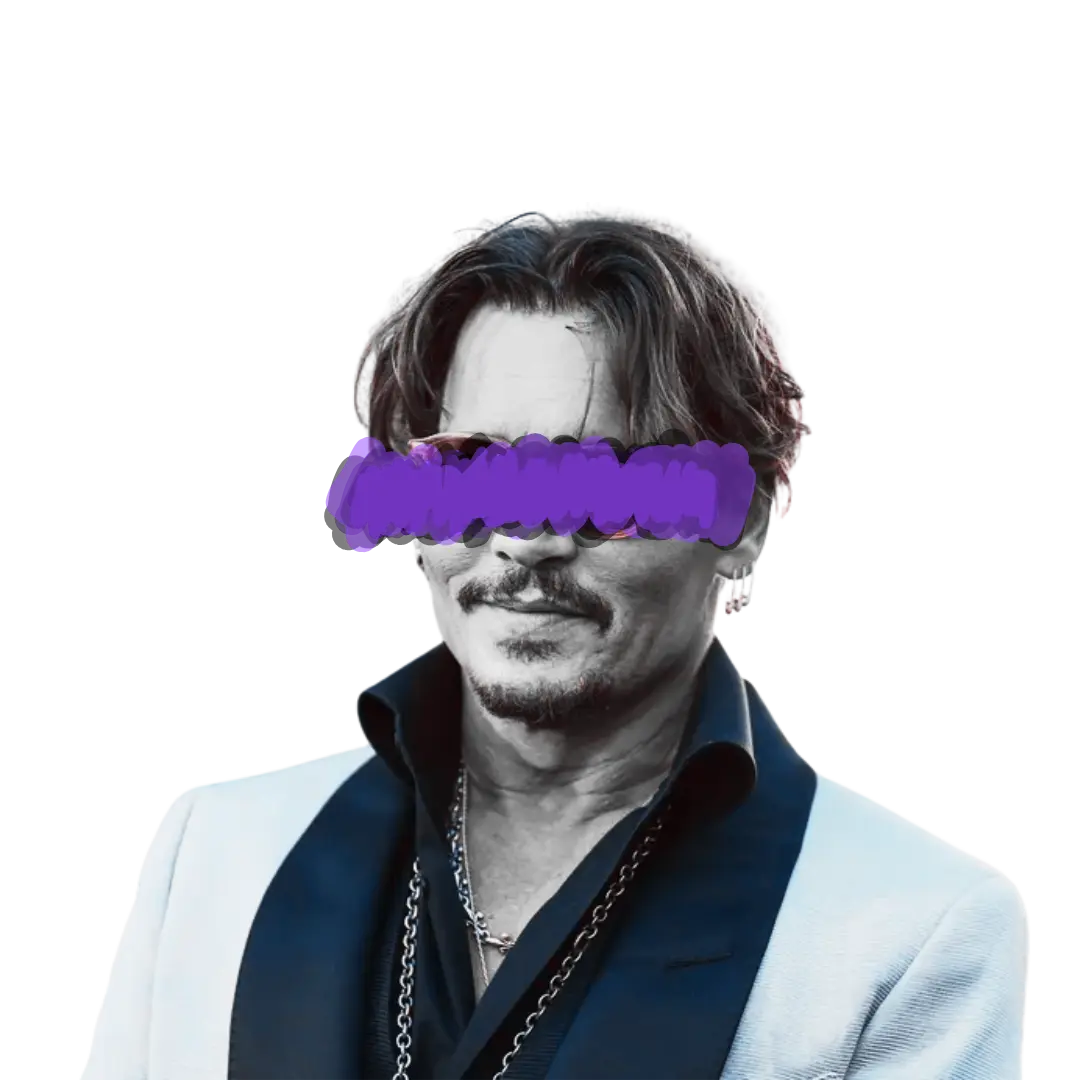
"Papa was out the window. I was Dad."
Johnny Depp has made a fortune becoming unrecognizable. But the most revealing thing he's ever said about himself isn't about acting. It's about a name that stopped applying.
For years, he built a life in the South of France, raising his kids away from Hollywood. In that world he was "Papa" — intimate, domestic, anonymous. After the split and the return to Los Angeles, the title changed to "Dad." Same children. Same love. Different distance.
Most people hear that and shrug. Depp says it like it hurt.
Because the central tension in his life isn't "eccentric actor." It's quieter than that: a man who built a career on masks who still seems desperate to find one version of himself that doesn't feel like a costume.
TL;DR: Why Johnny Depp is an Enneagram Type 4
- The core tension: A man famous for disappearing into characters, haunted by the one identity he can't act his way back into.
- The survival strategy: When home is unstable, you build an inner one. Depp did it through music, then acting, then art.
- The tell: He resists being loved for something false (teen idol, tabloid caricature) and will risk everything to be seen as who he believes he is.
- The payoff: Type 4 explains why the masks aren't a distraction from the "real" Johnny Depp — they're how he's tried to find him.
What is Johnny Depp's personality type?
Johnny Depp is an Enneagram Type 4
Enneagram Type 4, "The Individualist," is built around identity. Fours sit in the heart triad, where the core emotion is shame — not guilt about what you've done, but a quieter conviction that something about what you are is broken. They carry a need to be authentic, to be seen for who they really are, and an equally deep fear that the real self, once exposed, won't be enough.
Johnny Depp is a Four with a Five wing (4w5): intensely private, artistic, and internally inhabited. The public sees the costumes. The psychology lives in what the costumes protect.
The evidence shows up less in headlines and more in recurring patterns:
- Transformation as shelter: he chooses roles where the self can hide in costume — and somehow feel truer there.
- Revulsion at being a product: the teen-idol chapter wasn't flattering; it was suffocating.
- A hair-trigger sensitivity to identity: "Papa" and "Dad" aren't synonyms. They're two different worlds.
- A willingness to expose himself to correct the record: when misrecognized, he doesn't just feel annoyed — he feels erased.
- Art as sanctuary: whenever fame gets loud, he gets quieter and makes something.
The obvious objection: the partying, the rock-star lifestyle, the irreverent humor — isn't this a Type 7? Depp himself drew the line under oath: "My use of substances is to numb myself, not to party." Sevens reframe pain into adventure. Depp sits inside his and tries to survive it. He told GQ: "I don't trust anyone who hasn't been self-destructive in some way. You've got to bang yourself around a bit to know yourself." No Seven calls self-destruction a path to knowledge.
The other objection: the French countryside, the disappearing — isn't this a Type 9? But Nines withdraw to avoid conflict. Depp withdrew to construct a world that matched his inner one. And when that world was threatened, he didn't accommodate. He chose a six-week televised trial over a quiet settlement. No Nine does that.
"Whatever Was Handy"
In 2022, sitting in a Fairfax County courtroom, Depp described his childhood like a house with no reliable floorboards:
"There was physical abuse, certainly, which could be in the form of an ashtray being flung at you, it hits you in the head or you get beat with a high-heeled shoe or telephone — whatever was handy."
Then he added the line that tells you what the violence actually did:
"The verbal abuse, the psychological abuse, was almost worse than the beatings. The beatings were just physical pain. The physical pain, you learn to deal with. You learn to accept it."
The distinction matters. Bruises heal. But when the person who should mirror you back to yourself tells you — with words, with silence, with a phone across the room — that you are worthless, the damage settles somewhere deeper. It becomes identity. Not I did something wrong. Just: something about me is wrong.
Pair that with a childhood of constant displacement — he has said his family moved more than twenty times — and you get the early conditions that produce a very specific coping strategy:
When the outside world is unpredictable, the inside world becomes home.
By eleven he was taking his mother's nerve pills to "escape the chaotic nature" of the abuse. His sister Christi Dembrowski testified that they would run and hide when their mother became violent. And at some point in those years, Depp started marking his own body — small, deliberate cuts — not to hurt himself, but to keep a record.
"My body is a journal in a way. It's like what sailors used to do, where every tattoo meant something, a specific time in your life when you make a mark on yourself, whether you do it yourself with a knife or with a professional tattoo artist."
When asked which events the scars marked, he closed the door: "That would be like opening up my journal to you."
A boy who couldn't control the external chaos learned to write it on himself. The inside world was the first canvas. The guitar came next.
The First Locked Door
Depp got his first guitar at twelve. He has called it the moment everything changed:
"I was ecstatic when I got my first guitar and began to learn the songs that I tried to sing along to on the radio."
He locked himself in his bedroom and learned from records. Not entertainment. Protection. A room with a lock that nobody else had the key to.
"Music was always my first love. I use music in my work because it's the fastest way to an emotional place. If you're playing guitar, the feeling comes through — the way you bend the note, the intensity with which you hit the strings."
Long before he became famous for disappearing into characters, he learned the first disappearing act: how to leave a moment without leaving the room.
This isn't backstory. It's the template. At twenty, Depp moved to Los Angeles not to act but to play guitar in a band. Acting was the accident — Nicolas Cage suggested he try it. Music was the plan.
And it never stopped being the center. In 2012, he formed the Hollywood Vampires with Alice Cooper and Joe Perry, a supergroup named after a legendary 1970s drinking club. Cooper said the thing about Depp that most people miss:
"When he's with us he's not a movie star — he's a guitar player. And he's a great guitar player. You don't go out with Jeff Beck unless you can play guitar."
In 2022, Depp released an album called 18 with Jeff Beck — the title because playing together made them "feel 18 again." Beck described their bond in the simplest terms:
"He was just like a brother straight away. We laughed and didn't stop laughing for the last six years."
Beck died of bacterial meningitis in January 2023. Depp was reportedly at his bedside.
The pattern is consistent across four decades: when things get loud, Depp retreats to the instrument. The guitar at twelve. The band at twenty. The Vampires in his fifties. Every return to music is a return to that locked bedroom — the first place that felt safe.
The Role That Turned Him Into a Product
21 Jump Street made Depp a teen idol. For most young actors, that kind of attention is the dream.
For Depp, it looked like the beginning of a cage.
He later tried to talk honestly about it with a grim little shrug:
"Fame is an occupational hazard — but if I spout off about how upset I am, people will say, 'Sweetheart, take a job pulling trash bags.'"
He knows the deal. He also can't pretend the deal doesn't cost anything.
If the world insists on turning you into an image, and the image feels false, the reflex is to become the opposite — to chase the strange, the tender, the damaged, the honest.
That chase led him, almost inevitably, to the director who makes whole movies about misfits.
Burton and the Permission to Hide
Tim Burton didn't cast Depp as a conventional leading man. He explained why in language that cuts straight to the psychology:
"He didn't become an actor to be glamorous; he wanted to become characters. They're not in it for the celebrity or the perks; they're doing it because they kind of want to hide. He's more like Lon Chaney or Boris Karloff than he is Alan Ladd."
That's the best one-sentence summary of Depp's career anyone has offered, and it came from the person who saw it first.
Their first collaboration, Edward Scissorhands, is basically a visual metaphor for intimacy as threat: a boy built for tenderness who can't hold anyone without cutting them. Burton cast it by instinct:
"I was looking for somebody who got the idea, that sadness, of being mis-perceived. He's got those kind of eyes that can say things without speaking."
Depp felt it at the same depth. When he first read the script, he said it "passed through everything, anything, solid and went to the very core of whatever I am."
But it was their second film together that revealed the deeper pattern. Ed Wood (1994) tells the story of a man who makes art everyone mocks — and does it with total, unshakable sincerity. Wood wrote about his micro-budget B-movies as if he were making Citizen Kane. Critics called them the worst films ever made. He didn't care. He just kept making them.
For Depp, the role was irresistible:
"Within ten minutes I was committed to doing it. To me, it almost doesn't matter what Tim wants to film — I'll do it, I'm there. Because I trust him implicitly — his vision, his taste, his sense of humour, his heart and his brain."
Ed Wood is the parable in miniature: a man whose inner vision of himself has no relationship to how the world perceives him — and who refuses to let the world's version win. Depp played him with such joyful conviction that Janet Maslin wrote he "captures all the can-do optimism that kept Ed Wood going, thanks to an extremely funny ability to look at the silver lining of any cloud."
Eight films together across two decades. Sleepy Hollow, where Depp modeled Ichabod Crane after Angela Lansbury — "a very delicate, fragile person who was maybe a little too in touch with his feminine side." Sweeney Todd, where he drew from Peter Lorre's portrayal of a "creepy but sympathetic" surgeon. Every role another outsider. Every outsider another way to be real by being someone else entirely.
It's why Depp's best work feels closer to Joaquin Phoenix than to glossy, brand-forward stardom: the point isn't to look impressive. The point is to turn the private interior into something the world can finally see.
"Winona Forever"
In 1989, at the premiere of Great Balls of Fire, Depp saw Winona Ryder across the room. He later described it with the kind of language that belongs in a film he'd star in:
"It was a classic glance, like the zoom lenses in West Side Story, and everything else gets foggy."
Within five months they were engaged. He was twenty-six. She was eighteen. He got her name tattooed on his upper arm: WINONA FOREVER.
The intensity of that gesture is the tell. Most people in love say "forever." Depp wrote it on his body — made his skin a public declaration of identity. I am the person who belongs to this person.
This is what happens when a Four slides toward Type 2 under the pressure of love: the missing piece of identity gets projected onto the beloved. The relationship doesn't complement the self. It becomes the self.
When it ended in 1993, he didn't have the tattoo removed. He had it altered: WINO FOREVER.
Tim Burton, directing Depp through Ed Wood during the aftermath, saw what the breakup actually cost: "It's almost like Winona took Johnny's soul, Johnny's love."
Not his heart. His soul. When a Four loses the person they've merged with, they don't just grieve a partner. They grieve a version of themselves.
That detail says more about Depp's interior life than any interview. You don't erase a version of yourself. You edit it. The original meaning is still there underneath, visible to anyone who knows what it used to say. The grief doesn't get deleted. It gets repurposed. Turned into a joke that still carries the wound.
Years later, during Depp's defamation trial, Ryder submitted a witness statement. The woman whose name he'd altered on his arm wrote:
"I truly and honestly only know him as a really good man — an incredibly loving, extremely caring guy who was so very protective of me and the people that he loves, and I felt so very, very safe with him."
She called him her "first everything." She said the abuse allegations left her "shocked, confused and upset."
Whatever version of Depp the world was looking at by then, Winona was still reading the original text.
Jack Sparrow and the Permission to Be Weird
Then came the strangest twist of all: Depp's most commercially iconic role was born from his refusal to sand himself down.
Captain Jack Sparrow is a mask so extreme it becomes its own kind of honesty. It's flamboyant and sloppy and fearless. It's also a perfect hiding place: no one asks what's underneath a character that loud.
This is the paradox that follows Depp through his entire career.
When he's least "normal," he becomes most beloved.
And when he's most beloved, the private man inside the costumes has the most reason to disappear.
"The First Time I Felt I Had a Home"
In 1998, Depp met French singer Vanessa Paradis. Within a year, they had a daughter. Within three, they were living on an estate near Saint-Tropez, raising two children bilingually, far from any camera.
"The first time I felt I had a home was the place in the south of France where Vanessa and I raised the kiddies."
Read that sentence from a man who moved twenty times as a child. The first time. He was thirty-six years old.
Paradis chose France deliberately — "in the south of France you can live much more anonymously. And that's bliss, especially when the children are still young." The children spoke French. Nobody recognized their father at the market. The loudest version of Johnny Depp — the one the world couldn't stop watching — went quiet.
For fourteen years.
Paradis later described what she saw during that time: "I admire him as an actor, as a father, as a man. Above all, I admire the person he is." When abuse allegations surfaced years later, she called him "a kind, attentive, generous and non-violent person and father."
The identity he mourns most — "Papa" — was built in those years. Not performed. Not directed. Not costumed. Just a man at a table in the south of France, being called a name that meant he was home.
Then it broke. Depp and Paradis split in 2012. He moved back to Los Angeles. The title changed.
"I was Papa. I cannot tell you how much I loved being Papa."
He added, with the kind of self-awareness that makes the loss sharper: "I'm getting old enough for Papa to possibly come back."
What came next repeated the pattern — louder, worse, and on a global stage.
In 2012, Depp met Amber Heard. Years later, he described the attraction with the same instinct that had pulled him toward Winona two decades earlier — not desire, but rescue:
"If you're a sucker like I am, sometimes you look in a person's eye and see some sadness, some lonely thing, and you feel you can help that person."
The Four's stress arrow to Two, one more time: see someone's pain, make it your mission, lose yourself inside it. But this time, the cost was existential:
"I was as low as I believe I could have gotten. The next step was, 'You're going to arrive somewhere with your eyes open and you're going to leave there with your eyes closed.'"
The relationship ended in allegations. The allegations calcified into global narrative.
"I Knew I'd Have to Semi-Eviscerate Myself"
The Depp-Heard legal battle turned his private life into global entertainment. Plenty of public figures would have tried to outlast it quietly.
Depp chose the opposite: exposure.
"Look, it had gone far enough. I knew I'd have to semi-eviscerate myself. Everyone was saying, 'It'll go away!' But I can't trust that. What will go away? The fiction pawned around the fucking globe? No it won't. If I don't try to represent the truth it will be like I've actually committed the acts I am accused of. And my kids will have to live with it."
Whatever you think about the spectacle, that motivation is coherent: for someone wired like Depp, being misrecognized isn't a PR problem. It's an existential one. And the decision to face it — publicly, under oath, for six weeks — marks something the Enneagram tracks precisely.
When Fours move toward health, they access Type 1: less wallowing, clearer principles, action where there used to be only feeling. The man who had spent decades disappearing into characters and dissolving into relationships chose to sit still, tell the truth, and let a jury decide.
"So the night before the trial in Virginia I didn't feel nervous. If you don't have to memorize lines, if you're just speaking the truth?"
He also didn't pretend the truth was flattering. When his own violent, ugly texts about Heard were read aloud in court, he didn't deflect:
"I am ashamed of some of the references made and embarrassed at the tone that in the heat of the moment, the heat of the pain I was feeling, went to dark places."
Ashamed. Named. Out loud. In a courtroom. For a Four — someone whose entire architecture is built to avoid being seen as defective — that sentence cost more than the lawsuit.
The jury ultimately awarded Depp $10.35 million in damages and Amber Heard $2 million on her counterclaim.
And notice what happened afterward. He didn't take a victory lap. He sounded emptied out:
"They threw me in the bin. It hurt seeing these fake motherfuckers who lie to you, celebrate you, say all sorts of horror behind your back, yet keep the money."
The decision to sue wasn't driven by vanity. It was driven by the same instinct that made him alter the tattoo rather than erase it: if a story about who you are starts calcifying into permanent record, you have to intervene. You can't let the wrong version win.
So he did what he always does when the world feels false. He retreated into art.
Modigliani and the Fear of Being Loved Too Late
In the 2020s, Depp returned to directing with Modi, a film about Italian painter Amedeo Modigliani.
On the surface, it's an "obvious" choice: tormented artist, addiction, beauty, tragedy.
But the more interesting parallel is darker and more specific.
Modigliani died young and largely unrecognized. His work became legend after he was gone.
That isn't a romantic ending. It's the nightmare made literal: to be misunderstood while you're alive, then finally "seen" when you can't feel it. To be loved too late.
Depp's entire public saga — the adoration, the caricature, the trial, the exile, the reinvention — has revolved around one question: who gets to name him?
Directing a story where the truth arrives after the person is gone isn't just aesthetic taste. It's a way of staring directly at the fear underneath the masks.
"Whatever Happens to Be Nearby"
In October 2024, Depp opened an exhibition of his paintings in New York — thirty years of visual art he'd made mostly in private, including portraits of Marlon Brando, Keith Richards, and his son Jack.
The statement at the entrance read:
"Some may call it art, some may not; I call it mine, for better or worse. Whatever you want to call it, this is my way of chasing that spark of creativity and putting it down on whatever happens to be nearby. It's how I make sense of the world."
When asked what he likes to paint, his answer was the quietest thing he's ever said about his own psychology:
"What I love to do is paint people's faces, their eyes. Because you want to find that emotion, see what's going on behind their eyes."
A man who spent forty years putting on masks to feel real. Now he paints other people's eyes, searching for what's behind them.
The guitar at twelve. The characters at twenty-five. The paintings at sixty.
He became famous by disappearing. The question is whether he's finally arriving — or whether the disappearing was always the point.
Disclaimer: This analysis of Johnny Depp's Enneagram type is speculative, based on publicly available information, and may not reflect his actual personality type.
What would you add?