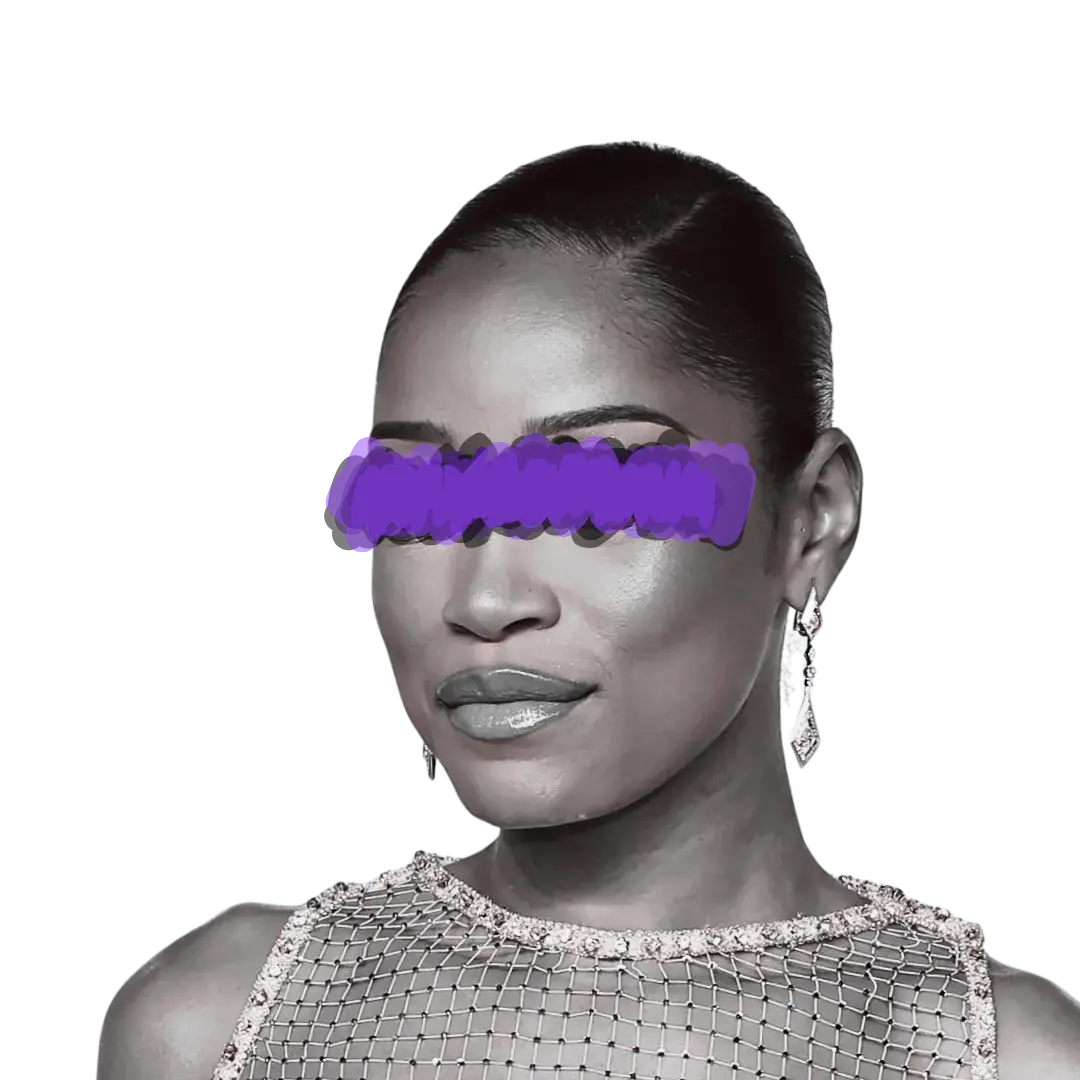
"I was showcasing the side of me I damn near forgot about myself because I was doing everything that I could to be Keke Palmer. But there's Lauren Palmer inside that created that persona to be able to survive."
When asked which of her two names she'd like to be remembered by, Lauren or Keke, she didn't hesitate. "Keke," she said. "That's the name the world wanted. So, that's what they got."
That answer tells you everything. Not because it's confident. Keke Palmer is always confident. But because of what it conceals. Lauren Palmer, the girl from Robbins, Illinois, built "Keke Palmer" like a suit of armor. She put it on at nine years old and didn't take it off for two decades. The performance was so good, so relentless, so bright that it blinded everyone, including Lauren herself, to what was happening underneath.
Here is a woman who has written two books about controlling her narrative and mastering herself. "Master of Me," she called the second one. And yet her life story reads like a catalogue of someone else holding the pen: a family that needed her paycheck before she hit puberty, record labels that signed her just to shelf her, a boyfriend who shamed her body on the internet, then destroyed her diaries when she tried to leave.
The woman who tells the National Guard to march beside her at a BLM protest. The woman who claps back at colorism comparisons with a list of firsts that could fill a Wikipedia page. That woman hid in a closet once. At a party, when a man wouldn't stop pressuring her to appear in his music video. She said no to the producer, no to the assistant, no to him directly. And when no one listened, she found a closet and shut the door.
That gap between the indestructible persona and the person who built it to survive is what makes Keke Palmer one of the most psychologically interesting entertainers of her generation.
TL;DR: Why Keke Palmer is an Enneagram Type 3
- The Persona Split: She explicitly describes "Keke Palmer" as a character Lauren Palmer created to survive the entertainment industry
- Achievement as Identity: Working since age 9 with no vacation for 15 years, she equated her worth with her output from childhood
- Constant Reinvention: Acting, singing, Broadway, hosting, activism, producing, each domain conquered methodically, not dabbled in
- Humor as Armor: The "sorry to this man" virality, Lady Miss Jacqueline, the meme queen persona. Her comedy is both art and emotional regulation
- Narrative Control: Two books, a visual album, and a career built on the thesis that you must author your own story, or someone else will
The Girl Who Went to Work at Nine
Lauren Keyana Palmer was born on August 26, 1993, in Harvey, Illinois, and raised in Robbins, a small, predominantly Black suburb south of Chicago. Her parents, Sharon and Larry, met in drama school. Both had been professional actors before economic reality intervened. Larry settled into a polyurethane company. Sharon became a high school teacher working with autistic children. They were a Roman Catholic household. Larry is a deacon.
At five, Lauren belted out "Jesus Loves Me" in the church choir with the kind of conviction that makes adults stop talking. By nine, she was working. By ten, she had a film debut in Barbershop 2. By twelve, she was starring opposite Laurence Fishburne in Akeelah and the Bee, and Roger Ebert wrote that "there's something about her poise and self-possession that hints she will grow up to be a considerable actress." He added: "The movie depends on her, and she deserves its trust."
She was twelve. She was also, by then, a millionaire.
Her parents quit their jobs. Larry gave up his pension after fifteen years. Sharon put her own dreams on hold. The entire family relocated to California. "What's mine is theirs and what's theirs is mine," Palmer said. They rationed her an allowance from her own money. At their best, her parents had made $40,000 a year. She was making that per episode of True Jackson, VP.
"I essentially had to abandon my childhood feelings and desires, becoming like a parentalized child," she later wrote. "There was so much pressure to rise to the occasion (for my community, for my parents, for my siblings, for their sacrifices) that it led to hatred on my end."
She hated her parents for a long time. She said that plainly, in a 2025 interview with The Cut. At seventeen, she considered emancipating from them. She thought they didn't understand what she was going through. She told a lawyer she was done.
Then Will Smith sent her a voicemail: "Sometimes it's hard being the first, but you'll get through. Just keep staying focused, love on your family and y'all gonna be good." She stayed, not because the voicemail solved anything, but because it reframed the isolation. Someone who had survived the same machine was telling her the loneliness was part of it, not proof that something was wrong.
Walking Around in a SpongeBob Suit
At fifteen, Palmer was trapped on a Nickelodeon cruise ship. She couldn't leave her cabin without being mobbed by children screaming "True Jackson!"
"I was trapped. I couldn't leave my room without someone coming up to me calling me 'True Jackson.' What you are, to everyone, is just a character... just part of their experience."
She compared it to "walking around in a SpongeBob suit that I couldn't take off."
True Jackson, VP made her the first Black woman to star in her own Nickelodeon show. She loved the work. But the character was accidentally autobiographical. "She was climbing a corporate ladder, working a grown-up job as a kid," Palmer said. "I felt the same way."
When the show ended in 2011, she was eighteen. The transition was brutal. "You're at this weird age where you're too young for the kind of roles that you would want and you're too old for the kind of roles you used to get. Your brand was made up of you being a kid, and you're not a kid anymore. So you have to build a new one."
She built a new one. And then another. And another. But first, she went broke.
The Millionaire Who Filed for Bankruptcy
Between twelve and eighteen, Palmer was the financial engine for a family of six. Two parents who had surrendered their careers. Three siblings. A cross-country relocation. Agents, managers, publicists, travel. The infrastructure of a Hollywood career, all running on the earnings of a child. Her parents hired a business manager when she was twelve, but as Palmer later put it, "the employee wasn't the end-all, be-all solution."
By eighteen, when True Jackson ended and the checks stopped coming at the same rate, the math collapsed. She filed for bankruptcy.
"I was so spooked," she said at a financial empowerment summit in Chicago in 2024. "I was like, 'What went wrong?'"
What went wrong was what always goes wrong when a child becomes a money machine. The infrastructure wasn't built for a kid. The lesson Palmer took from it, the one that still governs her life, was to live as if the floor could drop at any moment. She wears Zara instead of Gucci. She drives a Toyota. She caps her rent at $1,500 a month. "If I got $10,000 in the bank, then my house would be $500 a month... I'm going way under." She invested $500,000 of her own money into KeyTV rather than buying luxury cars.
"Everybody likes spending time with me," she told Marie Claire. "I would like to spend time with me too."
Signed, Shelved, Signed Again, Shelved Again
While the acting career was compounding, Palmer's music career was being systematically suffocated.
Atlantic Records signed her in 2005. She was twelve. She released her debut album, So Uncool, at fourteen. It peaked at number 85 on the R&B chart and vanished. The label saw her as an actress who happened to sing, not a musician worth investing in. No real promotion. No radio push. She was off Atlantic by 2009.
Then Jimmy Iovine signed her to Interscope Records in 2010. She recorded a full album, described as "complete and in the process of finalization" in a 2011 interview. The album was never released. Shelved entirely. The label let her put out a mixtape, then silence.
She tried again with Island Records around 2016. Released an EP called Lauren, notable because she used her real name, not the brand. That relationship faded too.
Three major labels. Each one said the same thing without saying it: you're profitable enough to sign but not worth investing in. For a child who had learned that her value was her output, being told her art wasn't worth promoting was a particular kind of wound. It confirmed the worst fear: that the industry wanted the character, not the person. Keke Palmer the actress was bankable. Lauren Palmer the musician was expendable.
She responded the way she always does: by building it herself. She founded Big Bosses Entertainment with her mother and her longtime music manager. She released mixtapes independently. One of them, Waited to Exhale, was named after a physical symptom of her anxiety: the habit of unconsciously holding her breath under stress. The body processing what the schedule wouldn't let her feel.
"Sorry to This Man"
If you're under forty and you know Keke Palmer, there's a decent chance you first encountered her not through Akeelah and the Bee or True Jackson or even Nope, but through a Vanity Fair lie detector test.
In September 2019, the interviewer showed Palmer a photograph of Dick Cheney and asked if she thought she'd been a better VP than the real-life Vice President. Palmer stared at the photo.
"I hate to say it — I hope I don't sound ridiculous — I don't know who this man is. I mean, he could be walking down the street, I wouldn't know a thing. Sorry to this man."
The lie detector confirmed she was telling the truth. The clip got 5.4 million views in a week. "Sorry to this man" became the meme of the fall. Three years later, a reporter asked if she'd ever looked Cheney up. "I didn't even honestly do the research," she said. "Everybody was like, 'It was Dick Cheney!' And I'm like, still means nothing."
This is the dimension the serious portrait of Palmer often misses: she is one of the funniest people in entertainment. And her humor is not incidental to the persona; it is the persona's most sophisticated tool.
On Strahan, Sara and Keke, when Bachelorette alum Mike Johnson tried to ask her out on-air, she stared into the camera with wide eyes and announced: "I'm at work!" Then she made her own memes from the clip. She created Lady Miss Jacqueline, a southern belle alter ego who delivers devastating shade with impeccable manners, and the character got popular enough that Amazon commissioned a short story collection based on it.
Black Twitter dubbed her "Keke 'Keep a Job' Palmer." As Essence noted: "While everyone was focused on her being booked and busy, Palmer was focused on building and buying."
The humor reads as spontaneous. It is also strategic. Every viral moment becomes a potential product, brand deal, or content franchise. The woman who looks like she's just being herself is also, always, working. For a Type Three, comedy is the perfect cover. It looks effortless, it generates love, and it keeps the audience watching the performance instead of the performer.
The Black Girl on the Network
There's a wound underneath the persona management that Palmer has named clearly:
"I wasn't necessarily in the same conversations as Victoria Justice or Selena Gomez or Miley Cyrus at that time. It was very much 'That's the Black show' or 'That's Keke Palmer, the Black girl on the network.'"
"There is a loss of innocence that comes with the awareness that you're treated differently that I'd accepted a long time ago."
She achieved things her white contemporaries didn't. First Black woman to star in her own Nickelodeon show. First Black Cinderella on Broadway. Youngest talk show host ever. But the achievements existed in a separate category. She was never allowed to simply be a star. She was always a Black star. The modifier came first.
This shaped her relationship with achievement in a particular way. If the system was going to limit her category, she would make the category undeniable. When a colorism debate tried to compare her to Zendaya, she responded with a resume instead of an argument (youngest talk show host, first Black Cinderella, first on Nickelodeon) and ended with: "I'm an incomparable talent. Baby, THIS, is Keke Palmer." Achievement as shield. Resume as identity.
But it also deepened the wound. The performance had to be twice as good to get half the recognition. And the person underneath the performance had even less room to exist.
At fourteen, Ice Cube pulled her aside on set and told her something she never forgot: "You're a beautiful young lady, and I see how kind you are and how nice you are to everybody on the set. But I want you to know you're growing into a young woman, and a lot of times the way that people see you, the way that these men see you on set, it's not the way you see yourself. So protect yourself, be careful, and don't let them take advantage of you."
She didn't fully understand what he meant until years of industry encounters made it impossible not to. "Being a woman is like, 'Damn, the biggest mistake you can make is trusting somebody,'" she said. She wasn't talking about one relationship. She was talking about a pattern that started before she was old enough to understand it: older men in the industry, record labels that used her audience without believing in her art, a system that rewarded her talent while boxing her identity.
What is Keke Palmer's Personality Type?
Keke Palmer is an Enneagram Type 3
People who share Palmer's core pattern, Enneagram Threes, carry a specific wound: the belief that they are only as valuable as what they produce. This belief usually forms early. A child who is praised for performance, rewarded for achievement, and taught, explicitly or implicitly, that love is conditional on output. The child learns to build a self that wins. The self that doesn't win gets buried.
Palmer has described this dynamic in almost textbook terms without ever naming it. "You get really quickly into being a people-pleaser and trying to be everything that everybody wants you to be," she told Today.com. "And so I think in a lot of that, you end up being misunderstood."
The evidence is structural, not anecdotal:
- The relentless output: Working since nine, no vacations for fifteen years, millionaire at twelve, bankrupt at eighteen, rebuilt from zero, conquered six different entertainment verticals. This isn't passion. It's compulsion rooted in identity.
- The persona split: She explicitly names "Keke Palmer" as a creation of "Lauren Palmer," a character built for survival. In her 2025 Grammy.com interview, she said: "I'm taking off the mask, so to speak."
- The book titles: I Don't Belong to You: Quiet the Noise and Find Your Voice (2017). Master of Me: The Secret to Controlling Your Narrative (2024). Both are about authorship and control, the central preoccupation of someone whose identity was fused with performance from childhood.
- The humor as camouflage: Even her comedy (the memes, the alter egos, the viral moments) serves the Three pattern. It generates adoration while keeping the real person hidden. Everyone loves the show. No one asks what it costs.
Jordan Peele, who wrote the role of Emerald in Nope for her, said: "The world is catching up to how capable she is." He added that he "hasn't met another like her."
Queen Latifah called her "one of the most talented human beings I've ever met... the epitome of grace, poise, and honesty."
What Peele and Latifah were both describing, without using the language, is the Three's superpower: the ability to become whatever the room needs, so flawlessly that the performance looks like nature.
The Girl Who Held Her Breath
Around sixteen, during the True Jackson years, when she was simultaneously the family breadwinner and a Nickelodeon star, Palmer started struggling with anxiety and depression. She has been direct about it:
"My anxiety, caused by the habit of unconsciously holding my breath, coupled with the stress of my personal life at that time, created a lot of hard years of depression for me."
She was literally holding her breath. The body processing what the schedule wouldn't let her feel.
"I had too much anxiety and could not process my experiences," she said. Being expected to perform happiness for a living while suffocating underneath it. That was the feedback loop. The persona needed to be bright. The person underneath was drowning.
She started therapy in her late teens. She participated in the Child Mind Institute's Dare to Share campaign, publicly discussing depression and anxiety to destigmatize it for young people. "Naming the things that cause me troubles in my life, like anxieties or depression, helps me to do something about it," she said. "When I'm doing good by myself, then I'm able to serve other people."
Now, every morning, she gives herself five hours. Walks. Runs. Pilates. Smoothies. Candles. A heated eye mask with beans. Meditation studying and transcendence classes. "Those rituals really help me to feel secure in myself," she's said, "because those are things that I'm doing with myself." Five hours to locate Lauren before Keke has to appear.
The Mirror in _Nope_
In 2022, Jordan Peele gave Palmer something no one in Hollywood had given her before: a leading role in a major film written specifically for her personality.
"As soon as the character came to me, it was Keke," Peele said. "We met early on and I just got a sense of her and got a sense of what she could bring to the role and I basically wrote it for her."
Emerald Haywood is a hustler, a natural performer, a woman with gale-force authority who can make even the most rehearsed pitch sound off-the-cuff. She lives in her brother OJ's shadow in the family horse-training business, craving validation she never received at home. "Her point of view is just connected to her family, her legacy, her need to find herself outside of it," Palmer said, "to be validated as a person because she never felt validated."
The parallels to Palmer's own life are almost too neat. A woman who performs constantly. Who uses charm and hustle to survive. Who lives in the shadow of a spectacle machine (literally, in the film's case) and whose deepest desire is not fame but being seen. Palmer described Emerald's arc in a sentence that could be her own autobiography: "The person that saw me was really the only person that I needed to see me."
The film's central theme, our addiction to spectacle and our inability to look away from the thing that might destroy us, is the theme of Palmer's entire career. She has been inside the spectacle machine since she was nine. Nope let her play a character who finally learns to stop feeding it.
Emerald's opening monologue, a virtuoso set piece about the Haywood family's Hollywood lineage, wasn't in the original script. Peele added it five days before shooting. Palmer shot fourteen takes, each wildly different, with improvisation woven through. "When it came, I was like, 'OK, you're putting me to the test, Jordan,'" she said.
He was. She passed. As she always does.
When the Suit Cracked Open
In July 2023, Keke Palmer attended Usher's Las Vegas residency wearing a sheer black dress. Usher serenaded her. It was a concert. She was having fun.
Then Darius Jackson, the father of her son, posted about it publicly: "It's the outfit tho.. you a mom." He doubled down when criticized: "We live in a generation where a man of the family doesn't want the wife & mother to his kids to showcase booty cheeks to please others & he gets told how much of a hater he is."
The most outspoken woman in Hollywood went silent. "I was speechless," she later admitted. "I was just at a concert, doing what I do as an entertainer."
But the Usher concert was not the cause. It was the inciting incident. In November 2023, Palmer filed a restraining order alleging that Jackson had physically attacked her multiple times throughout their relationship. The filing included allegations of being slammed on the floor, grabbed by the neck, body-slammed on the stairs, and having her belongings thrown into the street. He destroyed her personal diaries.
For a woman who has built her life around authoring her own narrative, the destruction of her diaries is the cruelest possible violation. It is an attack not just on privacy but on the very mechanism she uses to survive — her own story, in her own hand. The girl who once hid in a closet to escape a man who wouldn't take no for an answer was now watching her private words scattered in the street by a man who was supposed to be her partner.
"It got so out of control," she said. "The only way I knew how to bring order was through the court."
Six months later, she dropped the restraining order and reached a joint custody agreement. Her handling of the aftermath was characteristically nuanced: "I didn't want my son to think his father is a monster, because I don't." And: "I wish I could say he was terrible the entire time or that I was... but it wasn't that black-and-white and that was the problem."
Motherhood was the structural pivot. "I'm so happy to meet you," she said when she first held her son Leodis. The stakes shifted from self-image to stewardship, and the shift was concrete, not abstract. Career decisions started routing through a new question: what does this build for my son? She began building multi-generational infrastructure through KeyTV rather than chasing the next role. She tightened boundaries rather than expanding access. "When I'm done, I'm done," she told Essence. "When I don't want to do it, I don't want to do it."
The woman who never took a vacation for fifteen years planned her first solo trip, to Bali, inspired by Eat Pray Love.
"I'm Not the Puppet. I'm the Puppet Master."
In 2025, Palmer released Just Keke, her rawest musical project. A visual album that functions as a scripted world, beginning in confusion ("Off Script") and ending with unresolved but forward-moving acceptance ("Misunderstood"). She called this her "awareness era."
"I'm not the puppet," she told Scott Evans. "I'm the puppet master."
The album is about the difference between performing survival and choosing intention. She described wanting to be "less fragmented and more integrated," to merge the performing self with the private orchestrator. She credits songwriter Tayla Parx as an essential collaborator: trust enabled truthful writing, and tracks that felt too risky at first were kept once the writing room stabilized emotionally.
The progression across her 2024-2025 interviews tells its own story. On Club Shay Shay, the foundation: childhood labor, family sacrifice, the operating system she built to survive. On the Breakfast Club, crisis processing: the breakup framed as story mechanics, boundaries defined, co-parenting centered. On House Guest with Scott Evans, the most integrated tone: pain still named directly, but with closure language and future focus.
She is not rejecting performance. She is rejecting being reduced to it.
"I learned to separate my performance from my personal emotions by establishing a clear boundary," she wrote in Master of Me. "I am not my work, but I do my work."
How Keke Palmer Builds an Infrastructure That Doesn't Need Mickey Mouse
In the Breakfast Club interview, she asked a question that reveals where she's heading: "How can I build an infrastructure where I ain't got to be Mickey Mouse all the time?"
She's bankrolling KeyTV with $500,000 of her own money: nine original series, developed by emerging creators, pairing underrepresented voices with industry experts. She's not endorsing products; she's Chief Brand Officer of Creme of Nature, with an executive role, not a spokesperson contract. She's studying Eddie Murphy's craft choices, improvisation discipline, and how to scale beyond performer identity. She has a buddy comedy in development with SZA, produced by Issa Rae.
"I am who my parents would have been with the opportunities they gave me," she told Shannon Sharpe on Club Shay Shay. That sentence contains the entire arc. The gratitude and the burden. The achievement and the cost. The daughter who hated her parents for what they asked of her, and the mother who now understands why they asked.
"A big part of self-mastery," she wrote, "is knowing that you don't control anything but yourself."
The girl who was trapped in a SpongeBob suit on a Nickelodeon cruise ship at fifteen is now thirty-two, building a media company, raising a son, and releasing the most honest music of her career. She went from "I had to survive the machine" to "I can describe the machine" to "I can use the machine without being consumed by it."
But the suit is still there. She designed it herself now, and she chooses when to put it on. That's the difference.

What would you add?