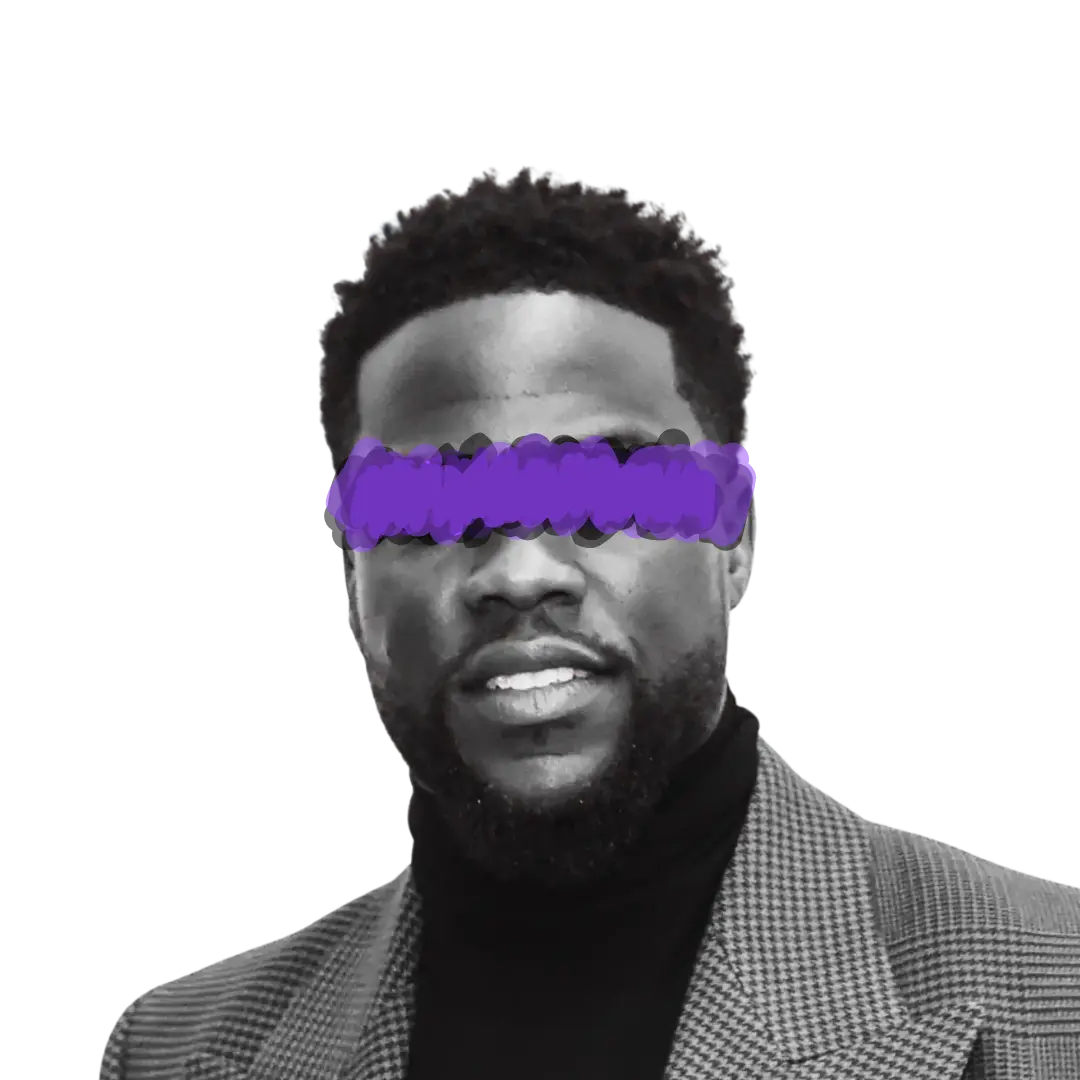
"There's nothing more humbling than a quiet room."
In March 2024, Kevin Hart stood at the Kennedy Center accepting the Mark Twain Prize for American Humor. Youngest recipient ever. Dave Chappelle, Chris Rock, Jerry Seinfeld — all there to honor him. Hart cried during his acceptance speech. Then he told a joke.
That moment is the whole man in two beats. The tears, then the pivot. The feeling, then the flight.
Hart has spent thirty years perfecting this move. Pain arrives. He turns it into material. His father's crack addiction became a set. His divorce became a special called Let Me Explain. His near-fatal car accident — three spinal fractures, eight screws — became the turning point he now calls his "resurrection." Everything gets processed through the machine. Everything comes out as a punchline.
But in September 2019, the machine broke. A shattered spine pinned Kevin Hart to a hospital bed, and for the first time in his adult life, the man who couldn't sit still had no choice but to be silent. What he found in that silence surprised him more than anything the stage had given him.
TL;DR: Why Kevin Hart is an Enneagram Type 7
- Pain became raw material: From a childhood shaped by addiction and absence, Hart built a psychological system that converts every wound into a joke, every setback into a setup.
- Motion as medicine: The relentless touring, filming, and empire-building isn't ambition alone — it's a man who discovered that if you move fast enough, grief can't land.
- He named his own demons: In a rare act of self-examination, Hart catalogued his psychological patterns as literal "monsters" — Control, Approval, Comparison, Do It All — and still feeds them.
- A broken spine taught him stillness: The 2019 car accident forced the first genuine pause of Hart's life, producing the deepest growth he's ever shown.
What is Kevin Hart's Personality Type?
Kevin Hart is an Enneagram Type 7
The Enneagram Type 7 is driven by a core fear of being trapped in pain — emotional pain, boredom, deprivation, limitation. The response isn't to confront the pain. It's to outrun it. Build something. Start something new. Stay in motion.
Hart has been running this program since North Philadelphia.
But under stress, the spontaneous pleasure-seeker becomes something unexpected: a harsh disciplinarian. Black-and-white rules. Moral absolutes. Hart's 4 AM gym sessions, his refusal of all pain medication after the accident, his uncompromising standards for fatherhood — these aren't the behavior of a man chasing fun. They're the behavior of a man imposing order on chaos because the alternative is feeling everything he's been outrunning.
And in health, 7s develop something else entirely: the capacity for stillness. The willingness to sit with depth rather than breadth. Hart's post-accident transformation — the meditation, the introspection, the book where he literally catalogued his psychological demons by name — shows a man learning that the room doesn't have to be loud to be safe.
Chappelle captured it at the Mark Twain ceremony: "If survival had a mascot, it would be him. A little guy, strong, but probably can't fight. And survived with humor and levity."
Not success. Not ambition. Survival.
"Am I Supposed to Be Crying?"
In January 2007, Nancy Hart died of ovarian cancer at age 56.
When Nancy learned her cancer was terminal, she told most of the family. She did not tell Kevin. He was supposed to film a movie in Australia, and she decided — without consulting him — that his career mattered more than his presence at her deathbed.
"I need him to be able to go forward because I see him doing great things," she told Kevin's brother Robert.
She wanted him gone. Not out of cruelty but out of conviction. The woman who'd raised two boys on a systems analyst salary while her husband cycled through jail cells made one final calculation: Kevin's future was worth more than her goodbye.
Kevin found out a few weeks before she died. He shuttled between Philadelphia and Australia. Nancy asked that all treatments be stopped. She wanted to go home. She took her final breath while Kevin was on set.
"It hit me, but I didn't know if it hit me correctly. I'm weird with emotion. I said, 'Am I supposed to be crying?' I really didn't know what my emotions were supposed to be."
That confession is the most revealing thing Kevin Hart has ever said. A man whose entire career is built on reading emotion, performing emotion, controlling the emotional temperature of a room with 50,000 people in it — could not identify what he felt when his mother died.
He went back to work.
When they cleaned out Nancy's house, Kevin found a box. Newspaper clippings. Magazine articles. Videos of his TV appearances. Every interview he'd ever done, she had collected and kept. The woman who hid her death so her son would keep working had been watching every moment of the work.
"My mom is responsible for giving me the ability to understand the benefit of hard work," Hart said years later in the Headliners Only documentary. "That work ethic is all attached to my mom."
The mother who taught him to keep moving made her death the ultimate reason to never stop.
The Boy from North Philly
Kevin Darnell Hart grew up in North Philadelphia. His father, Henry Witherspoon, was addicted to cocaine and cycled through incarcerations.
"My dad was in and out of jail. He was a drug addict. I didn't really have that male role model in my life growing up."
Nancy worked long hours at the University of Pennsylvania. She became everything — provider, disciplinarian, emotional anchor. She had one rule that shaped Kevin's entire operating system:
"You can't come in my house with that attitude. So I learned to switch it."
Learn to switch it. Take whatever you're feeling and convert it into something else. This wasn't a household rule. It was the founding algorithm of Kevin Hart's career.
"Comedy was my defense mechanism. I was dealing with a lot of negative stuff, and to stay positive, I would crack jokes."
Every laugh was a transaction: pain in, connection out. The boy from North Philly figured out early that if you could make the room laugh, you controlled the room. And if you controlled the room, the room couldn't hurt you.
The Grind Nobody Saw
His first comedy show, under the name "Lil Kev the Bastard," was a disaster.
"I got booed so bad. But in my mind, I thought I killed. I didn't realize how bad I bombed."
He performed anywhere — clubs, colleges, laundromats. He studied Pryor, Murphy, Chris Tucker. He bombed, adjusted, bombed again.
The breakthrough came with I'm a Grown Little Man in 2009 — a title that was itself a declaration: owning his height, demanding respect. Then Laugh at My Pain in 2011, which grossed $15 million and turned family wounds into theatrical experience. The material mined his father's addiction, his childhood in North Philly. It hurt, and it killed.
Then Let Me Explain at a sold-out Madison Square Garden — $32.3 million — his answer to the divorce media frenzy. The title is the psychology. Rather than hide from controversy, he processed it the only way he knew: on stage, in front of everyone, converting damage into material.
By 2016, he filled Lincoln Financial Field in Philadelphia. Fifty-three thousand people in his hometown. The kid who got booed at open mics came home to a stadium.
Chris Rock put it plainly at the Mark Twain ceremony: "I gave him advice and he became a bigger star than me. Within 800 days, Kevin Hart was a bigger star than me. He was taking parts from me."
And Chappelle: "I never played arenas until I saw him do it. It made me dream bigger — and he's younger than me."
Kevin Hart's Monsters
In 2022, Hart did something unusual for a man whose instinct is constant forward motion. He paused, looked inward, and published Monsters and How to Tame Them — cataloguing his own psychological patterns by name.
The Control Monster. The need to manage every variable, every outcome, every person. The Approval Monster. Wanting the whole world to love him. The Comparison Monster. Benchmarking himself against everyone. The "Do It All" Monster. Accepting every offer because saying no feels like dying. The "You Can't Go Backwards" Monster. The terror of regression.
"My monsters have been masked and disguised in various different ways but I've been able to pinpoint them throughout the years," he told Jay Shetty. "You're talking about the world of an ego. The idea of who you think you are versus what you are."
He went further: "The biggest drug — it's not cocaine, it's not heroin. It's not Molly or opioids. The biggest drug is fame. And if you can't handle this thing, the consequences attached are severe."
This is a man who sees his own machinery clearly. He knows what the hustle is for. He knows the monsters by name.
And he gets up at 4 AM and feeds them anyway.
The Pattern That Almost Destroyed Him
In 2017, Hart publicly apologized to his pregnant wife, Eniko Parrish, for cheating on her. It wasn't the first time. His first marriage to Torrei Hart ended in 2011 amid what Torrei called "lies and infidelity."
Eniko found out the way everyone finds out now.
"I was having breakfast, I opened my phone and immediately I just lost it," she recalled in Hart's Netflix documentary Don't F**k This Up. "You publicly humiliated me. Everything's on Instagram, everything's on social media."
Hart confronted the pattern directly: "The worst part was just knowing how you made somebody feel. When I got to see the effect my reckless behavior had on Eniko, it was crushing. That really tore me up."
He called it "probably the lowest moment of my life" and "Kevin Hart in his dumbest moment."
Under pressure, the man who fears pain seeks immediate pleasure — the quick hit, the new thrill, the escape into sensation. It works until it doesn't. Until the person you love is crying at breakfast because your escape became her humiliation.
"If you're OK with being flawed, then you can be fixed," Hart said.
The marriage survived. By 2025, they'd celebrated nine years together. "She's the backbone of our household," Hart said. "She has shaped and molded me in ways I never knew I possibly could."
The Quiet Room
September 1, 2019. A Plymouth Barracuda on Mulholland Highway. Three spinal fractures. The breaks were a quarter-centimeter from leaving him paralyzed. His spine was fused with eight screws.
For the first time in his adult life, Kevin Hart could not move.
"It all boiled down to four walls," he told Joe Rogan. "And in the space of those four walls was my wife and my brother, my kids and my friends, all on rotation. And I got a chance to think about what matters, and it's not fame. It's not money. It's not jewelry, cars, or watches. What matters are relationships. The people that were helping me get up and out of the bed."
The biggest cry of his life came the day he went home from the hospital: "Because I never had to see that house again. There was an option of me never walking on that driveway again. There was an option of me never seeing my wife and my kids again."
"I feel like the other version of myself died in that moment and this new version was born to understand and to do better."
Jack Black visited him in the hospital weeks later. What he observed: "He seemed to be coming from a different place emotionally and spiritually. He kept saying he was going to take the opportunity to breathe and slow down and appreciate his family."
Jack Black — a man known for his own boundless energy — watched Kevin Hart discover stillness. The man who'd been running since North Philadelphia had found, in a hospital bed, what thirty years of sold-out arenas never gave him: the ability to sit in a room and not need it to be loud.
Before the accident, Hart had admitted he was "coasting" — moving fast but with no real direction. "I was married to my career and dating my family." The accident didn't just slow him down. It showed him what he'd been running past.
4 AM
If you follow Kevin Hart on Instagram, you know the man is in the gym before dawn. Every day. Rest day once every two weeks. His trainer Ron "Boss" Everline calls fitness Hart's "anchor" and "sanctuary."
After the car accident, his doctor had to convince him that rest was part of rehabilitation. Hart wanted to train twice a day, seven days a week, with a fused spine.
He refused all pain medication. Every single dose. His father had been a crack addict. The son of Henry Witherspoon would rather lie awake in agony — "Every night was a horrible night" — than put a painkiller in his body.
"I lied in the hospital because I didn't want them to know that I was having pain, because I thought they would stop letting me try my walks."
This is not a man enjoying exercise. This is a man imposing absolute order on a body that nearly killed him. No excuses. No days off. No pills. No weakness. The rigid discipline of someone who learned that chaos — addiction, absence, a car on Mulholland — can take everything without warning. The gym is insurance against that vulnerability. The 4 AM alarm is a promise that today, at least, he will not be his father.
"I'm a Better Father Because of You"
The story of Henry Witherspoon doesn't end with crack and prison cells.
Henry got sober. Kevin and his brother helped him into rehab, and Kevin provided a home, a car, money. "Here, dad, here's a home, here's a car, here's some money. Go spend time with your grandkids. Be the best grandpop."
"I know why I am the way that I am, my dad has a lot to do with that. I saw firsthand what not being present did and because of that, I now know what being present means."
Kevin turned fatherhood into a moral absolute. Four children — Heaven, Hendrix, Kenzo, Kaori — and a father who shows up at every game, every recital, every moment. Not because it comes naturally, but because he watched what happens when a father doesn't.
"Perfect I am not. But one thing that I don't play games about are my kids."
Henry Witherspoon died on October 13, 2022, at age 73. Lung cancer and COPD.
"RIP to one of the realest & rawest to ever do it," Kevin wrote. "Give mom a hug for me. Y'all did good man. Thank you for everything. I'm a better father because of you."
He named his monsters. Catalogued them in a book. Control. Approval. Comparison. Do It All. He knows what the gym at 4 AM is for. He knows what the jokes are for. He's known since North Philadelphia.
He's still getting up before dawn. Still booking the next tour. Still feeding them.
But he knows their names now. And the sound that changed him — after thirty years of sold-out arenas — was no sound at all.
Disclaimer This analysis of Kevin Hart's Enneagram type is speculative, based on publicly available information, and may not reflect the actual personality type of Kevin Hart.
What would you add?