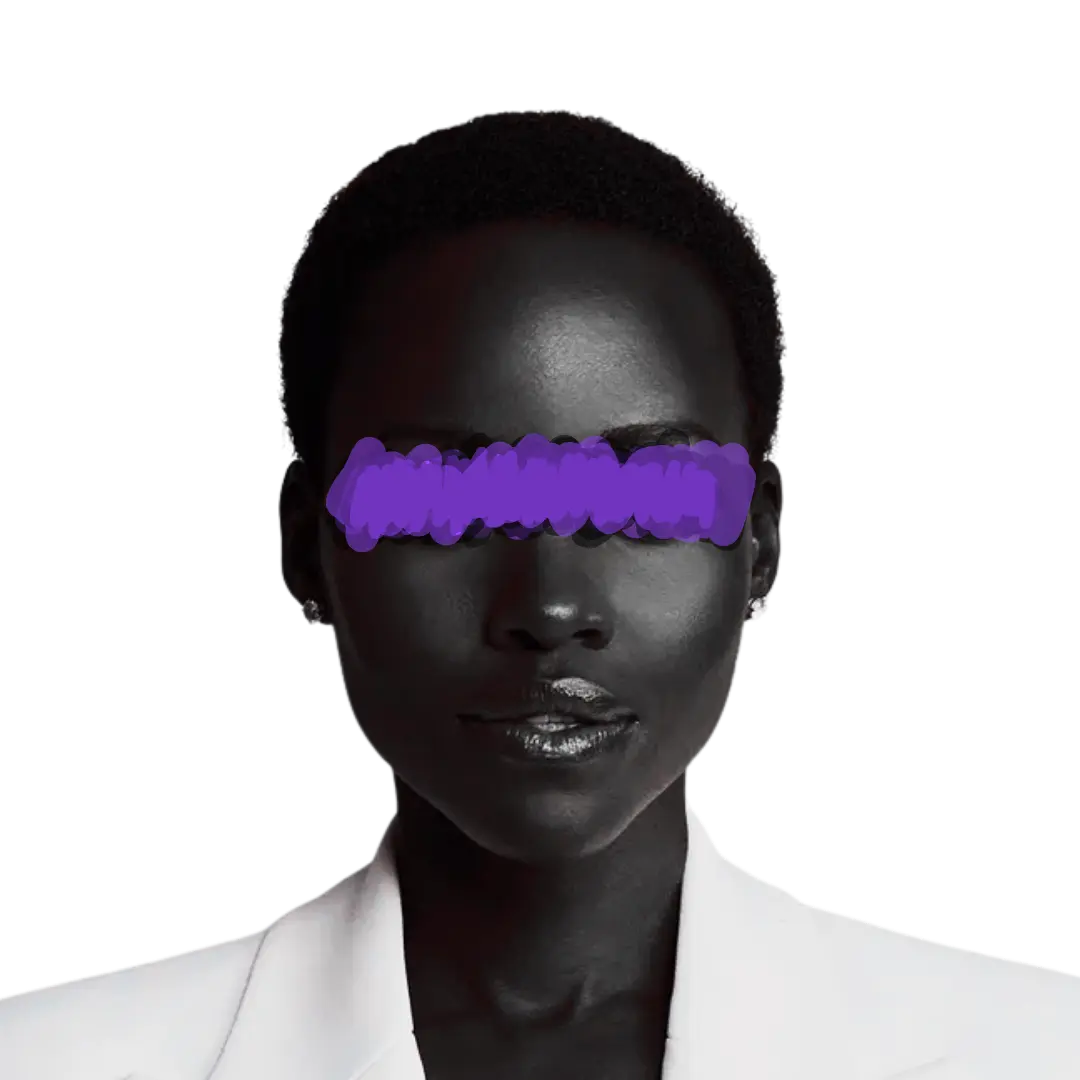
"I definitely grew up feeling uncomfortable with my skin color because I felt like the world around me awarded lighter skin."
When Lupita Nyong'o was a girl in Nairobi, she made a deal with God. She would stop stealing sugar cubes at night if He would make her lighter-skinned. She prayed this prayer every evening. She meant it.
Twenty years later, she stood on the Oscar stage in a pale blue Prada gown and told the world: "No matter where you're from, your dreams are valid." A girl from a village in Kenya watched that speech and put down the skin-bleaching cream she'd been about to use for the first time. She wrote Lupita a letter about it.
The prayer changed. The need behind it didn't.
There's a specific kind of person who transforms their deepest wound into a gift for strangers, not because they've healed, but because giving is the only language their pain learned to speak. Lupita Nyong'o has spent her career making others visible. Dark-skinned girls who were told they weren't beautiful. African stories that Hollywood dismissed as unmarketable. Women who suffered in silence under powerful men. Women whose bodies betrayed them with fibroids and shame.
She illuminates them all. But her own heart stays behind glass.
"In the arena where I'm being desired," she once said, "I'm absent."
TL;DR: Why Lupita Nyong'o is an Enneagram Type 2
- The wound that gives: Every major cause she champions — colorism, fibroids, representation — maps to a personal pain she experienced first and turned outward.
- The invisible helper: She turns down lucrative roles, chooses Broadway over blockbusters, and frames every career decision in terms of what it gives others — not what it earns her.
- The two voices: Behind the grace is a constant internal war between "I can" and "I can't" that she's described in striking detail.
- The privacy fortress: She makes the world feel seen while keeping herself unseen — a pattern that runs from childhood to the present day.
The Color of Midnight
In second grade, a teacher at her school in Nairobi looked at Lupita and asked: "Where are you going to find a husband? How are you going to find someone darker than you?"
She was seven.
Her sister, lighter-skinned, received compliments for her beauty. Lupita received silence, or worse. When she auditioned for a commercial in Nairobi as a teenager, the casting director told her she was "too dark to be on TV." A makeup artist once examined her face and said: "Oh, well, your skin can take anything. It's so tough."
These aren't headline traumas. They're the small, daily erasures that teach a child one lesson: you are not the one who gets seen. Your sister is. The girl on the commercial is.
"I wasn't aware that I belonged to a race called Black until I came to America," she's said. In Kenya, the categories were different. The wound wasn't about race but about shade, the hierarchy within her own community that placed her at the bottom of the beauty scale before she'd ever left the continent.
She dealt with this the way a child deals with impossible circumstances. She bargained. She prayed. She offered up the sugar cubes.
Her mother, Dorothy, watched this unfold. She would later tell Lupita something that stuck: "You can't eat beauty. It doesn't feed you." What Dorothy meant, and what Lupita eventually understood, was that compassion, not appearance, was what sustained a person. When Lupita began gravitating toward theater as a teenager, Dorothy drove her to rehearsals after long days at work and sat in the car for five hours without complaining. "My job was really to facilitate it," she later said. She looked for "opportunities to nurture" rather than impose.
And when the prayers didn't work, Lupita did something else. She started watching other people. Studying them. Playing make-believe in the cupboard with her Barbies, disappearing into imagined worlds. She saw The Color Purple at age eight and something clicked, not about acting as a career, but about the possibility of being someone else entirely.
A Dangerous Thing to Know
The invisibility wasn't just about skin. It was structural.
Lupita was born in Mexico City in 1983. Not because her parents loved Mexico, but because they had fled Kenya. Her father, Peter Anyang' Nyong'o, was a pro-democracy activist who'd been marked by President Daniel arap Moi's autocratic regime. Her uncle, Charles Nyong'o, had been murdered, thrown off a ferry by unidentified men. The family ran.
They returned to Kenya when Lupita was under a year old, but the political danger didn't end. Her father was detained without trial. There were stretches when he simply wasn't there. The family experienced house arrest. And Lupita's parents made a choice: they shielded their children from the details.
"It would be dangerous for them to know things," her father later explained, "because then they could be a target."
Think about what that teaches a child. Information is dangerous. Knowing too much makes you vulnerable. The safest position is to observe without being observed, to watch, to listen, to keep what you know behind a wall.
Her father believes this instability created what he calls Lupita's "chameleon" qualities. He may be more right than he knows. The girl who learned to navigate a household of political secrets grew into a woman who navigates Hollywood with extraordinary control over what the world gets to see.
She is fluent in four languages (English, Swahili, Spanish, and Luo). At sixteen, her parents sent her to Taxco, Mexico, for seven months to learn Spanish. She lived with strangers in a foreign country at an age when most teenagers are negotiating curfews. When her family visited America for the first time in 1999, she spent the entire vacation playing Final Fantasy VIII, not sightseeing, not socializing. Disappearing into a world that wasn't this one. The pattern was already forming: when reality offered no place for her, she built one. In a cupboard with Barbies. In a documentary about albinism. Inside a video game's infinite map.
From Taxco to New Haven
The path to the Oscar ran through two schools and one documentary.
At Hampshire College, she didn't study acting. She studied film. Her thesis project was In My Genes, a documentary about discrimination against people with albinism in Kenya, people who were, in a different way, punished for the skin they were born in. It won first prize at the Five College Film Festival.
She'd been hiding her desire to act for years. The moment she stopped hiding it is telling. While working as a production assistant on The Constant Gardener during its Kenya shoot, she approached Ralph Fiennes and asked him for advice on becoming an actress. He told her it was tough, but "if acting was what she really wanted to pursue, she simply had to persevere."
She needed someone else to say the thing she couldn't say to herself.
She applied to the Yale School of Drama and beat out 950 applicants for a class of 16. Ron Van Lieu, the chair of the acting program, described her as having "an intuitive gift for language" and working "from a completely truthful base, which was an unteachable quality."
At Yale, they told the students something that stuck: acting would be "one long, lonely, hard and fruitless journey." As Lupita later reflected: "They helped us to mentally prepare for failure, but they did not prepare us for success."
She graduated in 2012. The next year, she had an Oscar. No one was prepared for that, least of all Lupita.
"I Thought I Was Seeing Things"
Steve McQueen saw over 1,000 actresses before he watched Lupita's audition tape for 12 Years a Slave. When he did, he was so unsettled by what he saw that he brought in his wife and daughter to watch it with him, just to confirm that the woman on the screen was real.
"I thought I was seeing things," he said.
She had six weeks between being cast and the start of filming. She buried herself in research. She couldn't sleep. On set, McQueen treated her as a peer from the first rehearsal. His only direction: "Fail, and then fail better."
Her portrayal of Patsey, a woman who endures the most intimate horrors of slavery while maintaining an interior life of ferocious dignity, earned her the Academy Award for Best Supporting Actress. She was 31. It was her first film role.
"It doesn't escape me for one moment that so much joy in my life is thanks to so much pain in someone else's."
What happened next is what reveals the pattern. After the Oscar, Hollywood came calling with exactly the roles she dreaded: more slave narratives, more suffering. She turned them all down and chose Broadway instead.
Eclipsed, Danai Gurira's play about five Liberian women during civil war, became the first production with an all-Black, female cast and creative team on Broadway. Lupita earned a Tony nomination. On April Fools' Day during the run, she lured her castmates with homemade chocolate truffles filled with what she promised was "a caramel layer." They were booby-trapped. She posted the results and called it her "most successful April Fools Day prank EVER." For a play about women surviving annihilation, humor was the defense that kept the spirit alive.
What is Lupita Nyong'o's Personality Type?
Lupita Nyong'o is an Enneagram Type 2
The pattern is unmistakable once you see it.
Watch someone like Lupita long enough and you notice the math she's doing. Every cause she takes up started as a wound she carried privately. Every public act of advocacy began as a silent negotiation: if I make this pain useful to someone else, maybe it earns me the right to have felt it at all. That's how a Two moves through the world. Love isn't something they wait to receive. It's something they try to deserve, over and over, by giving first.
Look at her career through this lens:
She turned her childhood pain with colorism into an advocacy platform for dark-skinned girls worldwide. Her first major creative work was a documentary giving voice to people with albinism in Kenya, another group punished for the skin they were born in.
Then came Sulwe, a children's book about a girl "the color of midnight" learning to love herself. It was the story she needed as a child, given to other children instead. It became a New York Times bestseller. She could have written a memoir. She wrote a picture book.
She published a 3,000-word essay about Harvey Weinstein not for her own catharsis but because "my silence felt uncomfortable" while other women suffered. She launched a podcast, Mind Your Own, to amplify African diaspora stories: "to go beyond the news reports about Africans and hear straight from us." She joined legislators to introduce the U-FIGHT Act for fibroids research after suffering in silence for over a decade with her own diagnosis.
Each time, the same conversion: private pain alchemized into public service. This is the Type 2 pattern operating at its most magnificent, and its most costly.
The cost shows up in what she doesn't do: she doesn't advocate for herself. She has described her inner life as "a tug-of-war between two voices: the one who knows she can and the one who's scared she can't." She experiences imposter syndrome with every new role, even after winning an Oscar. When she was diagnosed with fibroids the same year she won that Oscar, she didn't speak about it for over a decade. Her first instinct was to blame herself: what did I do to cause this?
That question is the Two's signature. When something goes wrong, the Two doesn't blame the world. The Two searches for what they failed to give.
Lupita's Two Voices
She has talked about this more openly than most people in her position would:
"I've always had that going on: 'I can't,' and then I do, so the voice says, 'Well, that was an exception!' It's a tug-of-war between two voices: the one who knows she can and the one who's scared she can't."
That's not garden-variety imposter syndrome. That's a woman describing the architecture of her inner life, a constant negotiation between the part of her that has proven herself on the world's biggest stages and the part that still believes she's the dark-skinned girl who couldn't even land a commercial in Nairobi.
"I've learned not to let self-doubt stop me from the thing I'm trying to do," she's said. "It's just one of the hurdles you have to jump over, and if it appears again on the horizon, you just jump over it again."
She didn't say she conquered the doubt. She said she jumps over it. Again and again. It keeps appearing on the horizon. The two voices never merge into one.
Emma Thompson once told Lupita that she'd quit acting for eight years. The conversation gave Lupita permission to step back when needed, to choose what was best for her craft over what the industry demanded. But even that permission had to come from someone else. The Two waits for an external signal that it's okay to have needs.
The Self You Show and the Self You Hide
In 2019, Jordan Peele handed her a role that made the two voices literal.
In Us, she played both Adelaide Wilson (a composed, anxious mother hiding a catastrophic secret) and Red, her underground double who speaks in a shattered rasp. She prepared with "almost a mathematical precision," training in ballet three hours every morning, working with a vocal therapist to build Red's voice safely, creating distinct physical rules for each body. Peele gave her one word to anchor each character: for Adelaide, "queen." For Red, "cockroach."
What makes the performance a Type 2 revelation is how she described building Adelaide: "She's constantly making a mental effort to seem like she is from this world, in order to keep her secret safe. But despite her best efforts, she feels like she's not convincing enough. So I gave her this self-consciousness, which puts her in an almost constant state of anxiety and frustration."
That could describe Lupita herself, the girl who navigated political secrets and colorism by controlling what the world sees. Adelaide is the Two's performance made visible: the constant effort of seeming fine, the anxiety that the mask will slip. Her costar Shahadi Wright Joseph was genuinely frightened of her between takes. Peele told the New York Times: "She walked into the room and you just felt the air suck out of it."
When filming ended, she felt "bent" and "drained." "I stretched my muscles and reached into the depth of my training and my being to work on this movie," she said, "and I definitely had a moment of rupture." But she also said something revealing: "Because I was working on two characters at once, I think it's actually what saved me from having to go to some deep therapy afterwards." Even the healing had to come through giving, to both characters, to the work itself.
The Joyful Warrior
In February 2014, three weeks before her Oscar, Lupita gave a speech at Essence's Black Women in Hollywood luncheon. She told the audience about the girl with the bleaching cream, the one from the letter. She told them about the prayer, the sugar cubes. And then she said the line that became her thesis:
"I realized that beauty was not a thing that I could acquire or consume, but something that I just had to be."
That speech circulated to millions. It became a touchstone. But the structure of the moment is revealing: Lupita shared her deepest wound not for herself. She shared it because a stranger needed her to. The girl's letter gave her permission to be vulnerable, because the vulnerability would serve someone else.
This is the mechanism. It runs through everything.
Her fibroids advocacy follows the same arc. She was diagnosed in 2014. She suffered for over a decade in silence, originally had 23 fibroids removed, then they returned with over 50. Her biggest is the size of an orange. She blamed herself. She felt shame. She questioned her Christian sex education for teaching her to expect pain.
Then, in 2025, she went public. Not with a memoir. With legislation. She joined lawmakers to introduce the U-FIGHT Act — $150 million over five years for fibroids research. She launched the #MakeFibroidsCount campaign. She told interviewers: "Speaking up has really empowered me."
Suffer in silence. Wait until someone else needs you to speak. Then speak for them.
When the Grace Cracks
There are moments when the poised exterior fractures and something fiercer shows through.
In October 2017, when the Weinstein accusations broke, Lupita couldn't sleep. She wrote a 3,000-word essay for the New York Times detailing his harassment: the alcohol, the attempted massage, the proposition. "I needed to get it out," she said. "My silence felt uncomfortable."
Weinstein's camp did something they hadn't done with any other accuser: they disputed her account specifically. She didn't flinch.
In October 2023, she ended her relationship with Selema Masekela with an Instagram post that read: "A love suddenly and devastatingly extinguished by deception." She didn't name him. She didn't explain the deception. One controlled, precise sentence. Then silence.
When asked why she went public, her answer was practical, not emotional: "The thought of having to update people one at a time was going to be harrowing." Then she declared she would keep all future relationships off social media entirely. The door opened for one sentence. Then it locked.
When Hollywood kept offering her slave roles after the Oscar, she didn't politely decline. She drew a line and held it for years, at the cost of working less: "If that means that I work one job less a year to ensure that I'm not perpetuating the stereotypes, then let me do that."
These aren't outbursts. They're surgical strikes. The gentleness doesn't disappear; it concentrates into something harder. A Type 2 under extreme pressure accesses the force of a Type 8: direct, boundaried, unwilling to be moved. The relationship patterns that drive this type (give everything, suppress your own needs, then draw the line with devastating precision when the invisible ledger overflows) played out publicly in the Masekela situation.
Wakanda and What Came After
Black Panther was, for Lupita, something she'd waited her entire career to experience: "An African narrative that did not lead with the struggle of being African." Born in Mexico City to Kenyan parents, she felt both sides of her heritage in the franchise. Wakanda's Afrofuturism in the first film, the Mesoamerican-influenced Talokan in the sequel. There was fear from the executives, she later acknowledged. But the cast "assumed ownership over their performances" and knew they were making something different.
She once woke from a nap on a promotional flight and looked over to find Chadwick Boseman reading a dense African history book. "He had an aura," she said. "He was the leader, and we were all good with it."
When Boseman died in August 2020, she was paralyzed. She hasn't rewatched the original Black Panther since. Making Wakanda Forever meant channeling real grief into fictional grief, and the Type 2 in her found that easier than she expected: "It was heavy and easier than I'd like to admit because the grief was so present. Those scenes needed very little preparation because it was speaking the truth of a feeling that we were all feeling. In a sense, it was a place to put the grief."
When Ryan Coogler sent her the script, she wept: "He wrote something that so honored the truth of what every one of us was feeling."
"The grief is just the love. There's no place to put it. I don't run away from the tears or the grief."
Then, in 2024, she was cast in A Quiet Place: Day One. The role required her to act alongside a cat. There was a problem: Lupita had been terrified of cats her entire life.
"I wouldn't be in a room with a cat," she said. "I would cry."
She begged the director to use a different animal. He refused. So she did what she always does: pushed through the fear, gradually exposing herself until the phobia dissolved. By the end of filming, she'd fallen in love with her feline co-stars. She adopted an orange tabby and named him Yo-Yo.
Yo-Yo arrived during the aftermath of the Masekela heartbreak. She told interviewers the cat helped heal her "severely broken heart."
The Arena Where She's Absent
There's an image of Lupita Nyong'o that the world carries: the luminous Oscar winner in the pale blue gown. The woman whose fashion choices stop traffic, who describes her style as "playful, adventurous" with "elegance." The girl who was told she was too dark to be on TV became one of the most photographed women on red carpets worldwide. "I've always tried to express myself with what I wear," she's said, "to somehow reflect part of my inner appearance." Her mother taught her that presentation is "an expression of how much you care about yourself and those around you." The fashion, like everything else, is both self-expression and gift.
That image is not wrong. It's just not the whole thing.
The whole thing includes a woman who has described privacy as "a commodity that is hard to come by." Who decided, after one public heartbreak, to never let the world near her relationships again. Who suffered with fibroids for a decade before saying a word. Who still hears the second voice (that was an exception, you can't do this) every time she walks onto a set. Who, when asked what sixth sense she'd develop, chose clairaudience, the ability to hear what can't normally be heard, because "listening activates her imagination." The woman the world watches would rather listen than be listened to. She has always been more attuned to other people's frequencies than her own.
She chooses her projects like someone filling prescriptions: Black Panther for African aspiration. Us for the self you won't face. Eclipsed for women erased by war. Sulwe for children erased by colorism. The Wild Robot for the tenderness machines can teach us. Mind Your Own for the African stories no one tells.
"I don't get fulfillment from the number of zeros attached to a project," she's said. She gets fulfillment from the giving. She always has.
The question no one asks, because her grace makes it easy not to, is what happens inside the woman who gives this much. What lives behind the glass. Whether the girl who offered up sugar cubes ever got what she was actually praying for. Not lighter skin. Not beauty. Just someone to look at her the way she looks at everyone else: as if she were already enough, before she'd given a thing.
What would you add?