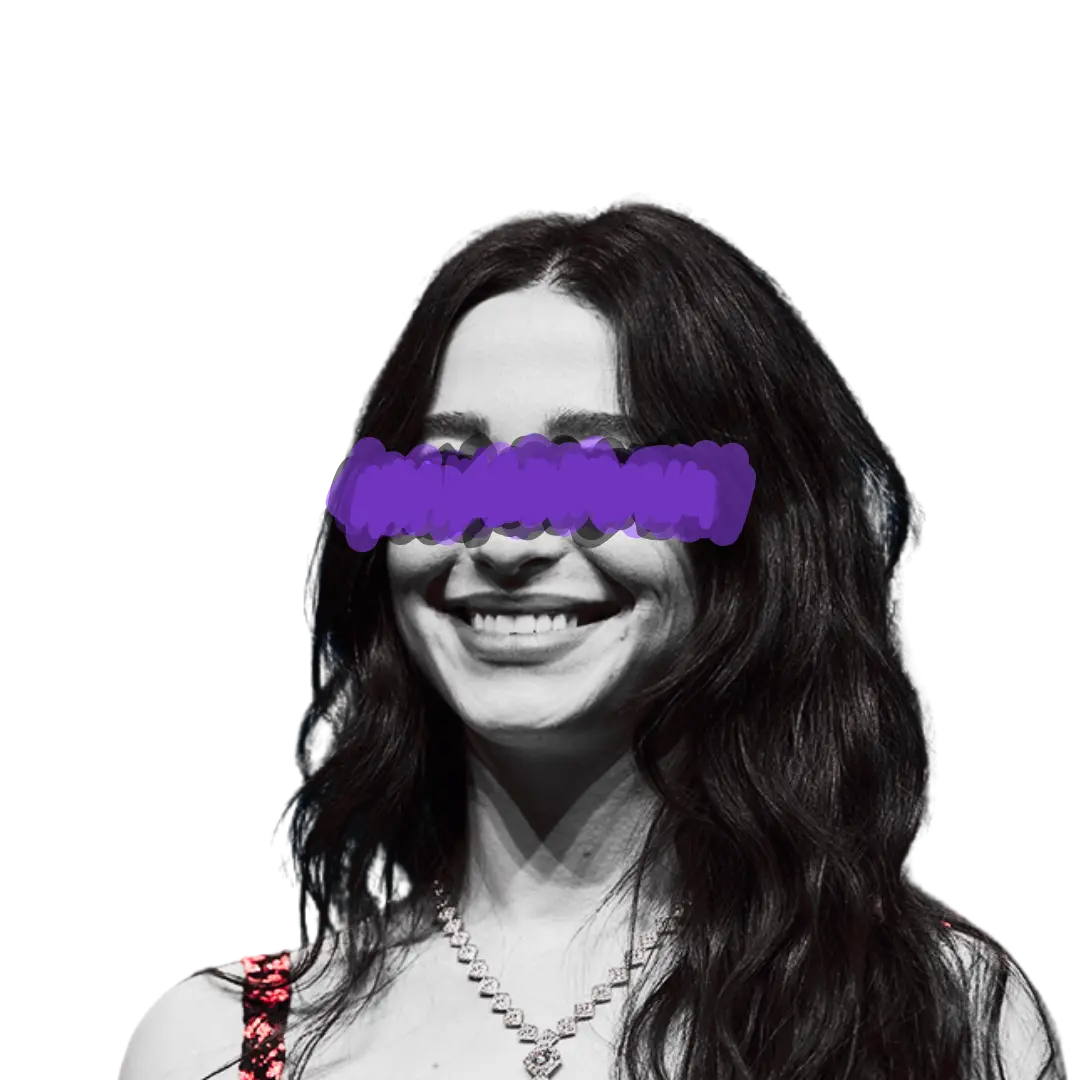
"I was a big daydreamer as a kid. I would daydream about being different versions of myself, versions where I wasn't shy, or I had lots of friends, or I did interesting, crazy things, and felt big emotions."
When Mikey Madison was 19, she walked into an audition for Quentin Tarantino carrying a psychedelic painting she'd made while pretending to be on acid.
She'd researched the Manson Family and discovered they took acid trips together. So she painted something wild, as if her character had painted it mid-trip, wrote a dramatic poem to Charles Manson on the back, cut off a piece of her own hair, sewed it into the canvas, and performed the whole thing for Tarantino.
She knew she'd gotten the part before anyone called. She saw the painting hanging in his office.
This is the same person who told Interview Magazine she was "painfully shy," who "couldn't talk to anyone" and had to "mentally prepare myself just to raise my hand in class." The girl who homeschooled herself so she could spend all day alone at a barn with her pony.
How does someone like that walk into a room with Quentin Tarantino and hand him a lock of her hair sewn into an acid-trip painting?
She doesn't. A different version of herself does. And that gap, between the girl who disappears and the girl who becomes unforgettable, is the key to everything about Mikey Madison.
TL;DR: Why Mikey Madison is an Enneagram Type 9
- The Daydreamer Who Became Her Daydreams: Acting wasn't a career choice — it was the only door between isolation and connection. She couldn't walk into a room as herself, so she walked in as someone else.
- Disappearance as Superpower: No social media. No public persona. She vanishes completely into roles, and the less of herself she shows the world, the more electric she becomes on screen.
- Conflict Through Characters: She avoids conflict "like the plague" in her own life but channels ferocious intensity through her roles — fight scenes, rebellion, rage — as if her characters carry the fire she won't let herself feel.
- The Quiet Core: After winning Best Actress, her first thought was going home to her puppies. No victory lap. No social media announcement. Just back to the quiet.
Mikey Madison's Childhood as a Horse Girl and Daydreamer
"My grandmother was a horseback rider, and my mom was a horseback rider, and so, naturally, I was riding horses before I could walk, or at least sitting on a horse."
Three generations of women on horseback. Mikey didn't choose it. She inherited it. She told The Cut she "literally homeschooled myself so I could be at the barn all day with my pony." Her entire childhood wrapped around the rhythm of the barn: the early mornings, the grooming, the silence between a girl and an animal that doesn't ask her to talk.
For a kid who could barely speak to strangers, it was the perfect refuge. No performance. No small talk. No classroom with hands to raise.
Her parents, both psychologists (her father specializing in schizophrenia, her mother in child psychology), gave her something unusual: an emotional vocabulary before she had the social skills to use it. Her mother's technique was direct: "Okay, what are you feeling? What are you feeling right now? Are you sad? Are you happy? Why are you sad?" Madison credits this as having "helped me a lot with character work." She knew who Freud was by age 11.
But growing up in that household did more than hand her a toolkit. It made her a watcher. "My parents being psychologists, I've grown up really understanding people and why they do things and why they don't do things. They've taught me to be people-savvy, in a way." She inherited, as she puts it, "my dad's depth of emotion and his nostalgia, and my mother's vulnerability and thoughtfulness. Both of my parents are very emotional people." Processing that sensitivity wasn't easy. She called it "very tortuous for me and really difficult to deal with, but I've learned to appreciate it in myself and also in my parents."
She journals to work through things — the daughter of two psychologists doing what comes naturally. Her mother once told her something she still carries: "If only you could see yourself the way you see others, you'd be so much happier."
By 14, something shifted.
"I loved the ritual of getting to the barn and taking care of my horse, but it's kind of an isolating sport," she told The Cut. "I just had a pull towards wanting some deeper connection with other people or wanting to experience something more emotional than what I was doing."
That sentence explains everything that came after. She couldn't get there by being herself — she'd spent years trying.
So she found a loophole.
"I've always had that connection with animals, but I wanted that with other people... internally, I was craving some kind of deeper connection, intimacy, with other people, and I saw acting as a way to possibly be able to have that."
Acting wasn't a career choice. It was the only door she could see between isolation and connection. She couldn't walk into a room as Mikey Madison. But she could walk into a room as someone else.
What is Mikey Madison's Personality Type?
Mikey Madison is an Enneagram Type 9
Most people see a shy actress who got a lucky break. But a deeper pattern runs through everything she does.
In the Enneagram, Type 9s are called the Peacemakers. They instinctively minimize their own presence, merge with whatever surrounds them, and often feel like they don't exist unless they're connected to something outside themselves. Madison has described this without ever naming it: "I was very surprised that you wanted to meet me," she told Baker when he cast her. "I'm very much just a lone wolf kind of person," she said in another interview. "It's a contradiction."
But she didn't retreat into passivity. She found a structured way to merge — acting let her disappear into other people, borrow their courage, their rage, their desire, while her own self stayed safely offstage. And when she finally committed to something she wanted, a competitive drive kicked in that you'd never expect from someone so quiet. The discipline she brought to Anora — a full year of preparation, Russian lessons, physical training, moving to a new neighborhood — reveals the growth line toward Type 3 that Nines tap into when they stop drifting and decide to fight for something.
You see it in the small moments too. "I try not to be emotional around her because I don't know if she likes that," she said of her mentor Pamela Adlon. Even with someone she deeply loved, her instinct was to hide her own feelings so the relationship stayed smooth. When she needs to access emotion on camera, she calls it switching back to "my life as Michaela" — as if being herself is just another character to inhabit.
But here's where most people misread the Nine: they see the peacemaker and miss the volcano. Madison told Screen Daily: "I avoid conflict like the plague." And yet — she sewed her own hair into a painting for Tarantino. She did every fight scene in Anora without a double, coming home covered in bruises. She described Anora's anger with startling precision: "Nobody is just angry or wanting to fight — there's pain underneath that. I always saw her as someone who was deeply vulnerable on the inside but is constantly protecting herself by covering it up with anger and spunk."
That's not just character analysis. That's the mechanism. The Nine's suppressed anger doesn't disappear — it finds a host. Madison's fire flows exclusively through her characters: Max's rebellion on Better Things, Amber Freeman's psychopathy in Scream, Anora's feral refusal to be dismissed. In her own life, she avoids conflict like the plague. On screen, she will bite your hand off. "Any of that bruising is so temporary," she said of the fight scenes, "but that scene is going to be forever, so I wanted to go all in for it." The body absorbs the damage. The art keeps the rage.
And under stress, Nines move toward Type 6 — anxiety, hypervigilance, scanning for threats. Madison's childhood was textbook: physically nauseous before school each morning, debilitated by a fear she couldn't name. "I love people," she told Hollywood Authentic. "But I've always been so scared of them." Her shyness wasn't preference. It was her nervous system in overdrive, a Nine under stress borrowing Six's fear until the classroom felt like a minefield.
How Directors Spotted Fire Inside Mikey Madison
At 16, Madison landed on Better Things, the FX series created by Pamela Adlon. She called it "my college, my acting school, my film school." For seven years she played Max, the surly, combative eldest daughter — a character nothing like her. "I started the show when I was 15 and a half and I'll be 23 soon. My entire career as an actor, I've been on the show. I don't really know life without it."
Max gave her something she couldn't access as herself. "I got to experience a lot of rebellion through her, but with this safety net underneath me." For a girl who avoided conflict in every corner of her own life, spending seven years inhabiting someone who picked fights and talked back was a kind of emotional apprenticeship — learning what anger and defiance felt like from the inside, even if they weren't technically hers.
Adlon became something between a mentor and a surrogate mother. "She looks like she came out of my vagina," Adlon told an interviewer, getting emotional while rewatching old scenes. When the show ended, Madison broke down crying watching Adlon do final ADR work. "I'm really kind of heartbroken that it's ending," she said. Seven years of borrowing someone else's courage, and then it was gone.
Then came Tarantino, who saw the acid-trip painting and, instead of flinching, hung it on his wall. She was 19 when she played Susan "Sadie" Atkins, a Manson Family member who dies by flamethrower in one of cinema's most spectacular deaths. She said Tarantino "reinvigorated my love of filmmaking." For a kid raised in isolation and daydreams, someone saw the wildness in her and welcomed it.
In Scream (2022), she played Amber Freeman, the real mastermind behind the Ghostface killings — a villain who lets her partner believe he's in charge while she does "most of the dirty work." Critics ranked her among the franchise's best. But the most important audience member was watching from a random theater: Sean Baker, sitting next to his wife, turned and said: "We're calling Mikey's reps the minute we leave the theater." He wrote Anora specifically for Madison. No audition. He just knew.
How Mikey Madison Prepared for Anora
Anora is about a 23-year-old exotic dancer in Brighton Beach who marries the son of a Russian oligarch on impulse, then fights tooth and nail when his family's enforcers show up to annul the marriage. It starts as a delirious screwball romance and turns into something rawer — a woman clawing to hold onto a life she was never supposed to have.
Baker's description of the character he needed: "A very strong protagonist with a strong New York attitude. I always thought of her as a scrapper, somebody who could hold their own in a fight."
Madison heard this and started training immediately.
She spent months taking pole dancing classes. She moved to Brighton Beach two months before filming, walking the neighborhood, absorbing the accent and rhythm of the place. She worked with a dialect coach to develop a thick Brooklyn voice that was "worlds apart from her own sophisticated variation of the Valley dialect." She learned Russian, not phonetically but actually studying the language so she understood what her character was saying. "In my first Russian session, I was crying at the end because it's an incredibly complicated language, but I didn't want to memorise the lines phonetically and wanted to understand what I was saying." She started on Duolingo, then realized she needed four pages of dialogue and the app wasn't going to cut it.
She visited strip clubs in LA and New York with Baker, shadowing dancers. "I went in without any preconceived notions of sex work," she said. She dressed up, walked around, observed how the women picked up men, started conversations, told jokes.
Then came the physical cost. She did her own stunts. No doubles for the fight scenes. "I was covered head to toe in bruises, which is why in the end we added that line: 'You bruise easily.' I was totally beaten up by that point."
Her co-stars watched the transformation up close. Yura Borisov, who played Igor, was stunned by how fast she could switch: "She's very calm, and she said, 'Yeah, I'm ready.' And 'Camera, action!' She's gone quiet and needs one second to turn it on." He said she didn't need warmup, didn't need preparation between takes. One second she was quiet and still. The next she was Anora.
Borisov insisted on real physical contact during their fight scenes. "We really had to fight, which was very funny. I got punched by Mikey and I liked it." Madison had never hit anyone before. Mark Eydelshteyn, who played Ivan, called her "one of the most charming, beautiful, nice, professional, and serious scene partners that I ever worked with" and credited her with helping shape his character, a creative partner, not just a performer waiting for direction.
The Voicemail That Changed Mikey Madison's Career
The final scene of Anora is one of the great endings in recent cinema. It's set in a car as snow falls on Brighton Beach. Anora has spent the entire film armored, furious, fighting, refusing to crack. Then Igor kisses her. She turns away. And she breaks.
Madison knew she had a problem. The emotional numbness she'd been channeling for Anora had bled into her own body. She never got emotional on set, even though, as she put it, "me as Mikey, I'm a very emotional person." For the final scene, "I was almost shaking going into the car because I didn't know what that would feel like, because I had been feeling the same way as my character for so long."
She needed to break through. "I think I need to unlock some personal memory from my life as Michaela to try to get to this emotional state."
She played the crew an old voicemail from her father. Something private. Something that tore her apart every time she heard it. "Very emotional. Very personal. Very embarrassing. It put me in a vulnerable position."
They all experienced it together. Then they filmed.
Baker, watching from the backseat: "She does this one single tear, and I was just like, 'Oh my god.'"
The most powerful moment in her Oscar-winning performance required her to stop pretending to be someone else and become, briefly and painfully, herself.
Her twin brother Miles watched the finished film. His response: "Mikey, I didn't see you at all; I just saw the character."
The weight of that sentence only makes sense when you know the history. Growing up, Miles pretended they weren't siblings. "On the last day of school, people would ask him, 'Miles, why are you getting into Mikaela's car?' He'd say, 'Oh, that's my sister.' He's since apologized." They were delivered by Caesarean section at the same time, their parents chose this specifically to avoid conflict about who was older. But while they shared a womb, they didn't share a social world. She was the weird horse girl. He wanted distance.
Now he's her best friend. He sat beside her at the Oscars, handed her the acceptance speech when her name was called, and she introduced him during her SNL hosting debut with the joke: "If you guessed the one who looks like Ron Weasley on testosterone, you win."
The twin who once denied her is now the person who confirms her transformation is complete.
Why Mikey Madison Never Felt Like a Hollywood Kid
The morning the Oscar nominations were announced, Madison was in bed FaceTiming her mom. They both screamed. Then her mother said: "Congratulations, sweetie, I love you so much. Also, you need to take your dog to obedience training."
Nobody expected her to win. Demi Moore was the presumptive Best Actress for The Substance. The industry had its narrative ready. But when Mikey Madison's name was called at the 97th Academy Awards, she walked to the podium and read from a piece of paper she'd brought, just in case.
"I grew up in Los Angeles but Hollywood always felt so far away from me." A pause. "I'm probably going to wake up tomorrow."
She thanked Sean Baker. She honored the sex worker community, the women she'd spent months shadowing and learning from, and pledged to continue as an ally.
Backstage, a reporter asked what she'd do next.
"I'll come home to my new puppies, clean up their mess and that will bring me right back down to earth."
An Oscar winner whose first instinct is to ground herself. To return to the quiet.
Why Mikey Madison Avoids Social Media
Mikey Madison has no Instagram. No Twitter. No TikTok. No public digital presence of any kind.
In an industry that treats social media as oxygen, this isn't a strategy. It's self-preservation.
"It's just not something that feels authentic or natural to me, and I don't think I would have anything very impactful to add to social media." She doesn't even allow herself a lurk. When Dazed asked her about ChatGPT, she replied: "What the fuck is ChatGPT?"
She describes herself as "a very sensitive person" who doesn't think "you're supposed to be reading the things people are saying about you." After her Oscar win, ex-boyfriends started reaching out. She told the LA Times: "Some of it doesn't seem super genuine. Like, old friends coming out of the woodwork. Ex-boyfriends reaching out to me saying, 'Hey, you wanna grab a coffee or something?' I'm like, 'Oh, because you've seen me on billboards?'"
The roles are the public offering. Everything else belongs to her.
Who Mikey Madison Is Off Camera
Ask Madison what a perfect day looks like and her answer could belong to anyone who's never been inside a movie theater: "Sleep in. Spend the day with my pets, my friends, my family. Go see a movie. Cooking, and eating good food. And being comfortable and cosy."
She lives in Laurel Canyon, has been vegan for years, and says the only thing she's "talented at" besides acting is cooking — specifically vegan chocolate chip pancakes, the first thing she ever learned to make. "I like to feed other people." It's how she connects without performing.
Her household includes three chihuahuas — Peaches, Birdie, and a rescue named Strawberry Jam ("to go with Biscuit," her Persian cat). Jam hates men and once made a sound at the vet that she described as "a cross between a distressed turkey call and Princess Peach falling from a tower."
She's funnier than the shy-girl narrative suggests. When a W Magazine shoot director asked for a booster box because she's 5'3", she shot back: "Are you calling me short?" On the Anora set, her improvised monologues got so ridiculous that the cinematographer's camera was shaking because he was laughing. And during her SNL hosting debut, she explained how her horse-girl past prepared her for the role: "Instead of riding horses, I was riding a Russian twink."
She collects vinyl, loves Radiohead and Mazzy Star, and cites David Lynch's Mulholland Drive as a major inspiration. She whispers that she's "generally more of a low energy kind of person."
Why Mikey Madison Turned Down Star Wars
A month after winning Best Actress, Disney came calling. The villain role in Shawn Levy's Star Wars: Starfighter, opposite Ryan Gosling. It was the kind of offer that reshapes a career overnight — the biggest franchise in cinema handing you a central role.
She walked away.
Reports cited a salary dispute — Disney and Madison were reportedly "far apart" on compensation — and that may be the whole story. But it also tracks with everything else about her. She's "an all-or-nothing person. If I do something, it needs to be my whole life." She left competitive horseback riding for the same reason — she couldn't do it halfway. A supporting villain role in someone else's franchise isn't nothing, but it isn't all-or-nothing either.
"I know who I am as an actor and an artist now. I know how I want to feel making a movie. It's an emotional job that I'm doing. So I'm waiting for something that really speaks to me."
What spoke to her instead: Frances Haugen, the Facebook whistleblower, in The Social Reckoning — the sequel to The Social Network. A mermaid thriller called Reptilia opposite Kirsten Dunst. An Edgar Allan Poe adaptation for A24. Smaller worlds she can disappear into completely.
The roles keep getting bigger. The person behind them keeps withdrawing. At 25, she still daydreams — "it kind of runs in my family; my dad is, too" — still drifts into "random little pockets of dreams." And she sees no contradiction in any of it.
Six months after the Oscar, sitting for a Vogue Italia cover story, she said: "I feel like everything around me has changed, and I think that's increasing my need to withdraw into myself." When asked about the gap between who she is and who the world now expects her to be, she offered this:
"We pretend to be who we're not to make others feel comfortable. I think shyness should be considered a form of poetry."
Disclaimer: This analysis of Mikey Madison's Enneagram type is speculative, based on publicly available information, and may not reflect the actual personality type of Mikey Madison.
What would you add?