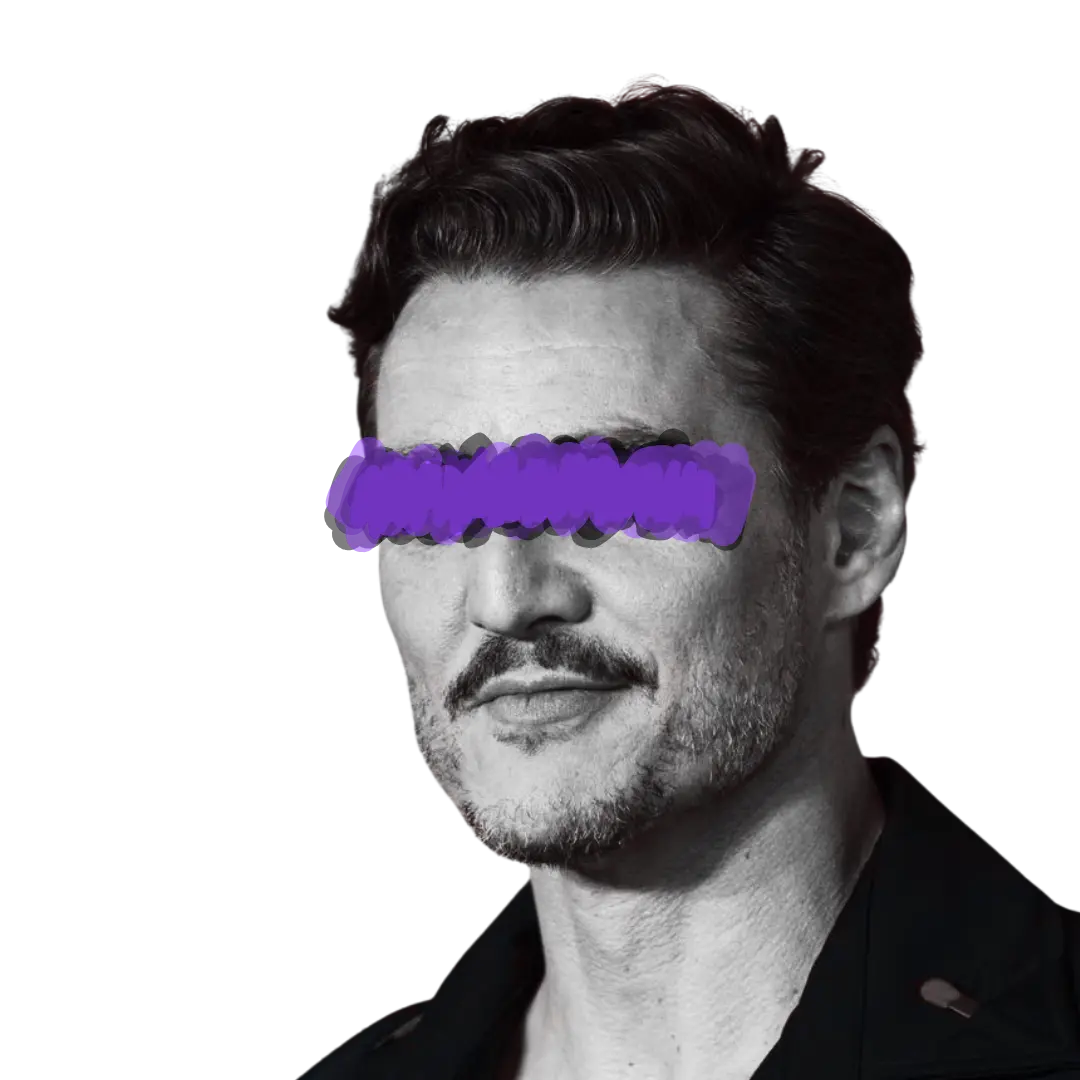
"Fear is the way that they win. So keep telling the stories, keep expressing yourself and keep fighting to be who you are."
In the summer of 2025, a coordinated smear campaign tried to destroy Pedro Pascal's reputation. Thousands of posts. Millions of views. AI-doctored videos. The accusations were baseless, with no victims, no complaints, no evidence, and they collapsed within days.
But what Pedro Pascal did next tells you more about who he is than any role he's ever played.
He didn't defend himself. He didn't issue a statement. He opened Instagram and posted links to the Trevor Project's suicide hotline for LGBTQ+ youth, to Doctors Without Borders, and to World Food Kitchen campaigns to get aid into Gaza.
The most anxious man in Hollywood responded to an attack on his character by redirecting every eyeball to the people who actually needed protecting. That tension, between the fear that lives in his chest and the reflex to shield everyone around him, runs through everything Pascal does.
TL;DR: Why Pedro Pascal is an Enneagram Type 6
- The paradox: He's lived with anxiety "since childhood" and calls it "part of my chemistry." Yet he keeps choosing roles, and real-life battles, that require him to be the protector.
- The loyalty test: A 30-year friendship that fed him when he was broke. A sister whose identity he championed before it was safe. An inner circle so tight they showed up within hours when the internet turned on him.
- The turning point: At 50, Pascal described feeling "much more vulnerable" than at any point in his career, while simultaneously becoming Google's most-searched actor in America.
- The question: What does it mean that the man America chose as its father figure has been afraid his entire life?
What is Pedro Pascal's Personality Type?
Pedro Pascal is an Enneagram Type 6
The Enneagram Type 6 mind scans constantly. What could go wrong? Who can I trust? Where is the exit? This isn't pessimism. It's preparation. And when a Type 6 decides you're one of their people, they will fight harder for you than they would ever fight for themselves.
Pascal's childhood exile, his 20-year struggle before fame, his anxiety management, his fierce advocacy: all of it traces back to a single psychological engine. He learned early that the world is uncertain, and he responded by becoming someone others could count on.
Director Celine Song captured it after working with Pascal on Materialists: "What I really love is how inside, just beyond [the harder exterior], is this very, very, very vulnerable person, who is not as certain as he seems. That duality really inspires me."
Born Running: The Exile That Shaped Everything
José Pedro Balmaceda Pascal was born in Santiago, Chile, in 1975. His mother Verónica was a child psychologist. His father José was a fertility doctor. They were young, liberal college students, not revolutionaries, as Pascal has clarified, but that distinction meant nothing under Pinochet.
When José treated a gunshot victim's injuries, the man revealed his name under torture. Both parents became targets overnight.
"Both of my parents were immediately dangerous to have in society as far as the military dictatorship was concerned," Pascal told NPR. The family hid for six months in the Venezuelan embassy. Baby Pedro was left with his aunt. Then Denmark. Then San Antonio, Texas.
Think about what those first years encode. Separation from parents. Hiding. Foreign countries. A child's brain absorbing the lesson that safety is something you flee toward, not something you're born into. This is the origin story of a Type 6 mind: the world proved itself unsafe before language could explain why, and the scanning — what could go wrong, who can be trusted — began before conscious memory.
And layered on top of the fear, something else: obligation. "In spite of what my parents went through, they were also very lucky," Pascal said on the Talk Easy podcast. "They carry the guilt of their parents' humble beginnings. It made us feel such permission to be and do what we want. It's some sort of duty. Be grateful."
Permission laced with duty. Freedom that feels like debt.
The San Antonio Kid
In Texas, Pedro's parents tried to build something normal. "My parents were so young and they were Chilean immigrants in San Antonio," Pascal has said. "It was all about going to movies, rock concerts, and Spurs games."
But normalcy fractured. His parents separated. The family moved to California when Pedro finished fifth grade, and he has described those years as "really, really rough," the outsider accent, the displacement, the bullying that comes with being the new kid who doesn't quite fit.
Then the worst thing happened.
His mother Verónica died in 1999. Pascal changed his professional name to honor her, dropping "Balmaceda," his father's surname, and keeping "Pascal," his mother's. He has spoken about this loss with a rawness that decades haven't softened: "I haven't been able, and I don't know if I can one day, completely reconcile how my parents separated and the tragedy that came after that separation."
Years later, the grief hardened into something else. "You think not getting a job can break me?" he told himself during the long years of rejection. "You can't break me. I'm already broken." The logic is pure Type 6: if the worst has already happened, nothing can leverage your fear against you.
His father José returned to Chile and continued practicing medicine. The relationship survived the distance. In 2021, José told Chilean media that he and Pedro stay connected through a family WhatsApp group called "Abuelo Pepe," and said of his son's success: "Everything that is happening to him he deserves enormously."
In November 2024, father and son walked the red carpet together at the global premiere of Gladiator II in London. The woman who had been a child psychologist, trained to understand how minds work, was gone. But the family she'd held together found its way back to each other.
Twenty Years in the Wilderness
Most people discovered Pedro Pascal as the charismatic Oberyn Martell in Game of Thrones or as the masked Mandalorian. What they don't know is the nearly two decades of waiting that preceded those roles.
After studying at NYU's Tisch School of the Arts, Pascal spent years doing exactly what thousands of actors do. Surviving. He waited tables at Time Cafe, El Teddy's, Ruby Foo's, and got fired from maybe ten of them because he kept leaving for auditions. He took single-episode guest spots on shows like Buffy the Vampire Slayer, Law & Order: SVU, and The Good Wife.
A residual check from his tiny Buffy role once kept him from having to quit acting entirely. At one point he had less than seven dollars in his bank account.
This was his entire twenties and most of his thirties. On NPR's Fresh Air, he talked about getting fired repeatedly, about a dance training background that didn't translate into steady work, about the specific grind of being talented enough to keep getting callbacks but not famous enough to keep getting cast.
The breakthrough arrived through friendship. Sarah Paulson, who'd met Pascal at NYU in September 1993 and had been in the trenches with him ever since, passed his Game of Thrones audition tape to David Benioff through Amanda Peet. That connection, built on 20 years of showing up for each other, opened the door to Oberyn Martell and everything that followed.
For a Type 6, the breakthrough didn't come from networking or luck. It came from the thing they value most: a bond tested by time.
Building a Career on Protectors
After Game of Thrones, Pascal landed DEA agent Javier Peña in Narcos (2015-2017), his first genuine leading role and the one that proved he could anchor a prestige drama across three seasons. Peña wasn't a clean-cut protector. He bent laws, allied with dangerous informants, and operated in what Pascal described as a world where "the lines between good guys and bad guys get more and more blurry the deeper you go." His loyalty wasn't to the DEA or any rulebook. It was to his own reading of what needed doing — "I'm gonna do my own thing, and it isn't necessarily because it's the right thing to do." That's the Type 6 who has decided the system can't be trusted and becomes his own authority.
Then came the Mandalorian, Joel Miller, Reed Richards. The thread connecting them isn't genre or budget. It's psychology.
Din Djarin protects the Child. Joel protects Ellie. Even Oberyn was driven by loyalty to his murdered sister. Pascal gravitates toward characters organized around a single question: who needs me, and what am I willing to sacrifice?
Playing Joel in The Last of Us earned Pascal his second Emmy nomination for Lead Actor in a Drama, making history as only the second Latino actor to compete in that category after Jimmy Smits, who earned five consecutive nominations for NYPD Blue between 1995 and 1999. A 24-year gap.
When Joel was killed in the second episode of Season 2, Pascal could have switched to a Supporting Actor submission. He stayed in Lead. The performance, reduced to fragments, flashbacks, the echo of a man, earned him a fourth Emmy nomination overall.
"It's hard for me to separate what the characters are going through and how it makes me feel, in a way that isn't very healthy," Pascal told Deadline about filming Season 2. He was injured and exhausted during production, in what he called "a low place." For an actor whose own psychology mirrors his characters' protective grief, the line between Joel's pain and his own had dissolved.
Anxiety as Operating System
"Part of My Chemistry"
"It's something I've lived with since I was a child, so it's a part of my chemistry," Pascal told The Guardian about his anxiety. "I don't know what kind of person I'd be without it. It's something that I manage, but it's also part of what makes me, me. I know that I have to put myself in high-stress situations to be happy. Within reason. But there's a certain level of anxiety that helps me do good work."
He doesn't fight it. He doesn't hide it. He has a physical tell: for nearly 20 years, cameras have caught him pressing his hand against his torso at red carpet events. When Bella Ramsey asked about it at a 2023 Last of Us FYC event, he said simply: "You know why? It's because my anxiety is right here." The pose, captured at the Met Gala, the Vanity Fair Oscar Party, and dozens of premieres, isn't a fashion choice. It's a grounding mechanism.
At the 2024 SAG Awards, Pascal won Outstanding Male Actor in a Drama Series. He walked onstage and immediately disclosed: "This is wrong for a number of reasons. I'm a little drunk. I thought I could get drunk." He thanked the union he'd been part of since 1999, forgot the other nominees' names, got choked up thanking his family, and then cut himself off mid-sentence: "I'm going to have a panic attack and I'm going to leave."
It got a laugh. It was also true.
At the 2024 San Diego Comic-Con panel for Fantastic Four, he reached for Vanessa Kirby's hand as they walked onstage. Some tried to spin it as inappropriate. Kirby shut it down: "He wanted me to know that we were in this together."
Doomscrolling and the Search for Connection
During the pandemic, Pascal's natural coping mechanisms broke down. "I was always one to reach out when I'm facing something that is challenging or making me anxious," he told Men's Health. "I definitely kind of stopped doing that, and instead I'm doomscrolling, or looking for something to watch; looking for different ways to disassociate from the feeling I'm having."
The habit never fully left. In a joint interview with Joaquin Phoenix for Eddington, Pascal admitted: "I'm doomscrolling like a fucking madman. It's worse than ever before." He described social media as "pacifying a feeling of helpless impotence against things that I feel angry about." Phoenix doesn't doomscroll. Pascal can't stop.
When it got bad enough, he went back to what always worked: "Engagement in my relationships, my friendships, and conversation and shared experience." Connection as medicine. Understanding how each type handles stress illuminates why this pattern runs so deep. His coping comes down to three things: human connection when possible, physical self-grounding when the body takes over, and naming the fear out loud instead of performing composure. He's never publicly mentioned therapy or meditation. His trainer has documented physical routines for role preparation, but when it comes to the anxiety itself, Pascal's toolkit is stubbornly interpersonal: talk to the people who know you, name what you're feeling, and stop pretending you're fine.
Public Vulnerability, Private Boundaries
Pascal told Vanity Fair he feels "perplexed" when identified as a "highly private person." His correction: "I'm very unprivate in my private life." He's open about anxiety, grief, politics, his sister's identity. What he guards is romantic relationships, and his explanation reveals the Type 6 psychology underneath: "I just know that personal relationships are such a complex thing to navigate, even without having this enormous lens on them."
He'll tell you about the fear that lives in his body. He won't tell you who he's dating. The things he protects most fiercely are the things where trust could be broken by a specific person rather than a faceless mob. Public vulnerability is manageable because it's on his terms. Intimate vulnerability requires trusting someone not to weaponize it.
For a man whose earliest lesson was that safety can be taken without warning, that's a different calculus entirely.
The 7 Wing: Chaos, Charm, and the "Daddy" Arc
Here's the thing about Pedro Pascal that the anxiety narrative alone doesn't capture: he is genuinely, chaotically funny.
At the SNL 50th Anniversary special in 2025, he missed his musical cue in a sketch with Sabrina Carpenter, not once, not twice, but three times in a row. His recap: "I was the first record scratch of the night." He described it as "a cognitive and auditory failure" caused by nerves so severe he literally could not hear the cue. Then he told the story on every press tour stop, laughing harder each time.
When paparazzi photographed his Starbucks order (six shots of espresso over ice in a venti cup) and Jimmy Kimmel asked about it, Pascal's outrage was magnificent: "I cannot begin to tell you how violating this was. It's an incredibly private morning ritual that I never wanted anyone to know about." The punchline: "You sip it, you get really high, and you answer emails and stuff."
This playful energy comes from a strong Type 7 wing, the combination sometimes called "The Buddy." The humor doesn't replace the anxiety. It rides on top of it. He misses the cue because he's terrified, then turns the terror into the funniest story of the night. The six-shot espresso order is objectively chaotic. He builds warmth by being so disarmingly honest about his own mess that people can't help trusting him.
The "internet daddy" phenomenon tracks a similar pattern. In 2022, when a reporter showed him a tweet calling him "my cool, slutty father," he leaned all the way in: "I am your cool, slutty daddy." By mid-2023, he'd built a theory for it: "It seems a little role-related. The Mandalorian is very daddy to baby Grogu. Joel is very daddy to Ellie. These are daddy parts."
By late 2023, the fatigue set in. An Esquire interviewer raised the topic and Pascal was blunt: "Everyone says 'zaddy,' and I still don't know what it means. And enough already." When an Access Hollywood reporter handed him explicit thirst tweets to read aloud at a Mandalorian premiere, he read them silently, said "No," followed it with "Dirty, dirty!" and walked away.
The arc is pure Six: engage cautiously, try to understand the rules, develop a theory to explain what's happening, and then, when the boundary starts to feel unsafe, draw the line firmly.
Everywhere Is Home and Nowhere Is Home
Pedro Pascal speaks Spanish as his first language. "That is what we spoke at home," he said in a 2014 Reddit AMA. His Oberyn Martell accent was modeled on his father's. At SNL, he closed his monologue with a message to his 34 Chilean cousins: "Te amo, te extraño, and deja de dar mi información personal." I love you, I miss you, and stop giving out my phone number.
But the identity question is more complicated than bilingual fluency. When asked by GQ Mexico what being Chilean-American means, his answer was deliberate: "To be in Chile is to be at home, but my life has been very nomadic. I do not feel as though my identity is completely Chilean or completely American."
In 2023, the Carnegie Corporation named him to their "Great Immigrants" list. His statement cut to the core: "Everywhere is home and nowhere is home. But that also still feels like a good thing to me. It's often framed as a disadvantage in our culture, but it's an advantage in character, and in perspective, and in outlook."
At Cannes in 2025, promoting Eddington, he made his most forceful public statement connecting his exile to the present: "I am an immigrant. My parents are refugees from Chile. We fled a dictatorship, and I was privileged enough to grow up in the United States after asylum in Denmark. If it weren't for that, I don't know what would have happened to us. I stand by those protections always."
A man who learned in infancy that home can be taken away builds a self that isn't dependent on place, and then spends his career playing men who create safety wherever they stand.
The Inner Circle
Sarah Paulson: 30 Years Deep
They met in September 1993 at NYU. They've been inseparable ever since.
During Pascal's struggling years, Paulson gave him money from her per diem to buy food. "There were times when I would give him my per diem from a job I was working on so that he could have money to feed himself," she told Esquire. And when it mattered most, she was the one who got his audition tape to the right people, opening the door to everything.
When he hosted Saturday Night Live in 2023 (the "HBO Mario Kart" sketch became the season's most-watched pretaped segment with 19 million YouTube views), Paulson appeared. As she recently put it: "He pays for dinner now."
Oscar Isaac: Brothers from the Same Exile
Pascal and Isaac met doing off-Broadway theater in 2005. The play was The Beauty of the Father, and Pascal was earning $500 a week before taxes. Isaac played a ghost, meaning Pascal's character couldn't see him. Isaac weaponized this theatrical rule, physically messing with Pascal during live performances to make him forget his lines or break character. Pascal called it "simultaneously dark and wonderful."
They share something deeper than friendship: both are children of Latin American immigrants who came to the U.S. under difficult circumstances and pursued the same impossible dream. Pascal described the bond to Esquire as finding "family along the way" while on "a lonely journey," and called Isaac "the younger brother I never wanted."
Isaac's characterization differs. Asked which actor he'd travel to space with, he said: "My sweet girlfriend Pedro. My girl. We're two sisters. Space sisters. That's my baby." The joke is always running. The loyalty underneath it never blinks.
Lux Pascal: "I See You Before I See Myself"
In 2021, Pedro's younger sister Lux came out as transgender in a Chilean magazine interview. Pedro's response was immediate: "Mi hermana, mi corazón, nuestra Lux."
But the support preceded the public moment by years. Lux has said Pedro "was one of the first people to gift me the tools that started shaping my identity." When she came out to him over FaceTime, his response was: "Perfect, this is incredible."
In October 2025, Pedro sat in the front row at Paris Fashion Week and watched Lux walk the Chanel runway for Matthieu Blazy's debut collection. He got teary-eyed. Lux said afterward: "Getting a hug from him was the best gift ever."
A month earlier, in a joint ELLE interview, Pedro called Lux his "muse" and said something that stopped the room: "I see you before I see myself." When discussing the persistent need to "qualify" transgender identities in public discourse, his frustration was direct: "I get annoyed that it needs to be qualified in any way."
He wore a "Protect the Dolls" T-shirt, a slogan celebrating trans women, at his own 50th birthday party. The shirts raised over $600,000 for Trans Lifeline.
Turning 50: "Much More Vulnerable"
Pedro Pascal turned 50 on April 2, 2025. He threw a multiday birthday bash in London headlined by DJ Honey Dijon. He danced on someone's shoulders. His sister was there. His friends were there.
But turning 50 cracked something open. "Stepping into my 40s felt adult and empowered," Pascal said. "Fifty felt more vulnerable, much more vulnerable."
When Fantastic Four fans criticized his casting ("He's too old. He's not right. He needs to shave"), Pascal felt it deeper than expected: "I think maybe my nerves were bigger than they usually are, and so I think I just was a little bit more sensitive to the love that people have for stories like this." He wasn't defensive. He was sensitive. And he named it.
The role itself came through a lifelong friendship with director Matt Shakman. They'd known each other since their twenties in the LA theater scene, shared the same early talent manager, and nearly became roommates. Pascal called the casting "absolutely fated in the stars," then immediately doubted it: "I was skeptical over his choice to cast me. I was questioning if I would serve it as best as it was meant to be served — to be convincing as an astrophysicist, as a father, a husband." He approached Reed Richards as a brain character, not a physical one, drawing creative inspiration from the octopus — "not in any literal physical translated way, but I put it into my subconscious." And he described the core vulnerability of entering the most scrutinized franchise in Hollywood with disarming honesty: "You just never know if people are going to be disgusted by your heart or not."
Then, in the middle of the press tour, the coordinated smear campaign from the opening of this piece hit. AI-doctored videos. Fabricated narratives built on interviews that didn't exist. His response: charity links, irreverent Instagram replies ("later, gator!" to trolls threatening to unfollow; "that's too bad. Wait, no I don't give a shit" to former fans), and zero capitulation. The man who described himself as "much more vulnerable" at fifty handled the worst public attack of his career by refusing to perform distress.
Robert Downey Jr., who hosted "homework days" for the new Avengers cast while filming Doomsday at Pinewood Studios, told Vanity Fair that "Pascal's slow trajectory to becoming a household name who is on a wildly hot streak kind of reaffirms my faith in our industry."
The slow trajectory. Two decades of near-empty bank accounts, residual checks from bit parts, and getting fired from restaurants before a single person knew his name. The man Downey described didn't burst onto the scene. He endured into it.
Why Pedro Pascal Became Everyone's Father Figure
The "internet daddy" phenomenon isn't random. America didn't just decide Pedro Pascal was attractive. Plenty of actors are attractive. What Pascal offers is something rarer: the sense that he would actually show up.
He told The Guardian that anxiety "helps me be aware of the things I need to be aware of." The fear doesn't prevent him from showing up. It's why he shows up. The scanning that never stops is the same mechanism that notices who in the room is nervous, who needs a hand to hold walking onstage, who needs a link to the Trevor Project more than they need another celebrity's self-defense.
He's been afraid his entire life. And the people closest to him — the ones who fed him when he was broke, who trusted him with their identity, who sabotaged him onstage in a 2005 off-Broadway play and became his brother — will all tell you the same thing: they have never once doubted that he would be there.
Disclaimer: This analysis of Pedro Pascal's Enneagram type is speculative, based on publicly available information, and may not reflect the actual personality type of Pedro Pascal.
What would you add?