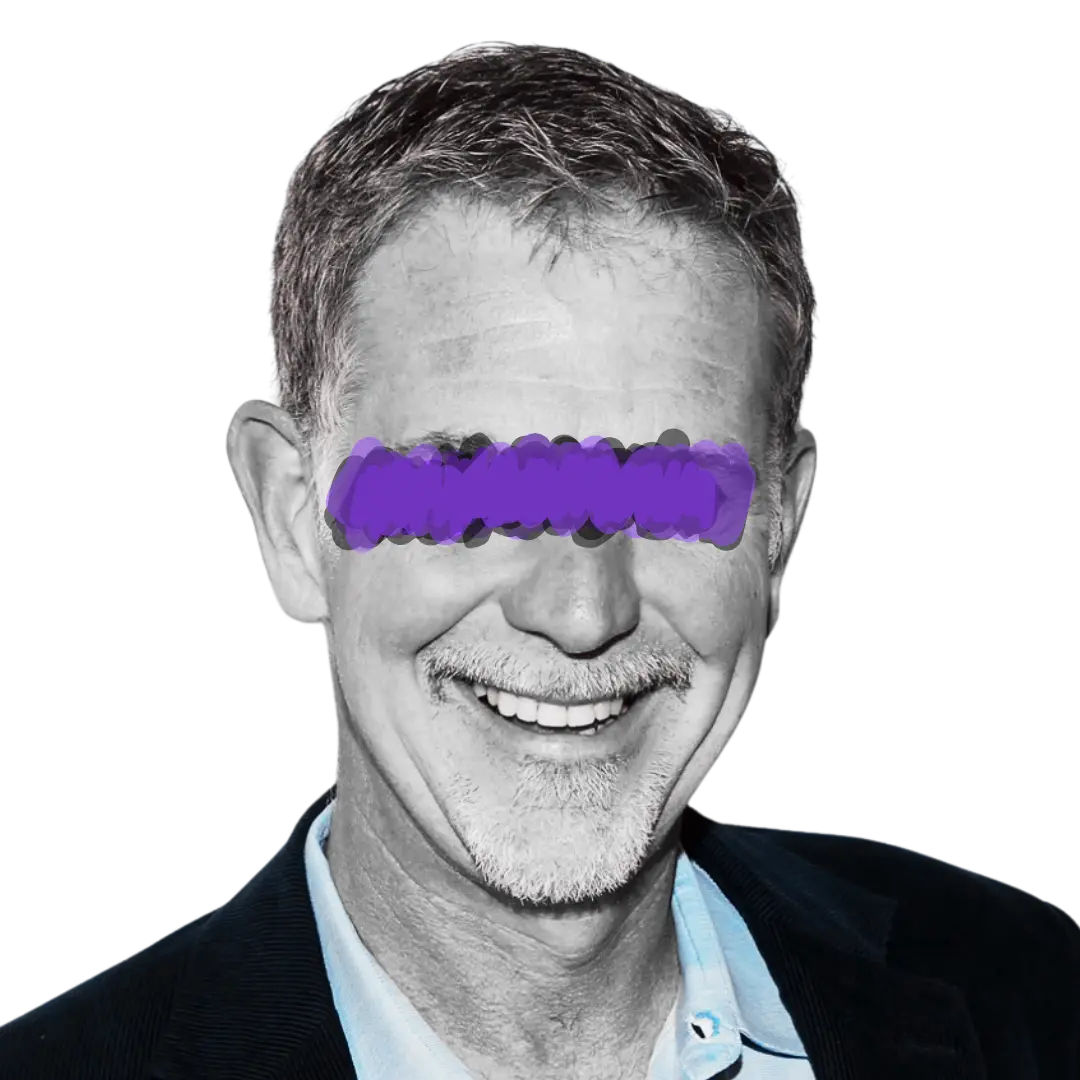
"Once you have hitchhiked across Africa with ten bucks in your pocket, starting a business doesn't seem too intimidating."
In the year 2000, on the 27th floor of the Renaissance Tower in Dallas, Reed Hastings sat across from the CEO of a $5 billion company and asked him to buy Netflix for $50 million. Marc Randolph, Netflix's co-founder, watched the response from across the table. He saw Blockbuster CEO John Antioco's face shift — "his earnest expression slightly unbalanced by a turning up at the corner of his mouth. It was tiny, involuntary, and vanished almost immediately. But as soon as I saw it, I knew what was happening: John Antioco was struggling not to laugh."
CFO Barry McCarthy put it more bluntly: "They laughed us out of their office."
Ten years later, Blockbuster filed for bankruptcy. Netflix had 16 million subscribers. By 2025, it had acquired Warner Bros. for $82.7 billion.
But this isn't really a story about a scrappy startup beating a giant. It's a story about a man who spent his entire life rejecting other people's systems — the Marine Corps, corporate bureaucracy, traditional management, elected school boards — and replacing them with his own. Reed Hastings didn't give Netflix employees radical freedom because he trusted them. He gave them freedom because rules are how other people control you. And the one thing he will not tolerate is being controlled.
TL;DR: Why Reed Hastings is an Enneagram Type 8
- Control disguised as freedom: He built a company with no vacation policy, no expense approvals, and no travel rules — then created the Keeper Test, where mediocrity is the only firing offense. The absence of rules IS the system.
- Reflexive rejection of authority: Dropped out of Marine officer training, sold vacuums for fun, joined the Peace Corps, hitchhiked across Africa — all before age 25.
- The marriage counselor revelation: A couples therapist taught him he was a "systematic liar" — and that lesson became the foundation for Netflix's radical transparency culture.
- Protective fury channeled into philanthropy: $1.1 billion toward education, with a focus on historically Black colleges and a belief that elected school boards are "the single biggest impediment to educational improvement."
What is Reed Hastings' Personality Type?
Reed Hastings is an Enneagram Type 8
Most people see a visionary who liberated his employees from corporate bureaucracy. The Netflix culture deck, the "Freedom and Responsibility" philosophy, the bestselling book No Rules Rules — it all looks like a man who genuinely believes in trusting people.
But if you understand Type 8, the real driver isn't trust. It's an allergic reaction to being controlled.
Enneagram Type 8s — "The Challengers" — carry a core fear of being vulnerable, manipulated, or subjected to someone else's power. They respond by seizing control of their environment. Some do this through domination. Hastings does it through architecture. He designs systems where he sets the terms, and the terms happen to look like freedom.
"I take pride in making as few decisions as possible," he told Stanford GSB. That sounds like delegation. It's actually a man who learned the hard way that making decisions means other people get to argue with you about them.
Why not Type 3? The achievement-driven Achiever is the most common mistype for successful tech CEOs. But Type 3s are image-conscious — they need to be seen succeeding. Hastings said, "I'm as surprised as anyone about my business success." When a Netflix VP told him he was "not a good listener" and "tends to be unempathetic," his response was: "Which, I have to say, even at my level of success, it hurts. I thought I had done better in that dimension." A Type 3 would manage that feedback. Hastings absorbed the blow and tried to grow. That's an Eight.
His wing leans 8w7 — the adventurer's restlessness layered on top of the Challenger's intensity. Hitchhiking across Africa, selling vacuums door-to-door for fun, the Peace Corps, nearly dropping out of Stanford to build a foot-operated computer mouse. "The few times I've done investing, I've lost my shirt," he admitted to Tim Ferriss. "I'm just so optimistic. Anybody who seems to have a good idea, I'm like, 'Sure!'" That wide-eyed optimism is pure Seven wing — and it makes his Eight core harder to spot until you watch what happens when someone tells him no.
The Vacuum Cleaners, the Marines, and the Valleys of Swaziland
Reed Hastings was born into Boston's elite. His father was an attorney in the Nixon administration. His mother, Joan Amory Loomis, was a debutante from old-money Boston Brahmin stock — and she was repulsed by it. She taught her children to disdain the world of high society.
His great-grandfather, Alfred Lee Loomis, had been a Wall Street tycoon who abandoned finance to become a physicist, helped develop radar during World War II, funded Ernest Lawrence's cyclotrons, and played a role in the Manhattan Project. The family legacy wasn't wealth. It was the conviction that if you're smart enough, you can tear down one world and build another.
Young Reed didn't go straight to college. He deferred his acceptance to Bowdoin College for a full year to sell Rainbow vacuum cleaners door-to-door.
"I loved it, strange as that might sound," he said. "You get to meet a lot of different people."
At Bowdoin, he threw himself into math. A professor ran a self-paced calculus program. After completing it, Hastings authored a detailed proposal for improving the entire program. The professor later noted: "We ran the program for well over 10 years and no student had ever turned in anything like that."
Between his sophomore and junior year, he spent summers at Marine Corps Platoon Leader Class in Quantico, Virginia. He found himself questioning how they packed their backpacks. How they made their beds. Why the procedures existed at all.
"My questioning wasn't particularly encouraged," he said. "And I realized I might be better off in the Peace Corps."
That pivot — from an institution that demands obedience to one that demands initiative — tells you everything about the engine running inside him. Hours after receiving his Bowdoin diploma in spring 1983, he boarded a flight to Swaziland.
He taught math at a high school of 800 students. He lived with a family three kilometers from the school and walked through what he described as "gorgeous valleys twice a day." He started a beekeeping project on the side, teaching villagers how to build hives, manage African killer bees, and market honey. He helped develop better water delivery systems.
"Out of a combination of service and adventure," he explained later about why he chose the Peace Corps. Service for the protective instinct. Adventure for the need to test himself against the world. Both drives would run his life for the next forty years.
The System That Ate Its Creator
After Stanford, where he earned a master's in computer science — and where he very nearly dropped out to start "The Foot Mouse Company," a foot-operated mouse that caused leg cramps after twenty minutes and got "gross" after a few days on the floor — Hastings founded Pure Software in 1991.
It went public in 1995. And then it started to die.
"It was the feeling of near-drowning constantly by the growth and by my lack of preparation," he said. "I just felt like a failure because I was clearly making these big, wrong decisions."
He churned through five VP of Sales in six years. Every mistake led to a new rule. Every rule drove out the people creative enough to break them.
"My first company was exciting and innovative in the first few years and bureaucratic and painful in the last few. The problem was we tried to systemize everything and set up perfect procedures."
The market shifted from C++ to Java. Pure couldn't adapt. It was acquired by a competitor.
"I was sincere but naive."
A lesser person would have called it a learning experience and moved on. Hastings spent two years dissecting what went wrong. He had built a machine designed to prevent errors — and the machine itself became the error. The rules he created to protect the company became the thing that controlled it.
He would not make that mistake again.
The Systematic Liar
Before Netflix, before the culture deck, before "Freedom and Responsibility" became a management philosophy studied worldwide, something happened in Reed Hastings' marriage.
He went to see a counselor. The counselor identified a pattern: Hastings would say things he believed were true — "Family is the most important thing" — while behaving in ways that contradicted them. Staying late at work. Prioritizing employees over his wife and children. Projecting values he didn't actually live by.
The counselor's diagnosis was blunt: he was a systematic liar. Not malicious. Not conscious. But systematic.
"That marriage counselor turned out to be the best CEO coach I ever had," Hastings said.
The lesson he took from his marriage into his company was radical honesty — total commitment to the truth, even when it's uncomfortable, as the only foundation worth building on. This wasn't a management theory he read in a book. It came from a couples therapist calling him out in a room he couldn't control.
Then came 2001. The dot-com bubble burst. Netflix laid off a third of its 120-person staff. Hastings and his HR chief chose who to keep based on one criterion: creativity and collaboration.
He expected morale to crater. Instead, something strange happened. "The entire office felt like it was filled with people who were madly in love with their work." He called it a "road to Damascus moment."
That accidental discovery — that cutting the adequate performers made the great ones come alive — became the Keeper Test. The name came from a childhood memory: when Hastings was seven or eight, he caught a large fish and his father said, "That's a keeper, Reed."
The test is simple. Ask yourself: if this person wanted to leave, would I fight to keep them? If not, give them a generous severance and let them go now. Not later. Not after a performance improvement plan. Now.
"Adequate performance gets a generous severance package."
Building a Jazz Band
Netflix's culture became famous because it sounds impossible: give people total freedom and hold them to the highest possible standard. No vacation policy. No expense approval. No travel rules. But also: no tolerance for mediocrity, absolute transparency, and a 360-degree feedback system so intense that a Wall Street Journal investigation of seventy current and former employees called it "ruthless, demoralizing, and transparent to the point of dysfunctional."
"Leave the conductor and the sheet music behind. Build a jazz band instead. Jazz emphasizes individual spontaneity."
"It is tantamount to being disloyal to the company if you fail to speak up when you disagree." — Erin Meyer, co-author of No Rules Rules
The paradox runs deep. Hastings says he makes "as few decisions as possible." But he spent only half an hour reviewing whether to greenlight House of Cards with David Fincher — because he'd already built a system where Ted Sarandos had the authority and the judgment to make that call. The decision seemed "perilously aggressive, just on the edge of reckless." He trusted the system anyway.
"When one of your people does something dumb, don't blame them," he wrote. "Instead ask yourself what context you failed to set."
Context, not control. That's the operating principle. But setting context is control — it's just control that's invisible to the person being controlled.
"If you're a leader, it's important to farm for dissent," Hastings told Tim Ferriss, "because it's not normal to disagree with your boss. Normally we learn deference." Netflix managers are trained to ask employees: "What are three things you would do differently if you were in my job?"
He wants people to push back. But the culture that rewards pushing back also punishes silence — reframing it as disloyalty. One former employee told NPR he "lived in constant fear of losing his job." People of color inside Netflix reported they "didn't feel as empowered to offer frank feedback as white colleagues."
Sheryl Sandberg called the Netflix culture deck "one of the most important documents ever to come out of the Valley." Critics called it a blueprint for making fear feel like freedom.
Hastings' response is characteristically direct: "It's risky trusting employees as much as we do. But it's essential in creative companies where you have much greater risk from lack of innovation."
He's not apologizing. He never apologizes. He explains the trade-off. Take it or leave it.
The Hot Tub and the 75% Drop
In the summer of 2011, Reed Hastings made the worst decision of his career, and he made it in a hot tub.
"The idea for Qwikster came to me while in a hot tub with a friend," he admitted. The friend thought it was terrible. Hastings did it anyway.
Netflix announced it would split into two companies — Netflix for streaming, Qwikster for DVDs — and raise prices 60% for dual subscribers. The stock dropped 75%. More than 800,000 subscribers fled. Saturday Night Live parodied his public apology.
"I messed up. I owe everyone an explanation."
Under stress, Type 8s can disintegrate toward Type 5 patterns — retreating into isolation, becoming overly cerebral, ignoring outside input while convinced their own analysis is sufficient. The Qwikster disaster is a textbook case. Hastings later told Tim Ferriss that Netflix "didn't do much farming for dissent" during the decision. Executives privately had severe doubts they never shared with each other. The very system Hastings had built to prevent groupthink — the rating system, the radical candor — went unused because the boss had already decided.
I see it clearly. Why can't they see it?
But watch what happened next. He reversed course within a month. No drawn-out pivot. No face-saving rebranding. He killed Qwikster, ate the embarrassment, and moved forward.
"The key is embracing managing on the edge of chaos. Of course there's going to be some mistakes — like Qwikster — but there's also going to be a lot of innovation."
"When you succeed, speak about it softly or let others mention it for you," he later wrote. "But when you make a mistake, say it clearly and loudly, so that everyone can learn and profit from your errors."
He didn't just recover from Qwikster. He turned the failure into a teaching tool. That's how an Eight processes shame — not by hiding from it, but by converting it into something useful. Something that makes the system stronger.
The $1.1 Billion Fight
When Hastings' own security was established — when Netflix was dominant, the culture was working, the money was real — the protective instinct that had been aimed at his company turned outward.
He served as president of the California State Board of Education from 2000 to 2004. He co-founded education lobbying groups and venture funds. He spent nearly $5 million in a single year backing the California Charter Schools Association.
His position was blunt: "School boards are the single biggest impediment to educational improvement in the United States. What we see in large urban districts is a little bit of progress and then a reset, little bit of progress and a reset."
Education blogger Diane Ravitch titled a post: "Reed Hastings: Destroyer of Public Schools." A parent activist asked: "Just because he and right-wing Republicans thought it was a good idea to force immigrant children to speak only English in school, he gets to derail bilingual education for a decade?"
He didn't flinch. He never flinches.
Then the focus shifted. In 2020, Hastings and his wife Patty Quillin donated $120 million to historically Black colleges — the largest HBCU donation at the time. $10 million to Tougaloo College in Mississippi. $100 million through the Hastings Fund for children's education. Over $20 million for Minerva University.
"White capital tends to flow to predominantly white institutions," he said. "And it's just what you know and are comfortable with and have grown up with."
In the foothills of the Rocky Mountains, he poured $20 million into a 2,100-acre retreat for educators — cabins, trails, a lodge with a wine cellar and yoga deck. It houses about thirty teachers at a time. Public school teachers. Charter school teachers. Nonprofit leaders.
When a healthy Type 8 integrates toward Type 2, the aggression softens into genuine protection. The control instinct becomes a giving instinct. But it's still Hastings' version of giving: he decides which institutions deserve funding, which model of education is correct, which teachers get to visit the mountain. The generosity is real. The hand on the steering wheel never moves.
The Man on the Mountain
In January 2023, Hastings stepped back to Executive Chairman. Ted Sarandos and Greg Peters became co-CEOs. Sarandos said he talks to Hastings "all the time," calling him "a great safety net."
He joined the board of Anthropic, the AI safety company — working alongside figures like Sam Altman to shape the future of AI — saying he wanted to "help humanity progress." He joined Bloomberg's board. He donated $50 million to Bowdoin College to create the Hastings Initiative for AI and Humanity.
And he bought a majority stake in Powder Mountain, the largest ski resort in America by skiable acres. He invested over $100 million. Built four new lifts in a single season. Created a members-only section called Powder Haven — three private lifts, a 40,000-square-foot lodge, spa, restaurants. A velvet rope on a mountaintop.
Locals filed a $75 million lawsuit accusing him of turning an accessible resort into "an exclusive enclave for the ultra-wealthy."
At home in Santa Cruz, he keeps four rescued dogs, four Nigerian dwarf goats, and ten chickens. He takes six weeks of vacation a year. He fantasizes about learning to cook but hasn't done it yet. "I don't sail, I don't fish," he said. "I'm a pitiful failure as a Renaissance man."
Marc Randolph, looking back on twenty-five years, said: "Working closely with Reed was the highlight of my professional life. Unlike me, Reed is not only a phenomenal early-stage CEO — he's good, or better, as a late-stage CEO."
The man who questioned how Marines packed their backpacks. Who sold vacuums for the fun of it. Who hitchhiked across Africa, taught math in Swaziland, and nearly bankrupted himself on a foot-operated mouse. Who built a company that destroyed Blockbuster, won twenty-three Oscars, acquired Warner Bros., and invented a management philosophy that Sheryl Sandberg called one of the most important documents ever to come out of Silicon Valley — outpacing even Steve Jobs' influence on how tech companies think about talent.
He's on a mountain now, literally. Building lodges for teachers and velvet ropes for billionaires. Shaping the rules for artificial intelligence and the rules for who gets to ski on his powder. The systems keep getting bigger. The freedom keeps looking more and more like his design.
At some point you have to wonder whether Reed Hastings ever stopped building Pure Software. Whether every company, every culture, every mountaintop club is just another attempt to build the perfect system — one where the rules are invisible, the talent is exceptional, and the only person who truly controls the game is the one who designed it.
He'd probably call that freedom. He might even believe it.
Disclaimer: This analysis of Reed Hastings' Enneagram type is speculative, based on publicly available information, and may not reflect his actual personality type.

What would you add?