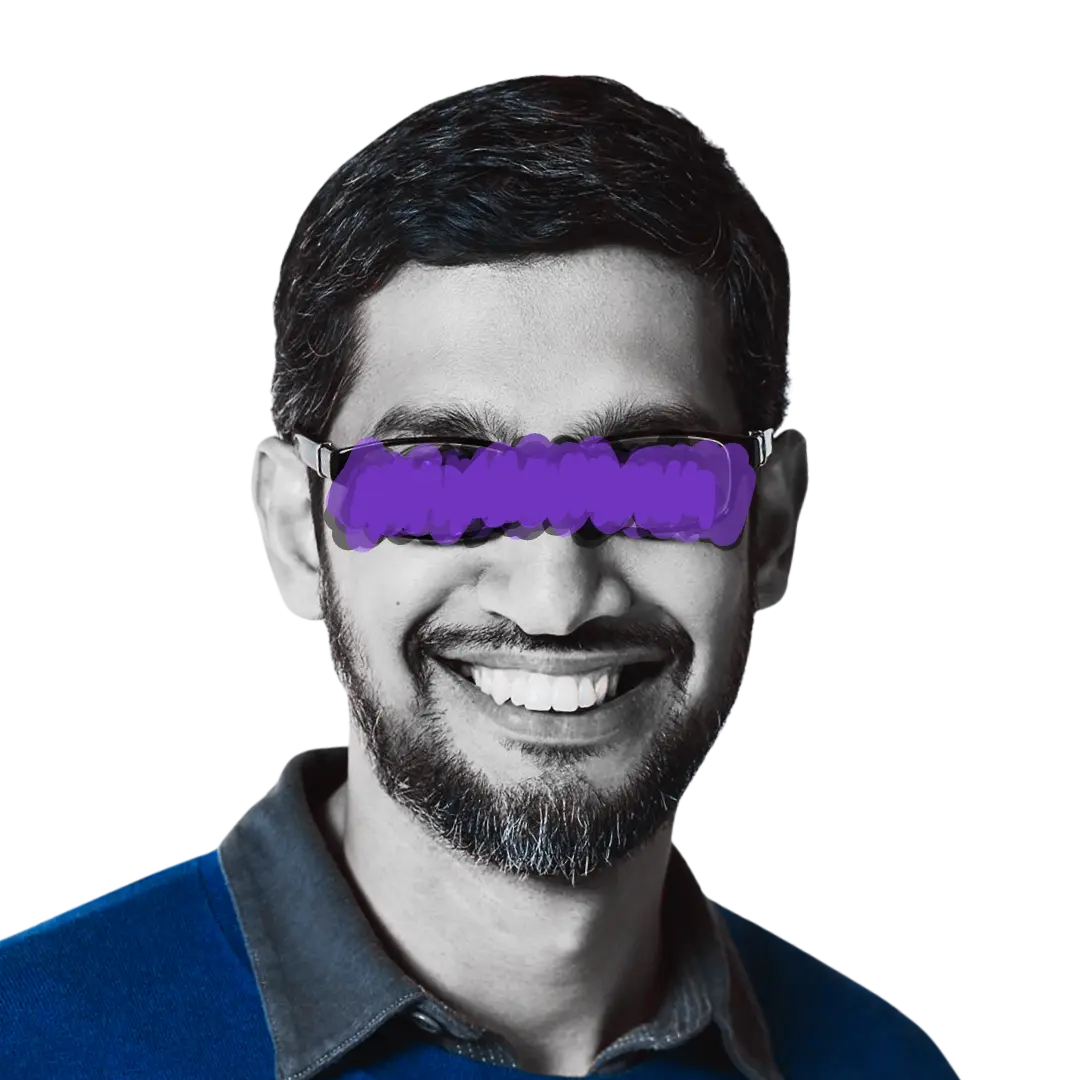
"I'm good at tuning out the noise. I do watch out for signals. It's important to separate the signal from the noise."
For six months, Sundar Pichai didn't call Anjali. Not because he didn't want to. Because a student stipend at Stanford in the mid-1990s didn't cover international calls to India. So he went silent. Six months without the voice of the person he loved most. He bore it without drama, without complaint, the way you bear something when you've decided it's the price of something else. That silence tells you more about him than any headline does.
His father had spent nearly a year's salary just on the plane ticket that got him to San Francisco. There was nothing performative about any of this. No declaration of sacrifice. No family gathering to mark the moment. The Pichais were not a family that made ceremonies out of hardship. They endured it and moved on.
Those two facts (the silence with Anjali, the year's salary for a single ticket) are the load-bearing structure of everything that followed. And the contradiction that defines his career: the man who endured six months of silence to preserve harmony would go on to lead a company that fired 12,000 people by email, pushed out its own ethics researchers, and was ruled a monopolist by a federal judge. The peacemaker built an empire where peace was never really possible.
TL;DR: Why Sundar Pichai is an Enneagram Type 9
- The Peacekeeper CEO: Pichai's consensus-building leadership style, going around the table to ensure everyone feels heard, reflects the Type 9's core desire for harmony and inclusion.
- Conflict Avoidance as Strategy: His notably calm demeanor during Congressional hearings and antitrust trials shows the Nine's natural tendency to maintain composure rather than engage in confrontation.
- The Merging Quality: Pichai rose through Google by bringing teams together, not by dominating them. His ability to synthesize different viewpoints is classic Type 9 behavior.
- Under Stress: When pushed, Nines can slip into anxiety and indecisiveness. Former CFO Patrick Pichette said directly: "He agonizes over decisions. I've told him that before." Fifteen executives told the NYT he created a "bias toward inaction."
- Body Triad Anger: Type 9s sit in the body triad (8-9-1) and their anger doesn't explode. It radiates. Pichai admitted: "Sometimes, the unspoken words. People can sometimes see that you're unhappy without you saying it."
What is Sundar Pichai's Personality Type?
Sundar Pichai is an Enneagram Type 9
Type 9s, known as "The Peacemaker," have a core desire for inner stability and peace of mind. They're naturally gifted at seeing multiple perspectives and bringing people together. But beneath that calm exterior often lies a fear of loss and fragmentation, a deep-seated anxiety that conflict might tear apart the connections they've built.
The childhood wound of Type 9 typically involves feeling overlooked, or believing their presence doesn't really change anything. They learn early that keeping the peace is safer than taking up space. This produces adults who are remarkably good at merging with others' agendas while sometimes losing track of their own.
Pichai fits this pattern in ways that are almost uncomfortably precise. Despite leading one of the world's most powerful companies, he remains self-effacing in a way that reads as genuine rather than strategic. Former colleagues describe him as "the nice guy who could pull teams together and get work done" in an environment "replete with formidable characters and much infighting." That description isn't glamorous. It's exactly right.
His contrast with Mark Zuckerberg is instructive. Zuckerberg at his worst turns every obstacle into a campaign. Pichai at his worst doesn't fight at all, and the people who needed him to fight pay the price.
But What About Type 5?
A reasonable reader could argue Pichai is a Type 5, The Investigator. The evidence isn't trivial. His "signal versus noise" mantra sounds like a Five's obsession with filtering information. He's been described as "skeptical, reserved, and analytical." During the Fortnite antitrust trial, he came across "as a professor explaining complex subjects to the jury." He displayed extraordinary memory for telephone numbers from childhood, the kind of detail-hoarding Fives are known for. And when the New York Times reported he "chewed over decisions and delayed action," that could read as a Five retreating into analysis rather than engaging.
But the pattern breaks on anger. Fives disengage from anger. They intellectualize it, distance from it, treat it as data. Nines sit on top of anger like a lid on a pot. Pichai told Lex Fridman: "Sometimes, the unspoken words. People can sometimes see that you're unhappy without you saying it, and so sometimes the silence can deliver that message even more." That's not detachment. That's suppressed anger leaking through the body. People read his displeasure from what he doesn't say. Classic body-triad behavior.
The deeper distinction: Fives withdraw from people to conserve energy. Pichai's entire career was built by moving toward people: merging with teams, synthesizing viewpoints, making himself the connective tissue between warring factions. A Five CEO gets criticized for being cold or detached. Pichai's criticism from fifteen former executives was the opposite: "too many competing voices and not enough perspective from Sundar on what we actually need to do." That's not withdrawal. That's a Nine drowning in the need to accommodate everyone.
And his body tells the story. He has to pace to think. "I love to pace, and actually to think I have to start walking." He uses a somatic metaphor for his mental state: "Do you scuba dive? Sometimes you jump in the ocean, it's so choppy, but you go down one feet under, it's the calmest thing." Fives live in their heads. Pichai's cognition runs through his body. He's a Nine.
Sundar Pichai's Upbringing
The two-room apartment in Ashok Nagar, Chennai, shaped everything. Sundar shared the living room floor with his younger brother Srinivasan while their parents (mother Lakshmi, a former stenographer, and father Regunatha, an electrical engineer) occupied the other room.
The family didn't have a car until Sundar was twelve. No refrigerator. Years later, on the Lex Fridman podcast, Pichai still marveled at what came after: "Many years later, we had running water and we had a water heater, and you could get hot water to take a shower." The wonder in that sentence is telling. A man running a trillion-dollar company who still remembers the day hot water arrived.
Street Cricket and the Captain's Instinct
What they lacked materially, they redirected into education. Regunatha's engineering work exposed young Sundar to technology early, and it stuck. But the street cricket in Chennai left its own mark. "I'm fond of playing cricket outside the home," Pichai recalled. "We just used to play on the streets... barefoot. Traffic would come. We would just stop the game." Not competitive glory, not tournament victories. The memory is about flow and adaptation, about the game bending around whatever interrupts it. He captained his school cricket team and won tournaments. What captaincy taught him wasn't how to dominate. It was how to read the field, manage temperaments, keep everyone playing.
From IIT Kharagpur to Stanford
At IIT Kharagpur he excelled academically and met Anjali Haryani. With no mobile phones, he'd walk to the girls' hostel and ask any girl entering to tell Anjali he was there. The messenger would inevitably shout: "Anjali, Sundar is here for you!" and the entire corridor would hear. He endured this public embarrassment repeatedly, without ever demanding a better system. That's a Nine: tolerating personal discomfort rather than making demands.
When Stanford accepted him for a materials science MS, the plane ticket cost Regunatha nearly a full year's earnings. This wasn't discussed as sacrifice. It simply was what it was, and Sundar went. Then came the six months of silence. Not estrangement, not a crisis, just the arithmetic of what he could afford. For someone who would later describe his core management philosophy as making space for people to feel heard, that period of enforced disconnection carries weight. He knew what it cost to be cut off. He built the opposite of that wherever he went.
How Pichai Won Google Without Fighting for It
Pichai joined Google in 2004 working on the search toolbar. When asked how he got hired: "I got into Google because Larry didn't interview me." Larry Page had stopped doing personal interviews after the company hit roughly a thousand employees. The self-deprecating humor is signature Nine, diminishing his own achievement to keep things comfortable.
The Chrome Play
The Chrome breakthrough tells you everything about how a Nine accumulates power. In 2008, internal resistance to building a browser was real. Internet Explorer dominated. Firefox was growing. The search business was printing money. Why the distraction? Pichai didn't force the case. He built consensus one conversation at a time, let the logic accumulate, made sure every skeptic felt heard before moving forward. Chrome launched in September 2008. By 2023, roughly two-thirds of all web browsing happened in it. He was right, and he won it the way Nines win — so quietly that the opposition barely noticed they'd lost.
Rising to CEO
By 2013, Android, Gmail, Maps, and Drive were all under his oversight. When Larry Page appointed him CEO in 2015, the people who'd watched him work weren't surprised. As one former Googler put it: "He promotes really good people as opposed to the most political and opportunistic people." That's the Nine in action: elevating others, not collecting leverage.
But the same quality that made him the unifying choice would become the central criticism: a man who values harmony above all now led a company that was, by any legal definition, a monopolist. The consensus-builder sat atop a machine that crushed competition by paying $26 billion a year to be the default. The contradiction was baked in from the start.
The Inner World: Personality Quirks and Mental Patterns
Pichai's psychology shows up in the small decisions. The daily habits. The things he says when he's not performing for a camera.
The Two-Step Mantra
Stanford Business School asked him how he handles pressure. His answer: "One is: making that decision is the most important thing you can do. You're breaking a tie and it unlocks the organization to move forward. The second is, with time, you realize most decisions are inconsequential."
This is the Type 9 who has done actual work on himself. Nines naturally struggle with decisiveness because they see every side, which can lock them in place. Patrick Pichette, Google's former CFO, said it directly: "He agonizes over decisions. I've told him that before." Fifteen executives told the New York Times that Pichai reportedly took a year to fill an important position even when qualified candidates were available. So he built a cognitive framework specifically to push through that tendency. He's not naturally decisive. He trained himself to be. That distinction matters.
The Body in the Room
Unlike most tech CEOs who lead from their intellects, Pichai's cognition is physically mediated. "I love to pace, and actually to think I have to start walking," he told Recode. He conducts walking meetings regularly. He finds relaxation in walking his dog Jeffree and listening to podcasts.
During the Epic Games antitrust trial, he was given a podium because "he has difficulty sitting for prolonged periods." His body resists the stillness that courtroom proceedings demand. In interviews, he angles his body away from the interviewer, folds his hands together, closing off his physical frame even as his words stay measured and open.
This is body-triad behavior. Type 9s, along with Types 8 and 1, process the world through physical sensation before cognitive analysis. Pichai doesn't meditate in the traditional sense. He can't quiet his mind that way. Instead, he uses NSDR (Non-Sleep Deep Rest), a practice of lying motionless and focusing on breath and bodily sensations. A body-triad person managing his state through somatic awareness, not intellectual frameworks.
The Controlled Anger — and What Happens When It Leaks
In a conversation with Lex Fridman, Pichai said something that doesn't get quoted enough: "I do get angry. I do get frustrated. I have the same emotions all of us do." Then the more revealing admission: "Have there been times I lose it? Yeah. Maybe less often than others, and maybe over the years less and less so, because I find it's not needed to achieve what you need to do."
But the most important line came next: "Sometimes, the unspoken words. People can sometimes see that you're unhappy without you saying it, and so sometimes the silence can deliver that message even more."
This is the Nine's anger in its purest form. It doesn't explode. It radiates. Colleagues learn to read his mood from what he doesn't say: a slight shift in energy, a visible displeasure he won't name. The silence that carried him through six months without Anjali's voice became a tool for managing an entire organization. People fear the withdrawal more than any outburst.
Most people covering Pichai treat his composure as proof that he's above emotion. It's the opposite. He knows exactly when he's angry. He's made a conscious choice about what to do with it. Type 9s who haven't done that work deny the anger entirely, which is far more dangerous. Pichai names it and holds it.
That's not passivity. That's discipline. But discipline has limits — and those limits showed up under oath.
The Coach Mentality
"You're not just a manager," Pichai said in one interview. "You're a coach, trying to get the best out of others. It's about empowering other people to succeed... To lead effectively, you have to understand the person you're working with, not just the role they play."
He draws from sports directly: "In soccer, people often talk about man management. Great coaches do. I think there is an element of that in our lives." What the street cricket in Chennai taught him about conflict isn't what it taught most captains. It taught him that the game continues. That you stop for traffic and start again. That holding the team together matters more than any individual at-bat.
Compare this to Donald Trump's combative approach or Elon Musk's pressure-through-chaos style. Pichai leads by creating conditions where people feel safe enough to do their best work. He goes around the table one by one to draw out quieter voices. He sits quietly through meetings, absorbs every perspective, then offers ideas that synthesize what he's heard. That's not a technique he learned from a management book. It's the instinct of someone who spent years in rooms where the loudest voice won, and decided to build something different.
But here's what the critics saw: "Mr. Pichai's attempts to lower the temperature had the opposite effect — allowing problems to fester while avoiding tough and sometimes unpopular positions." The same quality that makes him beloved by direct reports can paralyze an organization that needs a clear direction. One current executive told the Times: "Too many competing voices and not enough perspective from Sundar on what we actually need to do."
The Morning Routine
Unlike CEOs who wake at 4 AM for punishing workout regimes, Pichai admits: "I'm not a morning person." He rises around 6:30-7 AM, reads the Wall Street Journal and New York Times with tea and an omelette.
No performance. No optimization theater. Just a sustainable routine that doesn't require him to become someone else every morning. "Doing things well is more important than doing things fast," he told Wharton Magazine. A Nine's manifesto.
Controversies and Challenges
The Layoff Backlash
January 2023. Google laid off 12,000 employees, roughly 6% of the workforce. The announcement came via email while many workers were still asleep. Employees lost access immediately: accounts frozen, devices locked, no knowledge transfers, no goodbyes. The backlash was immediate and ugly. The optics of Pichai's $226 million compensation package made it worse. Employees circulated memes comparing him to Lord Farquaad from Shrek.
Pichai later said: "Clearly it's not the right way to do it. I think it's something we could have done differently for sure." At an all-hands meeting during the cost-cutting period, when employees asked about reduced perks, he told them: "Not to equate fun with money." The room's response was not warm.
This is where the Type 9 shadow is most visible. The avoidance of direct confrontation, the genuine desire not to cause harm face-to-face, can produce decisions that cause far more harm through distance. Pichai didn't send that email because he was callous. He sent it because he couldn't face 12,000 conversations. That's the Nine's failure mode: the attempt to preserve peace produces the opposite. The man who walks to every girl entering the hostel to ask them to fetch Anjali, who will endure any personal discomfort to avoid creating friction, made 12,000 people discover they were fired by checking their email over coffee. The harmony-seeker created maximum disharmony by choosing the path that required the least direct confrontation.
The AI Ethics Controversy
The departures of Timnit Gebru in December 2020 and Margaret Mitchell in February 2021 from Google's AI ethics team weren't a coincidence. Both were forced out after raising concerns about bias in large language models — concerns that were directly relevant to Google's core business.
The Type 9 in Pichai faced an impossible version of his usual problem: two factions with mutually exclusive demands. The research team wanted to publish findings that would constrain product decisions. The product teams needed room to move. No diplomatic maneuvering could satisfy both, and he chose the product teams. He made a choice. The researchers lost their jobs for telling the truth about Google's products, and the people who ran those products kept theirs.
When 28 employees were later fired for protesting Google's Israeli cloud contract in April 2024, Pichai followed up with a company-wide memo: the office is "not a place to fight over disruptive issues or debate politics." The message was clear: harmony is the priority, and those who disrupt it will be the ones who leave. The peacemaker's peace, it turned out, had terms.
The Antitrust Reckoning
In August 2024, Judge Amit Mehta ruled: "Google is a monopolist, and it has acted as one to maintain its monopoly." Google had paid roughly $26 billion in 2021 alone to be the default search engine on devices. The evidence was damning and the finding was clear.
Two Trials, One Pattern
Pichai testified in two separate trials in 2023. In the DOJ case in Washington, he stood at a podium in a dark suit, opened by recounting his journey from Chennai, and proceeded to say "I don't recall" and "I definitely don't know" with metronomic regularity. When shown meeting notes stating "Our vision is that we work as if we are one company" about the Apple relationship, he said: "I don't recall myself saying that line." He wryly noted he didn't believe he ever received the monthly reports on employee losses to competitors that he'd requested. Self-deprecating humor deployed as a defense mechanism, even under oath.
The more damaging reveal: during the DOJ investigation, it surfaced that Pichai had written in an October 2021 chat: "Also can we change the setting of this group to history off" and then attempted, unsuccessfully, to delete that message nine seconds later. The judge found Google engaged in "willful and intentional suppression of relevant evidence." The Nine's avoidance strategy extended beyond interpersonal conflict into institutional self-protection: prevent future friction by eliminating the record that might create it.
In the Epic Games trial in San Francisco, the confrontation was more direct. Judge Donato called the exchange a "rocking 75 minutes" of tense testimony. "At times, the soft-spoken Pichai looked nonplussed and frustrated by the confrontational questioning." He bristled at suggestions that Google paid Apple partly to keep it out of the search market. The composure held, but only barely. The anger that radiates through silence in boardrooms was visible to everyone in the courtroom.
The trials revealed what the Nine looks like under maximum pressure. He doesn't fight back aggressively like a Type 8. He doesn't retreat into cold logic like a Type 5. He maintains measured composure, occasionally bristles, deploys self-deprecating humor as deflection. And when cornered on the most damaging evidence, he retreats to "I don't recall." The man who can't sit still for prolonged periods stood at a podium for hours, holding his body in place while holding his reactions in check. The discipline held. Whether the strategy will hold is another question.
Alphabet's AI Pivot
When ChatGPT launched in late 2022, the media framing was quick: Google had been caught sleeping. Where was Pichai? Why was he so slow?
The framing missed something. Pichai had declared Google an "AI-first company" in 2017. The investments in DeepMind, the custom TPU chips, the language model research: none of it was visible to observers, but it was substantial and deliberate. By 2024, Google had launched Gemini, integrated AI across its product suite, and remained the dominant player in AI infrastructure.
The seeming slowness was a Nine moving when ready rather than reacting to external noise. But executives proposed acquiring Shopify to challenge Amazon in e-commerce, and Pichai rejected it as too expensive. When action carries risk of disruption, the Nine finds reasons not to act. Whether his AI timing was wisdom or the same avoidance pattern dressed as patience depends on which quarter's earnings you're reading.
Legacy and Current Work
At 52, Pichai leads Google and Alphabet through their most pressured era. The antitrust remedies could reshape the business model. The AI race demands faster decisions than his style naturally produces. Post-pandemic employee expectations have shifted in ways that his pre-2020 playbook doesn't fully address.
He and Anjali fund scholarships at IIT Kharagpur and support Stanford's Women in Engineering program. These contributions don't get announced. They just happen.
What hasn't changed: the emphasis on psychological safety, the patience, the going-around-the-table in meetings to pull out the quieter voices. Like Barack Obama, he projects an unshakeable calm that can read as either wisdom or distance depending on which side of his decisions you're on. He told the All-In Podcast that during moments of maximum pressure, "the good thing about these moments is you don't even have time a lot of times to think about some of those questions." He copes with existential challenges by staying immersed in execution. A Nine narcotizing himself through work — the most socially acceptable form of avoidance there is.
The real question his tenure leaves open isn't whether a peacemaker can lead a trillion-dollar company. He already answered that. The question is whether the peacemaker can survive what the company requires of him — the firings, the monopoly rulings, the ethics compromises, the silence where a clear voice was needed.
The contradiction isn't a flaw in his character. It is his character. The same man who endured six months without Anjali's voice endured a courtroom where his own words were used against him. The same instinct that made him the connective tissue at Google made him the person who couldn't fire 12,000 people to their faces. The harmony he builds is real. The harm that harmony produces is also real.
He's been building to this reckoning his whole career. Whether the silence taught him how to hold the tension, or just how to endure it, is something only he knows.
Disclaimer: This analysis of Sundar Pichai's Enneagram type is speculative, based on publicly available information, and may not reflect the actual personality type of Sundar Pichai.

What would you add?