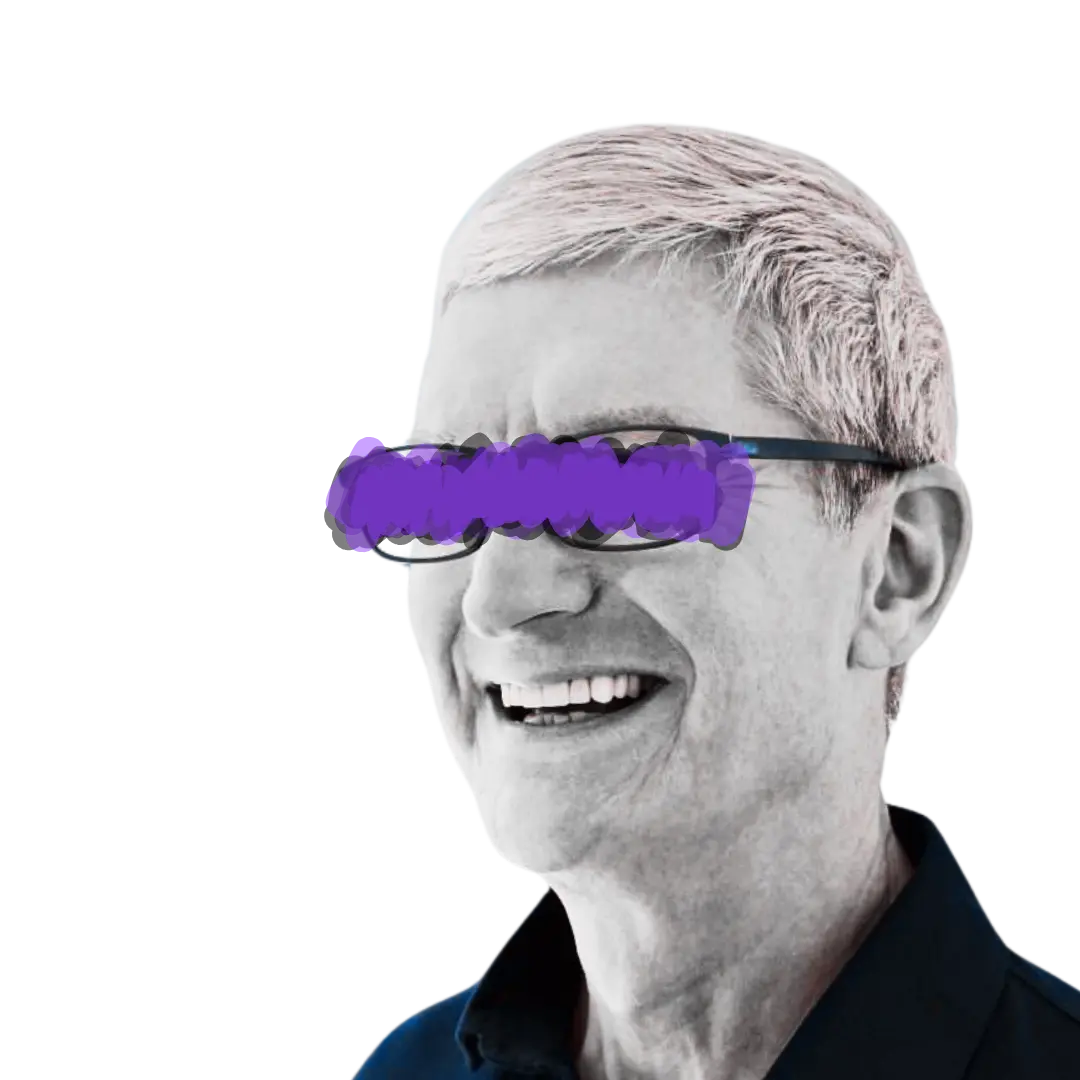
"I hope people remember me as a good and decent man. And if they do, then that's success."
Tim Cook was about thirteen years old, riding a brand-new ten-speed bike at night down a rural road outside Robertsdale, Alabama, when he saw the fire.
A burning cross on the front lawn of a Black family's home. Hooded figures in white robes standing around it. He stopped his bike. He yelled, "Stop!" One of the men lifted his conical hood, and Cook recognized him. It was a deacon at a local church. The boy pedaled home and did not tell his parents.
He has told that story for nearly fifty years now. It is the closest thing he has to a founding myth. "This image was permanently imprinted in my brain," he has said, "and it would change my life forever."
What it imprinted is not just outrage. It is a particular logic. A grown man you trusted, who taught Sunday school, was capable of evil while also being a respected member of the community. The other adults around him knew, or could have known, and said nothing. The lesson the child took home that night was simple, and it has shaped every consequential decision he has ever made: silence makes you part of it.
Forty years later, he runs the world's most valuable company. He wakes up at 3:45 a.m. He reads hundreds of customer emails before most people are out of bed. He calls a category of business activity "fundamentally evil." He came out as gay in a Bloomberg essay despite half a lifetime of guarding his privacy. He told the FBI no in front of the entire country. He has been the most morally outspoken CEO in technology — and he has done all of it from inside the body of a man whose strongest instinct, by every account of everyone who has ever worked with him, is to be left alone.
That is the contradiction. Tim Cook is one of the most private men in tech and the most public conscience in business at the same time. The two facts do not sit comfortably together. They are not supposed to. They are the engine of who he is.
TL;DR: Why Tim Cook is an Enneagram Type 1
- The internal courtroom never closes. The 3:45 a.m. wake-up, the personally answered emails, the executives "sliced up with questions" — these are not productivity hacks. They are how a Type 1 manages the part of himself that believes nothing is ever quite right.
- His conscience overrides his comfort — until the institution is at stake. Coming out, refusing the FBI, calling out Alabama on equality. The same man, by 2025, was donating personally to Trump's inauguration and handing him a gold trophy in the Oval Office to protect Apple's tariff exemptions. A Type 1 will, eventually, choose the institution over the gesture.
- He used moral language to describe a supply chain. Only a Type 1 calls inventory "fundamentally evil." Waste isn't inefficient to him. It's wrong.
- He killed the Apple Car the way a Type 1 kills things. Ten years, ten billion dollars, no press release, no eulogy, no public defense. The reformer cannot let a wrong thing keep going just because it cost a lot to be wrong.
- Steve Jobs gave him one piece of advice that mattered. Don't ask what I would do. Just do what's right. It is the only instruction Cook has ever needed — and the one that has made him both his bravest and his most rigid.
- The deacon under the hood is still teaching him. The lesson that "good" people commit hidden harm and that staying quiet makes you a participant has shaped every public stand he has ever taken — and complicated every private one.
What is Tim Cook's Personality Type?
Tim Cook is an Enneagram Type 1 (The Reformer)
Type Ones live inside an internal courtroom that never adjourns. There is a prosecutor in there, and a defendant, and a judge, and the judge is rarely in a generous mood. The verdict, even on a good day, is some version of not yet, not enough, could be better. To outsiders this looks like discipline. From the inside, it is closer to a moral survival reflex — a bone-deep belief that being good enough is the only thing standing between you and a kind of internal disgrace you cannot live with.
Ones do not usually rage. They tighten. They wake up early. They make checklists. They fold the towel correctly. They bite back the sentence they wanted to say in the meeting and they say the more diplomatic version, and then they replay both versions on the drive home. Their core fear is being corrupt, defective, or wrong. Their core relief is the feeling, however fleeting, that they did the right thing.
You can see the entire pattern in the language Cook uses about ordinary business problems. Inventory isn't a cost center. It is "fundamentally evil." Waste isn't a metric. It is a moral failure. When the FBI told him to build software that would weaken iPhone encryption, he did not call it a bad business decision. He called it a thing he would not build. Type Ones do not negotiate with the wrong answer. They refuse it and then they wait for the room to catch up.
More than anything else, that is what a Type 1 in command actually feels like up close. There is no yelling. There is just the calm, methodical revelation that you have not prepared as carefully as he has.
And he has prepared more carefully than you. He has been awake for hours.
The Boy Who Would Not Stay Quiet
Timothy Donald Cook was born on November 1, 1960, in Mobile, Alabama, and his family moved to Robertsdale when he was eleven. His father worked in shipbuilding. His mother worked at a pharmacy. The household, by Cook's own description on the Table Manners podcast in 2025, was "extremely modest." He started his first job at fourteen, flipping burgers for a dollar an hour.
"Southern hospitality was embedded. You were expected to treat everyone with dignity and respect."
That sentence is the ground floor. Everything Cook has built sits on top of it. The Alabama he grew up in was not, in practice, a place where everyone was treated with dignity and respect. Cook noticed the gap. Type Ones notice the gap before they can name it. They notice it as a small, constant ache in the chest that something is supposed to be different from how it actually is.
His teachers at Robertsdale High remember a long-limbed kid who played trombone in the band and was "always meticulous with his work." His math teacher Barbara Davis called him "a reliable kid." His classmates voted him "Most Studious" in the yearbook, the kind of designation a Type 1 high schooler accepts the way other people accept varsity letters. He graduated salutatorian in 1978 — second in his class, not first, a fact he almost certainly still knows the precise margin of. Then he went to Auburn for industrial engineering, the most procedural degree on offer in the most procedural college on campus.
After Auburn, IBM hired him into manufacturing in Research Triangle Park, North Carolina. He stayed for twelve years and rose to director of North American fulfillment. Somewhere in the middle of that, he enrolled in Duke's Fuqua School of Business and earned an MBA at night, while still putting in full days at IBM, and graduated in 1988 in the top ten percent of his class. Pay attention to the shape of that decision. He did not quit a job to chase a degree. He did not take a sabbatical. He stacked the second thing on top of the first thing because the first thing wasn't yet enough. He has been on Duke's board of trustees ever since, and he goes back to give commencement addresses the way other people go back to high school reunions — to revisit the place that confirmed who he already was.
This is the shape of a Type 1 childhood. Not "gifted in obvious ways." More like organized, watchful, slightly older than his age, the kid teachers never had to remind. The kid who internalized the rules so completely that he became a kind of walking enforcement mechanism for them — first against himself, then later, much later, against the world.
The cross burning sits inside that childhood like a pin holding everything together. The version Cook tells now is short and unsentimental. He has said it was "a seminal moment." He has said the image was "permanently imprinted" in his brain. He has not, in any version anyone has captured, said that it made him angry. Type Ones rarely use the word angry about anything. They use words like seminal and imprinted and changed me forever. The anger lives underneath, where it has always lived for them, doing its quiet work.
What that night actually taught him was a moral architecture he would carry into every job he ever held. There are people who do harm. There are people who could stop the harm and don't. Both are responsible. Doing nothing is doing something. The cost of staying quiet, when you know better, is that you become the deacon under the hood.
He has been arranging his life around that lesson ever since.
How Tim Cook Made Inventory His Enemy
By the time Steve Jobs called him in 1998, Cook had left IBM for a brief, almost-vestigial stint at Compaq. Jobs did not need another aesthete or another visionary. He had himself. What Jobs needed was somebody who could turn his visions into objects without bleeding the company to death in the process.
Within seven months of Cook arriving, Apple's inventory dropped from $400 million to $78 million. He cut inventory turnover from about thirty days to five. He went from a hundred suppliers to twenty-four. He closed factories. He replaced warehouses with a contract manufacturing network so synchronized it would later be studied in business school the way other generations studied Henry Ford.
Apple inventory cut in 7 months
Inventory turnover
Suppliers
"Inventory is fundamentally evil. You want to manage it like you're in the dairy business. If it gets past its freshness date, you have a problem."
Read that quote like a Type 1 talking, not like a CEO. He genuinely experiences sitting product as a moral failure — a thing that should be in someone's hands, providing value, and is instead taking up space, going stale, being wrong. The dairy metaphor is the most revealing part. He is comparing iPhones to milk because in his head, both are subject to the same law: you do not let the good thing rot.
This was the first place his wiring became a competitive advantage instead of a private burden. The thing his inner judge had been doing to him since childhood — the standard nothing could quite reach — turned out to be exactly the discipline a $6 billion company near death needed in order to become a $100 billion titan. For the first time in his life, the merciless inner voice was an asset. Apple was the first place Cook ever fully fit, because Apple was the first place where his conscience and his job description were the same document.
Then his boss got sick.
The Liver Steve Jobs Refused
In January 2009, Steve Jobs was dying. His liver was failing. Cook went through a series of medical tests on his own initiative and discovered that he was a viable partial-liver donor — they shared a rare blood type. He went to Jobs and offered him a piece of his liver.
Jobs cut him off before he could finish the sentence.
"He cut me off at the legs, almost before the words were out of my mouth. He said, 'No. I'll never let you do that. I'll never do that.' Steve only yelled at me four or five times during the 13 years I knew him, and this was one of them."
Cook reflected on it later in Becoming Steve Jobs: "Somebody that's selfish, doesn't reply like that. I mean, here's a guy, he's dying, he's very close to death because of his liver issue, and here's someone healthy offering a way out."
Sit with what Cook actually did. He did not say let me know if I can help. He did not start a foundation. He went to a doctor, in private, and got himself tested, and walked into his dying boss's office with a specific medical plan and a willingness to be cut open. That is not loyalty in the ordinary sense. It is the Type 1 reflex at full operating temperature. There is a wrong here that I might be able to fix. There is a thing I could do that other people are not doing. To not do it, knowing I could, would make me complicit in the outcome.
It is the same logic as the boy on the bike, twenty years older and wearing a suit. Stop.
When Jobs eventually told him privately that he wanted Cook as his successor, Cook protested. He didn't want it. He wanted Jobs to live. On August 24, 2011, Jobs resigned and recommended Cook to the board. Six weeks later, Jobs was dead.
The morning Cook went on stage as CEO for the first time, he asked himself what Jobs would have done. He has told this story many times. Jobs had given him one piece of advice during the handoff, and that advice cut through everything: don't ask what I would do; just do what's right.
For most successors, that line is a kind of license to drift. For a Type 1, it is the only sentence that matters. Just do what's right is not a release from duty. It is the duty itself, expressed in five words. Steve Jobs, in dying, gave Tim Cook permission to follow the only instruction he had ever been able to follow.
Cook has been following it ever since, and the world has not always known what to do with the result.
Why Tim Cook Wakes Up at 4 a.m.
There is a particular kind of person who wakes up before dawn not because they are a "morning person" but because the dawn is the only quiet they can trust. Cook is that kind of person.
He is up at 3:45 a.m. He starts his day reading customer emails — between five hundred and eight hundred a day, by his own count, and he has said he reads "the majority." When an Apple Watch helped save a customer's parent's life, Cook personally answered the email: I'm glad your father sought medical attention and received the treatment he needed. (His own father's life, separately, was also saved by an Apple Watch. He has told that story too. The product whose moral usefulness he believes in most is the one he can prove on his own family.) After the emails come the workout, the gym he attends off-campus because being seen sweating is too much exposure even for him, and then the meetings.
The meetings are where the questions begin.
"He's just very calm, steady, but will slice you up with questions. You better know your stuff." — Greg Joswiak, Apple SVP of Worldwide Marketing
Type Ones manage their internal anxiety by externalizing it as a question. They do not need to yell at you. They need you to know that you have not prepared as carefully as they have, and they will reveal that gently, methodically, the way a doctor reveals a diagnosis. The fear underneath the questions is not "you're going to hurt the company." It is something much older and much more personal: you might let something wrong happen on my watch.
The 3:45 a.m. wake-up is the same fear in a different format. If he is awake before everyone, he can prepare. If he prepares, he can ask the questions. If he asks the questions, fewer wrong things will happen on his watch. The whole architecture of his day is one long pre-emptive strike against the part of his own mind that believes he is, at any moment, one bad decision away from earning the verdict he has been trying to outrun since he was thirteen.
The rest of his life is built on the same logic of refusal. He bought a 2,400-square-foot condo in Palo Alto in 2010 for less than two million dollars and never moved out, even after his net worth crossed two billion. "I like to be reminded of where I came from," he told Fortune in 2012. "Money is not a motivator for me." He drives himself. He keeps no staff at the house. The man who runs the most valuable company in the history of capitalism lives the way a particularly disciplined regional manager would live. Ones do not buy yachts. Ones do not buy compounds. The compound is the inside of their own head, and it is already overcrowded.
Then there is the money he has actively committed to give away. In a March 2015 Fortune interview he announced he intends to give his entire fortune to charity in his lifetime, after paying for his nephew's college. He framed it the way Ones frame everything: not as generosity, but as obligation. "You want to be the pebble in the pond that creates the ripple for change." He has not built a Cook-branded foundation. He has not assembled a public giving program with his name on it. The donations show up in SEC filings as anonymous stock transfers, the way a Type 1 prefers to do good — quietly, by the book, with no statue at the end of it.
Apple has made more money under Cook than any company in the history of capitalism. The control system also has a cost, which is that the man inside it does not know how to do anything else. We will come back to that.
The Cost of Coming Out
For most of his adult life, Tim Cook was almost ostentatiously private. He did not attend Silicon Valley dinners. He did not date publicly. He did not, ever, give interviews about his personal life. He has a basic level of privacy, he once said, and he intended to keep it.
In October 2014, he became the first Fortune 500 CEO to publicly come out as gay. He did it in a 1,000-word essay in Bloomberg Businessweek. He was 53 years old.
The essay is worth reading carefully, because it is the cleanest piece of writing he has ever produced about himself, and because every paragraph is a Type 1 thinking out loud about a moral problem.
"It got to the point where I thought, 'I'm making the wrong call by trying to do something that is comfortable to me, which is to stay private.'"
That is not the language of pride or relief or liberation. It is the language of an audit. He was running the same internal courtroom on himself that he runs on his executives every morning. He had discovered a discrepancy. The discrepancy was that his preference for privacy was, by his own moral code, the wrong call. So the verdict came down. The verdict was: do the harder thing.
He quoted Martin Luther King Jr. — the same Martin Luther King Jr. who, in another version of Alabama, had been the moral counterweight to the deacon under the hood. The King line that mattered to him was: Life's most persistent and urgent question is, 'What are you doing for others?' Cook decided he was not doing enough. The letters from struggling LGBTQ kids piled up on his desk and he could not, in his own internal accounting, justify staying hidden any longer.
"So let me be clear: I'm proud to be gay, and I consider being gay among the greatest gifts God has given me."
Then, later in the same essay, the line that gives the whole thing away:
"If hearing that the CEO of Apple is gay can help someone struggling to come to terms with who he or she is, or bring comfort to anyone who feels alone, or inspire people to insist on their equality, then it's worth the trade-off with my own privacy."
Worth the trade-off. He weighed his own comfort against other people's suffering and decided his comfort weighed less. That sentence is the entire psychological architecture of a Type 1 conscience in one phrase. Privacy was the thing he wanted most. He gave it up because his code told him to.
But he gave up exactly as much of it as the code required, and not a millimeter more. In the more than a decade since the essay, Cook has never publicly named a partner. He has never been photographed on a date. Closer colleagues have told biographers they do not know whether he is in a relationship at all. He came out so a struggling kid in Alabama would know it was possible, and then he closed the door behind him. The world got the disclosure it needed for the moral case to land. It did not get one inch beyond that. Ones do not give themselves to the public. They give the public the part the public is owed, in writing, and they keep the rest.
A few days later, in the same week, he turned on his home state. Alabama, he said, was "too slow on equality." He was thirteen years old and on a bike again, calling out adults he had grown up with, knowing it would cost him something and knowing that the silence would cost him more.
The FBI, China, and the Hardest Test
On December 2, 2015, two attackers killed fourteen people in San Bernardino, California. The FBI recovered an iPhone 5C belonging to one of the shooters. It was locked. The Bureau wanted Apple to write new software that would let them brute-force the passcode without erasing the device — in effect, to build a back door into iOS for them.
Apple, meaning Cook, said no.
He published a public letter to customers on February 16, 2016. He could have stayed quiet and fought the order in court the way most CEOs would have. He went on the record instead, in plain language, in his own voice, on Apple's homepage. The U.S. government, he wrote, had asked Apple "for something we simply do not have, and something we consider too dangerous to create." Building the tool would set a precedent that would weaken the security of every iPhone on Earth.
The criticism came hard. He was protecting a terrorist. He was putting marketing above national security. He was a coward dressed up as a civil libertarian. None of it moved him. There is a particular tone Type Ones get when they have decided a thing is wrong, and once you've heard it you can identify it from across a room. It is not the tone of a man weighing trade-offs. It is the tone of a man who has already done the weighing, in private, weeks earlier, and is now simply telling you the answer.
That same tone will not always serve him.
Apple's deep manufacturing entanglement with China is the moral problem his code cannot cleanly solve. Most of the world's iPhones are still built in Chinese factories under conditions that, by any honest reading, would violate the standards Cook publicly espouses. Apps have been removed from the Chinese App Store at Beijing's request. Chinese user data lives on servers Cook does not fully control. Cook has chosen, repeatedly, to stay. His argument, which he has made in many forms, is that Apple's presence inside China does more good than its absence would, that audits and supplier standards and the sheer leverage of being Apple are real forms of pressure, that an exit would be theatrical rather than effective.
That argument may be right. It may also be the most convenient version of the truth that a Type 1 can live with. The cost of being a perfectionist who has decided to stay is that the staying becomes its own kind of compromise, year after year, until the compromise is the position. He has made the same call about China for fifteen years. At some point that stops being a dilemma and becomes a doctrine, and the inner courtroom has to find a way to acquit him over and over for the same case.
He does. It is one of the few places where you can see his certainty wobble. Press him on it in interviews and you can hear a man working harder than usual to be at peace with himself.
The Subscription Conscience
There is a version of Tim Cook's CEO career that does not make it into the moral biographies, and it is the version that paid for the moral biographies. Cook's actual business legacy is not the iPhone — that was Jobs's product, handed to him already glowing. Cook's legacy is what he built around it: a recurring-revenue platform that turned every iPhone in the world into a small, monthly tenant of Apple, Inc.
In May 2014, eight months into his tenure, he did the most un-Cook thing a Type 1 operator can do. He spent three billion dollars on a headphones company. The Beats acquisition was the largest deal in Apple's history at the time, and it was uncharacteristic in every direction at once. Apple did not buy companies that big. Apple did not buy companies for taste. The deal brought in Jimmy Iovine and Dr. Dre as Apple executives, and a year later, in June 2015, the streaming service they had been building under the Beats Music banner relaunched as Apple Music. That was the door. Through it walked Apple Pay (October 2014), Apple TV+ (November 2019), Apple Arcade (September 2019), Apple Card (August 2019), Apple One (October 2020), and Apple Fitness+ (December 2020).
The numbers are the part nobody quite registered while it was happening. In 2010, Apple's services revenue was somewhere south of eight billion dollars. In fiscal 2024, services brought in more than ninety-six billion, at gross margins north of seventy percent — almost double the margins on the hardware. Services are now roughly a quarter of Apple's revenue and nearly half of its gross profit. The company that the world thinks of as a phone company is, in actual financial reality, a phone company surgically attached to a subscription business that Cook conceived, executed, and defended.
You can read this two ways. The standard way is that Cook is the operator who refused to let Apple plateau. The Type 1 way is that Cook was building a moat around the thing he had been entrusted with so it could never again be the company Jobs had to come back and rescue. The recurring-revenue tenant in your pocket is also a hedge against any future quarter in which the conscience-driven CEO finds himself outvoted by the conscience-free market. Services are not just a business strategy. They are the financial form of I will not let this fall apart on my watch.
The 30 Percent and the Rulebook
The thing about building a subscription business is that the subscription business needs a rulebook, and the rulebook needs to be enforced, and the enforcement looks, from the outside, exactly like the kind of monopolistic high-handedness a Type 1 should hate. Cook spent the back half of his tenure on the wrong side of that paradox.
In August 2020, Epic Games slipped its own payment system into Fortnite to bypass Apple's 30 percent App Store commission. Apple removed the app within hours. Epic sued the same day. The lawsuit was a calculated piece of theatre — Epic knew exactly what it was doing — but the trial it produced was the first time anyone had ever forced the App Store rules into open court, and it dragged Cook himself onto the witness stand on May 21, 2021. Judge Yvonne Gonzalez Rogers asked him directly whether the 30 percent commission was justified. Cook gave the operator's answer: it pays for security, for review, for infrastructure. The judge did not buy all of it. In September 2021, she ruled for Apple on nine of ten counts but issued an injunction against Apple's "anti-steering" rules, ordering the company to let developers tell users about cheaper payment options outside the store. Apple appealed. The Ninth Circuit affirmed. The Supreme Court declined the case in January 2024.
The injunction was the kind of thing a Type 1 should have read as instruction. Cook read it as negotiation. Apple complied with the letter of the order by introducing a 27 percent commission on external links and surrounding the alternative checkout flow with warning pop-ups so ominous they were essentially deterrents. In April 2025, Judge Rogers held Apple in civil contempt and used language no Apple CEO had ever heard from a federal courtroom: she wrote that Cook himself "chose poorly," found that an Apple finance executive had "outright lied under oath," and referred the matter to the U.S. Attorney for possible criminal contempt. The Ninth Circuit later softened the remedy in December 2025, but the language in the contempt order is now part of the record.
In the European Union, the same fight ran in parallel. Brussels designated Apple a "gatekeeper" under the Digital Markets Act in 2023, and in March 2024 forced Apple to allow sideloading and alternative app stores in the EU for the first time. Apple complied, but again with a twist — it introduced a "Core Technology Fee" that made the alternatives commercially nonviable for most developers. The European Commission fined Apple €1.8 billion for App Store music-streaming restrictions in March 2024 and another €500 million for DMA non-compliance in April 2025.
You can hear the Type 1 contradiction in all of it. Cook believes the 30 percent is fair. He believes it is earned. He believes the App Store is, on balance, a net moral good for users and developers, because the alternative is the wide-open internet where anyone can be defrauded by anyone. The conviction is sincere. The conviction is also load-bearing for ninety-six billion dollars of services revenue, and a Type 1 with ninety-six billion dollars riding on a moral position will defend it with all the certainty of someone defending a position they have not allowed themselves to question. The deacon under the hood can also be a man who believes he is the deacon's opposite.
The Car He Killed
In February 2024, Cook did something Type 1s find genuinely difficult. He shut a thing down.
Project Titan had been Apple's secret car program for almost a decade. At its peak it employed roughly two thousand people. Bloomberg's reporting put the total spend somewhere north of ten billion dollars. The project had cycled through multiple chiefs, multiple visions, full-self-driving fantasy, then luxury sedan, then a reduced lower-autonomy version that nobody on the team believed in. Inside Apple, some employees had taken to calling it the Titanic disaster.
On February 27, 2024, COO Jeff Williams and project lead Kevin Lynch told the team it was over. There was no press release. Cook did not go on television. He did not give a speech. He did not even, in any record anyone has produced, publicly say the word Titan. The cancellation was leaked to Bloomberg's Mark Gurman the same day, the way a contained controlled demolition leaks. Hundreds of employees were reassigned to the generative AI organization. Hundreds more were laid off.
This is a Type 1 in his most disciplined form. Most CEOs cannot kill a project that has eaten ten years and ten billion dollars without a long, tortured public defense of why the death is actually a victory. Cook killed it on a Tuesday and went back to work. The reformer in him was incapable of letting the wrong thing keep going just because it had cost a lot to be wrong. The internal voice that wakes him at 3:45 a.m. has no patience for sunk cost. It only asks one question, and the question is is this still right?, and the day the answer for the car program turned to no, the project had about six hours left to live.
What it tells you about Cook is that the conscience and the operator are not separate people. They are the same person making the same call. Killing the car was a moral act dressed in operational clothing, and the fact that he could not bring himself to mourn it in public is the most Cook thing about it.
Apple as a Moral Argument
Apple under Cook became the first company to reach $1 trillion in market cap, then $2 trillion, then $3 trillion, then briefly $4 trillion in 2025. He launched the Apple Watch, AirPods, Vision Pro. He institutionalized Apple's gross margins until they hum like a power plant. But the numbers miss the more honest version of what he did with the company. Cook spent the last decade trying to make Apple stand for something specific, and the thing is not innovation. The thing is conscience.
He pushed Apple toward end-to-end encryption while every other major tech company — most notably the one run by Mark Zuckerberg — was monetizing user behavior. He made privacy a marketing position, not because privacy sold (it mostly didn't, until Apple made it sell) but because he believed it was the morally correct stance and was willing to stake the company on it. He committed Apple to carbon neutrality and recycled materials. He poured resources into accessibility — Voice Control, screen readers, hearing-aid features — long after the press had stopped paying attention, because Ones do not stop fixing a thing just because no one is watching. They mostly prefer no one to be watching.
"We do a lot of things for reasons besides profit motive. We want to leave the world better than we found it."
Most CEOs say a version of that line. Cook is one of the very few who has written it into the supply chain.
The honest critique of Cook's Apple is not that it stopped innovating. The honest critique is that it became a refinement company, a get-it-right company rather than a find-the-next-thing company — and that this is exactly what you would expect when a Type 4-leaning visionary is replaced by a Type 1 reformer. Jobs was driven by what was missing from the world. Cook is driven by what is wrong with what already exists. Those are not the same engine. They produce different futures.
You can see the difference most clearly in what happened to the design studio. In June 2019, Jony Ive — Apple's design chief for nearly thirty years and Jobs's closest creative partner — announced he was leaving to start his own firm, LoveFrom, with Apple as his founding client. The Wall Street Journal reported that Ive had grown "dispirited" by Cook's lack of interest in design, that Cook rarely visited the studio Jobs had treated as a daily pilgrimage. Apple publicly disputed the framing. The departure stuck anyway. The Apple-LoveFrom contract quietly ended in 2022. Industrial design was reorganized to report not to Cook but to COO Jeff Williams, which is to say it was rerouted through operations. The aesthetic high temple of the company became a cost center on an org chart. That decision was a Cook decision in its purest form. He did not break Ive's department on purpose. He simply did not visit it, because the part of Apple that Ive ran was the part Cook had no internal map for. A Type 1 cannot manage what he cannot audit, and you cannot audit taste.
The 2024–2026 era has stress-tested Cook's version of the company harder than anything else in his tenure, and the stress test has a name: artificial intelligence. At WWDC in June 2024, Apple unveiled "Apple Intelligence" and promised a Siri rebuilt around personal context, on-screen awareness, and deep cross-app integration. The marketing campaign for the iPhone 16 leaned heavily on those features. Some of them shipped. The big one — the new Siri — did not. In March 2025, Apple confirmed the personalized Siri was being delayed "to the coming year." By 2025 it was being targeted at 2026 at earliest. John Gruber, the most respected Apple writer alive, published an essay called Something Is Rotten in the State of Cupertino and accused Apple of having marketed software it had not built. Apple's AI chief John Giannandrea, recruited from Google in 2018, was stripped of Siri oversight, then pushed out entirely in late 2025. Jeff Williams, Cook's closest deputy for most of his tenure, retired the same month. Several other senior executives followed. The bench is being rebuilt around Cook in real time, and the question the rebuild is silently asking is whether perfection is fast enough anymore.
The deeper trouble is not that Apple is late on AI. The trouble is that the failure mode of a Type 1 company is exactly this failure mode. A reformer would rather ship a thing that is right than a thing that is fast. A reformer believes the keynote should not promise what the lab has not finished. A reformer trusts the audit and distrusts the demo. The world has spent the last three years rewarding companies that do the opposite, and Cook's Apple has been watching from the get-it-right side of the line, falling further and further behind in a race the reformer was never psychologically equipped to win.
The President He Could Not Refuse
For most of Cook's first term as CEO, the question of how a Type 1 conscience handles real political power was theoretical. The FBI fight was the cleanest version of it, and he won that one. Then Donald Trump was elected.
Cook decided very early that he was going to handle Trump differently from every other CEO in Silicon Valley. He did not sign open letters. He did not give resistance speeches. He did not tweet. He picked up the phone. For nearly a decade now, he has run a single, patient line of personal access into the Trump White House — a one-on-one diplomatic channel that has produced tariff exemption after tariff exemption while every other tech company has spent the same period being publicly humiliated, shaken down, or both.
The pattern showed up early. On March 6, 2019, at a White House workforce policy meeting, Trump introduced him to the room as "Tim Apple." Cook leaned into it, changing his Twitter display name to "Tim" with an Apple logo. Most CEOs would have privately seethed. Cook treated the slip as a gift, a small bridge to the only person in the room whose ego he needed to keep flattered. Later that year, when Trump's first-term China tariffs threatened Apple's manufacturing base, Cook personally negotiated exemptions for Mac Pro components and walked Trump through an Apple supplier facility in Austin. Commerce Secretary Wilbur Ross, of all people, paid him the highest compliment a Type 1 in business diplomacy can receive: Cook "is not a public whiner, he's not a crybaby."
Then Trump came back.
In the weeks between the November 2024 election and the January 2025 inauguration, Cook flew to Mar-a-Lago and had dinner with him. On January 3, 2025, Axios reported that Cook was personally donating one million dollars to Trump's inaugural committee. On January 20, he sat in the VIP section at the inauguration alongside Bezos, Musk, Zuckerberg, Pichai, and Altman. The optics, for the first openly gay Fortune 500 CEO and the most outspoken corporate voice on civil rights of his generation, were not gentle. He did not address them. He almost never does.
What followed was the full weight of the Type 1 contradiction in real time. On April 2, 2025, Trump announced sweeping reciprocal tariffs on China. Apple's stock dropped sharply. Nine days later, on April 11, the administration exempted smartphones and computers from the new tariffs entirely. The Washington Post reported that Cook had called Trump and Commerce Secretary Howard Lutnick directly. Trump confirmed it himself: "I helped Tim Cook recently, and that whole business." In February, Apple had announced a $500 billion U.S. investment commitment over four years and a new server-manufacturing facility in Houston. In August 2025, Cook stood in the Oval Office and increased the commitment by another hundred billion, bringing the total to $600 billion, and then handed Trump a personal gift: a glass disk on a 24-karat gold base, engraved with Trump's name and "Made in USA 2025." Cook narrated the gift for the cameras — the glass made by a former Marine corporal at Apple, the gold from Utah, the box from California. Trump beamed. Apple, in return, was exempted from a planned 100 percent tariff on imported semiconductors.
The reaction split exactly along the lines you would expect. The business press treated it as a masterclass. LGBTQ outlets called it bending the knee. The Daily Beast called the gold base "tacky." Cook did not respond to any of it. He has not, in a decade of Trump diplomacy, ever publicly described what he is doing or why.
Sit with what is actually happening here, because it is the central drama of late-career Tim Cook. The man who refused to write a back door for the FBI is the same man who is making personal cash donations to a president who has spent the last ten years reshaping the federal government in ways that are the precise opposite of every value Cook said he came out in 2014 to defend. The man who called Alabama "too slow on equality" is the same man handing out gold trophies in the Oval Office. There is no version of this story in which his Type 1 conscience is at peace with itself. There is only the version in which the conscience has accepted a price, paid in private, and moved the rest of the moral case underground.
His own internal accounting almost certainly looks like the China argument turned up to ten. Apple's presence inside this administration does more good than its absence would. The exemptions protect thousands of American jobs. The investment commitments bring real manufacturing back. An exit would be theatrical rather than effective. Every line of that defense is plausible. Every line of it is also the kind of defense a perfectionist constructs when he has decided to stay inside a room he does not like, and once a Type 1 has talked himself into staying, he cannot easily talk himself back out without indicting his own ten years of staying. The compromise becomes the position. The position becomes the doctrine. The doctrine becomes the man.
The honest reading is not that Cook has been corrupted. He hasn't. It is that the same conscience that made him brave in 2014 has been bargained down, slowly, by the same Type 1 instinct to protect what he was given. The boy on the bike who yelled stop at adults he had grown up with became a CEO who, by the time the second Trump administration arrived, had something to lose that he was no longer willing to risk. He chose Apple over the speech. A Type 1 will always, eventually, choose the institution over the gesture, because the institution is the moral object. The institution is the thing he is responsible for. Letting Apple be wrecked by tariffs would be, in his accounting, a kind of dereliction the inner judge would never forgive.
The cost is that the man who once weighed his comfort against other people's suffering and chose against himself is now weighing his company's exemptions against his own moral record and choosing the exemptions. He is going to have to live with that. He is going to live with it the way he lives with everything: at 3:45 a.m., reading customer emails, doing the next right thing in front of him, not looking at the larger ledger.
A Note on the Defense
The case against the Type 1 reading of Tim Cook is straightforward, and it deserves to be made out loud: this framework lets him off the hook. It takes the China deal and the Trump donations and the gold trophy and the App Store contempt order and translates them into the gentle psychology of a perfectionist trying his best inside a hard situation. It hands him a kind of moral immunity by sympathetic explanation. A Type 1 piece on Cook can become, almost without meaning to, a defense brief for the inside of his head.
That criticism is fair, and it should sit on the record next to everything else this article says about him.
The honest answer is that the Enneagram is not a moral verdict. It is a description of how a particular nervous system manages its own discomfort. It tells you what a person will tend to do under pressure. It does not tell you whether what they did was right. The fact that Cook's compromises with China and Trump and the App Store fit beautifully inside the Type 1 pattern does not make them excused. It makes them legible. Legibility is a tool for understanding, not a license for absolution. A reader who finishes this article thinking Cook's choices were inevitable has read it wrong. The point is that they were characteristic, which is not the same thing.
The Cook who refused the FBI and the Cook who handed Trump a gold disk are the same man making the same kind of decision under different conditions — a man trying to keep the institution he has been entrusted with from breaking, while telling himself the cost of staying is smaller than the cost of leaving. Sometimes that calculation is right. Sometimes it is the most expensive thing a person can believe. The article is not claiming to know which one this turned out to be. It is only claiming to know which kind of person makes that calculation in the first place.
The Office He Will Not Take
Steve Jobs's old office at Apple is still empty. It has been empty since 2011. Cook has not moved into it. No one has. He has explained this many times: he likes the connection back to Steve, he wants the values to keep emanating from that room, he does not need the corner office to do his job.
All of that is true. None of it is the whole truth.
The whole truth is that Tim Cook does not want to take the office because to take the office would be to admit that he is the principal, and being the principal is not actually how he sees himself. He sees himself as a steward. A trustee. A man holding a thing in trust for the people who built it and the people who will use it, accountable to a standard he did not invent and cannot repeal. The empty office is a daily reminder that he answers to something. Type Ones need to answer to something. If they cannot find it in the world, they invent it inside themselves and it is more demanding than any boss they ever had.
"I like my connection back to Steve. From him emanates our values and our DNA."
He is not lying. He is also describing, without quite knowing he is doing it, the central condition of being a Type 1 in command: you cannot be the final authority, because if you are the final authority then there is no one above you to keep you honest, and the entire moral architecture you have built your life on collapses. Cook needs the empty office in the same way a religious person needs a shrine. He needs there to be a higher thing. If Steve has to be that higher thing, fine. The point is that someone is.
He has not taken the office for fifteen years. He is not going to take it now.
Why He Cannot Stop
Cook turned 65 in November 2025. By Apple's stated retirement age guidance for executives, he is past the point where most of his leadership team has gone home. The board is reportedly preparing for a transition. John Ternus, who runs hardware engineering and now also oversees design, has begun appearing at product launches and on morning TV in the slots Cook has always taken himself. Everyone in the building can see what is coming. Cook can see it more clearly than anyone, because seeing things more clearly than anyone has been his job since 1998.
And yet he has not gone.
"I'll do it until the voice in my head says, 'It's time,' and then I'll go and focus on what the next chapter looks like. But it's hard to imagine life without Apple, because my life has been wrapped up in this company since 1998. It's the overwhelming majority of my adult life. And so I love it."
Listen to that quote one more time, but listen for what it is actually saying. He is waiting for an internal voice to give him permission to leave. He is not waiting for the board, or the markets, or his health, or his successor to be ready. He is waiting for the same internal verdict that has run his life since Robertsdale. And that verdict, in a Type 1, never says you have done enough. It is not constructed for that sentence. It is constructed to find the next thing that is not yet right.
There is always another wrong thing. There is the AI bench he is still rebuilding. There is the App Store ruling he is still digesting. There is the China question he is still answering, the Trump question he is still answering, the empty office he still will not move into. There is always another email at 3:45 a.m. There is a version of Tim Cook's life where he left Apple at 60, took the wisdom of forty-five years of work, wrote a book, mentored a generation, learned to live in the long quiet stretches he has always carved out at 4 a.m. and never extended past 6. That version of him would be happy. He cannot reach it.
The paradox at the center of him is that the same conscience that made him brave — the conscience that yelled stop at thirteen, that came out at fifty-three, that refused the FBI at fifty-five, that chose dignity over comfort over and over for half a century — is also the conscience that will not let him rest, and that has cost him things in the second half of his career he is not yet ready to look at directly. There is always another standard he has not quite met. The deacon is still under the hood somewhere. The Apple Watch has not yet saved everyone's father. The boy on the bike is still pedaling.
He cannot put the bike down.
Disclaimer: This analysis of Tim Cook's Enneagram type is speculative, based on publicly available information, and may not reflect his actual personality type.
What would you add?