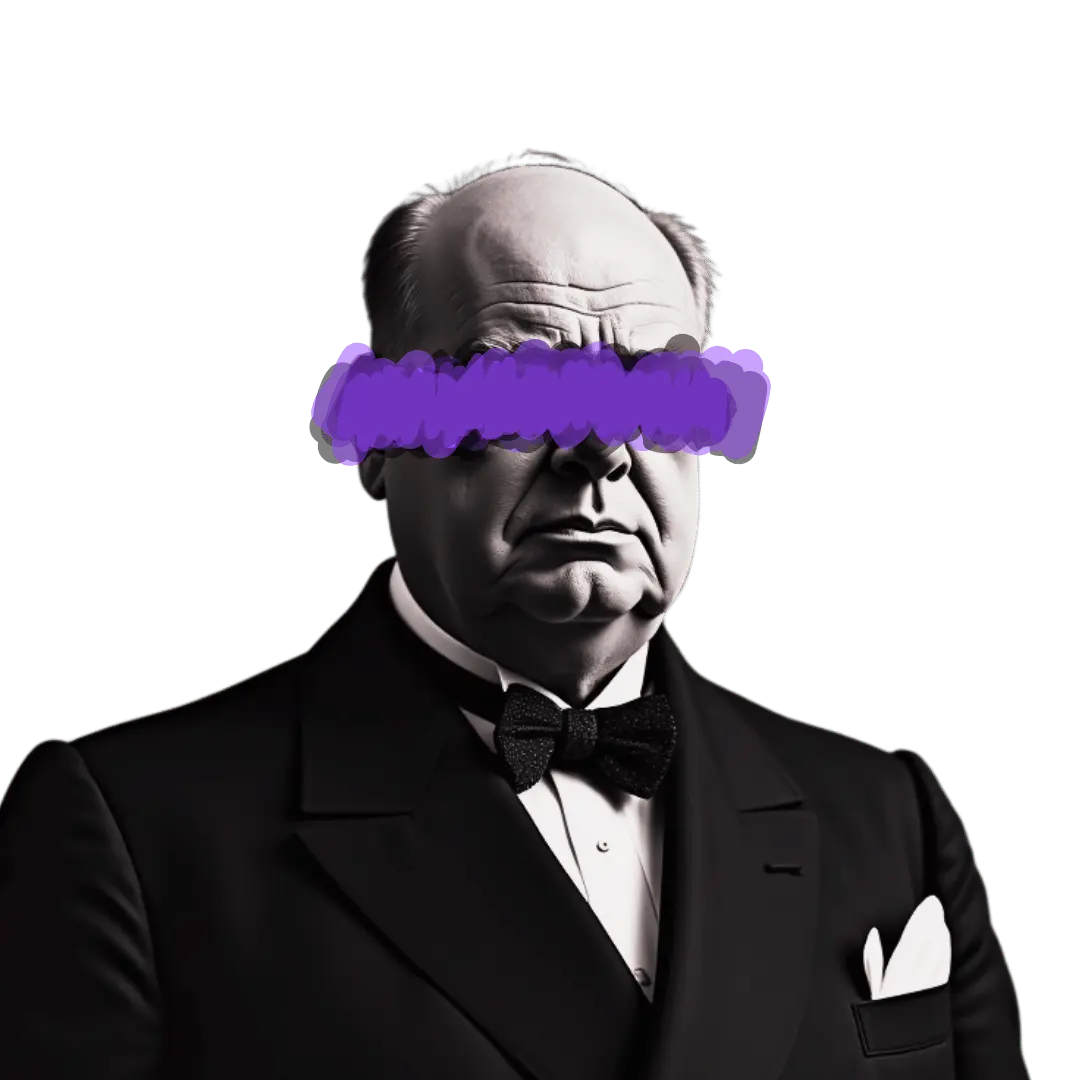
Churchill wept. Openly, repeatedly, at funerals, during films, upon walking through bombed neighborhoods. The man who stared down Hitler and addressed the Commons with "We shall fight on the beaches" would cry at a school choir. He battled what he called his "Black Dog" of depression for most of his adult life. He kept a photograph of his childhood nanny on his nightstand until the day he died — seventy years after her death.
This is not the bronze statue Churchill. This is the one who admitted, "I've always been blubbery. You have to get used to it."
The Enneagram doesn't simplify Churchill. It explains how all of it — the iron will, the tears, the cruelty, the tenderness — comes from the same source.
What is Winston Churchill's personality type?
Winston Churchill is an Enneagram Type 8
The boy who wrote desperate letters to a mother who never answered grew into a man who made sure no one could ever ignore him again.
That's the engine of the Type 8. Not aggression for its own sake — protection. 8s build themselves into forces of nature because they learned early that the world wasn't safe, and that no one was coming to save them. Churchill's childhood shows exactly how that happens.
Winston Churchill's Childhood and Emotional Neglect
To understand Churchill, start with the lonely boy at Blenheim Palace.
His father, Lord Randolph Churchill, was a brilliant but unstable politician who had little use for his son. His mother Jennie, a glamorous American socialite, was consumed by her own social calendar. Young Winston once wrote to her begging for attention: "I have only one who loves me, and that is you."
The letters often went unanswered.
But one person loved him without conditions: Elizabeth Everest, his nanny. He called her "Woom" (the closest he could get to "Woman" as a toddler), and she became his entire world.
As Churchill wrote in his autobiography: "My nurse was my confidante. Mrs Everest it was who looked after me and tended all my wants. It was to her I poured out all my many troubles."
Violet Asquith captured Mrs. Everest's role precisely: "She was his comforter, his strength and stay, his one source of unfailing human understanding. She was the fireside at which he dried his tears and warmed his heart. She was the night-light by his bed. She was security."
When Mrs. Everest died in 1895, Churchill was the only family member at her bedside. He paid for her tombstone, arranged for flowers on her grave for years, and kept her photograph displayed until his own death seventy years later.
This early experience carved the pattern that would define his life. Parents who dismissed him. A nanny who saved him. The result: total self-reliance, a lifelong distrust of weakness, and an iron loyalty to the handful of people who proved themselves worthy.
This documentary clip captures the emotional architecture of Churchill's early years — the loneliness, the letters, and how Mrs. Everest became the foundation for everything that followed.
Winston Churchill's Black Dog and Depression
Churchill famously called his depression his "Black Dog." The phrase came from Victorian nannies describing bad moods, but Churchill applied it to something far more serious.
In 1911, he wrote to Clementine: "I think this man might be useful to me, if my Black Dog returns. He seems quite away from me now. It is such a relief. All the colours came back into the picture."
The colors going out of the picture. That's depression — not as metaphor, but as physical experience.
His doctor, Lord Moran, observed "prolonged fits of depression" throughout Churchill's life and later diagnosed him with what we'd now call bipolar tendencies. For decades, Churchill avoided standing too close to train platforms and ship railings.
As he confessed: "I don't like standing near the edge of a platform when an express train is passing through... A second's action would end everything."
How does a man battling suicidal thoughts become the leader who saved Western civilization?
The 8's psychology answers this. 8s don't just fight external enemies. They fight internal ones with the same ferocity — and Churchill turned his drive against his own darkness with the same force he turned against Hitler. He stayed relentlessly busy. He wrote, painted, built brick walls at his estate, gave speeches, drank champagne, and kept moving. Always moving.
His daughter Lady Soames observed: "Marriage to my mother, and later his discovery of painting, which was a lifelong solace, largely kennelled the Black Dog."
The 8's answer to pain isn't to sit with it. It's to outlast it through sheer force of will.
Painting: How Churchill Survived Gallipoli
In 1915, Churchill's world collapsed.
As First Lord of the Admiralty, he'd championed the Gallipoli campaign — a disastrous invasion that killed over 100,000 Allied troops. He was publicly blamed, stripped of his position, and demoted to a meaningless role.
His wife Clementine later said she thought he would die of grief.
What's notable is what he did with that grief. He didn't harden against it or rationalize it away. The failure genuinely broke him — for a time. And when he picked up a brush while watching his sister-in-law paint watercolors during a family retreat, something clicked that couldn't have clicked before Gallipoli.
"Painting came to my rescue in a most trying time," he later wrote.
This matters for understanding the Type 8. Gallipoli didn't just wound Churchill's reputation — it wounded his self-concept. He had pushed for a strategy others doubted, and he had been wrong, catastrophically, with thousands of lives as the price. For a type that builds its entire identity around certainty and force of will, that's not just a professional setback. It's an identity fracture. The painting wasn't escapism. It was reconstruction.
Over the next five decades, Churchill painted more than 500 canvases. Landscapes, still lifes, scenes from Marrakesh to the French Riviera.
"If it weren't for painting, I couldn't live. I couldn't bear the strain of things."
Churchill found in painting a way to process what he couldn't express directly — to make something beautiful when his world was breaking apart. The brush gave him something no speech or military strategy could: a form of control that didn't require dominance over anyone.
The Wilderness Years: Right While Everyone Ignored Him
If you want to see 8 resilience at its most naked, look at Churchill in the 1930s.
By 1930, he was a political pariah. He'd opposed Indian independence, backed Edward VIII during the Abdication Crisis, and spent his days at Chartwell writing books and newspaper articles. Most people thought his career was finished. Churchill himself thought so too. He reportedly told those around him "I'm finished" about twice a day.
The financial pressure was real. He'd been gutted by the 1929 Wall Street crash and told Clementine bluntly: "The only thing that worries me in life is — money." He was writing books and newspaper columns at a furious pace partly because he had to keep the family afloat. The Black Dog was bad during this period — the train platform fears, the restless overwork at Chartwell, the bricklaying and beekeeping that were less hobbies than survival tactics to outrun his own mind.
But Churchill saw something the establishment didn't want to see. Hitler's rise. Germany's rearmament. The coming storm.
As early as 1933, he warned Parliament of "odious conditions in Germany" and the threat of "another persecution and pogrom of Jews." In 1934, he declared "there is not an hour to lose" in building up British defenses.
The response? Prime Minister Ramsay MacDonald tried to silence him. The Conservative Party kept him off the BBC. He was dismissed as a warmonger, a scaremonger, a relic.
Churchill kept warning anyway.
This is the 8 pattern at its most costly. Not the triumphant bulldog — the stubborn outcast. The willingness to stand alone against the crowd when you're depressed, broke, and convinced your career is over, because your own read of reality tells you the crowd is wrong. 8s don't defer to consensus. They defer to their own assessment, and they'll pay the social price without flinching — even when the social price includes a decade of irrelevance and ridicule.
When war came in 1939 and his predictions proved horrifically accurate, Churchill was brought back as First Lord of the Admiralty.
As he wrote in his memoirs: "My warnings over the last six years had been so numerous, so detailed, and were now so terribly vindicated, that no one could gainsay me."
How Winston Churchill Led Britain in World War II
Churchill became Prime Minister on May 10, 1940 — the day Germany invaded France. His first speech to Parliament: "I have nothing to offer but blood, toil, tears and sweat."
His wartime routine was pure 8 — designed to maximize his own output while exhausting everyone around him. He worked from bed until 1 PM, dictating speeches and memos to secretaries while propped up against pillows. His private secretary Elizabeth Layton described him dictating "sometimes until 4:30 a.m., from his bed or while roaming around the room in his red, green and gold dressing gown." At 5 PM he napped for ninety minutes — a habit from Cuba — then worked deep into the night again. He claimed naps allowed him to do "a day and a half's work in 24 hours."
He stamped red "Action This Day" labels on documents demanding immediate resolution. When Alan Turing and the Bletchley Park code-breakers wrote asking for more resources, Churchill scrawled: "Action this day! Make sure they have all they want on extreme priority and report to me that this has been done."
But the 8's force didn't just flow downward through memos. It showed up in person.
On September 8, 1940 — the morning after the first major German bombing of London — Churchill went to the devastated East End docks with General Ismay. Fires still raged. Buildings reduced to skeletons. Their first stop was an air-raid shelter where about forty people had been killed. Someone in the crowd shouted: "Good old Winnie! We thought you'd come and see us. We can take it. Give it 'em back."
Churchill broke down completely. An old woman watching him said: "You see, he really cares; he's crying."
On another visit, a woman yelled: "When are we going to bomb Berlin, Winnie?" Churchill whirled, shook his fist and walking stick, and snarled: "You leave that to me!" Morale rose immediately.
When Lady Diana Cooper told Churchill his best achievement was giving people courage, he corrected her: "I never gave them courage; I was able to focus theirs."
His relationship with his generals showed the same dynamic. Field Marshal Alanbrooke, Chief of the Imperial General Staff, kept wartime diaries that capture the stormy partnership. His assessment: "God knows where we would be without him, but God knows where we shall go with him." Alanbrooke privately called Churchill's strategic ideas "absurdities" that made his "blood boil." Churchill relished it: "When I thump the table and push my face towards him, what does he do? Thumps the table harder and glares back at me."
But crucially, Churchill never overruled the Chiefs of Staff when they agreed among themselves. The arguing wasn't ego — it was his way of stress-testing assumptions. He demanded alternatives. He forced clarity. The 8 doesn't need to be right about every detail. The 8 needs to know that every detail has been fought over hard enough to be trusted.
After the war, Alanbrooke asked readers to forgive his harsh diary entries, reflecting that future historians would struggle to square them with Churchill's "most marvelous qualities and superhuman genius."
Winston Churchill and Clementine
8s are notoriously difficult partners. They dominate conversations, make unilateral decisions, and don't take well to being challenged.
So how did Winston Churchill stay married for 57 years?
Clementine Hozier was not a pushover. She was one of the few people who could tell Churchill when he was wrong and make him listen.
Their marriage worked partly because they gave each other room. She was an early riser; he worked until 3 AM. She loved outdoor sports; he loved books and painting. They slept in separate bedrooms. Rather than forcing conformity, they let each other remain themselves — which is harder than it sounds when one of you is Winston Churchill.
But Clementine also served as his moral compass — and in June 1940, weeks after Dunkirk, she put it in writing. A trusted member of Churchill's entourage had come to her, alarmed. Winston's behavior was deteriorating.
She sat down and wrote a letter. Tore it up. Rewrote it.
"One of the men in your entourage (a devoted friend) has been to me and told me that there is a danger of your being generally disliked by your colleagues and subordinates because of your rough, sarcastic, and overbearing manner."
She reported that his private secretaries had agreed to "behave like schoolboys and 'take what's coming to them' and then escape out of your presence shrugging their shoulders." That at conferences, he was so contemptuous that "presently no ideas, good or bad, will be forthcoming."
Then her own observation: "My Darling Winston, I must confess that I have noticed a deterioration in your manner; and you are not as kind as you used to be."
Her counsel: "It is for you to give the Orders... with this terrific power you must combine urbanity, kindness, and if possible Olympic calm."
No written reply exists. Their daughter Mary speculated they spoke about it in person — and that Winston took it to heart. Many people who subsequently served under him recorded their admiration for him as a leader and their affection for him as a human being.
Their love letters, compiled by their daughter Mary into a 700-page volume, reveal a tenderness Churchill almost never showed the world. They drew little cartoons for each other. She drew cats; he drew pigs. They signed off with pet names and declarations of love that have no trace of the Bulldog in them.
For an 8, finding someone who can stand up to you without triggering your defenses is genuinely rare. Clementine did it for over half a century. When he died, she was at his bedside.
The Darker Side: Bengal and the 8's Blind Spots
No honest analysis of Churchill can sidestep his failures. And they were serious.
The 1943 Bengal Famine killed between 2 and 3 million people. Churchill's wartime government diverted food supplies away from India, and his private comments were damning. According to Secretary of State for India Leo Amery's diaries, Churchill said he "hated Indians" and considered them "a beastly people with a beastly religion." When informed of the starvation, he reportedly said Indians "must learn to look after themselves as we have done."
Historians debate the degree of Churchill's personal culpability — the causes of the famine were structural, and his government did eventually send aid. But his racist attitudes are documented, and his initial response to the dying was contemptuous.
Here is where the Type 8 frame has to do some real work. 8s understand themselves as protectors. That is genuine. Churchill wept for bombed-out London families. He raged at the German bombers. He held the line when no one else would. The protector identity wasn't a pose.
So how does a protector turn cold to suffering on that scale?
The answer is proximity and abstraction. 8s protect what they can see, what they have claimed, what has claimed them back. The loyalty runs both ways or it doesn't run at all. Churchill had no relationship to the Bengali farmer. He had a relationship to the British war effort — to soldiers, to the supply chain, to the survival of a civilization he believed he personally embodied. In that frame, Bengal wasn't a failure of protection. It was a trade-off made by someone who had decided, at some level below explicit reasoning, that these people were not his people.
That's not exculpation. It's the specific psychological mechanism — and it reveals something uncomfortable about the 8 worldview: the same ferocity that makes an 8 an extraordinary protector to those inside the circle makes them capable of extraordinary indifference to those outside it. Churchill's circle was Britain. The Empire was an abstraction. Three million abstracted deaths didn't break through.
The Bottle: Churchill's Other Constant Companion
Any honest portrait of Churchill has to account for the drinking — and it was considerable.
His daily routine: whisky and soda after breakfast (his secretary Jock Colville called these a weak "mouthwash," though Anthony Eden once noted "a stiff whisky and soda, at 8:45 a.m."). More whisky through the morning. A pint bottle of Pol Roger champagne at lunch, followed by cognac. Whisky through the afternoon. Sherry before dinner. Another pint of champagne at dinner. Cognac after. Whisky and soda while working into the small hours.
Churchill leaned into the reputation: "All I can say is that I have taken more out of alcohol than alcohol has taken out of me." And: "When I was younger I made it a rule never to take strong drink before lunch. It is now my rule never to do so before breakfast."
When a car struck him on Fifth Avenue in 1931, his doctor wrote a Prohibition-era medical note prescribing "alcoholic spirits especially at meal times" in quantities "naturally indefinite." Churchill kept the note.
It is estimated he consumed more than 42,000 bottles of Pol Roger in his lifetime. The house of Pol Roger named its prestige cuvée in his honor.
Was it a problem? White House speechwriter Robert Sherwood noted that Churchill's "consumption of alcohol continued at quite regular intervals through most of his waking hours without visible effect." No one who worked closely with him reported seeing him impaired. But the sheer volume — combined with his lifelong depression — makes it hard to avoid the conclusion that the bottle was part of the Black Dog management system. His doctor Lord Moran recognized as much, eventually prescribing amphetamines for depressive episodes and barbiturates for sleep.
8s have enormous appetites — for food, drink, work, conflict, pleasure. Churchill didn't moderate. He consumed. The champagne, the cigars, the 4 AM work sessions, the 500 paintings, the 40 books — it was all the same engine running at full throttle, all the time.
The 1945 Shock: When the Nation Said No
Three months after Germany surrendered, Britain held an election. Churchill was the most popular man in the country, with approval ratings above 80%.
He lost in a landslide.
The Labour Party won 393 seats to the Conservatives' 197. A humiliating rejection by the people he'd spent six years defending.
Churchill woke on July 26, 1945, with what he described as "a sharp stab of almost physical pain. A hitherto subconscious conviction that we were beaten broke forth and dominated my mind... The power to shape the future would be denied me."
Clementine, trying to comfort him, suggested the defeat might be "a blessing in disguise."
Churchill's reply: "At the moment it seems quite effectively disguised."
King George VI offered him the Order of the Garter. Churchill declined, noting ruefully that the British people had just given him "the order of the boot."
He was crushed. And then he wasn't. Churchill remained party leader, kept fighting, and won the 1951 election to serve as Prime Minister again until 1955. The wit, and the return, are both pure 8. You don't stay down. Even when you've been leveled, you get back up — not because it's strategically sound, but because staying down is simply not available to you.
The Type 8's Growth Path
Under real stress, 8s move toward Type 5. They become withdrawn, secretive, detached — retreating from the front lines to think, observe, and rebuild from inside.
Churchill showed this pattern his whole life. The painting. The prolific writing — over 40 books, which eventually won him the Nobel Prize in Literature in 1953. The long periods of depression and deliberate isolation. When overwhelmed, he didn't keep charging. He went inward.
In genuine growth, 8s move toward Type 2. They become more attuned to others' needs. More willing to be seen without the shell on.
Churchill had this too. His devotion to Clementine. His fierce loyalty to friends. His capacity for tears — at school choirs, at films, at bomb sites. The June 1940 letter from Clementine worked precisely because the 2-direction was already there. He could hear "you are not as kind as you used to be" and actually change, because kindness wasn't foreign to him — just buried under the armor.
The man who could be brutal and domineering could also be tender and undone. That is the 8's actual range.
What Remains
Churchill learned at Blenheim Palace that no one was coming to save him. He built an identity that would never again need anyone the way that boy needed his parents. And then he spent 57 years needing Clementine, kept Mrs. Everest's photograph by his bed, and cried at films.
"History will be kind to me," he once said, "for I intend to write it."
He did. Both ways. The defender of freedom who let millions starve. The man who focused a nation's courage while privately edging away from train platforms. For all his failures — and they killed people — when Western civilization needed someone willing to stand alone against something genuinely evil, Churchill was there.
That's the Type 8 at full extension. Not a hero without shadows. Someone whose refusal to be defeated made them equal to a moment that would have broken almost anyone else.
Disclaimer: This analysis of Winston Churchill's Enneagram type is speculative, based on publicly available information, and may not reflect the actual personality type of Winston Churchill.

What would you add?