"In the sub-sub-subculture I grew up in, the purpose of having money is to become a poet."
Alex Karp has never learned to drive a car. When asked why, he offers five words that contain his entire biography: "I was too poor. And then I was too rich."
He went from a biracial kid at protest marches in Philadelphia to the highest-paid CEO of a publicly traded company in America ($6.8 billion in compensation in 2024, nearly all of it from stock options granted before Palantir went public) and somehow skipped the part where normal life is supposed to happen.
He keeps tai chi swords in his offices. He calls his various properties "ski huts I sometimes work from." The thought of having children, he has said, "gives me hives."
And he runs Palantir Technologies. In plain terms: imagine every camera feed, satellite image, phone record, intercepted message, and financial transaction in a war zone appearing on one screen, with the connections drawn for you — who called whom, which truck went where, which pattern matches last week's ambush. That is what Palantir builds. Software that lets intelligence agencies, militaries, and governments see what no human analyst could piece together alone. A company that governments cannot function without, that critics call "the West's AI arms dealer," and that Karp describes as "a Frankenstein monster led by a freak show leader."
The contradiction at the center of Alex Karp is not the one people think it is. Not "progressive CEO builds weapons for the military." That's the surface. The deeper contradiction: a man who has spent his entire life cultivating an identity around not belonging anywhere has made himself indispensable to everyone.
TL;DR: Why Alex Karp is an Enneagram Type 4
Outsider by constitution — biracial, dyslexic, raised outside every mainstream category
Refuses the mask — quotes philosophers in shareholder letters, calls himself a "freak show leader"
Wound became weapon — every limitation turned into competitive advantage
Poet trapped in a CEO — dreamed of contemplation, built a defense empire instead
Alex Karp's Outsider Childhood
Alex Karp was born in New York City to Robert Joseph Karp, a Jewish clinical pediatrician, and Leah Jaynes Karp, an African American artist. The family moved to Philadelphia, where Alex attended Central High School.
His parents were activists who took their children to civil rights marches. Art and science held equal weight. Political argument was the household language. The Karps existed in what Alex would later call a "sub-sub-subculture": progressive, intellectual, interracial, and entirely outside the mainstream of American suburban life.
Being biracial in a heavily Jewish community created a particular dislocation. "Some black people considered me black while some did not," Karp has said. "I view me as me. And I'm very honored to be honored by all groups that will have me."
"I view me as me" sounds like resolution. It isn't. It is the statement of someone who learned early that no existing category would hold him. Not Black enough for some. Not Jewish enough for others. So he built his own category, and eventually, a company around it.
Why He Hid the Dyslexia for Decades
For most of his adult life, Karp concealed that he was dyslexic.
He hid it the way someone hides a scar under clothing. Not because it's shameful, but because showing it would change how people saw him, and he couldn't afford that. He was already an outsider. Already the kid who processed differently. Already the one watching through glass while everyone else seemed to work from an instruction manual he never received.
📰
Fortune: Alex Karp Credits Dyslexia for Success
December 2025
"If you are massively dyslexic, you cannot play a playbook. There is no playbook a dyslexic can master. And therefore we learn to think freely."
Then, decades later, he called dyslexia the "formative moment" of his life.
Not a formative experience. A formative moment. As if the entire condition, the years of hiding, the compensatory strategies, the forced independence of thought, collapsed into a single point of origin. The moment he realized he would never process the world the way everyone else did.
"A non-dyslexic will read the text, and the text will become them de facto," Karp explained. "The more you read ... the more the text becomes you. No dyslexic works that way."
Most people absorb the standard narrative and become shaped by it. Karp couldn't. His brain refused the template. So he thought from scratch. Every time.
"I process in a way that has very little to do with what anyone else thinks," he said. "And that has powered a lot."
ENNEAGRAM TYPE 4 · THE INDIVIDUALIST
TYPE 4 · THE INDIVIDUALISTHEART TRIAD
AUTHENTICITY
DEPTH
IDENTITY
BEAUTY
EXPRESSION
UNIQUENESS
MEANING
LONGING
NUANCE
STANCE
Withdrawn
HARMONIC
Reactive
AKA“The Aristocrat” or “The Bohemian”
CORE FEARHaving no identity or significanceCORE DESIRETo find an authentic selfINTELLIGENCEEmotionalCORE EMOTIONShame
At Stanford Law School, Karp met Peter Thiel. They bonded the way only two intellectual misfits can: through combat.
"We argued like feral animals," Karp has said.
Thiel was the libertarian capitalist. Karp was the self-described socialist. Thiel would later become a MAGA kingmaker. Karp would support Kamala Harris. But in the 1990s at Stanford, they were just two people who hated law school and loved the fight.
"He was more the socialist, I was more the capitalist," Thiel recalled. "He was always talking about Marxist theories of alienated labor and how this was true of all the people around us."
What makes the partnership last is not agreement but the appetite for conflict itself. "One of the problems in this country is that there are not enough people like Peter and me," Karp has said. "We've been fighting about things for 30 years."
When Thiel publicly backed Trump in 2016, Karp said bluntly: "I didn't enjoy it." It made government contracts harder to win, since having your co-founder as the most visible tech supporter of the incoming president raised suspicions about Palantir's motives on both sides. Yet Thiel asked Karp to lead Palantir in the first place, precisely because a self-described socialist running a national-security company would be harder for critics to dismiss as an authoritarian project. They chose the fight over the friendship, and got both.
They still have both. Thiel remains on Palantir's board. They still disagree about nearly everything political. But they share the conviction that the West needs better technology to defend itself, and that the old defense establishment will never build it. It is a partnership held together not by affection but by a shared enemy: mediocrity in the institutions that matter most.
Karp didn't stay for a conventional career. He left for Germany, earning a PhD in social theory from the Johann Wolfgang Goethe University in Frankfurt, the intellectual home of critical theory, of Adorno and Habermas. His dissertation explored how language and aggression shape culture. He studied the mechanics of power while dreaming of a contemplative life.
"I just wanted to move to Berlin and spend all day in bed," he admitted in a 2025 Semafor interview.
The man who now runs a defense technology company valued at over $250 billion once wanted nothing more than to lie in bed in Berlin. He didn't get to be a poet. He got to be something far stranger.
How Alex Karp Became Palantir's War-Tech CEO
In 2004, Karp and Thiel co-founded Palantir Technologies, named, like so many Thiel ventures, after Tolkien. A palantir is a seeing stone, a device for observing things at great distance.
Karp had no technical background. No business training. He had a philosophy degree and a PhD in critical theory — credentials that qualified him to teach a seminar, not run a startup. He became CEO anyway. And for years, it looked like a mistake.
Palantir's first client was the CIA, through its venture capital arm In-Q-Tel. But beyond the intelligence community, almost no one would buy the software. For roughly five years, Palantir bled money. Thiel personally poured in around $30 million to keep the company alive. Karp didn't code. He didn't read architecture documents. What he did was sit in rooms with intelligence analysts and military officers, listen to what they actually needed, and translate that back to his engineers in the language of a philosopher asking what the problem meant. It was an absurd way to run a tech company. It also worked.
The real breakthrough came when Palantir's software reached troops in Iraq and Afghanistan. U.S. forces used it to map IED networks, track insurgent supply chains, and identify bomb-makers. Soldiers in the field loved it. Word-of-mouth from the front lines created demand that eventually forced the Pentagon bureaucracy to adopt it, bottom-up, against the wishes of defense contractors who had been building the same failed systems for decades.
"If you were to do a sitcom on Palantir," Karp told The New York Times, "it's equal parts Larry David, a philosophy class, tech and James Bond."
He was not joking. Palantir's culture is a direct expression of Karp's psychology. Consider what he built:
A flat hierarchy where disagreement is the norm. "Half the people disagree with me, at least on any issue," Karp has said. He constructed "this incredibly painful internal structure of flatness" specifically so he could "hear how wrong I am all day."
A company that treats product building "more like art than enterprise software." A workplace where Karp calls the whole operation a "freak show" and means it as the highest compliment.
"We cultivate minds by being exceedingly difficult."
So what is it actually like to work for him?
Karp personally interviews candidates and claims he can spot talent in under two minutes. He sometimes picks "the child of a mechanic" over a polished Ivy League graduate. "If you ask the question that the Stanford, Harvard, Yale person has answered a thousand times," he has said, "all you're learning is that they've learned to play the game." German is spoken in Palantir's offices. Austrian assistants serve as his closest confidants. He leads employee meditation sessions personally.
Glassdoor tells two stories. Deployment strategists — the ones closest to the mission — rate the company 4.1 out of 5 and describe colleagues as brilliant and the work as meaningful. Sales teams rate it half that. One former employee wrote: "A dictatorship, not a democracy. Takes some Kremlinology to understand who is in control." The "flat hierarchy" Karp prizes can feel, from the inside, more political than flat. People work punishing hours. Burnout is common. But the term "Palantirian" has a cult-like stickiness to it, and the ones who stay tend to stay hard.
The split makes sense once you understand Karp. He built a company optimized for people like him: misfits who thrive on intensity and wilt in conventional structures. If you're wired that way, it's the best job in tech. If you're not, it's unbearable. There is no middle setting, and he designed it that way.
This is not a CEO building a company. This is an artist building a self-portrait, then daring the world to buy it.
And the world bought it. Palantir's U.S. commercial revenue grew 54% year over year in 2024. The company joined the S&P 500. Governments across the Western world now depend on its software for intelligence, military operations, and pandemic response.
What is Alex Karp's personality type?
Alex Karp is an Enneagram Type 4
The Enneagram Four's core wound is the feeling of being fundamentally different from everyone else, not by choice, but by constitution. Where others seem to follow an effortless script, the Four feels the gap: acutely aware of what is missing, what doesn't fit, what can never be made to fit.
Most people see Alex Karp and think: eccentric tech billionaire who likes philosophy. But if you understand the Four, the real driver becomes visible. Every decision Karp has made, from studying critical theory in Frankfurt to keeping tai chi swords in his office to writing philosophy in shareholder letters, is the same act repeated across decades: turning the wound of being fundamentally different into something the world cannot ignore.
The evidence is everywhere, once you know what to look for:
The outsider identity as foundation. He didn't just feel different — he was constitutionally unable to follow the standard playbook. And rather than hiding this, he made it the operating principle of an entire company.
Authenticity as survival. He refuses to modulate. He quotes philosophers in shareholder letters, tells Wall Street analysts he's "an arrogant prick," and says the thought of children gives him hives. There is no corporate mask. The mask would kill him.
The longing beneath the combativeness. "I have lots of faults, but 'primarily money driven' is not one of them." The purpose of money was to become a poet. He built a weapons company instead. That gap between who he wanted to be and who he became is the most Type Four thing about him.
The wound becomes the work. His dyslexia, his outsider childhood, his inability to sit still — Fours don't just endure their differences. They transform them into contributions the world can't ignore. Every limitation Karp has disclosed became a competitive advantage or a hiring program.
His biographer, Michael Steinberger, who spent six years with Karp, compared him to Pinot Noir: "a very ornery grape." The comparison is more apt than Steinberger may have intended. Pinot Noir thrives only in specific conditions, refuses to blend easily, and produces either something transcendent or something undrinkable. There is no middle ground, and there has never been a middle ground with Alex Karp.
Why Alex Karp Can't Sit Still
At the New York Times DealBook Summit in December 2025, Karp broke his own rule against refined sugar and drank a Mexican Coca-Cola before going onstage with Andrew Ross Sorkin.
What followed went viral.
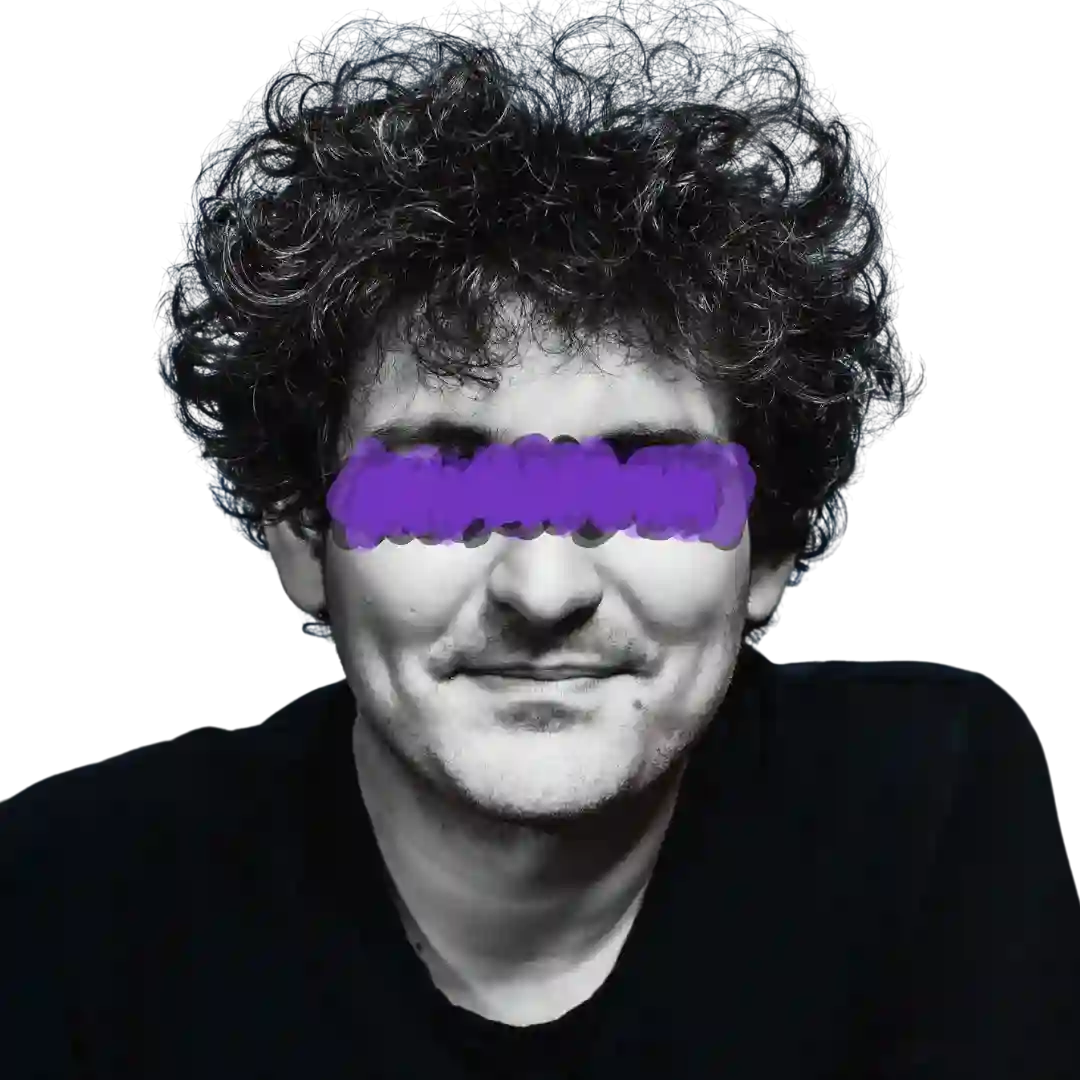
To understand the visual: Karp does not look like the CEO of a defense technology company. He looks like a philosophy professor who just came in from a windstorm. Wild, dark curls — untamed enough to have spawned a parody Twitter account (@AlexKarpsHair, which he says he wishes he ran). Quirky glasses. A track-suit jacket and red leather sneakers where other defense executives wear ties. The overall effect is controlled chaos, which, as a description, extends well beyond the hair.
Onstage, he made big, looping gestures. He fidgeted in his seat. He talked fast and nervously adjusted his chair. He gripped both sides of the chair and leaned forward. A prominent venture capitalist posted the clip with the caption: "Every pre-school teacher in America should be required to watch this video of Alex Karp being completely unable to sit still in his chair."
Most CEOs would have ignored it or issued a polished PR statement. Karp's response was pure Karp: while cross-country skiing the next morning, he decided to launch Palantir's "Neurodivergent Fellowship," a recruitment pathway for people who think faster than they can speak and cannot sit still.
"This is not a diversity initiative," the company wrote. The fellowship pays $110,000 to $200,000 a year.
The man who hid his dyslexia for decades turned his inability to sit in a chair into a hiring program.
He cross-country skis five hours a week, 90% of it at a glacial pace. "To run like a deer," he told Axios, "you have to spend 90% of your time running like a snail." His security detail is composed largely of Norwegian special forces veterans — the only bodyguards fit enough to keep up with him on the trails.
Alex Karp's Political Contradiction
"I actually am a progressive," Karp told Maureen Dowd of The New York Times. "I want less war. You only stop war by having the best technology and by scaring the bejabers, I'm trying to be nice here, out of our adversaries."
This is the contradiction that makes headlines. The man who calls himself a socialist, "a neo-Marxist" even, runs a company that builds AI-powered targeting systems for the U.S. military. Palantir's technology has been used by ICE, by the Israel Defense Forces, by intelligence agencies across the Western world.
His critics are not subtle. The Nation called Steinberger's book "the fables of weapons dealers." When a Palestinian-American activist confronted him at an event, saying Palantir's technology "kills Palestinians," Karp reportedly responded: "That's true, mostly terrorists."
Karp does not flinch. But he makes two arguments most critics never engage with. One is philosophical. The other is operational.
The operational one first. In Ukraine, Palantir's software fuses satellite imagery, drone footage, intercepted communications, and open-source intelligence into a single battlefield picture. Ukrainian commanders use it to identify Russian positions, coordinate strikes, and track logistics convoys. The system compresses the time between detecting a target and acting on it from hours to minutes. Critically, every data point, every analyst decision, every step in the chain is logged. If a targeting decision goes wrong, there is a complete, reviewable record of why.
This is the accountability argument made concrete. And it extends beyond the battlefield.
Take the ICE contracts, which prompted 60 of his own employees to sign a petition demanding Palantir walk away. Karp's response was counterintuitive: "If you are critical of ICE, you should be out there protesting for more Palantir." His reasoning: the software creates audit trails and constraints on enforcement agents. Without it, agents have unchecked discretion. With it, every action is logged, trackable, reviewable. Whether you buy that argument depends on whether you trust the institution wielding the tool. But it is not a dismissal.
"The far right hates that I grew up in a Jewish family and defend Jews against the most disgusting and obvious vehement attacks. And the far left thinks because of my background, I should somehow give up real progressive thought and support ideologies that only hurt the people they claim to support."
Underneath the combativeness is a concession most profiles leave out. "These technologies are dangerous societally," Karp has said. "The only justification you could possibly have would be that if we don't do it, our adversaries will do it. And we will be subject to their rule of law." He has gone further: "If we knew China and Russia and Iran wouldn't build them, I would be in favor of very heavy, very heavy, legal constraints."
He has not silenced the moral question. He has answered it, and he knows the answer is fragile.
What people miss about the contradiction: it isn't a contradiction to him. He doesn't experience tension between progressive values and military technology. He experiences them as the same commitment, defending a system that protects dissent, autonomy, and self-expression. The very things that allowed a biracial, dyslexic kid from Philadelphia to become whatever he wanted.
"I am not saying all cultures are equal," he told Bari Weiss. "In fact, I'm saying this nation is incredibly special and we should not view it as equal. We should view it as superior."
The boy who grew up at protest marches now argues for American supremacy. But he has been making the same argument since childhood: protect the system that protects people like me.
Why Alex Karp Talks About China So Much
If the military contradiction is the one that makes headlines, the AI question is the one that will define Karp's legacy.
In 2023, Palantir launched AIP — its Artificial Intelligence Platform — integrating generative AI with its proprietary data layer. Karp called it "product-market fit 2.0." The results were immediate and staggering: U.S. commercial revenue surged 109% year over year, total revenue hit $4.48 billion, and the stock price made Karp, briefly, the highest-paid CEO in America.
But Karp is not a cheerleader for AI. He is something rarer: a true believer who is also genuinely frightened.
"My general bias on AI is it is dangerous," he told CNBC. "There are positive and negative consequences, and either we win or China will win."
His position is "build it or lose it," but with a philosopher's discomfort about the building. He has called for heavy legal constraints on domestic AI use and urged Silicon Valley to self-impose limits: "The Valley should have a consortium: This is what we're going to do, and this is what we're not going to do." He draws a hard line between military and domestic applications: "There's a difference between U.S. military and surveillance. Despite what everyone thinks, Palantir is the anti-surveillance company."
When Anthropic hesitated over Pentagon use of its AI in early 2026, Karp was blunt at the a16z American Dynamism Summit: "If Silicon Valley believes we are going to take away everyone's white-collar job and you're gonna screw the military — if you don't think that's gonna lead to nationalization of our technology, you're fooling yourself."
On what AI means for workers, he is equally unsentimental. "It will destroy humanities jobs," he said. "You went to an elite school, and you studied philosophy — I'll use myself as an example — hopefully, you have some other skill." He believes the future belongs to two groups: the vocationally trained and the neurodivergent.
His book, The Technological Republic, became an instant bestseller. Its thesis: "An entire generation of software engineers has turned its back on the nation-state." And: "This next era of conflict will be won or lost with software."
The philosopher who dreamed of spending his life in bed wrote a manifesto about hard power. But again — it's the same argument. Software is the new defense. The West needs it. And if the people who build it won't defend the institutions that protect them, those institutions will fall.
How Alex Karp Lives Off the Silicon Valley Grid
Alex Karp has never married. He has no children. He prefers "separate bedrooms" in relationships, calling it "a German attitude" toward personal space.
He retreats to a 500-acre compound in rural New Hampshire, far from Silicon Valley, far from Washington. He does not use social media. According to his biographer, he maintains two long-term relationships with women in different parts of the world. He once complained that having bodyguards "crimps your ability to flirt."
"I don't know how people pull that off," he said in the Semafor interview. "They don't like each other, but they pretend to at the cocktail party."
He can't pretend. Won't pretend. The inauthenticity that most people handle with ease, the social performance, the polite fiction, the small talk, is physically intolerable to him. This is the kind of relational withdrawal that Fours default to when the world feels too shallow to bear.
But there are cracks in the armor. In an Axios interview, Karp became emotional recounting how, after his parents' divorce, a local jeweler and landlord provided housing for his mother when she had nothing. "Someone helped her," he said, his voice breaking. "I paid them back." He now buys regularly from that landlord's jewelry store. A small detail, but it reveals something the philosopher-CEO rarely shows: uncomplicated gratitude, unmediated by ideology.
"You would think in America, where you can really pick your lifestyle," he mused, "[one] could just pick the 'I want to be happy' lifestyle."
The implication hangs: he couldn't. Or wouldn't. Or doesn't know how. Happiness as others experience it, easy and chosen, seems to him like something observed from the other side of a window.
And yet.
His shareholder letters, those "meandering proclamations of things we believe to be true," are love letters. Not to investors. To the idea of Palantir itself. To the possibility that a company can be beautiful, that software can be art, that outsiders can build the most important technology company in the Western world.
He quotes St. Augustine: "All men are to be loved equally. But since you cannot do good to all, you are to pay special regard to those who, by the accidents of time, or place, or circumstance, are brought into closer connection with you."
He told Fortune that these letters are written "to people we believe to be intellectually curious and intelligent." He is not addressing shareholders. He is addressing kindred spirits. Fellow outsiders who might understand.
The company has become the extraordinary thing he could not be as a poet. And it might be enough.
What Alex Karp Is Still Chasing
The purpose of having money, in the world he grew up in, was to become a poet. Alex Karp became the highest-paid CEO in America instead and writes philosophy in his shareholder letters as if trying to close the gap.
"If you have a position that does not cost you ever to lose an employee," he said, "it's not a position."
His positions have cost him. Employees have left over his support for Israel. The far left has abandoned him. The far right has never wanted him. He has made himself essential to a civilization whose categories have never quite fit him.
What's next is more of the same, only bigger. Palantir guided 2026 revenue to over $7 billion — 61% growth. Karp told analysts the company is "at the outset, the very beginning, of a generational project." He wants to make AIP the operating system of the AI era, to move every major Western institution from "AI adopter" to "AI native." And he wants to do it before China does.
"All the people who made the 'right' decisions," he said in his latest shareholder letter, "went broke, are going out of business, or now have to copy us."
An ornery grape. And somewhere in a ski hut he sometimes works from, the philosopher who dreamed of a contemplative life is still awake, still restless, still building. Stopping would mean sitting still, and he has never once been able to do that.
Disclaimer: This analysis is speculative, based on publicly available information, and explores Alex Karp's personality through the lens of the Enneagram framework. Alex Karp has not publicly identified as any Enneagram type.
ONE QUESTION · NINE WAYS TO ANSWER IT
If you never quite fit in with the group around you, how much of yourself would you change to belong?
A sentence is enough.
You answer before you see. That is the whole point.
Former USMC infantry turned personality psychology nerd. I built 9takes to help people see
the underlying emotions and logic behind their worldview. Ask a question, see 9 takes.







Add your read on Alex Karp