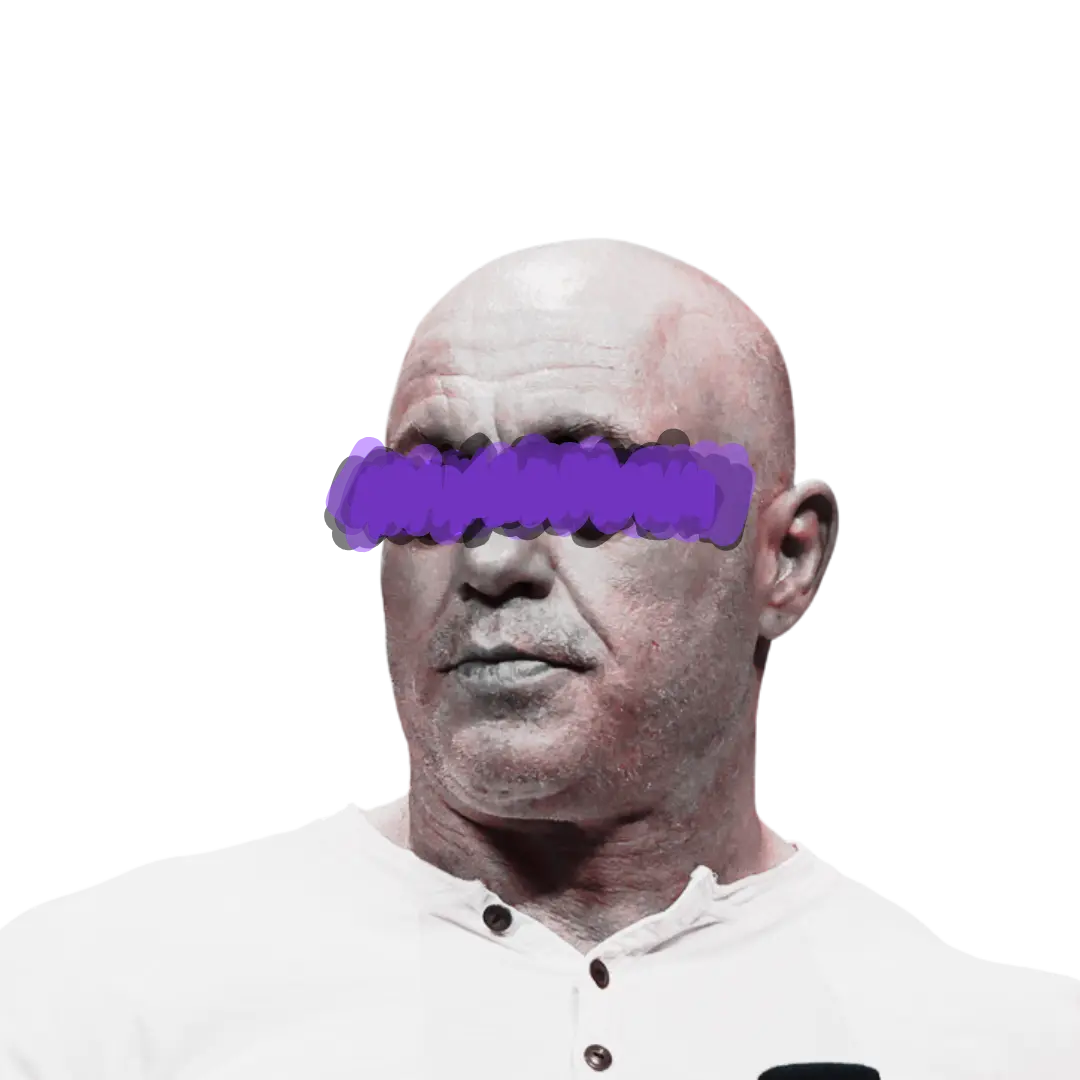
"I tried to persuade him to divorce his wife five times."
Five dinners. Five car rides. Five times between takes on the NewsRadio set when Joe Rogan looked at Phil Hartman and said some version of the same sentence: Leave her. Get out. This isn't safe.
Hartman was one of the funniest humans alive. He was also Joe's friend, his co-star, the man confiding marital terror to him over and over like it was just another workplace venting session. Joe didn't soften it. He didn't stay in his lane. He told Phil directly that his wife Brynn was going to hurt him, and when Phil said he couldn't leave because of the kids, Joe told him again the next time. And the time after that.
Hartman didn't listen. In May 1998, Brynn shot him in their bed while their children slept down the hall.
Joe canceled a week of gigs. He couldn't perform.
That story tells you almost everything you need to know about Joe Rogan. He saw a threat. He confronted it directly. He refused to soften the message because softening might cost someone their life. And when it did, the loss cut him open in a way the kid from Newark had spent his whole life trying to prevent.
This tension runs through everything Joe Rogan has built. The man who created the world's largest conversation platform has spent his life trying to control what can't be controlled. He'll challenge a president he endorsed. He'll compare federal agents to the Gestapo on his own show. He'll platform conspiracy theorists and Nobel laureates in the same week. But ask him to stay away from his daughters for more than three days, and he falls apart.
Control vs. connection. The empire builder who can't be owned by anyone, and the father who discovered that real strength means surrendering to people you love.
And underneath both — the reason the whole pattern is so intense in the first place — is the thing Joe himself named to Lex Fridman in a rare moment of stillness: "There's a lot of violence in me. It scares me."
TL;DR: Why Joe Rogan is an Enneagram Type 8
- The abandoned kid who armored up: Father gone by age 7, stepfather who showed him a different model of manhood — and a very specific moment, age five, that wired everything that came after.
- Anger as engine, not outburst: Joe's gut-center anger doesn't explode the way people expect. It gets refined — turned into jiu-jitsu reps, long-form interrogations, businesses that can't be taken from him.
- Power as survival: Martial arts champion by 19, still trains jiu-jitsu at 58, co-built Onnit into a nine-figure exit, media empire with no corporate owner.
- Loyalty to truth over tribe: Endorsed Trump, then publicly torched his immigration policies within months. Declared himself "politically homeless" by April 2026.
- The protector instinct: Renegotiated Spotify for freedom over money, built Comedy Mothership, hunts his own food, won't leave his daughters for more than three days.
The Violence I Carry
Most Type 8 analyses stop at the behavior: Joe fights, Joe confronts, Joe platforms dangerous ideas, Joe won't back down. But that misses where the fuel comes from.
It's anger. Not loud anger. Not tantrum anger. The steady, low-frequency hum of a gut-center type who was taught before kindergarten that feeling is danger and impact is safety.
The scene is age five. A fight with his cousin over King Kong versus Godzilla. Joe's father — the "psychotic" Newark cop — pulls him into a room and shuts the door.
Did you cry?
No.
Don't ever cry.
A pat on the head. The door opens. The door closes.
"I got the green light to punch kids as long as I didn't cry."
That's what anger is for a Type 8: a permission slip. The only feeling that doesn't get you hit for having it. Grief, fear, loneliness, tenderness — those get locked in a different room. Anger walks freely.
Decades later, on Lex Fridman's show, Joe said the quiet part out loud:
"There's a lot of violence in me for sure. I don't know if it's genetic or learned, but it's because a lot of my formative years, from the time I was 15 until I was 22, all I did was fight. That was all I did."
And then the deeper admission:
"I'm sure it's connected to my dad because he was very violent and I was scared to be around him. But I also think it's connected to who he was as a human, being transferred into my DNA."
Who does that? Who goes on the biggest podcast in the world and tells 200 million people that he's worried he inherited his father's violence like a recessive gene?
A Type 8 who has stopped flinching from his own anger and started studying it. Which is the best version of Type 8 you can get.
This is why the sauna makes sense. 190 degrees, four times a week. Cold plunge at 34 degrees every morning. Jiu-jitsu at 58. Bow hunting his own food. Kettlebells never to failure. The body as a pressure valve. If you don't give the anger somewhere to go, it comes out in the room.
Joe gave it somewhere to go.
Newark, and the Two Fathers
Joe's parents divorced when he was five. He hasn't spoken to his real father since he was seven.
"My real father was crazy, he was like a psychotic person." A big, scary cop from New Jersey. "He beat the f*ck out of my mother, he beat the f*ck out of my cousin." Joe has said flatly: "All my damage came from my real father before I was seven." And in a moment of almost clinical self-analysis: "He would have turned me into a f***ing psychopath."
Then his mother remarried. A hippie computer programmer. The polar opposite. "My mom and my step-dad are actually very happy, and they've been happy since I was seven." His stepfather was "a completely non-violent person" who showed him that manhood didn't require violence.
Two fathers. Two blueprints. One wired him for combat. The other showed him fighting wasn't mandatory.
Newark, San Francisco, Florida. Constantly the new kid, no stable friend group. Joe absorbed the lesson that would shape everything: the world is unpredictable, and survival starts with self-reliance.
"I really felt like a loser." He told Jimmy Carr that divorced parents and constant relocations left him "terrified of employment" and deeply insecure.
The Dojo as Sanctuary
At 14, taekwondo. At 15, karate.
"Martial arts were the first thing that ever gave me hope that I wasn't going to be a loser. So I really, really gravitated toward it."
The dojo became his sanctuary. By 19, he'd won the US Open Championship as a lightweight. Massachusetts full-contact state champion four consecutive years. Teaching taekwondo while still a teenager.
Every kick, every victory reinforced the same message: I am strong. I cannot be hurt.
Then his body betrayed him.
"I would have these headaches that would just be crippling. I couldn't do anything. I couldn't function."
Forced retirement at 21. Severe headaches ended his competitive career. The strength had limits.
Joe found comedy.
In 1996, he walked into Jean Jacques Machado's jiu-jitsu academy and got humbled immediately. A different kind of fighting: slower, more cerebral, where a smaller person with better technique can control a bigger one. By 2010, he'd earned black belts from Machado (gi) and Eddie Bravo (no-gi, 10th Planet).
He still trains at 58. Jiu-jitsu, Muay Thai, cycling through disciplines the way he cycles through podcast guests. The dojo that saved him at 14 never stopped saving him.
How Comedy Replaced the Dojo
At 21, after six months of preparation, first open-mic night at a Boston comedy club.
Richard Pryor had shown him what was possible. "Nothing had made me laugh like that." Raw truth-telling as performance art.
The transition years were brutal. Teaching martial arts at Boston University, delivering newspapers, driving a limousine, doing construction, assisting a private investigator. Every job a bridge to independence.
His comedy style reflected who he was: direct, confrontational, unpolished. No dancing around subjects. Like opponents in the ring, he tackled them head-on.
Tom Segura puts it simply:
"Joe doesn't have a filter, and that's why people connect with him. He's the same guy on air as he is off."
"Burn the Boats" dropped live on Netflix in August 2024, his first special in six years. The title tells you everything. Commit fully. No retreat.
Critics weren't kind. Variety called him "a sort of inverse Chappelle... not a generationally gifted comedian." Rotten Tomatoes: 0% critics, 41% audience. Too much yelling, culture-war material that reads more as opinion than craft.
Joe's comedy works because of who he is, not because of the writing. The persona carries the material. That's a legitimate form of comedy. It's also a form that critics will never reward.
The guy who built the Mothership and the Netflix deals and the podcast that launched a thousand careers, getting middling reviews for the actual comedy. The engine keeps going anyway.
Why Other People's Pain Lands So Hard
1995 to 1999. Joe played Joe Garrelli on NBC's cult-favorite sitcom NewsRadio. The character: street-smart electrician who espoused government conspiracy theories. Sound familiar?
Joe called it "a dream gig." But it also brought the most formative loss of his adult life.
His instinct with Phil Hartman wasn't to listen sympathetically and stay out of it. His instinct was to intervene. Five separate times, by his own count. "I tried to persuade him to divorce his wife five times." Hartman loved his kids. He wouldn't leave. Later, Joe summarized the cost in a single line on the Nerdist podcast: Hartman's death "opened my eyes up to the actual real dangers of bad relationships."
That's Type 8 grief talking — not the sadness of loss but the specific agony of I saw it coming, I said it out loud, and it wasn't enough.
Twenty years later, the pattern repeated. Anthony Bourdain became a close friend. When Bourdain took his own life in 2018, Joe was gutted: "When he died, I was f**ked up for a while."
Then the detail that says everything.
"I have an old phone that I change my number all the time and I keep this number because I have text messages from him... just to go over the text messages and see pictures and s**t he would send me."
He keeps a dead man's words in his pocket. The world's most famous podcaster carries a phone he'll never use because throwing it away would mean losing the last conversation with someone he couldn't save.
"The worst feeling is, 'I feel like if I was there, I could have stopped him from doing that.'"
Twice, Hartman and Bourdain, Joe watched someone he cared about slip away despite his warnings. The man who believes in confronting problems head-on, forced to sit with the knowledge that some problems can't be solved by speaking up louder.
No Single Point of Failure
Most people build a career. Joe built a portfolio of redundancies.
In 2009, he launched "The Joe Rogan Experience" with Brian Redban. Long-form conversations. No editing. No pre-approved questions. Episodes running two, three, four hours. In 2009, nothing else sounded like this.
The format didn't just succeed. It created a genre. Lex Fridman, Andrew Huberman, the entire ecosystem of long-form interviews that now dominates media — all of it traces back to JRE. Huberman: "Rogan is the best by far in the world at [long-form conversation]. I don't think people really appreciate how skilled he is at what he does."
But the podcast alone was never enough. A Type 8 who has decided autonomy is survival doesn't keep one revenue stream, one employer, one point of leverage. He keeps four.
Fear Factor (2001-2012) — six seasons on NBC hosting a show about confronting fear. Proof he could hold a camera and an audience.
Onnit — co-founded 2010 with Aubrey Marcus. Joe pushed toward cognitive enhancement. Alpha Brain sold out three times before the first manufacturer payment came due. In 2021, Unilever acquired Onnit for an estimated $250-400 million. Joe reportedly still holds 50% equity.
UFC commentary — the booth since 1997. His policy: no international travel for commentary. For domestic pay-per-views, his voice remains synonymous with the sport. The martial artist honoring the dojo.
Comedy Mothership — his club in Austin's historic Ritz building on 6th Street, opened after two and a half years of development. "Mothership was created because I wanted a space that would draw comics from around the world to Austin." Ron White, Theo Von, Erik Griffin perform regularly. Independent from major ticketing platforms. Another institution Joe controls from the ground up.
The pattern isn't random ambition. It's a man who decided, somewhere around childhood, that he would never again be at the mercy of a single person, institution, or platform. Every venture is another weight on the "nobody owns me" side of the scale.
The Spotify Standoff
- Spotify offered a reported $100 million (later revealed to be over $200 million) for exclusive rights.
January 2022. Neil Young issued an ultimatum: remove Joe Rogan's podcast or lose his music. Young was protesting "fake information about vaccines." Joni Mitchell and others followed.
Joe didn't bend. "I'm not trying to promote misinformation, I'm not trying to be controversial." He offered to bring on more balanced experts but refused to change his approach. Spotify chose Joe. They pulled Neil Young's music rather than their most popular podcaster. Young quietly returned to Spotify in 2024, without fanfare.
February 2024. Joe renegotiated: up to $250 million, but without exclusivity. His show now available on Spotify, Apple Podcasts, YouTube, and Amazon Music simultaneously.
Read that again. He traded guaranteed exclusivity money for freedom across every platform. That's not a business decision. That's an 8's immune response to the word "exclusive."
By 2025: #1 on Spotify for the sixth consecutive year. First time ever topping Apple Podcasts and YouTube simultaneously.
When the Golden Globes debuted a "Best Podcast" award in January 2026, Joe wasn't nominated. Not because he lost. Because he refused to pay the $500 submission fee. He told Bert Kreischer: "You can't tell me I didn't win. I've been number one for six years in a row."
The COVID Flashpoint
September 2021. Joe tested positive for COVID-19 and posted a video announcing his treatment: "We immediately threw the kitchen sink at it, monoclonal antibodies, ivermectin, Z-Pak, prednisone, everything." Three days later, he said he felt great.
CNN repeatedly characterized ivermectin as a "horse dewormer." Joe's response was direct: "They keep saying I'm taking horse dewormer. I literally got it from a doctor." And then: "Bro, do I have to sue CNN?"
The peak confrontation came when CNN's Dr. Sanjay Gupta appeared on JRE. Joe pressed him: "Why would they lie and say that's horse dewormer?" Gupta conceded on air: "They shouldn't have said that." Don Lemon doubled down anyway.
This wasn't about the medicine. It was about the frame. A major news network tried to define him. Joe refused to accept the definition. He invited their own medical correspondent onto his turf and extracted a concession on air. Whether you think Joe was right or reckless, the pattern is unmistakable.
Why Texas Made Sense
- COVID lockdowns. California shut everything down. Joe visited Austin in May, took his kids to a restaurant where nobody made them wear a mask, and something clicked.
"I just want to go somewhere in the center of the country, somewhere it's easier to travel to both places and somewhere we have a little bit more freedom."
He bought a $14.4 million compound on Lake Austin. The move wasn't about taxes — he's pushed back on that narrative directly: "I'm not a person who wants to keep all my money and not pay taxes." It was about control. California had shown him what happens when a government decides how you live. For a Type 8, that's intolerable.
The gravitational pull worked. Shane Gillis relocated from New York. Brendan Schaub came from LA. A whole constellation of comedians followed Joe to Austin, betting that wherever he built, the scene would follow. Some thrived. Some regretted it.
Joe didn't just leave California. He built a rival center of gravity.
What is Joe Rogan's Personality Type?
Joe Rogan is an Enneagram Type 8
Enneagram Eights are called "The Challenger." Their core fear: being controlled or harmed by others. Their core desire: protecting themselves and determining their own course.
This doesn't just mean they're tough. It means the entire architecture of their life — career choices, relationships, daily routines, political positions — is organized around a single question: Who has power over me?
The answer, for a healthy Eight, is always: Nobody. By design.
In Joe's case, that answer is carved into every major decision he's made since he was a kid punching his way out of anger he wasn't allowed to name. The dojo instead of the living room. Comedy instead of a day job. His own podcast instead of someone else's TV show. A comedy club he owns. A supplement company he sold but still owns half of. A family compound in a state he chose. Every move a brick in the same wall: no single person, no single institution, no single platform gets leverage over me again.
Most Eights dominate one domain. Joe dominated martial arts, then comedy, then television, then podcasting, then business, then live venue ownership — each time on his terms.
The Hartman grief, the Bourdain phone, the three-day rule with his daughters — those aren't counter-evidence to the Eight read. They're what Type 8 looks like when the armor comes off. The same gut-center intensity that drives the confrontation drives the devotion. The same refusal to look away that makes him platform Alex Jones also made him warn Phil Hartman five times.
Enneagram Rabbit Hole: Wings, Subtypes & Connecting Lines for Joe Rogan
For the Enneagram nerds. Skip if you're not deep into the system — the rest of the analysis stands on its own.
Joe Rogan's Wing: 8w7
The 7 wing is what separates Joe from the stereotypical 8. An 8w9 is a bear — quieter, more behind-the-scenes, content to guard territory rather than expand it. An 8w7 is a maverick — stimulation-seeking, appetite-driven, pulling the 7's curiosity into the 8's engine.
Look at the evidence. The JRE format — four-hour conversations, cycling through physicists, comedians, flat-earthers, MMA fighters, and hunting guides — isn't a territory-guarding move. It's 7-wing hunger. The psychedelics, the DMT curiosity, the sensory deprivation tank, the "let's try this" energy around new training protocols — all 7-wing exploration grafted onto 8's directness.
The 7-wing also explains the shape of his political evolution. An 8w9 stays loyal to a tribe once chosen. An 8w7 gets bored of any tribe that starts to feel confining. "Politically homeless" by April 2026, after less than two years of Trump-era alignment, is 7-wing restlessness applied to ideology.
And it explains why Joe can hold anger without exploding. 8w9s pack the rage down; it leaks sideways. 8w7s metabolize rage through new experience — more jiu-jitsu, more hunting trips, more guests, more saunas, more novel inputs. The 7-wing is his pressure valve.
Joe Rogan's Instinctual Subtype: sp/sx
Joe reads as self-preservation dominant with sexual (one-to-one) secondary — the "satisfaction" subtype variant of 8, though with more sx intensity than classic sp/sp.
The sp-dominance is everywhere in the body: sauna at 190°F, cold plunge at 34°F, kettlebells on Tsatsouline's protocol, the assault bike, the Rogue rig, 190+ pounds of hex dumbbells. Eight months of elk meat in the freezer from a single bow kill. The Austin compound. The three-day rule. Sp-8s build a fortress of sustenance and defensible space, and Joe has built one of the most elaborate fortresses in celebrity culture.
The sx shows up in the format of the podcast. Three-, four-hour one-on-one sessions are a sexual-subtype move — narrow, intense, mutually consuming attention on a single other person. Joe doesn't run a panel show. He runs a series of long, intimate duels. The loyalty to specific inner-circle people (Joey Diaz, Cam Hanes, Eddie Bravo, Tom Segura) over any broader "comedy community" is the same signature. Sx/so 8s are the classic Challenger archetypes — big, public, movement-leading figures. Joe is more private than that. He's an sp-8 who found a medium that lets his sx intensity breathe.
Social instinct is his weakest. He's not a scene-builder at the group level. He built the Mothership, but he doesn't manage it as a social hub — he uses it as a stage for his specific friends. He endorses candidates but can't stay in any movement for long. Tribal belonging just isn't a live wire for him.
Stress (8 → 5) and Growth (8 → 2) — the Asymmetry
The 8's stress and growth arrows don't move in opposite directions of the same quality. That's the nuance worth naming.
Under stress, Joe pulls the worst of Type 5. Not the thoughtful, careful systems-thinker 5 — the withdrawn, suspicious, conspiracy-flavored 5 who hoards information and isolates. You see flashes of this in his darker periods: the bunker energy, the "they're lying to us" framing, the sense that institutions are coordinated against him personally. A healthy 5 integrates with data. A stressed 8 borrowing from 5 builds a threat model out of pattern-matching and vibes. The AI Walz video he fell for in September 2025 — insisting it was real while the "AI Generated" label sat at the top of the screen — is stressed-8 certainty masquerading as 5-style analysis. He trusted his gut over the evidence literally on screen. 5-in-stress for the 8 is not more careful thinking. It's faster jumping to darker conclusions.
In growth, Joe pulls the best of Type 2. Not the codependent, image-managing 2 — the generous, present, uses-their-strength-for-others 2. You see this in his quiet championing of comedians who were written off: Bert Kreischer before the tour, Shane Gillis after the SNL firing, Joey Diaz through his darkest years. You see it in the Theo Von moment in late 2025, voice quivering: "[You] can't be alone, man." An 8 at 2 doesn't just protect his own. He makes his strength available. See Type 8 in stress and growth for more on this split.
Counterarguments: Why Joe Rogan Might Not Be Type 8
The strongest alternate read is 8w9, not a different core type. 8w9 advocates point to the long silences in interviews, the slow pace of the podcast, the bear-like domestic life, the preference for Austin over Los Angeles, the insistence on family quiet. Real signals, but they're the domesticated edges of an 8w7, not the base. The format of what he chose — a stimulation-rich, guest-rotating, psychedelics-and-hunting life — is 7-wing. 8w9s build moats. 8w7s build amusement parks with moats.
The next alternate case is Type 6 counterphobic. Counterphobic 6s look almost identical to 8s from the outside — they charge at threats, they confront authority, they build loyalty structures. The tell: 6s scan for an authority to either rely on or rebel against. 8s don't. Joe's default move is to trust himself over every expert, every institution, every tribe. A 6 in that situation would have eventually anchored to some authority — a politician, a guru, a framework. Joe keeps floating free, "politically homeless," suspicious of any structure that wants his loyalty. That's 8, not 6.
Type 7 comes up because of the appetite — psychedelics, hunting, comedy, multiple businesses, new guests every week. But 7s flee pain. Joe walks into it: 190° sauna, 34° plunge, jiu-jitsu at 58, admitting on the biggest podcast in the world that he's scared of his own capacity for violence. 7s would never sit with that admission. They'd reframe, rationalize, redirect toward something pleasurable. Joe's 7-wing flavors his 8 core. It doesn't replace it.
Type 3 gets floated because of the empire. But 3s optimize for image and validation. Joe turned down the Golden Globe submission, gave up exclusivity money at Spotify, and said publicly he's "not a respected source of information, even for me." A 3 at his scale would be collecting awards, polishing narrative, managing perception at every turn. Joe refuses the game. That's 8.
Type 1 gets raised because of his moralizing on certain issues (ICE, government lies, media dishonesty). But 1s have an internalized code that constrains their own behavior first. Joe has no such filter — he curses, platforms anything, says whatever lands on his tongue, then apologizes only when he wants to. His moralizing is 8 protector-of-the-weak energy, not 1 internal-standards energy.
The simplest test: when Joe is attacked, what happens? He doesn't retreat into self-doubt (9), he doesn't reframe (7), he doesn't analyze (5), he doesn't perform repair (3), and he doesn't reach for an authority figure (6). He pushes back harder. Gut-first, consequences-second, tribe-of-one.
That's an 8.
Joe Rogan and Trump: Why He Won't Stay Loyal to Any Tribe
October 2024. Joe interviewed Donald Trump for three hours. Over 59 million views.
Days before the election, Joe officially endorsed Trump. The assassination attempt in Pennsylvania factored heavily, along with what he saw as media bias.
Then came the twist. Not one break, but a cascade.
Even before the inauguration, Joe slammed Trump for attacking filmmaker Rob Reiner after his death: "When you see it with no empathy, that's when it's hard to like." He said he was "so disappointed" and that someone should have taken Trump's "f**king phone" away from him.
Within months of Trump taking office, Joe was publicly torching the administration he'd helped elect:
- On ICE deportations: "This is f***ing crazy." Called the agency's tactics "the Gestapo."
- On deporting non-criminals: "You gotta get scared that people who are not criminals are getting, like, lassoed up and deported. That's horrific."
- On the Renee Nicole Good shooting: "It's very ugly to watch someone shoot a U.S. citizen, especially a woman, in the face."
- On Trump's feud with Canada: "Stupid."
- On 2020 election fraud claims: In July 2025, Joe stated flatly that Trump had no evidence to support widespread election fraud.
- On Tim Walz and Minnesota fraud (February 2026): Called Walz a "dangerous f**k" over a $9 billion fraud scheme, showing he'll target both sides.
By April 2026, after criticizing Trump over escalating Iran tensions and calling it a distraction from the Epstein files, Joe declared himself "politically homeless." Less than eighteen months after the endorsement. For an 8w7, that's not flip-flopping. That's the system working as designed. Fierce loyalty to truth. No permanent loyalty to people.
Fatherhood: The Soft Spot He Can't Armor Over
Joe met Jessica Ditzel in 2001 while she was working as a cocktail waitress in Los Angeles. Eight years of dating before marrying in 2009. Her Instagram bio reads: "Anonymity is underrated." The world's most famous podcaster married a woman who wants to be invisible. That's not an accident.
Three daughters: Kayja Rose (adopted after her biological father, R&B singer Keven "Dino" Conner, died in a 2003 car accident), Lola (born 2008), and Rosy (born 2010).
"Three days f*cks up my feelings." He doesn't stay gone from family longer than that.
Before his daughters, Joe saw people simply. A 50-year-old was just a 50-year-old. Now he thinks about their whole journey: "He used to be a baby, used to be a kid... I think of the whole path of that person becoming an adult now. I never used to do that before."
"I think the universe did me a solid by giving me only daughters." Raising girls forced a different kind of strength. Not confrontation strength. Patience. Emotional attunement. Vulnerability.
The boy who lost his father at 7 becoming a fiercely present father himself. The strength his daughters need most is the kind you can't build in a gym.
Why a Man With Social Anxiety Built the World's Biggest Podcast
"I had a lot of social anxiety." The man who now talks to 200 million people per month once found basic social interaction deeply uncomfortable. The podcast itself may be therapeutic infrastructure: a controlled environment where he gets to be intimate with people on his terms, from behind a microphone.
"My inner monologue is just intense curiosity. I'm constantly asking myself, 'What's really going on here?'"
Sensory deprivation tanks offer a window into what he's running from, and toward:
"In the tank, you're forced to be with yourself. You're forced to confront your own thoughts."
Psychedelics reveal the most. DMT, psilocybin, plant medicines — substances that temporarily lower the defenses he's spent a lifetime building.
"Plant medicines have been the most positive thing to happen to me from a mental health perspective."
For someone who struggles with vulnerability, psychedelics offer connection without the perceived danger of losing control. The walls come down, but on his schedule.
The Inner Circle
"There's only one way to get good at anything; you surround yourself with the bad motherf*ckers who are doing exactly what you do and you force yourself to keep up and inspire each other."
Tom Segura, Bert Kreischer, Joey Diaz. Cameron Hanes for bow hunting. Duncan Trussell for philosophical sparring.
Joey Diaz on Joe helping him through his darkest times:
"He never judged me. He just said, 'What do you need?'"
"Joe is the type of guy who's genuinely happy for your success," Segura has said. "That's rare in this business."
The most revealing moment came in late 2025. Theo Von mentioned suffering from depression on JRE #2413. Joe's initial response, that Von was depressed because he wasn't "hanging around with us," could sound dismissive. But then, with a deep sigh and quivered voice:
"[You] can't be alone, man."
A YouTube commenter captured it: "Rogan actually tears up for a sec and no one caught it." The empire builder, the man who'll challenge anyone, pleading with a friend not to isolate. Because he knows what isolation does.
Why He Platforms Conspiracy Theorists
Critics treat Joe's conspiracy openness as a flaw. It's the same impulse that makes him a great interviewer.
Joe likes edgy people. Comedians are edgy by profession — they test boundaries for a living. Conspiracy theorists do the same thing with ideas. For someone who grew up sparring in dojos, then sparring onstage with audiences, sitting across from someone with a wild theory is just another form of combat. Mental jiu-jitsu. He's rolling with ideas the way he rolls on the mat.
"The only time I commit to conspiracy theories is when something way retarded happens. Like Lee Harvey Oswald acting alone."
The key is that Joe trusts himself to sort fact from friction. He has an inner resilience, forged through decades of physical training and thousands of long-form conversations, that lets him engage with dangerous ideas without being consumed by them. He doesn't just platform people he agrees with. He platforms people who are interesting. Then he pressure-tests them in real time.
"I'm just approaching every single subject completely open-minded, even the one that I didn't believe in."
Eddie Bravo is the perfect case study. Joe's jiu-jitsu instructor, close friend for decades, and a man who believes the earth is flat. The "look into it" meme was born from Bravo's appearances on JRE, where he'd insist on conspiracy after conspiracy while Joe pushed back, laughed, and kept the conversation going. He never cut Bravo off. He also never pretended flat earth was credible. That's the balance most people miss.
Alex Jones is the same pattern, amplified. Friends since the early 2000s. Real friends — trips together, time outside the spotlight. When Jones faced widespread deplatforming after the Sandy Hook lawsuits, Joe continued having him on. In his 2024 Netflix special, Joe defended Jones, saying Alex had "taught me about this sh*t 20 years ago." Joe has challenged Jones on-air, pushed back on his wilder claims, acknowledged his friend's "alcohol and drug problems." But never cut ties.
"It's terrifying when you're too dumb to know who's stupid. That's a position that I find myself in sometimes."
That self-awareness matters. After his COVID vaccine comments drew backlash: "I'm not a doctor, I'm a f***ing moron, and I'm a cage fighting commentator. I'm not a respected source of information, even for me."
That's not false modesty. That's an 8 who knows the difference between strength and expertise. He trusts his instincts. He doesn't trust his credentials — because he knows he doesn't have any.
The AI Video Blindspot
In September 2025, during an episode with Tim Dillon, Joe fell for an obviously fake AI-generated video of Tim Walz dancing in a "F**k Trump" shirt on an escalator. He insisted it was real while producer Jamie Vernon pointed out the "AI Generated" label visible at the top of the video.
When finally confronted: "I fell for it too, and do you know why I fell for it? Because I believe that he's capable of doing something that dumb."
The moment crystallizes the shadow side of self-trust. Joe's confidence in his own judgment — the same force that makes him challenge presidents and refuse to bend to public pressure — can blind him. He trusted his gut over the evidence literally on screen. The stressed 8 borrowing from 5's worst pattern-matching.
Sometimes the sparring partner lands a clean shot. The question is whether you learn from it.
The Strength That Built It Is the Blind Spot That Threatens It
"Be the hero of your own story."
Joe Rogan built the world's biggest conversation platform. He endorsed a president and criticized him within months. He left California because the government told him how to live. He created a comedy club so others would have a stage. He hunts his own food with a bow. He still rolls jiu-jitsu at 58. He platforms flat-earthers and physicists in the same week because he trusts himself — and his audience — to sort through it.
And the same force that built all of it — the self-trust, the directness, the refusal to defer — is the thing that sometimes blinds him. But he knows that. "I'm not a respected source of information, even for me."
The strength that built the empire is the blind spot that threatens it. The self-awareness to name it is what keeps the whole thing from collapsing.
Except his daughters. Three days away and his feelings start to crack.
The kid in that room, the one his father ordered never to cry, finally has a reason not to armor over.
FAQs About Joe Rogan's Personality
What personality type is Joe Rogan?
Joe Rogan reads most clearly as an Enneagram Type 8, likely 8w7 sp/sx. The core through-line is autonomy: he keeps building businesses, routines, and relationships that make it harder for anyone to own him.
Why does Joe Rogan talk to so many different kinds of guests?
For an 8w7, every idea is either a threat or an ally — and the only way to know which is to get close and pressure-test it. He'd rather spar with a conspiracy theorist in real time than trust institutions to sort it for him.
Why did Joe Rogan move to Texas?
The move was not just lifestyle branding. It was a direct response to feeling constrained in California, followed by the classic Type 8 move of building a new power center on his own terms.
Why does Joe Rogan platform conspiracy theorists?
Because he treats conversation like combat and assumes he can sort signal from noise in real time. That makes him compelling when he's right and vulnerable to overconfidence when he is not.
Is Joe Rogan an 8w7 or 8w9?
8w7. The stimulation-seeking (psychedelics, hunting, new disciplines), the restless curiosity across wildly different guests, and the inability to stay in any political tribe for long are all 7-wing signatures grafted onto the 8 core.
Disclaimer This analysis of Joe Rogan's Enneagram type is speculative, based on publicly available information, and may not reflect Joe's actual personality type.
What would you add?