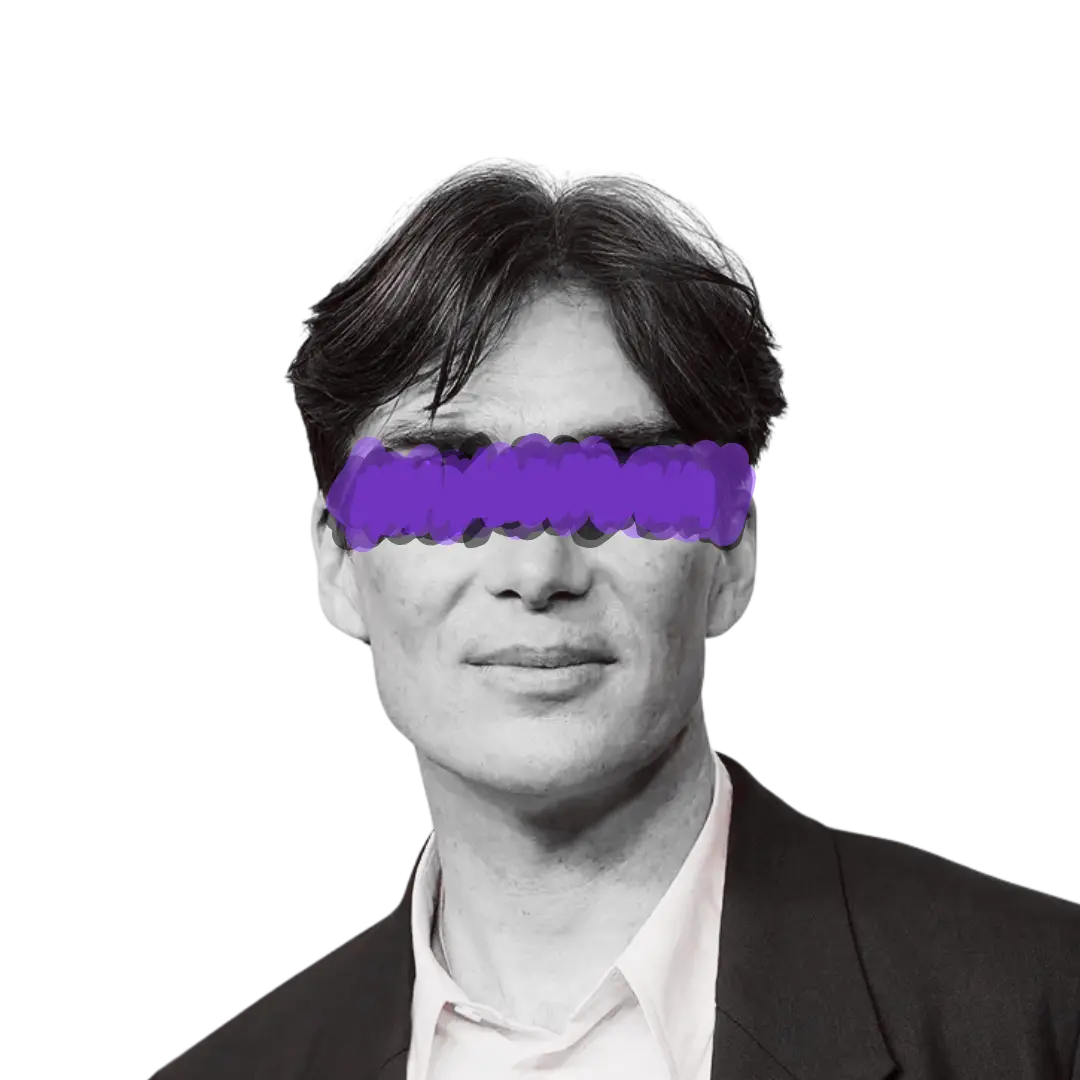
"I'm stubborn and lacking in confidence — a terrible combination."
Robert Downey Jr. had just returned from four days off on the Oppenheimer set. He was excited. He'd been antiquing around Santa Fe, had stories to tell. He found Cillian Murphy and started in on the highlights.
Murphy cut him off. Could they run lines instead?
Downey wasn't offended. He was mesmerized. "Cillian is so warm and nice and inviting," he said later. "But then we'd roll, and I'd feel like he was looking through me like I didn't exist. And I was like, 'That sucks.'"
Emily Blunt put it more bluntly: "He's the best actor in the world and he's the worst celebrity in the world."
She meant it as a compliment. But it's also a diagnosis. Why would the worst celebrity in the world choose the most visible profession on earth? What kind of person empties himself completely (privacy, personality, body weight) to become someone else, then goes home to a house with no internet and walks his dog along the Irish coast until the next script arrives?
The answer runs deeper than introversion. It runs deeper than craft. It runs to a place Murphy himself once described with devastating self-knowledge: stubborn and lacking in confidence, a terrible combination.
TL;DR: Why Cillian Murphy is an Enneagram Type 5
- The Controlled Disappearance: No social media. No smartphone. No internet at home. Murphy has built the most extreme privacy infrastructure of any A-list actor, not from technophobia, but from a Type 5's core need to control what gets in and what gets out.
- Obsessive Preparation, Total Surrender: For Oppenheimer, he spent six months researching, learned 30,000 words of Dutch for one scene, and lost 28 pounds. Then he walked on set and "abandoned it all." The paradox (hoard knowledge, then release it) is the Five's engine.
- The Art of Withholding: "You have to withhold more than you add," Murphy says of acting. It's also how he lives. He withholds personality to reveal character. He withholds information to preserve the inner life that fuels everything.
- "Stubborn and Lacking in Confidence": His own self-description captures the Five's paradox: the relentless drive to master paired with the persistent fear of being exposed as insufficient. Catholic guilt amplifies it: "It's all going to go wrong. You don't deserve this."
What is Cillian Murphy's personality type?
Cillian Murphy is an Enneagram Type 5
Enneagram Type 5s, known as "The Investigators," share a core fear of being useless, overwhelmed, or incapable. Their defense? Retreat into the mind. Observe rather than participate. Accumulate knowledge until action feels safe. Minimize needs so the world can't deplete you.
But here's what most descriptions miss: the fear isn't about stupidity. It's about exposure. Being caught without enough (enough knowledge, enough preparation, enough energy) to meet what the moment demands. So Fives build fortresses. They study. They prepare. They hoard information and ration social contact like supplies in a siege.
Murphy's version of the fortress has no WiFi.
His home in Monkstown, south Dublin, has no internet connection. His phone has black wallpaper and every notification turned off. He has never had a social media account. When asked about the "Disappointed Cillian Murphy" meme (67 million TikTok views of him looking bored in interviews), his response was: "What's a meme?"
This isn't eccentricity. It's architecture. Murphy has designed a life where the only information that reaches him is information he chose to seek. Everything else is noise. And noise, for this particular mind, is the enemy.
"My life is very simple," he's said. "I read a lot of books. I watch a lot of movies. Listen to a lot of music. Walk the dog. Cook with my family."
Simple. Controlled. A fortress with exactly the doors he wants.
Cillian Murphy's Childhood in Cork
Murphy grew up in Douglas, Cork, the eldest of four children. His mother taught French. His father worked for the Department of Education. Aunts, uncles, grandparents, all teachers. "I come from a long line of teachers," he's said. "Not only did I not go into the family business; I had an aborted law career."
He attended Presentation Brothers College, a fee-paying Catholic school where sports dominated. Murphy wasn't interested in sports. He was interested in music. He started writing and performing songs at ten, and by his mid-teens he was getting suspended from school, not keen on the curriculum, not interested in conforming.
"It was a dark year," he's said about his final exams. "I still have nightmares about it, even more so than walking on stage."
He still has recurring dreams where he's back at his desk in school uniform, taking the Leaving Cert. Decades later. After an Oscar. The anxiety of that environment (the intrusion, the demands, the feeling of being in the wrong place) left marks that fame hasn't erased.
When he enrolled at University College Cork to study law in 1996, he knew within days it was wrong. He failed his first-year exams because, as he put it, "Why the fuck I was studying law, I don't know."
He was busy elsewhere. His band, The Sons of Mr. Green Genes (named after a Frank Zappa track), was playing acid jazz around Cork, "wacky lyrics and endless guitar solos." They were offered a five-album deal by Acid Jazz Records. They turned it down. His brother Paidi was still in school, and the financial terms would have meant signing away Murphy's compositions for minimal money.
Years later, he reflected on why he didn't pursue music further: "I just never thought that I was good enough really. It's why I haven't pursued the music either. I like to do one thing quite well."
There it is. The Five's engine, running since adolescence: the conviction that competence requires total commitment, and the fear that even total commitment might not be enough.
The Summer Everything Changed
In the same fateful summer of 1996, three things happened. Murphy failed his law exams. He saw Corcadorca Theatre Company's production of A Clockwork Orange and badgered director Pat Kiernan until he got an audition. And he met Yvonne McGuinness.
Kiernan cast him in Enda Walsh's Disco Pigs, playing a volatile Cork teenager opposite Eileen Walsh. Murphy described performing as "a huge high" and "a fully alive" feeling that he set out to chase for the rest of his life.
"Everybody knows Disco Pigs changed everything for me," he's said. "It was the first thing I ever did, and it formed me totally."
The play, originally intended to run three weeks in Cork, toured Europe, Canada, and Australia for two years. Murphy left university. He left his band. His future wife came on tour with them.
"That time was kind of the most important period of my life. The people I met there remain my closest friends. And it was around the same time I met my wife. She came on tour with us. It was so exciting. We were all just kids, trying to find our way."
He was, by his own admission, "unbelievably cocky and had nothing to lose." That cockiness, the confidence of youth or the ignorance of it, sits strangely against the man he'd become. But it makes sense through the Enneagram: a young Five who hasn't yet learned to be afraid of exposure. The fortress hadn't been built yet. The world hadn't demanded it.
Danny Boyle would discover him a few years later for 28 Days Later. Boyle's first impression: "He's a very sweet guy. He's very laid back. And we wanted this raging fucking guy at the end." Murphy convinced him with a single argument: "I come from Cork, in Ireland. Do you know Roy Keane? Cork produces fighting men. Trust me."
Boyle trusted him. And after seeing the finished film, he said: "I remember thinking, 'Whoa, he'll have an amazing career.' I was right."
How Cillian Murphy Became a Leading Man
Christopher Nolan first noticed Murphy in a promotional image for 28 Days Later, recalling "your shaved head and your crazy eyes, no offense." When they met, Nolan knew Murphy wasn't Batman. But there was something he couldn't let go of.
Nolan deliberately arranged a Batman screen test, not to cast Murphy as Batman, but to convince studio executives to let him cast Murphy as Scarecrow. It worked. Every previous Batman villain had been played by a massive star: Nicholson, Schwarzenegger, Carrey. Casting a 28-year-old Irish theater actor was, as Nolan put it, "a big leap."
That leap began a collaboration spanning six films and twenty years. Murphy played supporting roles in Batman Begins, The Dark Knight, The Dark Knight Rises, Inception, and Dunkirk. He showed up when Nolan called. He never asked for more.
"I have always said publicly and privately, to Chris, that if I'm available and you want me to be in a movie, I'm there," Murphy explained. "I don't really care about the size of the part."
Then, quietly: "But deep down, secretly, I was desperate to play a lead for him."
When Nolan finally wrote a lead role for Murphy, Oppenheimer, he left a handwritten note on the title page of the script:
"Dearest Cillian. Finally, a chance to see you lead... Love, Chris."
Murphy's response: "Finally!"
Twenty years of patience. Twenty years of showing up without complaint. Then five words and a laugh. That restraint, the willingness to wait, the refusal to demand, is how a Five builds a career. Not by pushing. By being so undeniably good that the opportunity arrives on its own terms.
But that's not the whole story. Because the same man who waited twenty years for Nolan also fought for himself when it mattered.
When Steven Knight created Peaky Blinders, he initially preferred Jason Statham for Tommy Shelby. Knight met both actors in Los Angeles and chose Statham: "Jason was Jason and Cillian when you meet him isn't Tommy, obviously, but I was stupid enough not to understand that."
Murphy sent Knight a text. Five words: "Remember, I'm an actor."
Knight never forgot. "What he meant was that when he walks into a room, he's not Tommy Shelby. But he can become him." Knight changed his mind. Murphy transformed completely: gave up vegetarianism to bulk up, spent time in Birmingham pubs recording accents, lived with Romani communities. A "reasonably sized cowardly Irishman," as he calls himself, became the most terrifying character on television.
That text is the moment where Murphy's personality cracks open. The man who hates self-promotion, who finds publicity "terrifying," who would rather be invisible, advocating for himself with quiet, absolute confidence. Not aggressive. Not desperate. Just: remember what I am.
In Enneagram terms, this is a Five accessing their growth direction, Type 8. When a Five is healthy, they stop hoarding and start acting. They step forward. They claim space. Murphy does this rarely, but when he does, it changes everything.
Why Cillian Murphy Is So Private
Murphy's philosophy of acting is also his philosophy of living:
"For me, the whole art of it is that you have to withhold more than you add. By withholding, you let the audience join the dots emotionally. Not to demonstrate, but withhold, and then the audience can try and figure out what the inner workings of the man are."
This is the key to Murphy, not just as an actor, but as a person. He withholds personality to reveal character. He withholds information to preserve his inner world. He withholds social energy to fuel creative intensity. The emptying out is the fullness.
His preparation is obsessive. For Oppenheimer: six months of research, every biography, every archived lecture. He learned 30,000 words of Dutch for a single scene. Robert Downey Jr. described the contrast: "We'd be like, 'Hey, we got a three-day weekend. Maybe we'll go antiquing in Santa Fe.' And Cillian would say, 'Oh, I have to learn 30,000 words of Dutch. Have a nice time.'"
He lost 28 pounds. Emily Blunt joked he ate "one almond most nights." He worked with a nutritionist but refused to discuss specifics: "I don't want to go into numbers. It feels inappropriate, unhealthy."
But here's the paradox. After all that preparation, he lets it go.
"I still do the research and read all the books and talk to all the people and learn how to ride the fucking horse or drive the car or shoot whatever," he's said. "But when I get on set, I abandon it all."
"Instinct is your most powerful tool. Nothing must be predetermined."
Hoard, then release. Prepare obsessively, then surrender completely. It sounds contradictory, but for a Five, it's the only way the engine works. The preparation isn't the performance; it's the foundation that makes the performance feel effortless. The knowledge isn't for showing. It's for knowing, so that when the camera rolls, the conscious mind can step aside and something deeper can take over.
"It's like being buffeted by the wind and being buffeted by emotion," he says of that surrender.
The man who controls everything — releasing control.
How Cillian Murphy Disappears Into Roles
The cost of Murphy's method is paid by the people closest to him.
Matt Damon called him "the worst dinner companion imaginable." During Oppenheimer, Murphy never joined the cast for dinner. Not once. "His brain was just too full," Damon explained. Murphy didn't disagree: "I've always been like that. But it's because you have the time on set, which is short, you have 10 hours, maybe. And then you're keeping your lines fresh. And then the other big thing for me is sleeping. I love sleeping and I need sleep."
Downey called it "the greatest sacrifice by a lead actor in my career."
But Oppenheimer was temporary. Peaky Blinders lasted a decade.
"I'm not all there when I'm filming," Murphy has admitted. "And in terms of life when we're filming: I don't socialise, I just go home, learn the lines, go to bed." His wife and sons described him as "not being all there" during shooting periods.
Then the slow return. Murphy's wife Yvonne can see it happening: "OK. Tommy's gradually leaving. I'm getting Cillian back."
That sentence, spoken by the woman who has watched her husband disappear into other men for thirty years, is the most intimate window into what it costs to live with a Five who has made disappearance into an art form. The roles don't just occupy his mind. They replace him. And the people who love him have to wait for the person they know to return.
"I cancel reality for a while," Murphy has said of this state. It's meant as description. It reads as confession.
During COVID-era filming of Peaky Blinders Season 6, the isolation was total: "There was nothing open, no restaurants. It was just myself and Tommy Shelby, who you don't want to be alone with for five months, believe me."
For his 2025 film Steve, Murphy described being in "a jangled state of anxiety for two months," playing a character that was, by his own admission, written partially from his own psychology. "One of the most exposing and terrifying characters I've ever played."
Terrifying. He keeps using that word. Publicity is terrifying. Fame is terrifying. The roles he's drawn to are terrifying. For a head-centered type driven by fear, Murphy doesn't avoid what frightens him. He walks straight into it, then walks home to a house with no internet and closes the door.
"It's All Going to Go Wrong"
Growing up Catholic in Ireland left marks Murphy hasn't tried to erase.
"My family wasn't particularly religious, but I was taught by a religious order. The Irish school system was almost exclusively controlled by the Catholic Church. I have no problem with people having faith. But I don't like it being imposed. When it's imposed, it causes harm."
The harm he's talking about is specific. In 2024, Murphy produced and starred in Small Things Like These, a film about the Magdalene Laundries, institutions where the Catholic Church confined and exploited Irish women for decades. He called it "a collective trauma, particularly for people of a certain age, and I think that we're still processing that."
Then he asked a question that could only come from someone who has spent his life observing complicity from the inside: "Where do the rest of us sit on that spectrum, between innocence and complicity?"
And: "The thing about complicity is that sometimes the system of oppression is run by the people who are oppressed."
A quiet man making himself loud about the quietest crime in Irish history. A Five stepping into the public arena not for self-promotion but because the story demanded it. He launched his own production company, Big Things Films, specifically to get this film made. He pitched it to Matt Damon during Oppenheimer filming.
But the Catholic imprint goes deeper than politics. It lives in his relationship with success.
"Actors are overpaid, you know? It's nice when you get paid, when you're young, and you've gone from having no money, but the Catholic guilt kicks in immediately, and I'm like, 'It's all going to go wrong. You don't deserve this.' And I don't."
Read that again. And I don't. Not "and I sometimes feel that way." Not "and I struggle with that thought." He states it as fact. He doesn't deserve this.
A Five's core fear (being insufficient, incapable) amplified by a Catholic childhood where guilt was the air you breathed. The result is a man who has won an Oscar, transformed himself into the most commanding screen presence of his generation, and still believes, at some fundamental level, that the floor is about to drop.
"I don't like watching myself. It's like, 'Oh, fucking hell,'" he's said. "You become competitive with yourself a little bit, which is not healthy."
When asked after the Oscar whether the unprecedented success of Oppenheimer changed his plans: "The types of films that I want to make and the types of stories that I want to tell haven't been changed by that." He went straight back to work. "That was my way of dealing with it."
He called the win "a fever dream, really. I don't think I've properly thought deeply about it or processed it in any way."
A man who can spend six months processing Oppenheimer's psychology but can't process his own triumph. The fortress keeps certain things out. Including, apparently, joy.
But What About the Life Force?
If Murphy were only withdrawal and withholding, he'd be an interesting recluse. He wouldn't be a great actor.
Emily Blunt said something that doesn't fit the Five profile at all: "The whole room crackles with a sort of life force when you work with him." That's not retreat. That's not conservation. That's someone who radiates when the conditions are right.
Nolan sees it too: "He's always looked to challenge himself. He's never been an actor to rest on his laurels. He's the same guy he was." And: "I've always known since I first met him that he is one of the great actors, not just of his generation, but of all time."
Danny Boyle described Murphy's core quality as "changeability," the ability to be "an affable, carefree bike messenger" and then transform into "an avenging angel, capable of the kind of violence that the infected are capable of."
These aren't descriptions of someone hiding. They're descriptions of someone who has done so much internal work (observation, preparation, emotional processing) that when they finally act, the accumulated energy is staggering.
This is what the Enneagram explains that a simple "introvert" label misses. Fives don't hoard energy for nothing. They hoard it to spend it, in rare, concentrated bursts. Murphy's public appearances are few. His performances are volcanic. The correlation isn't accidental.
At the 2024 Oscars, accepting the Best Actor award, Murphy was warm, generous, publicly emotional, nothing like the interview-avoidant hermit the tabloids describe. He called his collaboration with Nolan "the wildest, most exhilarating, most creatively satisfying journey," declared himself "a very proud Irishman standing here tonight," and dedicated the award "to the peacemakers everywhere." He signed off in Irish: Go raibh mile maith agat.
He brought his sons.
That's not a man who can't connect. That's a man who chooses when and how to connect, and when he does, it's undeniable.
The Man on the Train
Here's the detail that makes the whole analysis click.
Murphy was riding a Dublin train, reading Claire Keegan's novella Foster, a quiet story about a girl sent to live with relatives, about abandonment and care and the things people do for each other without speaking. He started crying. On a public train.
"But that book is so beautiful and so tender," he said. "I was just kind of overcome. And luckily, it was winter time and I had a really big hood so I don't think anyone saw me."
A really big hood. So no one would see.
The man who has spent thirty years training himself to disappear, overcome by a story about a child who needed someone to notice her. Hiding his tears on a commuter train because the feeling was real and the exposure would have been unbearable.
That book led him to Keegan's other work, which led to Small Things Like These, which led to his first producing credit, which led to confronting Ireland's darkest institutional secret on an international stage. The tears on the train weren't weakness. They were the catalyst. A Five's inner world, vast, detailed, carefully protected, breaking through the walls he built and demanding to be used.
"Art can be a really useful balm for that wound," he said about Ireland's collective religious trauma. But he didn't just say it. He made the art. He built the production company. He used his Oscar momentum to get it funded.
The man who cries under his hood, then channels those tears into the work that matters most.
How It Ends
Murphy's Dublin life looks like this: He walks his black Labrador Scout along the coast. He takes the DART train. He reads scripts in a house with no internet, no notifications, no intrusions. He cooks with his family. He makes music that is, in his words, "never, ever for public consumption."
His test for whether a script is worth doing: "If I feel compelled to do something while I'm supposed to be reading it, like make a cup of coffee or cut the grass, I'm out."
He believes it takes thirty years to make an actor: "It's not just technique and experience. It's maturing as a human being and trying to grapple with life and figure it out, so that by the time you've been doing it for 30 years, you have all of that banked." He was 48 when he won the Oscar. Almost exactly thirty years since Disco Pigs.
And when the next role calls, when someone writes something that won't let him make coffee, he'll disappear again. Lose the weight. Learn the language. Cancel reality.
His wife will watch it happen.
And eventually, she'll see it reverse: the character departing, the man returning, the fortress reopening one door at a time. OK. Tommy's gradually leaving. I'm getting Cillian back.
Disclaimer: This analysis of Cillian Murphy's Enneagram type is speculative, based on publicly available information, and may not reflect his actual personality type.

What would you add?