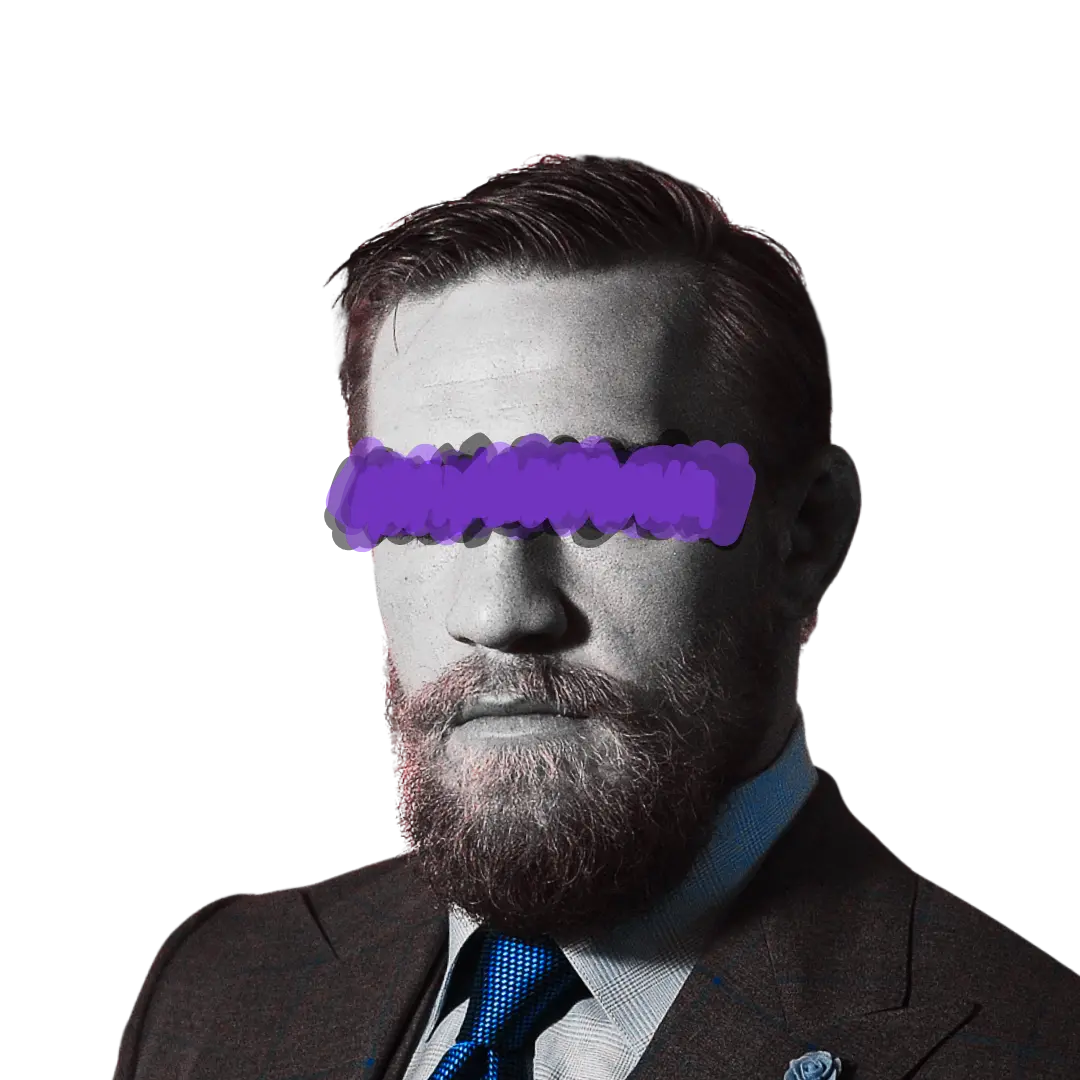
"I was an apprentice plumber. I was waking at 5am and walking in the dark, in the freezing cold, until I reached the motorway and waited for a guy I didn't even know to take me to the site, where I worked for 12 hours."
Before the Rolls-Royces, before the $600 million whiskey sale, before he knocked out Jose Aldo in 13 seconds and changed combat sports forever — Conor McGregor was standing in the dark on a motorway shoulder in Dublin, waiting for a stranger's headlights.
He was seventeen. He hated plumbing. And something about that cold, about that helplessness, about depending on someone else's schedule to get through the day, broke something open in him that has never fully closed.
What happened next is one of the most documented rags-to-riches stories in sports history. The welfare checks. The visualization. The trash talk that turned out to be prophecy. The Mayweather payday. The whiskey empire.
But there's a detail that gets buried beneath the highlight reel. The same man who visualized every victory with terrifying accuracy — who predicted knockdowns, rounds, and finishes before they happened — is the man who punched an old man in a pub for declining his whiskey. Who attacked a bus full of fighters with a steel dolly. Who, after the most devastating loss of his career, screamed threats at his opponent's wife from the canvas with a broken leg.
The question isn't why Conor McGregor became the biggest star in UFC history. That part is obvious: supernatural belief, ridiculous talent, a mouth that prints money.
The question is why the same force that built everything keeps setting it on fire.
TL;DR: Why Conor McGregor is an Enneagram Type 8
- Control as survival: From the motorway to the octagon, McGregor's entire life has been a campaign against ever depending on anyone else again
- Vulnerability converted to fury: Every soft emotion — fear, shame, sadness — gets alchemized into aggression before it can land
- The protector paradox: The same loyalty that makes him worship Dee Devlin and credit his team is the impulse that makes him attack perceived disrespect with disproportionate force
- Self-destruction under stress: When the armor cracks, he doesn't retreat — he escalates, mirroring the Type 8 disintegration pattern of doubling down when control slips
The Motorway and the Makings of a Fighter
Conor Anthony McGregor was born July 14, 1988, in Crumlin — a working-class suburb on Dublin's south side where the pubs outnumber the opportunities. His father Tony drove a taxi. His mother Margaret worked in a laundry. The family lived in the kind of tight-knit neighborhood where everyone knew your business and ambition was treated with suspicion.
He was scrappy early. Started boxing at Crumlin Boxing Club at age 11 and won a Dublin Novice Championship before he turned 17. But boxing was an outlet, not a plan. The plan, such as it was, was plumbing.
"I weren't too happy," McGregor said later about the apprenticeship. Twelve-hour days. Frozen mornings. A body built for fighting being used to fix toilets. He lasted one year before he quit to train full-time at John Kavanagh's Straight Blast Gym.
His parents thought he was insane. His friends thought he was lazy. And for years, the welfare office was the only institution that seemed to agree with his decision — they sent him €188 a week while he trained, fought in small Irish promotions, and told anyone who would listen that he was going to be the UFC champion of the world.
"I was collecting 188 Euro a week off the social welfare," he told reporters years later. "And now here I am."
He collected his final welfare check — worth about $220 — in April 2013. Days later, he made his UFC debut.
Driving Dee's Peugeot and Seeing the Future
The woman in the passenger seat — or, more accurately, the woman driving while he visualized — was Dee Devlin. They met in a Dublin nightclub in 2008, when McGregor had nothing except an iron certainty that he was destined for something extraordinary.
"My girlfriend worked very hard throughout the years and stuck by me when I had essentially absolutely nothing," McGregor said. "I only had a dream that I was telling her."
Dee drove him to the gym. She waitressed to pay the bills. She listened to predictions that sounded, at the time, like delusion.
And here is where the McGregor story tips from sports biography into something more psychologically interesting. Because the visualization wasn't casual. It was obsessive. It was the organizing principle of his existence.
"This is the law of attraction," McGregor explained. "When things are going good and you visualize these good things, that's easy. What's not easy to do is when things are going bad, and you're visualizing the good stuff. And that was what I was able to do. Driving in my girlfriend's little car, a little Peugeot 206 shaking down the road, I was visualizing my success."
A man on welfare, in a shaking Peugeot, seeing himself holding a belt that didn't exist for him yet. Not hoping. Not wishing. Seeing.
"If you have a clear picture in your head that something is going to happen and a clear belief that it will happen no matter what, then nothing can stop it."
He was right. And that was the problem. Because when belief is your superpower, what happens when belief becomes untethered from reality?
13 Seconds and the Architecture of Belief
The UFC debut came in April 2013. A first-round TKO. Then another. Then another. McGregor didn't just win fights — he predicted the wins beforehand with eerie specificity, then delivered.
The peak was Jose Aldo. The Brazilian featherweight champion had been undefeated for a decade. McGregor spent an entire year telling the world exactly what would happen: a left hand, early in the first round.
13 seconds. One punch. Aldo crumpled. McGregor stood over him and screamed.
"If you see it here," McGregor said, tapping his temple, "and you have the courage enough to speak it, it will happen."
He wasn't just talking about confidence. He was describing something closer to a religious conviction — a belief system in which speaking something into existence was not metaphor but mechanism. And for years, the evidence kept proving him right.
He became the first fighter in UFC history to hold two championship belts simultaneously. He talked his way into a boxing match with Floyd Mayweather and earned over $100 million for it — a spectacle that fellow combat-sports crossover Jake Paul would later try to replicate. He launched Proper No. Twelve whiskey and turned it into a nine-figure empire.
The plumber's apprentice from Crumlin had willed himself into a different universe. But the operating system he'd built to get there — the absolute refusal to be vulnerable, the conversion of every soft emotion into aggression, the belief that he could will any outcome — that wiring doesn't rewire just because you've arrived.
What is Conor McGregor's Personality Type?
Conor McGregor is an Enneagram Type 8
The core wound of Type 8 forms around a specific lesson: the world doesn't protect the vulnerable. It eats them. Someone who absorbs that lesson early builds a personality around one imperative — never be the vulnerable one.
McGregor's entire biography reads like a case study.
A working-class kid watches his parents grind through jobs that go nowhere. He stands on a motorway in the dark because someone else controls his schedule. He quits because depending on someone else's mercy is intolerable. He goes on welfare — which, for most people, means accepting vulnerability. For McGregor, it was the opposite: he was buying himself time to build the only thing he trusted. Himself.
The traits track precisely:
- The refusal to depend: "I am not talented, I am obsessed. There's no talent here, this is hard work. This is an obsession. Talent does not exist, we are all equals as human beings. You could be anyone if you put in the time."
- Vulnerability converted to fuel: Every setback becomes material for the next comeback. Every insult becomes a prediction he has to prove wrong. The soft feeling is never expressed as softness — it's expressed as intensity.
- The protector instinct: His loyalty to Dee, his team, his coach John Kavanagh, his neighborhood — this isn't casual. "I honestly believe there is no such thing as self-made," he said after a fight. "The people who have been around for my whole career have helped shape this moment."
- Testing through confrontation: The press conferences, the trash talk, the deliberate provocations — this isn't theater. It's reconnaissance. Who folds? Who stands? Who's real?
The 8w7 wing adds the expansive energy — the showmanship, the humor, the ability to take over a room not through intimidation alone but through a charisma so dense it has its own gravitational field. The Seven wing wants experience, novelty, stimulation. It's why McGregor isn't the cold, quiet kind of 8. He's the kind who buys the pub. Who shows up to press conferences in mink coats. Who wants to own the fight, the party, and the afterparty.
John Kavanagh, his longtime coach, recognized the dual nature early. "He often says that you need to have a darkness inside you to compete at a high level in any sport," Kavanagh noted. "If you can't tap into that dark side, you'll quickly come unstuck."
The darkness. The intensity dial cranked past 10. The lust for experience that Type 8s carry like a pilot light — it produces championship performances and bar fights with equal indifference.
The Dolly, the Old Man, and the Broken Leg
Here is where the McGregor narrative splits.
In one version, he's an underdog success story: welfare to champion, belief over circumstance, Ireland's greatest sports export. In the other, he's a cautionary tale about unchecked aggression and money amplifying a man's worst impulses.
Both are true. And the split is where the Enneagram becomes useful.
April 2018: McGregor storms the Barclays Center in Brooklyn. He and his crew attack a bus carrying Khabib Nurmagomedov and other UFC fighters. McGregor hurls a steel dolly through the bus window. Fighters inside are injured. The incident is captured on camera and broadcast worldwide.
He pled guilty to disorderly conduct. Five days of community service. An anger management evaluation.
October 2018: UFC 229. The biggest pay-per-view in UFC history — 2.4 million buys. McGregor versus Khabib Nurmagomedov, the undefeated Dagestani wrestler who represented everything McGregor couldn't out-talk or out-punch: quiet discipline, grinding pressure, an iron will that didn't need an audience.
For three rounds, Khabib controlled McGregor on the ground — the place where an 8's striking power means nothing. In the fourth round, Khabib took his back and locked in a rear-naked choke. Lip-readers caught what McGregor said as the choke tightened: "It's only business."
Then he tapped.
For a Type 8, there is no more psychologically devastating act than public submission. Not losing — 8s can rationalize a knockout as a single mistake, a flash. But tapping is surrender. It is the body admitting, in front of 20,000 people and millions watching at home, I cannot escape this. I give up. For the man who built an identity on never yielding to anyone, the tap was the one outcome his visualization had never rehearsed.
Then Khabib leapt over the cage to attack McGregor's teammate, Khabib's cornermen swarmed McGregor inside the octagon, and the entire arena descended into chaos. In the locker room afterward, McGregor reportedly said, "I was beat and that's that." But the simplicity of that sentence masked the damage. He wouldn't win another fight for over two years.
April 2019: McGregor walks into The Marble Arch pub in Dublin. He lines up glasses of his Proper No. Twelve whiskey for the patrons. An older man declines. McGregor punches him in the head.
The video went viral months later. McGregor pled guilty. He was fined €1,000.
In his interview with ESPN's Ariel Helwani about the pub incident, McGregor showed something rare — genuine remorse that pierced the fortress: "To see it is like a dagger into my heart as a young martial artist."
A dagger into his heart. Not the old man's jaw. His heart. The distinction matters. For an 8, the worst thing isn't the consequence — it's the evidence that you've become the thing you were supposed to protect people from.
July 2021: The third fight with Dustin Poirier. McGregor's leg snaps at the end of the first round. He collapses. From the canvas, with a broken tibia, he screams threats at Poirier and his wife.
"I thought it was over," McGregor later admitted about the injury.
What the world saw
A wealthy fighter losing control — attacking buses, punching civilians, screaming obscenities with a broken leg. An ego out of control.
What the Enneagram reveals
A man whose only coping mechanism is intensity, losing access to the arena that made intensity a virtue. Every 8 who loses their primary outlet for power doesn't become peaceful — they become dangerous. The energy has to go somewhere.
Between the Khabib loss in October 2018 and the broken leg in July 2021, McGregor went 1-3 in the octagon. His last real dominance was 2016. For five years, the man who built his identity on being unstoppable was getting stopped. And during those same five years, every major off-cage incident occurred.
The timeline is damning in its precision. The bus attack happened before the Khabib fight — when the loss of control was anticipatory. The pub punch happened six months after the Khabib submission — when the loss was confirmed. The broken-leg screaming happened during the third consecutive defeat. Each escalation tracks the narrowing of legitimate outlets. When an 8 can dominate inside the rules, the aggression has a container. When the container breaks, the aggression doesn't disappear. It floods.
This is the Type 8 stress pattern mapped onto a life in real time. Under extreme stress, 8s don't crumble outward like some types. They either withdraw into paranoid isolation (moving toward unhealthy Type 5) or they escalate — pressing harder on the same lever that used to work, unable to process the possibility that the lever is broken.
McGregor escalated. Every time.
The Whiskey King and the Compound in Crumlin
There's another Conor McGregor that doesn't make the tabloids.
The one who, after making $100 million from the Mayweather fight, tracked down his old plumbing employer and paid back a debt that was 15 years old.
The one who, when Ariel Helwani lost his job at Showtime, privately reached out with support — a gesture Helwani later described as "the epitome of class."
The one who launched Proper No. Twelve and poured himself into it not as a celebrity endorsement but as an obsession — developing the product, building the brand, studying the whiskey market. He sold his majority stake for $600 million. The plumber's apprentice who couldn't afford a round became the man who bought the rounds for an entire country.
Then there's Road House. In 2024, McGregor made his acting debut as Knox — a psychopathic Irish enforcer — opposite Jake Gyllenhaal. Critics were split, but the role itself is telling. The 8w7's Seven wing doesn't sit still when the primary arena closes. It hunts for the next one. Acting, bare-knuckle fighting, whiskey — the impulse isn't diversification. It's the refusal to let a single arena define or contain him.
That same impulse led him to acquire a minority ownership stake in BKFC in 2024. "I'm not up here as just an owner," he told reporters. "I'm player-manager." Bare-knuckle fighting — rawer, less regulated, more primal than the UFC — is an interesting gravitational pull for a man whose career has been a steady escalation toward something more unfiltered. The 8 moving toward a purer expression of the thing itself.
He has four children with Dee — Conor Jr., Croía, Rían, and Mack. They married at the Church of Santo Stefano degli Abissini in Vatican City on December 12, 2025 — at exactly 12:12 p.m., because even a wedding required the precision of a man who visualizes outcomes. An 8 who once said he feared no man, kneeling in one of the oldest churches inside the Vatican walls. Through every scandal, every court case, every tabloid headline, Dee has been there. Not in silence, but in choice.
This is the 8's integration path — the movement toward Type 2, the Helper. When the 8 is healthy, when the wiring isn't being tested, the ferocity that terrorizes opponents becomes the devotion that surrounds the inner circle. The same intensity. Different direction.
McGregor described it himself without knowing he was describing it: "A lack of commitment is an insult to people who believe in you."
"I Am Saved"
In October 2025, at a BKFC press conference in Italy, McGregor did something no one expected. He got emotional. He talked about faith.
"Since around that time that you mentioned, at the last event, I've engaged in a spiritual journey, and I've been saved. I'm saved. I am healed."
The broken leg, he said, became a turning point. Not just physically — spiritually. The man who built an empire on believing in himself was now talking about believing in something bigger. After his Vatican wedding, he went further: "God's hand guided every detail. Serving God is my number one priority."
Let that land. A man whose number one priority was once himself — who said it out loud, who made it a brand — now naming a higher authority. Whether you believe it or not, the language itself represents a revolution in the McGregor operating system.
For Type 8s, the concept of surrender is almost biologically repulsive. Surrender means vulnerability. Vulnerability means destruction. Every instinct rejects it at the deepest level.
But the healthiest 8s eventually reach a point where the fortress has become heavier than what it's protecting them from. Where the intensity that saved them is now the thing doing the damage. Where the only path forward requires the one thing they've spent their entire life avoiding.
Letting go.
Whether McGregor's faith transformation is genuine, performed, or somewhere in between is the hardest question in the McGregor story — and it's not the only one.
In November 2024, a Dublin jury found McGregor civilly liable for sexual assault against Nikita Hand, stemming from an incident in December 2018 — two months after the Khabib loss. He was ordered to pay approximately €250,000 in damages. His appeal was unanimously dismissed in July 2025. McGregor denied the allegations and maintained the encounter was consensual. A separate civil suit was filed in the United States in January 2025.
This is the part of the story that resists any neat psychological framing. You can map the 8's stress patterns onto the timeline. You can note that the incident occurred during the most destabilized period of his life. But none of that explains it away, and it shouldn't. Some damage doesn't fit into a personality framework. It just sits there, demanding to be reckoned with.
What we can say is this: the faith testimony, the missed drug tests, the civil verdict, the continued controversies — they all coexist. The man saying "God saved me" is the same man whose actions suggest the saving isn't finished.
For an 8, publicly saying "I am saved" is still seismic. A man who once said "I fear no man. If you breathe oxygen, I do not fear you" is now saying someone else did for him what he couldn't do alone. That's a structural shift — even if the structure is still shifting.
The Comeback That Hasn't Happened Yet
As of March 2026, McGregor hasn't fought in the UFC since the broken leg in July 2021. An 18-month anti-doping suspension for missed tests pushes his eligibility to March 20, 2026. There are rumors about a UFC White House card in June 2026, part of America's 250th anniversary celebration.
He's 37 years old. He has $200 million. Four children. A marriage. A faith testimony. A body held together by titanium and willpower. Every rational argument says walk away.
But the rational argument has never been the operating system.
"I don't feel pressure in a negative way," McGregor said years ago. "I like pressure. No pressure, no diamonds."
The man who stood on a motorway at 5am is still the man making the decisions. The cold. The dark. The absolute refusal to let anyone else determine when it's over.
He built a fortress out of belief so total it bent reality around it. He predicted fights. He predicted wealth. He predicted an empire. And he was right about all of it.
The thing he never predicted was himself. The fists that couldn't miss in the octagon and couldn't stop swinging outside it. The visualization that could conjure a championship but couldn't see the old man in the pub, the dolly through the window, the leg folding underneath him on the canvas.
He's still building. Still fighting. Still convinced that the next version of Conor McGregor will be the one that finally gets it right.
At some point, you have to wonder whether the belief is the weapon or the wound.

What would you add?