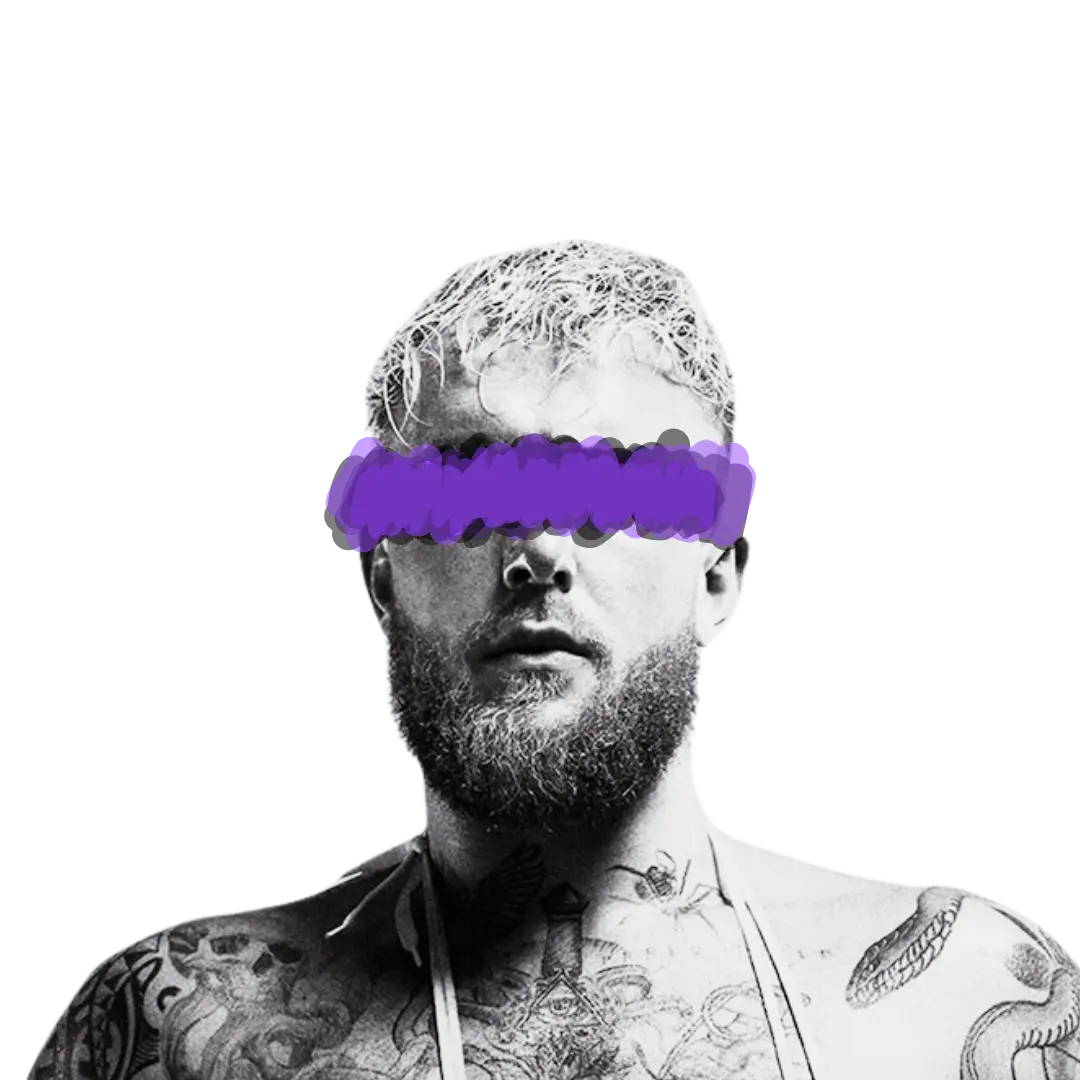
"I have this lurking energy of needing approval because my dad didn't give me much."
In a 2024 Men's Health interview, the journalist noticed something strange. Jake Paul, the man who trash-talked his way from YouTube to a 12-2 professional boxing record, who called out Canelo Alvarez from a hospital bed with a broken jaw, was sitting across from them clutching his own forearm. Nervous. Thoughtful. Nothing like the person on screen.
That gap between the "Problem Child" who climbs on news vans and the quiet kid from Westlake, Ohio who still flinches at his father's memory is the key to everything Jake Paul has done and everything he's still chasing.
He built a $200 million empire on being watched. Boxing became the first thing that felt real. And now, sobbing in an Olympic arena as his fiancee broke a world record, he may finally be discovering who he is when the performance stops.
TL;DR: Why Jake Paul is an Enneagram Type 3
- The approval engine: A father's withholding and abuse created a relentless drive to prove his worth through views, knockouts, and billion-dollar bets.
- The persona trap: 800 consecutive days of daily content blurred the line between Jake and "The Problem Child" until he couldn't tell where one ended and the other began.
- The reinvention instinct: Vine star, Disney actor, YouTube king, professional boxer, venture capitalist. Each pivot follows the same pattern: master a domain, then find a bigger stage.
- The vulnerability beneath: Panic attacks after victories. Suicidal thoughts at his lowest point. Open sobbing at his fiancee's Olympic gold medal.
The Camera His Dad Bought for Football
Jake Joseph Paul was born January 17, 1997, in Westlake, Ohio, a comfortable suburb about thirty minutes from Cleveland. His father Gregory was a commercial roofer and realtor. His mother Pamela was a nurse. They attended church regularly. On the surface, normal.
When Jake was seven, his parents divorced. By all accounts, ugly.
Then Greg bought his sons a camera, thinking they'd film themselves playing football. Jake was ten. His older brother Logan was twelve. Instead of football, they started filming skits and pranks. They named their channel "Zoosh," a riff on their favorite YouTube channel, Smosh. Even then, Jake deviated from what authority expected of him.
"When I started to gain viewership and money — first of all, I wanted to make my dad proud, mostly because I saw him lose everything in the divorce," Jake told Men's Health. "I thought to myself, I'd never want to be in that position, for my kids to see me weak."
That sentence contains the blueprint for everything that followed. A seven-year-old watching his father crumble. Deciding in that moment that weakness and financial failure were the same thing. That being seen as vulnerable was the worst thing that could happen to you.
The Hands That Shaped Him
In the Netflix documentary Untold: Jake Paul the Problem Child, Jake was more explicit about his father.
"Yeah, my dad would slap the shit out of me."
"Our parents were really strict and mainly my dad. It was always Logan and I against him."
Greg Paul, on camera, denied hitting his sons. Then added: "I did pick you up and throw you on a couch a couple of times."
The most revealing detail isn't the abuse itself. It's what Jake said next: "I don't resent it. I'm understanding of why he did that. That's all he knew."
And then: "I attribute pretty much all of my success to my father."
Slapped by his father, then crediting that father for his success. Years of therapy to forgive abuse, then inviting that same father on an ayahuasca trip to process their shared wounds, footage that appeared in the 2025 HBO series Paul American. The healing is still underway.
The Bully Who Got Bullied
Jake's origin story gets complicated here, because he was both.
He has admitted openly to bullying other kids in school. His reasoning: "Because it made me feel better about myself because I was actually insecure." He also confessed to stealing iPhones in high school, distracting classmates while friends pocketed their phones and flipped them for profit.
Former classmate Lauren Richter tweeted: "Jake Paul literally was the bully. Ask anyone from here."
A childhood neighbor posted footage of the Paul family's sizable Westlake home, mocking Jake's claims of growing up poor: "Dude, you landscaped and had rich-ass parents."
But Jake also says the dynamic flipped when he started posting on Vine. "I was the laughingstock of my high school, including the teachers. My principal was hating on me, actually talking shit about me to my face. And it broke my heart."
Both stories appear to be true, in different periods and contexts. A popular athlete who used mockery as armor, then experienced genuine social rejection when he did something his peers found strange. The bully who discovered what it felt like to be on the other side.
Years later, he founded Boxing Bullies, a nonprofit in Puerto Rico that renovates gyms and uses boxing to build confidence in at-risk youth. A bully who knows he was a bully, trying to channel that energy differently.
"It's Easy to Get Lost in That World, and I Did"
By 2013, sixteen-year-old Jake was posting on Vine. Within three years: 5.3 million followers, 2 billion views. He landed a role on Disney Channel's Bizaardvark. He was making more money than his parents before he could legally vote.
Then the feedback loop accelerated.
Jake formed Team 10, a content collective and talent management company. A house full of young creators living together, filming everything. What it produced was virality. What it cost was harder to measure.
Former member AJ Mitchell, who joined at fourteen, later told the New York Times that Jake bullied Team 10 members into dangerous stunts, getting tazed without warning, jumping from roofs into pools, and withheld video tags from anyone who didn't comply. The Martinez Twins alleged daily bullying, racial slurs, and withheld earnings.
As Jake told Shane Dawson in 2018: "Everybody has made their career based on controversy." And: "I didn't know where the line was."
Then the line found him. In July 2017, a KTLA news crew arrived to investigate complaints about Jake's rented house in Beverly Grove: dirt-bike drag races, fires in drained swimming pools, mobs of fans blocking the street. Jake's crew ambushed the reporter with a T-shirt cannon, climbed on the news van, and mocked the reporter's shoes on camera.
Disney fired him within days.
"I feel like a zoo animal," Jake told the Hollywood Reporter.
At twenty, he was too chaotic for Disney. The YouTube persona had leaked into every corner of his life. He couldn't separate performance from reality.
The Fake Wedding That Was Real Marketing
In July 2019, Jake and YouTuber Tana Mongeau held a lavish Las Vegas wedding ceremony, livestreamed as pay-per-view. Sixty-six thousand fans paid $50 each to watch, generating roughly $3.3 million. No marriage license was ever filed. When asked on camera if it was legal, Jake said: "I don't know if we can talk about that though because we should make it seem like it is."
Both later admitted it was for content. Jake told Entertainment Tonight the marriage was fake.
A man who staged his own wedding for revenue. The persona hadn't just leaked into his life. It had replaced the parts where real things were supposed to go.
The Brother Wound
The Logan dynamic deserves more than a footnote. It mirrors everything else in Jake's psychology.
In 2017, after Jake released "It's Everyday Bro," the brothers went to war publicly. Logan released "The Fall of Jake Paul" featuring Alissa Violet, Jake's ex-girlfriend, who revealed she and Logan had been together. For Jake, who had already experienced his father's betrayal of trust, the wound hit the same nerve. Logan later admitted: "Jake was way more hurt" than people realized.
They reconciled publicly with the collaborative track "I Love You Bro." Their mother Pam mediated. Then Logan's crisis made everything worse.
The Lamborghini, the Cliff, and the Decision to Stay Alive
In January 2018, Logan Paul posted a video from Japan's Aokigahara Forest, the "suicide forest," showing a dead body. The internet turned on both Paul brothers overnight.
Jake lost approximately $30 million in deals. A $15 million retail contract evaporated through a morality clause. He was blacklisted from auditions, brand deals, and sponsorships for eighteen months. Logan's scandal became Jake's punishment.
"No money, kind of hating myself, the whole world hates me. I'm drinking. I'm depressed and not having a good relationship with either of my parents or Logan."
He was producing a new YouTube video every single day. 800 consecutive days. To sustain the pace, he'd developed a dependence on alcohol and marijuana. "I would smoke weed or get drunk to make videos." Every single day.
On the Aubrey Marcus podcast, Jake revealed the rest.
He had a plan. Fill his Lamborghini with gas cans, get very drunk, and drive off a cliff in Calabasas.
What stopped him was characteristically Jake Paul.
"I was not going to let them win. I was like, 'I'm going to fight. This is what every social media hater wants is to wake up and see Jake Paul killed himself.'"
Even his reason for surviving was competitive. He stayed alive partly out of spite, framing his own continued existence as a victory over enemies. The instinct to win overrode the instinct to quit.
He was too embarrassed to ask for help.
A man who built his career on shamelessness, too ashamed to reach out during the worst moment of his life.
What is Jake Paul's Personality Type?
Jake Paul is an Enneagram Type 3
Enneagram Type 3, The Achiever, runs on a core need to be valuable, successful, and admired. Their deepest fear is worthlessness. Their childhood wound typically involves receiving love conditionally, based on performance rather than being.
Jake's father wound maps precisely onto this pattern. A father who withheld approval. A boy who watched that father lose everything and decided weakness was the enemy. A teenager who started accumulating followers, money, and achievements as fast as possible, not because he loved content creation, but because achievement was the only language that felt like safety.
"The Problem Child" persona isn't chaos. It's a calculated brand. Jake has said he consciously embraces the villain role: "I think a lot of people shamelessly love the villain and I think even more people quietly love the villain." That's Type 3 image-crafting as survival strategy: if people are going to watch you regardless, you might as well control the character they see.
The reinvention pattern is textbook. Vine, YouTube, Disney, Team 10, boxing, venture capital. Each domain mastered and then outgrown, because the achievement stops feeling like enough. Hours after jaw surgery with two titanium plates: "Double broken jaw. Give me Canelo in 10 days." The loss must immediately become setup for a bigger win.
And fighting Anthony Joshua, a former two-time unified heavyweight champion, when everyone said he'd get destroyed? For a Type 3, the size of the challenge is the size of the validation.
What makes Jake a particularly interesting version of this type: most Type 3s work within systems. They become the best student, the top salesperson, the most accomplished executive. Jake disrupts systems. He doesn't want to win the game everyone else is playing. He wants to invent a new game and dominate it before anyone else understands the rules.
Boxing Saved His Life (He Means That Literally)
Jake wrestled at Westlake High School, 182-pound weight class, sectional finalist as a junior. A multi-sport athlete who left sports behind when he moved to LA for content.
When he picked up boxing in 2018, something shifted beyond career strategy.
"Boxing brought back the old Jake Paul," he told Rolling Stone. "The competitive, athletic Jake Paul."
His mother Pamela noticed: "I think he's happier being an athlete... YouTube, and all that stuff, it's competitive in a different way and it's not competitive, to me, in a healthy way."
On the Aubrey Marcus podcast, Jake framed boxing as the antidote to everything that had gone wrong: "A real boxing gym is the perfect contrast to LA." The influencer world rewarded escalation, posturing, and persona. The gym rewarded suffering, discipline, and skill. You cannot fake a punch.
Boxing gave him "purpose, routine, health, community, all the things I needed. Since 2020, it's been boxing's number one and everything else comes after that."
After knocking out Nate Robinson in November 2020, only his second professional fight, Jake had a fifteen-minute panic attack backstage. Overwhelmed. A man whose brand is unshakeable confidence, hyperventilating in a back room after a victory.
He describes himself as someone who "overthinks and beats himself up over stuff, dealing with anxiety on a day-to-day basis." The loudest person in any room moved to Puerto Rico specifically to escape "noise, temptation, and distraction."
"Jake Paid for My Hospitalization and Saved My Life"
In August 2023, YouTuber Fousey appeared on Bradley Martyn's Raw Talk podcast and revealed something that never made headlines.
After losing a boxing match to Deji, Fousey spiraled into suicidal thoughts. His life was falling apart. No support system.
Jake, who had no close relationship with Fousey, learned what was happening, connected him with "the best therapist in LA," and anonymously paid for Fousey's psychiatric hospitalization.
"Jake paid for my hospitalization and saved my life when nobody was in my life."
When asked about it publicly, Jake said: "I don't really want to talk about it."
The man who puts everything on camera, who films every training session, every business deal, every knockout, did the most meaningful thing in silence.
The $200 Million Empire Nobody Expected
Jake's ambitions extend far beyond content and combat. A venture capital firm (Anti Fund, with Logan joining as General Partner, their first formal business partnership). A men's body-care brand at Walmart on track for $50 million in first-year sales. A sportsbook operating in 25 states. A 6,000-acre Georgia estate with a private lake and plans for its own airstrip.
Forbes ranked him the No. 3 highest-paid creator globally in 2025 at $50 million in annual earnings. Net worth estimates sit around $200 million.
For someone whose psychology is built around proving he's not weak, not financially vulnerable like his father after the divorce, the numbers speak a specific emotional language. Every dollar is evidence. Every business is a fortification against the thing he fears most.
The Ring Where the Mask Breaks
Jake's professional record stands at 12-2 with seven knockouts. That record tells a carefully constructed story, and the construction is the point.
The Strategic Record
A YouTuber. A former NBA player with zero boxing experience. A retired MMA wrestler known for terrible striking. Two fights against the same aging UFC welterweight. A 47-year-old Anderson Silva. A 58-year-old Mike Tyson.
The criticism was relentless and, in boxing circles, damning: Jake Paul was cherry-picking opponents he knew he could beat. Dana White called it out. Michael Bisping called it out. Every boxing commentator with a microphone called it out.
The Type 3 psychology is visible in the strategy itself. Jake wasn't randomly picking easy fights. He was engineering a narrative. Each opponent was famous enough to generate massive pay-per-view numbers, old or unskilled enough to be beatable, and credentialed enough that a win sounded impressive to casual fans. A former UFC champion. An MMA legend. Mike Tyson. The resume reads better than it fights.
When he finally faced his first actual boxer, Tommy Fury, a young, active professional, Jake lost.
He went back to fighting MMA guys and lower-tier boxers. Then accepted the Tyson spectacle on Netflix. At the end of that fight, Jake bowed. For a kid who grew up idolizing fighters, standing in the ring with one wasn't just career strategy. It was a form of acceptance he'd been chasing since childhood.
The Joshua Fight: Choosing to Get Hit
On December 19, 2025, Jake stepped into the ring with Anthony Joshua, former two-time unified heavyweight champion, at Kaseya Center in Miami.
He knew the odds. He took the fight anyway.
Joshua dominated from the opening bell. Four knockdowns across six rounds. A devastating right hand in the sixth broke Jake's jaw in two places. Referee Christopher Young stopped it at 1:31 of round six.
Post-fight, with a jaw he already knew was shattered: "Nice little ass-whooping from one of the best to ever do it."
From his hospital bed after surgery to install two titanium plates and remove teeth: "Double broken jaw. Give me Canelo in 10 days."
The humor is the mask. The broken jaw is the reality. The gap between those two is where Jake Paul actually lives.
On Logan's Impaulsive podcast days later, the bravado thinned. He admitted his biggest mistake: not training at altitude. He acknowledged Joshua was "imposing his will on me." He talked about wanting kids. About baby fever. About stepping back from boxing to support Jutta at the Olympics.
Logan's words afterward: "Jake has this conviction that makes you believe and he has this ability to defy reality."
Jake is currently on indefinite medical suspension. His return is planned for the second half of 2026, this time at cruiserweight, chasing a world title belt.
The Person Behind the Person
Jake's fiancee Jutta Leerdam, Dutch Olympic speed skater and six-time world champion, may be the first person to publicly articulate the gap. On Jake's podcast: "You're actually a little bit more introverted in real life. You're more chill. You're like sweet and genuine and more vulnerable and like emotionally open."
When she first heard from Jake, a DM inviting her on his podcast, her reaction was instinctive: "What an arrogant expletive. He thinks he can do anything, but he won't get me." She was right about the character, and wrong about the person.
In March 2025, Jake proposed in Saint Lucia with her parents present. The ring, a $1 million oval-cut diamond, was shaped like an ice skating rink. Both their birthstones. Compare this to the Tana Mongeau production: a $3.3 million pay-per-view spectacle with no marriage license. The distance between those two proposals is the distance Jake has traveled.
The wedding is planned for 2027, delayed so Jutta could focus on the 2026 Winter Olympics. For a Type 3 who typically wants achievement now, choosing to wait for someone else's timeline is significant.
The Olympic Tears
On February 9, 2026, Jutta Leerdam won gold in the women's 1000m speed skating at the Milano Cortina Winter Olympics, shattering the Olympic record with a time of 1:12.31.
NBC cameras caught Jake in the stands. Sobbing.
Not the controlled, camera-ready emotion of a public figure. Uncontrollable tears. Hugging Jutta's mother Monique. Hugging his own mother Pam.
"I can't stop crying. You did it my love. Olympic Gold. God is great and so are you."
The Washington Post headline: "Jutta Leerdam won a gold medal, and Jake Paul cried and cried."
For a man who built everything on being watched, who performed for cameras starting at age ten, who created a persona so consuming it nearly killed him, crying openly at someone else's achievement may be the most real thing he's ever done on screen.
The Parts That Don't Fit the Redemption Arc
No honest assessment of Jake Paul can skip the parts that complicate the narrative.
In April 2021, TikTok creator Justine Paradise publicly accused Jake of forcing her into a sexual act without her consent at his Calabasas home in 2019. The New York Times corroborated her account with three friends she told immediately afterward. Jake denied the allegations through his attorney, calling them "100% false." No criminal charges were filed. The matter was reportedly settled privately. A second woman, a former Team 10 member, made a separate allegation around the same time.
These accusations exist alongside the growth story. They don't erase it, and it doesn't erase them.
In October 2024, Jake released a 20-minute video endorsing Donald Trump for president, urging his 80 million followers to vote despite being unable to vote himself (Puerto Rico residents can't participate in presidential elections). The video racked up 19 million views. For a Type 3, gravitating toward the biggest possible stage, including presidential politics, tracks perfectly. The scale of the platform is the point.
How It All Connects
Jake Paul's life makes a specific kind of sense when you stop looking at the chaos and start looking at the engine underneath.
A father who withheld approval and used his hands. A boy who decided weakness was the enemy. A teenager who discovered that the internet would give him what his father wouldn't: attention, validation, proof that he mattered. A young man who rode that discovery until it consumed him, until the persona swallowed the person, until he was drinking and smoking every day just to produce content and seriously planning his own death.
And then boxing. The first arena where you can't fake it. Where the hierarchy is based on who can take a punch and keep moving forward. Where no amount of followers protects you from a right hook.
"It's almost like starting over," Jake told Shane Dawson back in 2018, before most of this had happened.
He didn't know how right he was.
The venture capital, the body-care brand, the Georgia ranch: these are a Type 3 doing what Type 3s do. Building, achieving, accumulating evidence of their own significance. The formal business partnership with Logan, the brother who once publicly humiliated him with a diss track featuring his ex-girlfriend, is itself a form of achievement: rebuilding what was broken.
But the Olympic tears, the secret hospitalization payment for Fousey, the engagement ring shaped like the thing she loves. These are something else. A man learning that significance doesn't always require an audience.
What Jake Paul's Story Reveals About All of Us
Jake built "The Problem Child" so well that it nearly destroyed the actual person inside. He produced 800 videos in a row, medicated himself to keep creating, and almost drove off a cliff because the character demanded more than the human could give.
Most people don't have 20 million followers. But most people have a version of this. The work persona that bleeds into weekends. The social media version that starts feeling more real than the private one. The achievement treadmill that keeps accelerating because stopping feels like dying.
Jake's story suggests the exit isn't through more achievement. It's through something that can't be performed. For him, that was boxing. Then therapy. Then ayahuasca with his father. Then a woman who saw through the character and stayed anyway.
Then sitting in an Olympic arena, crying at someone else's gold medal, with nothing to sell and no camera he controlled.
Disclaimer: This analysis of Jake Paul's Enneagram type is speculative, based on publicly available information, and may not reflect the actual personality type of Jake Paul.

What would you add?