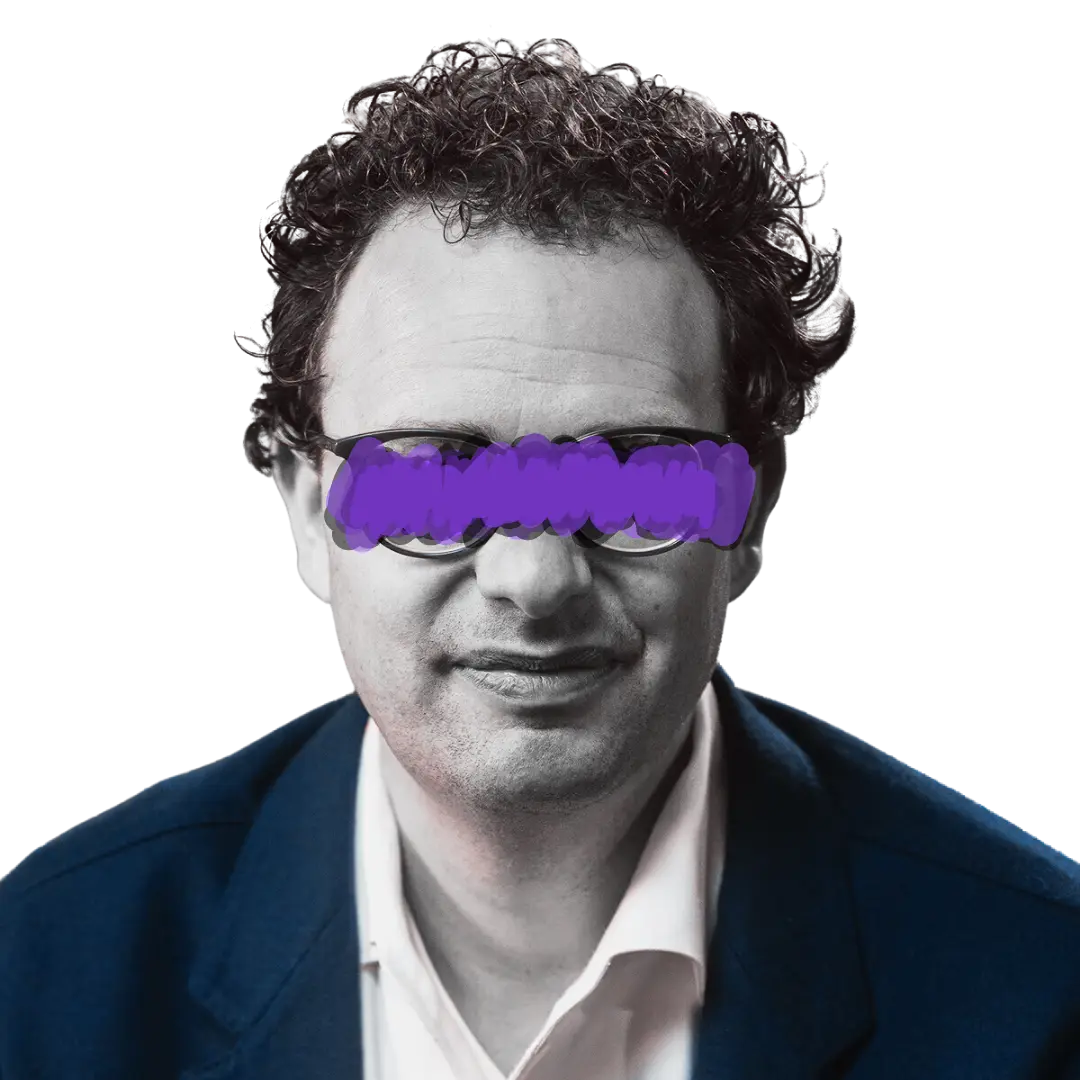
"My father died because of cures that could have happened a few years earlier. I understand the benefit of this technology."
In 2006, Dario Amodei's father died after a long illness. Within a few years, the cure rate for the disease that killed him surged from roughly 50% to 95%.
A handful of years. The difference between a father's gravestone and a father's recovery.
That gap between what science could have done and what it did in time is the engine that drives one of the most consequential AI companies on earth. Dario Amodei builds machines that might compress a century of scientific progress into a decade. He also writes 14,000-word essays about how those same machines might destroy everything. He does both things with equal intensity, and neither one is an act.
TL;DR: Why Dario Amodei is an Enneagram Type 5
- The mind that can't stop mapping: From childhood math obsession to 14,000-word risk essays, Dario processes the world by understanding it completely before acting.
- The scarcity engine: A father's death taught him that time and knowledge are the scarcest resources. Everything he builds is an attempt to make them less scarce.
- The safety paradox: His obsession with AI safety isn't caution — it's a Five's compulsive need to map every risk before crossing the terrain.
- The reluctant CEO: Never wanted to run a company or work in tech. Wanted to discover "fundamental scientific truth." Ended up leading a $380 billion AI lab anyway.
A Boy Who Trusted Numbers
Dario grew up in the Mission District before San Francisco gentrified into a tech capital. His mother, Elena Engel, was Jewish and ran renovation and construction projects for libraries in Berkeley and San Francisco. His father, Riccardo Amodei, was a leather craftsman who had emigrated from Massa Marittima, Tuscany. The household was modest and morally clear.
"They gave me a sense of right and wrong and what was important in the world," Dario has said. "Imbuing a strong sense of responsibility is maybe the thing that I remember most."
He was drawn to math early. Not the way some children gravitate toward puzzles for entertainment, but the way a certain kind of mind reaches for the one thing in the world that can't argue back.
"I was interested in being a scientist. I was interested in physics and math," he said in a 2025 interview. "The idea of writing some website actually had no interest to me whatsoever."
The tech boom happened around him during high school. He watched it the way a theoretical physicist watches a stock ticker: aware that money was being made, completely uninterested in making it. What mattered was objectivity. Math had a sense of objectivity that opinions didn't. In a world of subjective arguments, numbers held still.
His younger sister Daniela was four years behind him, but they were close from the start. "I think we decided very early that we wanted to work together in some capacity," Dario later said. That decision would reshape the AI industry.
The Four-Year Gap
Dario went to Princeton to become a theoretical physicist. He spent his first months on cosmology. Then his father's illness, which had been a presence for years, began to close in.
"He was ill for a long time and eventually died in 2006."
The death reoriented everything. Dario switched from theoretical physics to biology. If he could understand human illness at the molecular level, maybe he could prevent the kind of loss his family had just endured.
But biology frustrated him in ways physics never had.
"The complexity of the underlying problems in biology felt like it was beyond human scale," he said. The biological systems he was trying to decode refused to yield to elegant equations. They were messy, recursive, layered beyond what any single mind could hold. Even a brilliant one couldn't make progress fast enough.
Then came the breakthrough that haunted him. The cure rate for his father's disease surged from 50% to 95% in the years just after Riccardo died. Dario has never publicly named the illness, a boundary he maintains even in long interviews. But the math doesn't require a diagnosis to understand.
Jade Wang, Dario's former girlfriend, put it plainly: "It's the difference between his father most likely dying and most likely living, okay?"
"There was someone who worked on the cure to this disease, that managed to cure it, and save a bunch of people's lives, but could have saved even more."
The lesson was blunt. Scientific progress saves lives. Delayed scientific progress kills people. The margin between saved and killed can be vanishingly small: a few years, a few research grants, a slightly faster computer.
"AI, which I was just starting to see the discoveries in, felt to me like the only technology that could kind of bridge that gap."
Not bridge the gap between disciplines. Bridge the gap between what science knows and how fast it can apply that knowledge. The gap that killed his father.
The Most Talented Graduate Student
At Princeton, Dario earned his Ph.D. in computational neuroscience under advisor Michael Berry, co-inventing a new sensor to measure retinal signals. His dissertation won the Hertz Thesis Prize. Berry later called him "the most talented graduate student he ever had," as reported in Alex Kantrowitz's profile for Big Technology.
But Berry added something else: "I think internally, he was kind of a proud person."
Not a criticism. An observation about fit. Dario's instinct was to build with teams, to synthesize across fields, to move fast on problems that mattered. Academia rewarded the opposite: individual papers, narrow specializations, years of incremental contribution to questions no one outside the department would ever ask about.
The pride Berry noticed wasn't vanity. It was a systems thinker chafing against a system built for specialists.
After Princeton, he moved through the emerging deep learning world: Baidu's AI research lab with Andrew Ng in 2014, then OpenAI as VP of Research. Each step brought him closer to the tool that could do what biology alone couldn't: compress decades of scientific progress into years.
What is Dario Amodei's personality type?
Dario Amodei is an Enneagram Type 5
Enneagram Fives operate from an economy of scarcity: time, energy, and knowledge are finite resources that must be carefully managed. The world takes more than it gives, so mastery becomes a survival strategy. Understand completely before engaging. Map the territory before crossing it.
This pattern explains something about Dario that confuses most observers: how can the same person be one of the most aggressive AI accelerationists and the most vocal AI safety advocate?
"I am indeed one of the most bullish about AI capabilities improving very fast," he has said. And in almost the same breath: "I worry about the risks and I continue to be worried about the risks."
For a Five, this isn't contradiction. It's coherence. Understanding the risk IS the way forward. You don't slow down to map the territory; mapping the territory is how you move. The 14,000-word essay isn't procrastination. It's propulsion.
Look at the evidence pattern by pattern:
He gravitated toward math because "it had a sense of objectivity." That's the Five's signature move: retreating from the chaos of subjective opinion into systems that hold still long enough to be understood.
His biweekly "Dario Vision Quest" meetings involve standing before the entire company with a three-to-four-page written document and speaking for an hour. Not bullet points. Not slides. Written essays on everything from product strategy to geopolitics. He also drives strategy through "extensive, essay-style messages" on Anthropic's internal platform. For a Five, writing isn't communication. It's thinking made visible.
He never wanted to found a company or work in tech. He wanted to discover "fundamental scientific truth." The CEO role is a means, not an end: the minimum organizational structure required to do the thing he actually cares about.
The Five's wing matters here. Dario reads as a 5w6, the Investigator with a Loyalist wing. The 6 wing adds something the core Five often lacks: institutional thinking, loyalty bonds, and a visceral concern for security. This wing explains Anthropic.
A pure Five might have stayed in academia, accumulating knowledge for its own sake. The 6 wing made Dario build an institution around his understanding, a company explicitly designed to prepare for worst-case scenarios. It's also what made fourteen researchers follow him out of OpenAI. People don't follow pure intellects. They follow people they trust.
Fourteen People Followed Him Out the Door
By 2020, Dario was VP of Research at OpenAI and increasingly convinced that the organization he'd joined because of its safety mission was not treating safety seriously enough.
His proposal inside OpenAI (where Sam Altman was CEO) was straightforward: dramatically increase investment in interpretability and alignment research. The gap between what AI could do and what humans understood about controlling it was widening with each new model generation.
The response was tepid.
In December 2020, he left. Over the following months, fourteen researchers followed, including his sister Daniela, who had been vice president of safety and policy, and several of OpenAI's strongest technical minds.
They founded Anthropic in early 2021 with $124 million. The name comes from "anthropic principle," the observation that the universe's fundamental constants appear fine-tuned for human existence. It was a statement of intent: build AI that was fine-tuned for human benefit, not just human use.
Daniela has described the dynamic simply: "It's genuinely a privilege to run Anthropic with my sibling. We've known each other our whole lives — or my whole life, at least. He had four years without me, poor guy."
On working with Daniela, Dario has been characteristically direct: "Total and complete trust."
For someone who processes the world by mapping it alone, letting another person share the map is no small thing.
In practice, the division is clean. Dario drives research strategy, technical direction, and AI policy. Daniela runs operations, hiring, and commercial partnerships. An early investor put it simply: building the leadership team and growing at speed is Daniela's wheelhouse.
She is married to Holden Karnofsky, the former head of Open Philanthropy who now works at Anthropic on AI safety strategy. The connection has drawn scrutiny. It also reflects how tightly the Amodei orbit integrates mission-aligned thinking.
The Constitution
Anthropic's valuation rests on Claude — a family of AI models positioned as both the safest and most capable in the industry. But what separates Anthropic from OpenAI or Google DeepMind isn't the chatbot. It's the training.
Anthropic developed Constitutional AI: instead of relying entirely on human reviewers to rate outputs, they wrote a set of principles (drawing from the UN Declaration of Human Rights and other sources) and trained the model to critique and revise its own responses against them. The AI learns to evaluate itself. It's a characteristically Dario solution: systematize the ethics so they scale with the technology rather than depending on an ever-growing army of human judgment calls.
They also built the Responsible Scaling Policy, which defines AI Safety Levels modeled after biosafety levels in laboratories. Current Claude sits at ASL-2 — early signs of dangerous capabilities, but not yet reliably weaponizable. The critical feature: the policy requires pausing development if safety measures can't keep pace with capability gains. No other major lab has a comparable brake.
Zero Time for Bullshit
Running a $380 billion company might seem natural for a tech CEO. For a theoretical physicist who trusted math because it couldn't argue back, organizational leadership is the hardest possible domain. Everything he valued about numbers, their objectivity, their stillness, is absent from the work of managing people.
"I probably spend a third, maybe 40%, of my time making sure the culture of Anthropic is good," he has said. Spending 40% of his energy on the squishiest, most subjective thing in any organization is a deliberate choice. He does it because he's studied the terrain and concluded it matters more than anything else.
The "Dario Vision Quest," a name he initially resisted because of its "psychedelic connotation" but eventually kept, is where this shows up most clearly. Every two weeks, the entire company gathers. Dario stands up with his pages and talks.
"The point is to get a reputation of telling the company the truth about what's happening, to call things what they are," he has said. "To acknowledge problems, to avoid the sort of 'corpo speak,' the kind of defensive communication."
"If you have a company of people who you trust — and we try to hire people that we trust — then you can really just be entirely unfiltered."
He also admitted something most CEOs would never say out loud: "Perhaps I have too much pride in my own writing." This was about using Claude, his own company's AI, to help draft communication. The man who built one of the most capable writing tools on the planet would still rather trust his own sentences.
"There is zero time for bullshit," he told Dwarkesh Patel in February 2026, the day after closing a $30 billion funding round. "There is zero time for feeling like we're productive when we're not."
The Bomb and the Manual
In October 2024, Dario published "Machines of Loving Grace," a 14,000-word essay on what the world looks like if AI goes right. Fifteen months later, he published "The Adolescence of Technology," equally long, describing how it all goes wrong.
AI cures all major diseases. Lifts the developing world out of poverty. Solves mental health crises. "We can have such a good world if we get everything right."
Autonomous systems slip human control. Biological weapons designed by AI. Authoritarian regimes consolidate power forever. Millions of workers made obsolete overnight.
"One of my main reasons for focusing on risks," Dario wrote, "is that they're the only thing standing between us and what I see as a fundamentally positive future."
He's not oscillating between optimism and pessimism. He holds both at once, with equal force, because he's mapped the territory and concluded that the utopia and the catastrophe sit the same distance away from each other. The margin is thin. A few years. A few decisions.
"I get really angry when someone's like, 'This guy's a doomer. He wants to slow things down,'" he said in a 2025 interview.
His entire life was shaped by the cost of slow progress. Calling him a doomer misreads the basic logic. He doesn't want to slow down. He wants to go so fast that the mapping has to happen at the same speed as the building.
"We're under an incredible amount of commercial pressure and make it even harder for ourselves because we have all this safety stuff we do that I think we do more than other companies," he told Fortune. "If Anthropic sits on the sidelines, we're just going to lose and stop existing as a company."
The Red Lines
In July 2025, Anthropic signed a $200 million contract with the Pentagon. The contract included two restrictions Dario insisted on: no fully autonomous weapons targeting, and no mass domestic surveillance of Americans.
The Pentagon demanded those clauses be removed. Dario refused.
Secretary of Defense Pete Hegseth formally designated Anthropic a "Supply-Chain Risk to National Security," the first time that label had been publicly applied to an American company. The Trump administration ordered all federal agencies to cease using Anthropic's technology. David Sacks, the president's AI czar, called the company "woke." Pentagon official Emil Michael went further: Amodei is "a liar and has a God-complex."
Dario's response, in an exclusive CBS News interview:
"Disagreeing with the government is the most American thing in the world. And we are patriots. In everything we have done here, we have stood up for the values of this country."
On autonomous weapons: "It doesn't show the judgment that a human soldier would show, friendly fire or shooting a civilian. We don't want to sell something that we don't think is reliable, and we don't want to sell something that could get our own people killed."
"We can't just be a total race to the bottom."
Remember: this is the same person whose parents taught him "a sense of right and wrong and what was important in the world," and whose father's death proved that getting the science right in time matters more than getting it right in theory.
The fallout was swift. Lockheed Martin cut ties. OpenAI struck a Pentagon deal hours after Anthropic was blacklisted. Anthropic claims hundreds of millions in lost revenue, with billions at risk as private-sector customers scrambled to renegotiate contracts.
On March 9, 2026, Anthropic filed lawsuits in two federal courts, alleging the designation punishes them for being outspoken on AI policy. Over thirty employees from OpenAI and Google DeepMind, including Google chief scientist Jeff Dean, filed an amicus brief warning that the designation threatens the entire American AI industry. Sam Altman publicly disagreed with the government's decision.
The red lines held. The cost of holding them is still being calculated.
Outside of work, Dario is almost invisible. He is married, but his wife's name has never appeared in public reporting. No social media footprint. No weekend-profile features. The privacy is total and non-negotiable.
The Unresolved Frequency
"I see this exponential," Dario has said. "When you're on an exponential, you can really get fooled by it. Two years away from when the exponential goes totally crazy, it looks like it's just starting."
He sees the curve that most people miss because he's mapped it obsessively, in writing, across thousands of pages of internal memos and public essays and biweekly addresses to his entire company. He knows that being four years late on an exponential isn't a minor miscalculation. It's the difference between a father living and dying.
So he builds the thing he fears most. Not because he's reckless. Not because he's cautious. Because the only way to ensure the gap closes in time is to be the one closing it, while writing down everything that could go wrong if it closes too fast or in the wrong direction.
His father died in the four-year gap between a disease being 50% fatal and 95% curable. Everything Dario Amodei has built since is an attempt to close that kind of gap forever. And everything he writes about risk is a reckoning with the possibility that he might create a bigger one.
Disclaimer: This analysis is speculative, based on publicly available information, and explores Dario Amodei's personality through the lens of the Enneagram framework. Dario Amodei has not publicly identified as any Enneagram type.
What would you add?