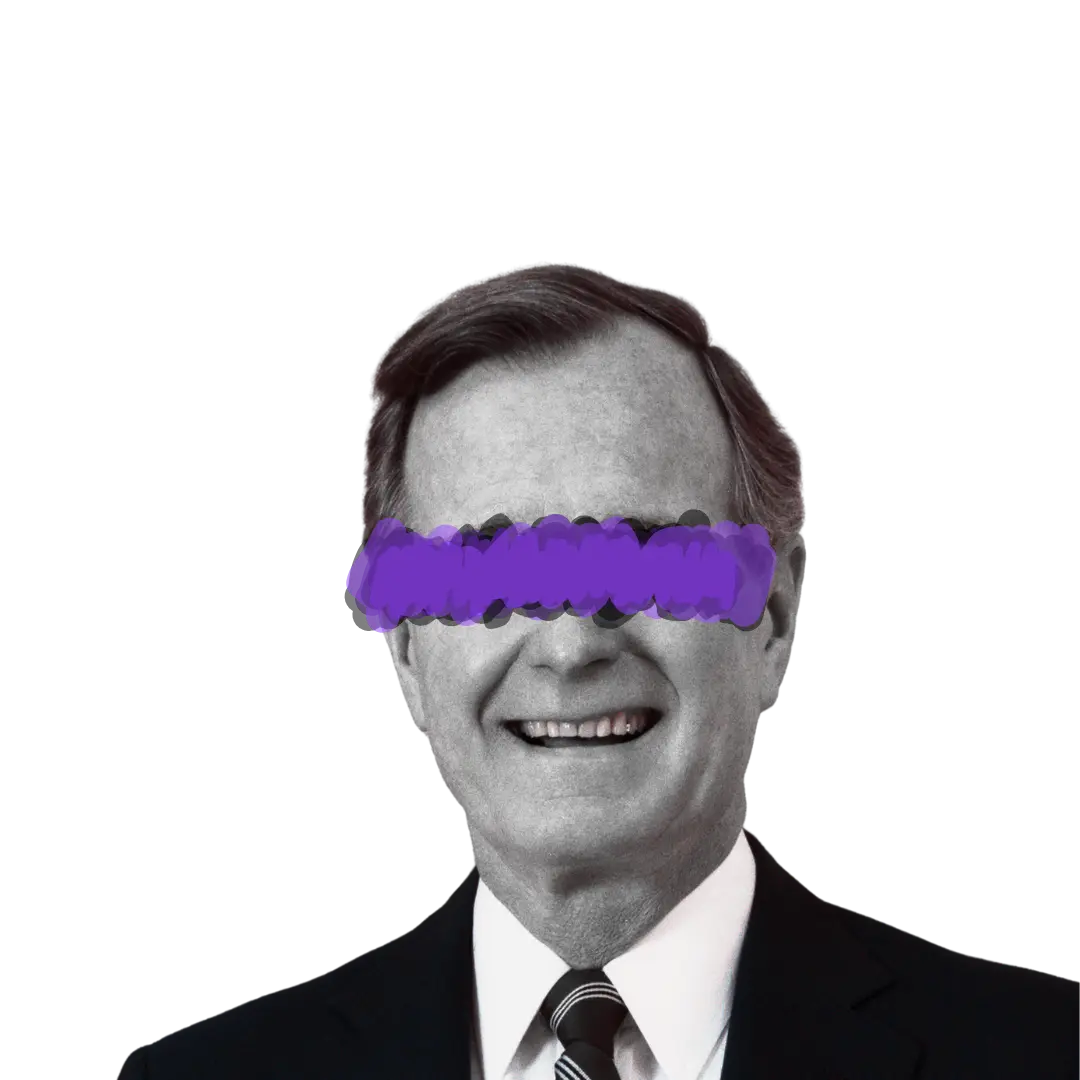
"Family is not a neutral word for me. It's a powerful word, full of emotional resonance."
He was shot down over the Pacific at 20. He built an oil empire in Texas. He ran the CIA. He assembled the largest military coalition since World War II. And through it all, George Herbert Walker Bush maintained a quality that would define his character more than any achievement: unwavering loyalty, to his country, his family, and his principles.
The 41st President of the United States embodied the Enneagram Type 6 personality in ways that shaped both his greatest triumphs and his most painful political defeat. To understand Bush is to understand the Loyalist's deep drive for security, their talent for building alliances, and their sometimes paralyzing tension between duty and self-preservation.
TL;DR: Why George H.W. Bush was an Enneagram Type 6
- Coalition Builder Extraordinaire: Bush's 35-nation Gulf War coalition represents the ultimate Type 6 achievement, creating security through trusted alliances rather than going it alone.
- Lifetime of Institutional Loyalty: From Navy pilot to UN Ambassador to CIA Director to Vice President to President, Bush served institutions faithfully, never seeking to tear them down.
- The "Read My Lips" Anguish: His famous broken tax pledge reveals the Type 6's core conflict, loyalty to a promise versus pragmatic concern for the nation's fiscal security.
- Humble to a Fault: His mother's admonition against "the Great I Am" created a self-effacing style that both earned respect and created the damaging "wimp factor" perception.
- 73 Years of Marriage: His devotion to Barbara Bush demonstrates the Type 6's deep capacity for enduring commitment and partnership through life's challenges.
What is George H.W. Bush's Personality Type?
George H.W. Bush is an Enneagram Type 6 (The Loyalist)
The Enneagram Type 6 is driven by a fundamental need for security — not personal safety, but structural safety. They build alliances because alliances hold. They defer to institutions because institutions outlast individuals. And when the security structure they've built is threatened, they can either freeze or fight back harder than anyone expects.
Bush did both at different points in his life. He froze on the "Read My Lips" promise when the budget math terrified him. He fought back hard when Dan Rather cornered him on Iran-Contra.
His mother Dorothy's rule against boasting — "I don't want to hear any more about the Great I Am" — captures how Type 6 programming gets installed. You learn early that the group matters more than you do. That credit should be deflected. That stepping into the spotlight is vaguely embarrassing. Bush absorbed this so completely that even as Vice President, his then-86-year-old mother was still calling to remind him: "You're talking about yourself too much, George."
Forged in Greenwich: The Making of a Loyalist
Privilege with Purpose
George Herbert Walker Bush was born on June 12, 1924, in Milton, Massachusetts, into one of America's most prominent families. His father, Prescott Bush, was a Wall Street investment banker at Brown Brothers Harriman and would later serve as a U.S. Senator from Connecticut. His maternal grandfather, George Herbert Walker, was a successful financier whose fortune provided the family's considerable wealth.
The family moved to Greenwich, Connecticut, when George was a young boy, and he grew up largely unaffected by the Great Depression due to the family's financial security. But this privilege came with strict expectations.
The Lessons of Duty and Modesty
At Greenwich Country Day School, boasting was considered "the boorish behavior of parvenus." Students were graded not only in academics but in a category called "Claims no more than his fair share of time and attention." Young "Poppy" Bush absorbed these lessons completely.
His mother Dorothy reinforced this at home with remarkable consistency. When a Bush child burst in to announce hitting a home run, she would sweetly ask, "How did the team do, dear?" Years later, as Vice President, Bush received phone calls from his then-86-year-old mother telling him, "You're talking about yourself too much, George."
"It stuck," Bush later said of his mother's anti-boasting campaign. This explains both his genuine humility and the political liability it would later create.
Father's Shadow and Model
Prescott Bush modeled public service as a sacred duty. He served as moderator of Greenwich town meetings for over 15 years before running for Senate, reportedly delaying his political ambitions until he had paid for his children's elite education. This pattern of patient service, of earning one's position through loyal work rather than self-promotion, would define George's entire career.
The Prescott Bush household taught that you serve institutions. You don't use them as stepping stones. You build coalitions. You don't go it alone. You keep your promises, even when it hurts.
Before the White House: Combat, Marriage, and Oil
WWII: The Youngest Pilot's Courage
On his 18th birthday, immediately after graduating from Phillips Academy, Bush enlisted in the Navy as a seaman. Within a year, he was commissioned as an ensign and became one of the youngest naval aviators in American history.
His wartime service reveals the counterphobic courage that Type 6s can display when their values are at stake. On September 2, 1944, while flying a TBM Avenger torpedo bomber over the Japanese-held island of Chichi Jima, Bush's aircraft was hit by anti-aircraft fire. His engine caught fire.
What happened next defines the man: Bush completed his attack run. With flames engulfing his aircraft, he released his bombs on target, scoring several damaging hits, before finally bailing out over the ocean. His two crewmen were killed, one's parachute failed to open, the other went down with the plane. Bush spent four terrifying hours in an inflatable raft, with Japanese boats trying to capture him, before being rescued by the submarine USS Finback.
Over the course of 1944, Bush flew 58 combat missions while his squadron suffered a 300% casualty rate among its pilots. He earned the Distinguished Flying Cross for bravery, three Air Medals, and a Presidential Unit Citation.
Love Letters and Lifetime Partnership
While at Phillips Academy, 17-year-old George met 16-year-old Barbara Pierce at a Christmas dance in Greenwich. He called her "the niftiest girl at the dance." She described him as "the most beautiful creature I ever laid eyes on."
Since they attended different schools, they kept in touch through letters, a practice they would continue for the next 77 years. During his Navy service, Bush named his torpedo bombers after Barbara, christening the aircraft "Barbara III."
Six months into his military service, they were engaged. In a letter to his "Darling Bar," he wrote: "You have made my life full of everything I could even dream of, my complete happiness should be a token of my love for you."
They married on January 6, 1945, shortly after Bush returned from the Pacific. The marriage lasted 73 years: the second longest in presidential history. And produced six children: George, Robin, Jeb, Neil, Marvin, and Dorothy.
"I married the first man I ever kissed," Barbara later told Time magazine. "When I tell this to my children, they just about throw up."
Texas Oil: Breaking Away (While Staying Connected)
After Yale, Bush made a decision that would shape his identity: he moved to Texas. His biographer Jon Meacham notes this allowed Bush to move out of "the daily shadow of his Wall Street father and Grandfather Walker," while still being able to "call on their connections if he needed to raise capital."
This is classic Type 6 behavior, seeking independence while maintaining security networks. Bush started as an oil field equipment salesman, then co-founded Bush-Overbey Oil Development Company in Midland, Texas. In 1953, he co-founded Zapata Petroleum Corporation, named after the Marlon Brando film Viva Zapata!
During this period, Bush became deeply involved in civic activities, serving on committees for the Midland Exchange Club, the Community Theater, and the American Cancer Society. He served as a ruling elder at First Presbyterian Church and even managed the local American Legion baseball team. The coalition-builder was already at work.
The Loyalist in Action
Horseshoes as Leadership Philosophy
Colin Powell captured Bush perfectly: "He was competitive. If you tried to play horseshoes with him, you'd see how competitive he can be." Bush was so devoted to horseshoes that he had courts installed at the White House and Camp David. When Queen Elizabeth II visited in 1991, she brought him a silver-plated horseshoe set. In 1992, he hosted the Super Bowl champion Washington Redskins for a late-night horseshoe tournament. And threw a ringer to win.
The competitiveness was real. But it was always funneled into the game, never into self-promotion. Bush's instinct was never "I'll handle this" — it was "who should be on this team, and how do I get them there." That distinction defined every major decision of his public life.
The Thousand Points of Light Philosophy
Bush's signature domestic initiative: the "Thousand Points of Light", perfectly encapsulates Type 6 thinking. The phrase, introduced at the 1988 Republican National Convention, compared America's volunteer organizations to "a brilliant diversity spread like stars, like a thousand points of light in a broad and peaceful sky."
The underlying philosophy was pure Type 6: society's strength comes not from government alone, but from the interconnected networks of community organizations, churches, and volunteer groups that form a safety net of mutual support. During his presidency, Bush formally recognized more than 1,000 volunteers as "Points of Light," and created a foundation that continues today as the world's largest organization dedicated to volunteer service.
"Any definition of a successful life includes service to others," Bush often said. His son would later eulogize him as "the brightest of the thousand points of light."
The Loss That Never Left
In 1953, the Bushes faced every parent's nightmare. Their three-year-old daughter Robin was diagnosed with leukemia. At the time, the disease was poorly understood and almost always fatal.
For six months, Barbara and George flew Robin to New York for experimental treatments while keeping her diagnosis secret, as doctors advised, from their other children. When Robin died, George became the rock for his devastated wife.
"I was very close to her," Bush told ABC News decades later, still tearing up. "Normally I push it away, push it back."
Barbara credited George with saving her: "I crumbled completely, and he took care of me." This dynamic: the Type 6 becoming the reliable, steady presence in crisis, would characterize their entire marriage.
Sixty-five years later, the family reinterred Robin's remains at the Bush Presidential Library in Texas. "It seems funny after almost 50 years since her death how dear Robin is to our hearts," Bush said.
Building Security Through Alliance
CIA Director: Rebuilding Trust
In January 1976, President Ford appointed Bush as Director of Central Intelligence, a position that required all of Bush's coalition-building skills. The CIA was in crisis. Watergate, Vietnam, and congressional investigations had devastated morale and public trust. Six different directors had served in ten years.
Bush was initially opposed by many who considered him too partisan for the job. He secured confirmation only after pledging not to run for president or vice president in 1976.
Once confirmed, Bush immediately set about rebuilding relationships. Being a former Congressman, he understood Capitol Hill's hostility toward the Agency. His clever strategy: hosting dinners at his home where CIA officers and their congressional critics could meet as human beings. The bridge-building worked.
"Despite being new to the Agency, he quickly identified with CIA's workforce," noted official CIA history. When he departed a year later (after Carter's election), Bush had restored the agency's morale. In 1999, CIA headquarters was renamed the George Bush Center for Intelligence: the only former president to have previously served as Director of Central Intelligence.
The Gulf War Coalition: Type 6 at Its Finest
When Saddam Hussein invaded Kuwait on August 2, 1990, Bush faced the defining test of his presidency. His response would become the textbook example of coalition warfare.
Rather than acting unilaterally, Bush assembled a coalition of 35 nations: the largest military alliance since World War II. He worked the phones relentlessly, calling world leaders personally, building consensus through relationships rather than ultimatums. The coalition included not just traditional allies like Britain and France, but Arab nations like Saudi Arabia, Egypt, and Syria.
Operation Desert Storm succeeded in just 42 days. Kuwait was liberated. Coalition casualties were minimal. And Bush made a decision that would prove controversial in retrospect but reflected his Type 6 prudence: he chose not to invade Baghdad and overthrow Saddam.
"I believed it would lead to an unstable Middle East," Bush later explained. He anticipated the chaos that would follow regime change, a chaos that would indeed materialize when his son invaded Iraq twelve years later.
This calculated restraint was classic Type 6 thinking: achieving the objective while avoiding the unintended consequences that come from overreaching.
End of the Cold War: Quiet Competence
Bush's foreign policy achievements extend far beyond the Gulf War. He managed the end of the Cold War and the dissolution of the Soviet Union with remarkable deftness, resisting pressure to gloat or humiliate the defeated superpower.
His approach was typically understated. "I've got to be careful not to be seen as doing things that [would] complicate the lives of the Soviets," he said. Rather than declaring victory, he focused on building relationships with emerging leaders like Boris Yeltsin and ensuring the transition was peaceful.
This quiet competence was his greatest strength and his fatal political liability. Americans don't see phone calls. They see press conferences. They saw a Cold War ending, a Soviet empire dissolving, and a president who refused to spike the ball — and they wondered if he'd done anything at all. He had. He'd just done it the way Type 6s do everything: through relationships, behind the scenes, without taking the credit.
Where the Loyalist Cracked
"Read My Lips: No New Taxes"
At the 1988 Republican National Convention, Bush delivered what would become the most consequential six words of his political career: "Read my lips: no new taxes."
The pledge was designed to address two problems. Conservatives doubted his commitment to Reagan's tax-cutting legacy. And the broader public had a nagging perception problem: the "wimp factor," as Newsweek had memorably labeled it.
For two years, the pledge held. Then came the 1990 budget crisis. The deficit was soaring. Democrats controlled Congress. Military operations in the Gulf were looming. Bush faced an impossible choice: keep his promise or address what he saw as a genuine threat to national security.
He chose to raise taxes.
"Yes, I wish like hell I had never said that," Bush later reflected, "because they could focus on the quote, rather than on how the economy was."
This decision reveals the Type 6's deepest conflict. Loyalty to his word clashed with loyalty to what he believed was best for the country. The pragmatic concern for stability won, but at devastating political cost.
Conservative supporters felt betrayed. Patrick Buchanan mounted a primary challenge in 1992. The broken promise became Exhibit A in the case against Bush's reelection.
The Iran-Contra Contradiction
This is where the Type 6 psychology gets uncomfortable to look at directly.
The Iran-Contra affair involved selling missiles to Iran — a state sponsor of terrorism — and illegally funneling the proceeds to Nicaraguan Contra rebels. Bush participated in more than a dozen meetings where the weapons sales were discussed. He later acknowledged some responsibility for the Iran arms deal while maintaining he knew nothing of the illegal money laundering for the Contras.
But the real Type 6 story isn't about what he knew. It's about how a man whose entire identity was built on institutional loyalty could rationalize supporting a covert operation that undermined the very institutions he worshiped.
Here's the mechanism: Type 6s don't experience loyalty as a single obligation. They experience it as a hierarchy of loyalties, constantly being weighed against each other. Reagan was the president. The chain of command demanded deference. The Contras were fighting Communism. The CIA, the institution Bush had personally restored, was running the operation. Supporting the rebels could be reframed not as betraying American law but as serving a higher security interest — the kind of threat-based reasoning that Type 6 anxiety makes feel absolutely necessary in the moment.
Bush told himself this was prudent. That the threat was real. That the institutional players involved were trustworthy. Every one of those rationalizations is a Type 6 move.
Then came the pardons. As president, Bush pardoned six Reagan officials charged with Iran-Contra crimes — including former Defense Secretary Caspar Weinberger, whose trial was expected to reveal what Bush himself knew. Special Prosecutor Lawrence Walsh called it "the completion of a cover-up." Bush called it healing. The Type 6 never stops protecting the network, even when the network is what got everyone in trouble.
His most revealing moment came in a combative 1988 interview with Dan Rather, where he pushed back hard against any suggestion he had lied. The aggression was real. Type 6s attacked when cornered — it's the counterphobic response, fight rather than freeze. But the underlying anxiety that produced it never went away. His diary entries from the period, released posthumously, show a man in genuine torment about the gap between his public image of honor and what he knew he had been part of.
The "Wimp Factor"
In October 1987, Newsweek published a cover story titled "George Bush: Fighting the 'Wimp Factor.'" The article captured a perception problem that had dogged Bush for years: that despite his resume, combat pilot, CIA director, Vice President, he somehow wasn't tough enough for the presidency.
The irony was bitter. Here was a man who had completed a bombing run with his plane on fire, who had led the CIA, who had stood up to world leaders. Yet his mother's lessons in modesty, his self-effacing style, his reluctance to use "I" sentences, all created an image of weakness.
Bush spent years trying to combat the perception. He ate pork rinds on the campaign trail. He was photographed in nuclear bombers. He sent joking memos calling himself "the pit bull of SDI."
But the wimp label never fully disappeared. His prudent approach to the Soviet collapse, celebrated by historians as masterful diplomacy, seemed passive to many Americans. His thoughtful deliberation appeared as indecision. His humility read as weakness.
Looking back, reporter Margaret Warner, who wrote the original "wimp" story, reflected: "We see qualities in George Bush that were not appreciated at the time: the modesty, the ability to reach out to the other side, to try to include everyone."
After the Fall
The 1992 Defeat
Bush's reelection campaign in 1992 was, by his own admission, "lackluster." The broken tax pledge had fractured his conservative base. Patrick Buchanan drew blood in the primaries. Ross Perot's independent run split the center-right vote three ways. And Clinton had one message on repeat: "It's the economy, stupid."
37.4% of the vote. A sitting wartime president, humiliated.
The defeat stung. But Bush handled the transition with characteristic Type 6 grace, leaving Clinton a private note in the Oval Office: "You will be our President when you read this note... Your success now is our country's success. I am rooting hard for you." His opponent. His successor. He was already rooting for him.
The Longest Goodbye
In retirement, Bush and Bill Clinton — the man who demolished him in 1992 — became genuine friends. They traveled together after the 2004 tsunami and Hurricane Katrina, raising hundreds of millions in relief funds. Clinton called him "a man I respect enormously." The Type 6 coalition-builder, still building coalitions, this time with his political enemy.
He also took up skydiving. Jumps on his 75th, 80th, 85th, and 90th birthdays. The man Newsweek once labeled a wimp was jumping out of airplanes at 90. That detail never gets old.
Barbara died on April 17, 2018. George was beside her, holding her hand. He had told her "I love you, Barbie" every night of their 73-year marriage, and that night was no different. He outlasted her by seven months.
His last words, spoken to his son George W. by phone on November 30, 2018, were "I love you, too." He was 94. The longest-lived president in American history.
He was buried beside Barbara and Robin at the Bush Presidential Library — the wife he wrote love letters to, and the three-year-old daughter who never left his mind in 65 years.
The Son Who Broke at the Podium
At the Washington National Cathedral on December 5, 2018, George W. Bush delivered his father's eulogy. He had been composed through most of it — steady, presidential. Then he reached the final lines:
"The best father a son or daughter could have. And in our grief, let us smile knowing that Dad is hugging Robin and holding Mom's hand again."
He broke. Voice cracking, shoulders shaking, fighting to hold it together in front of the nation. The former president who had gone to war in the same region his father had refused to overrun, who had spent years in his father's complicated shadow, who could not get through the last sentence without falling apart.
That's the whole picture. That's what the coalition-building and the horseshoe courts and the "How did the team do, dear?" and the 73 years of letters to "Darling Bar" — that's what it all pointed toward. Not the presidency. Not the polling numbers. The family at the center of it.
George H.W. Bush spent his entire life building structures of trust. In institutions, in alliances, in the people around him. The Type 6 at his most integrated: not anxious and grasping for security, but actually providing it — to nations, to the CIA in crisis, to a grieving wife who "crumbled completely." He was the person others could count on when things fell apart.
The voters in 1992 decided they needed something else. They were probably right, for 1992. History decided differently. And in the end, the measure wasn't the 35-nation coalition or the diplomatic restraint or even the broken tax pledge. It was a son, unable to finish a sentence, in a cathedral full of the people his father had held together.
Disclaimer: This analysis of George H.W. Bush's Enneagram type is speculative, based on publicly available information, and may not reflect his actual personality type.

What would you add?