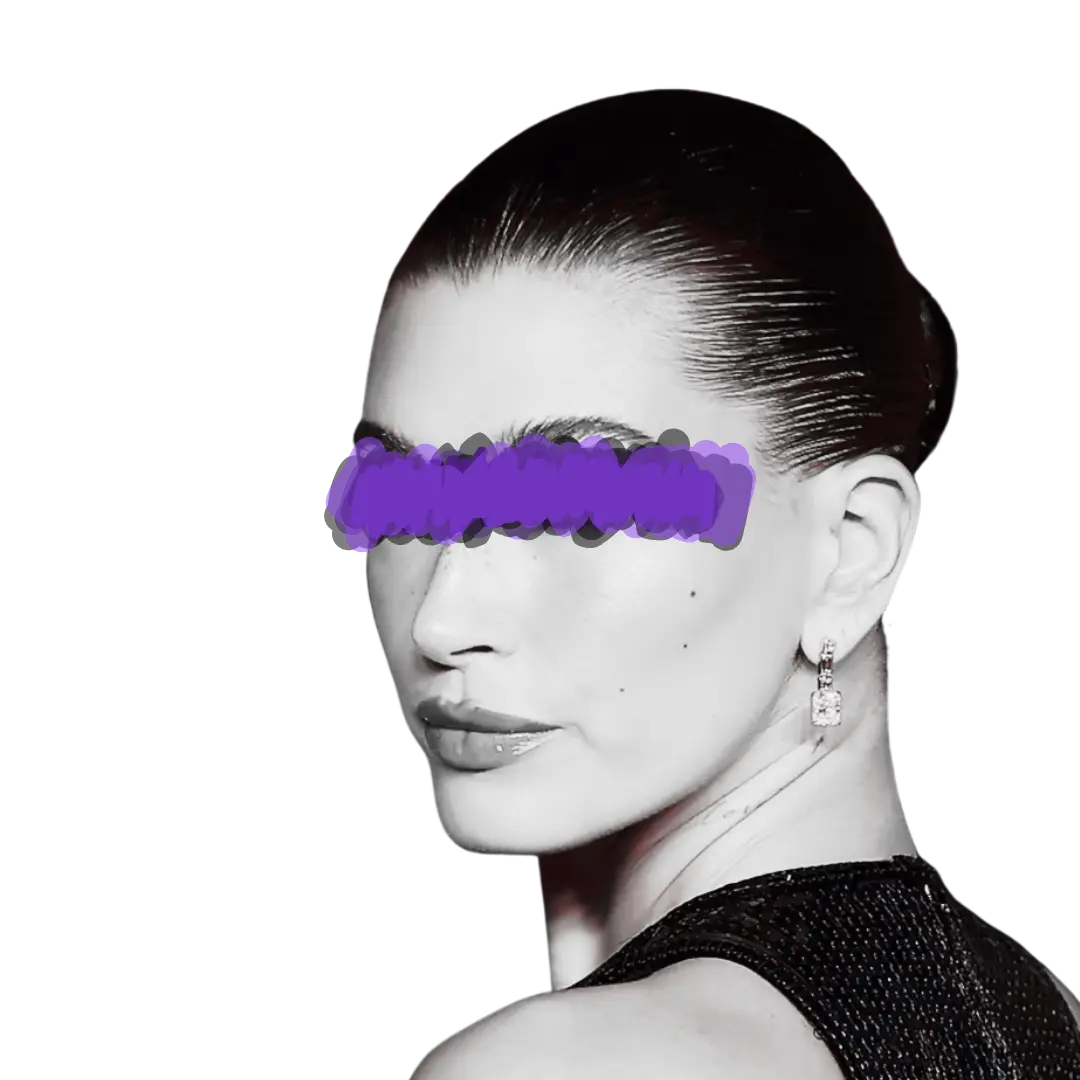
"I feel like I've fought so hard to try to get people to understand me, or know who I am, or see me for me. And people just don't want to sometimes."
That confession from Hailey Bieber's 2025 Vogue interview reveals something most fans never consider. Behind the glazed lips and billion-dollar skincare empire sits a woman who has spent years fighting an invisible battle—not for fame, but for the simple recognition of who she actually is.
She's been called a nepo baby, a mean girl, a snake. The internet has dissected her every outfit, questioned her marriage, and manufactured feuds where none existed. Yet somehow she built Rhode from three products to a billion-dollar acquisition in just three years. How does someone so publicly scrutinized channel that pressure into extraordinary success?
The answer lies in understanding the personality type that drives her every move.
TL;DR: Why Hailey Bieber is an Enneagram Type 3
- Image-Consciousness: Hailey's constant awareness of public perception—from curated Instagram feeds to media training—reflects the Type 3's deep need to be seen favorably. She's admitted that "the negativity screams so loud" when she's online.
- Achievement Through Reinvention: From 12 years of ballet to modeling to founding Rhode, Hailey has continuously reinvented herself through measurable accomplishments. Each pivot showcases the Type 3's adaptability and drive to succeed.
- The Worthiness Wound: Her 2019 confession—"I'm insecure, I'm fragile, I'm hurting"—reveals the core Type 3 struggle: feeling that love and value must be earned through achievement rather than simply existing.
- Faith as Anchor: Raised evangelical, Hailey has said that following Jesus with Justin is "the most important part of our relationship" and "everything." Yet she's also wrestled publicly with church culture making her feel like an "outcast"—revealing the Type 3 tension between belonging and performing.
What is Hailey Bieber's Personality Type?
Hailey Bieber is an Enneagram Type 3
Enneagram Type 3s are called "The Achievers" for good reason. They're driven by a core desire to feel valuable and worthwhile, which manifests as an intense focus on success, image, and accomplishment.
But here's what most people miss about Type 3s: their achievement orientation isn't vanity. It stems from a deep-seated belief that they must earn love through what they do rather than who they are.
For Hailey, this plays out in every arena of her life. She didn't just become a model—she walked the "Big Four" fashion weeks for designers like Dolce & Gabbana, Versace, and Tommy Hilfiger. She didn't just start a skincare brand—she built it into a billion-dollar company that e.l.f. acquired in 2025.
The shadow side? Hailey has spoken openly about it: "I've gotten to the point where I just can't set all the records straight, because there's so much out there that's not true." She's so skilled at presenting the right version of herself that the boundary between performance and person blurs. Ballet dancer, model, entrepreneur, mother—each reinvention is seamless, which is exactly what makes it exhausting.
Hailey Bieber's Childhood: Faith, Family, and Early Pressure
The Baldwin family might conjure images of Hollywood glamour, but Hailey's childhood tells a different story.
Born in Tucson, Arizona, to actor Stephen Baldwin and Brazilian graphic designer Kennya Deodato, Hailey and her sister Alaia were raised in suburban Nyack, New York—far from the spotlight. Her parents homeschooled her starting at age eight, deliberately shielding her from the fame that surrounded her family.
Faith anchored everything. Stephen Baldwin's evangelical Christianity shaped the household, and Hailey still shares Bible quotations on social media. Her mother Kennya regularly prays with a pastor's wife for Hailey and Justin. This spiritual foundation gave Hailey structure, but it also introduced an early awareness of external judgment.
She trained in ballet at the American Ballet Theatre for 12 years, played Clara in The Nutcracker at age 12, and spent summers at the Miami City Ballet program. Then a foot injury ended it. She's never publicly detailed the exact diagnosis, but she's said she "got hurt a lot" as a dancer and "didn't know if she was going to be good enough to make it into the company." The combination—injury plus uncertainty about being enough—is a pattern that would repeat in every phase of her life.
The discipline of classical dance wired something in early. Years of constant critique, physical reshaping toward an ideal, and the binary of making the company or not. She's said ballet "totally shaped how I see and feel movement" and "plays a big part in my body type and in my athleticism." What it also shaped was a tolerance for pain in the service of achievement.
"When I look back on my childhood and how I grew up, I have very fond, beautiful memories," Hailey has said. But she's also noted that she's "not super close" with her family now, having built her own independent life. That separation isn't coldness—it's the natural result of someone who defines herself through what she's built rather than what she inherited.
Faith: The Thread That Stayed
Most profiles mention Hailey's Christian faith in passing and move on. But it's the one constant that has survived every reinvention.
She drifted from it as a teenager—"It got harder to follow church and the Bible because it felt very adult," she's admitted. "I don't want to sound wrong, but it was boring." What pulled her back was finding Hillsong NYC around age 16, a church that felt geared toward young people. She and Justin later moved to Churchome, led by pastor Judah Smith, who became a close friend.
But faith hasn't been frictionless. After a breakup with Justin in 2016, Hailey felt abandoned by her church community: "There were a lot of people in the church world that made me feel very outcast. When did church become a social club?" For a Type 3, being excluded from a community you've invested in hits differently—it's not just rejection, it's a performance review you failed without knowing the criteria.
As an adult, faith has become the counterweight to her achievement drive. "I know that you don't find the things that fill the voids in your life or your heart through money or fame or this industry or cool parties," she told the Wall Street Journal. She's "been there and seen it" and is "married to somebody who's seen it on even a bigger scale."
She's described her shared faith with Justin as "the most important part of our relationship, following Jesus together. It's everything." After Jack was born, she went further: "Your depth of spirituality becomes deeper when you bring life into the world."
The tension is real, though. Hailey isn't performing piety. She's posted criticisms of pastors who replace "wisdom with well-placed words." She's wrestled publicly with guilt from past mistakes and the pressure to be a "good girl" because of her Christian upbringing—pressure she now calls "not realistic." This is a Type 3 negotiating the gap between who she's supposed to be and who she actually is, played out in the one arena where image management isn't supposed to matter.
How Hailey Bieber Built Her Career Before Rhode
At 17, Hailey signed with Ford Models. Within a year, she had her first commercial campaign with French Connection and walked her runway debut for Topshop.
But the trajectory required real work.
By 2015, she was shooting for American Vogue and Teen Vogue. She landed covers for Jalouse, L'Officiel, and Wonderland in rapid succession. In 2016, she signed with IMG Models—the agency representing Gigi Hadid, Kendall Jenner, and the world's top talent.
The real shift came when she started dating Justin Bieber. Their 2018 engagement after years of on-and-off friendship thrust her into a different stratosphere of public attention. Suddenly, she wasn't just a model from a famous family—she was half of one of the most scrutinized couples in pop culture.
Rather than retreat from the spotlight, Hailey leaned into it on her own terms. She co-hosted Drop the Mic. She guest-judged Next in Fashion. She appeared in Justin's documentary. Every move was calculated to establish her own identity separate from her husband's.
The Glazed Donut Moment
Before Rhode even launched, Hailey had already turned her personal aesthetic into a cultural movement. In summer 2022, her manicurist Zola Ganzorigt gave her a pearlescent nail look for the Met Gala that Hailey dubbed "glazed donut nails." Google named it the top beauty trend of 2022. She followed it with "glazed donut skin"—dewy, luminous, minimal—and suddenly a personal preference became a beauty philosophy.
The timing was deliberate. Rhode's first three products—Peptide Lip Treatment, Barrier Restore Cream, and Glazing Milk (literally named for the look)—all launched around that aesthetic moment. She posed alongside actual donuts in promotional imagery. The glazed look signaled a shift away from full-coverage perfection toward something more nourished and skin-first. And Hailey owned it.
For someone whose inner life revolves around image, turning that instinct into a brand identity rather than just a personal burden was the pivot that made everything else possible.
Then came Rhode.
Why Hailey Bieber Seems So Controlled in Public
Why Hailey Bieber Needs Privacy After Being Perceived
Hailey recently shared that she identifies as an "otrovert"—someone who enjoys being around people but needs solitude to recharge. Her need for alone time isn't introversion. It's recovery from the constant work of being perceived. Maintaining the polished image is draining even when it looks effortless, and she needs somewhere the performance can stop.
Hailey Bieber and Social Media: The Tool She Can't Put Down
"Being off Instagram is the best thing ever," Hailey has admitted. "Whenever I take breaks from it I feel so much better, so much happier as a person... the second I come back on I get immediate anxiety."
In December 2021, she completed a seven-day intensive therapy program—no phone, hours of therapy daily. "I've had to work a lot of this through with a therapist," she explained, "because it had gotten to a point where they'd [the trolls] gotten way too crazy for me, and I was really anxious all the time."
And yet Rhode's entire business model runs on her social media presence. She films "Get Ready With Me" skincare routines with Rhode products. She turns product launches into viral events—the Lip Case phone accessory sold out on launch day after she teased it at the Super Bowl with a "mid-game touch up." Rhode's TikTok strategy deliberately avoids over-produced campaigns in favor of content that looks like Hailey's personal feed, blurring the line between person and brand. The #Rhode hashtag has accumulated over 356,000 TikTok posts—most of them fan-created, not brand-created.
The contradiction is the point. The same platform that triggers her anxiety is the engine that built her billion-dollar company. She can't step away from the thing that hurts her because it's also the thing that proves her worth. That tension—needing the stage while knowing it's draining you—is the most honest window into how her mind works.
How Hailey Bieber Turned Pressure Into Rhode
Why Rhode Worked So Fast
Rhode wasn't a celebrity vanity project. It was a meticulously planned business built on one insight: do fewer things and make them actually work.
She launched in 2022 with just three products while competitors were peddling 30-SKU lines. The $16 Peptide Lip Treatment became the breakout—all shades sold out in three days, 440,000 people joined the waitlist, and by August 2023 that single product had earned the brand $16 million.
The moves that followed showed a knack for turning products into cultural moments. In February 2024, she released a $35 phone case molded to hold the Lip Treatment—teased at the Super Bowl, tied to a Valentine's Day Erewhon collab, sold out on launch day. Everything was packaged in post-consumer recycled materials with deliberately minimal design. No excess.
She also knew what she didn't know. She assembled an expert team: Versed's founding president Melanie Bender, marketing expert Lauren Rothberg, and Michael D. Ratner from OBB Media. Hiring people who were better than her in their domains—and letting them run—is one of the healthiest things someone with her wiring can do.
By March 2025, Rhode had generated $212 million in revenue with just ten products. The company doubled its consumer base in a single year. Then came the ultimate validation: e.l.f. acquired Rhode for $1 billion.
"I found a like-minded disruptor with a vision," Hailey said of the deal. She retained her role as Chief Creative Officer and Head of Innovation—proof that her success wasn't about cashing out but about continued achievement.
Surviving a Health Crisis
On March 10, 2022, while eating breakfast with Justin, Hailey felt a strange sensation travel down her arm to her fingertips, which went numb. When she tried to respond to Justin, she couldn't speak. The right side of her face started drooping.
By the time she reached the ER, she had mostly recovered and could talk normally—making the whole event disorienting in a different way. A Trans Cranial Doppler ultrasound at UCLA revealed a grade 5 patent foramen ovale (PFO)—a hole in her heart, the largest grade possible, that had allowed a blood clot to travel to her brain. Doctors inserted a small closure device through her femoral vein to seal the hole permanently.
Her YouTube video about it, "telling my story," ran 12 minutes and was notably unpolished. She walked through the medical details with specificity that most celebrities avoid—naming the contributing factors (she had just started birth control pills, which she said she "should have never been on" because she suffers from migraines and had never discussed that stroke risk with a doctor), a recent COVID infection, and a long flight where she didn't move much. She directly warned women who suffer from migraines to talk to their doctors before using hormonal birth control.
She later shared that she "struggled with a little bit of PTSD" after the event. You can't perform your way out of a blood clot. For someone whose instinct is to control the narrative, choosing to show herself scared and medically vulnerable—not curated—was its own kind of breakthrough.
Hailey Bieber's Biggest Public Controversies
Hailey Bieber and Selena Gomez: Why the Feud Story Stuck
No analysis of Hailey's public life is complete without addressing the manufactured feud with Selena Gomez.
Justin and Selena dated on-and-off from 2011 to 2018. When he married Hailey months after the final breakup, fans created a narrative of betrayal, villainy, and revenge. TikTok's algorithm amplified conspiracy theories. "Team Selena" trolls targeted Hailey relentlessly.
The facts tell a different story. Both women have publicly denied any feud. "It's all respect. It's all love. There is no drama personally," Hailey stated on Alex Cooper's Call Her Daddy podcast. Selena asked her fans to "be kind to everyone."
But the narrative persisted. And this is where her deepest sensitivity gets weaponized against her.
"I've been in a position where I've tried to tell my side of a story or correct a narrative or tell the truth of a lie and then they go, Well, she's lying," Hailey has said. "Imagine how trapping that feels."
"I don't think that this is about me, Hailey Bieber, and Selena Gomez," she explained on The Circuit with Emily Chang. "It's about the vile, disgusting hatred that can come from completely made-up and twisted and perpetuated narratives. That can be really dangerous."
Truth doesn't equal belief. And no amount of denial rewrites a story that people want to keep telling. For someone who has spent a lifetime earning acceptance through what she accomplishes, being unable to control a public narrative—despite doing everything right—is its own kind of prison.
The "Nepo Baby" Label
When the nepo baby discourse peaked in late 2022, Hailey didn't deflect. She posted on Instagram Stories that fellow nepo babies should "just acknowledge your privilege, the opportunities your last name has gotten you and move on." She added: "Let's stop acting like this is in any way a rational burden that people know who your parents are—you sound like a**holes."
A few weeks later, she wore a t-shirt that literally read "NEPO BABY." Her explanation: "I'm just going to call myself a nepo baby, because I am one, and I embrace that I am."
Then came the twist she anticipated. "What was funny about that to me, the way the internet is, it's like nothing's ever enough... You're going to sit there and call me a nepo baby all day long, but then I acknowledge it and then I'm not enough of a nepo baby? There is never any winning with the internet."
After becoming a mother in 2024, she reframed it entirely: "The whole nepo conversation is really just a conversation about privilege. I think having that dialogue with your kid is important... it's just a conversation of awareness and understanding."
The progression is revealing. From defensiveness to self-deprecation to genuine reflection—each response was a different strategy for the same unsolvable problem. When your proof of worth gets dismissed as inheritance, the goalposts don't move. They disappear.
Who Hailey Bieber Is in Private
The public Hailey is a content machine—curated feeds, red carpet precision, brand-aligned everything. The private Hailey, by all accounts, is a homebody who cooks.
Her YouTube series "What's in My Kitchen?" launched in 2023 with a disarming disclaimer: "I'm just a foodie that loves to cook, but I am NOT a professional chef. My recipes aren't always going to be from scratch, be the healthiest, or always make sense! This is just my Hailey way of doing it." She makes pizza toast with truffle olive oil and burrata, chicken parm, creamy Tuscan pasta, and pancakes that prompt her to announce, "Honestly, why am I a genius?"
It's a revealing contrast. The woman who built a billion-dollar brand on aesthetic precision tells viewers that "perfection isn't real" and not to worry about messing anything up. The cooking show is where the performance drops—or at least shifts into something looser, more playful, more recognizably human.
Her friendship with Kendall Jenner captures the same disconnect between perception and reality. "People actually think that we do all this crazy s--t together," Hailey has said. "When the reality is we just sit at home and drink wine or watch movies. It's so normal people don't even understand how normal it is."
She's described herself as "somebody who struggles with people-pleasing and really wanting everybody to like me"—which, for a Type 3, isn't a quirk. It's the operating system. The energy it takes to care that much about every room she walks into explains why she needs the couch, the wine, and the cooking show to decompress.
Hailey Bieber and Justin Bieber: What Their Marriage Reveals
Most coverage of Hailey and Justin's relationship treats it as a subplot of the Selena narrative or a vehicle for divorce rumors. But their actual dynamic reveals something more interesting about how two very different personalities hold a partnership together.
Justin has been blunt about the contrast: "I'm the emotionally unstable one. I struggle with finding peace. Hailey's very logical and structured, which I need." Hailey sees the inverse: "I have to really dive deep and struggle to be in touch with my emotions. He gets there immediately."
This complementary wiring has been tested hard. Their first year of marriage was, by Justin's admission, "really tough"—marked by "a lot going back to trauma stuff" and "lack of trust." They started seeing a marriage counselor shortly after the wedding. "Marriage is very hard," Hailey told Vogue. "That is the sentence you should lead with."
In 2022, both faced health crises months apart—Hailey's ministroke and Justin's Ramsay Hunt syndrome, which paralyzed half his face. "He slept with me in the hospital when I went through my situation," Hailey recalled. "He was really there for me." She described the twin scares as bringing them closer: "It was such a scary time, but it's a silver lining."
More recently, Justin has been publicly vulnerable about his struggles with anger. "People keep telling me to heal," he wrote on Instagram in 2025. "Don't you think if I could have fixed myself I would have already?" Sources have said Hailey has encouraged him to seek professional help—"for the sake of his own well-being"—leading to a brief period of space in mid-2025 that she framed not as separation but as breathing room.
Through all of it, Hailey keeps returning to the same word: "He's my best friend. I never get sick of him." And: "My favorite thing about being married is honestly the companionship. There's nobody I would rather spend more time with." For a Type 3 who has spent her life performing for approval, choosing to be vulnerable with one person—repeatedly, even when it's hard—is the most un-performative thing she does.
How Motherhood Changed Hailey Bieber
Motherhood has upended Hailey's relationship with achievement in ways no amount of therapy quite prepared her for.
She welcomed son Jack Blues Bieber in August 2024 with Justin. They'd renewed their vows in Hawaii while she was pregnant—a private reset before the public chaos of new parenthood.
"Being postpartum is the most sensitive time I've ever gone through in my life," she told GQ, "and learning a new version of myself is very difficult." She described the online speculation about her marriage during this vulnerable period as "such a mindf*ck." Every day she talks herself through it: "Hailey, you had a baby. You grew a human. You birthed a human. It's okay. Give yourself grace. Give yourself time."
But something shifted. "I like who I am so much more than I ever have," she told Vogue in 2025. "There's an ease that comes with it, a confidence. You really start to give less of a f*** about so many things." She described watching Justin see her differently after the birth: "Your partner suddenly sees you like, 'My woman is a god. A superhero. I could never.'"
The growth shows up in how she talks about what's real. "It's not real," she said of the constant public attention. "I have a real life. My real life is that I get to wake up to my beautiful family and my son and my friends and I have people that know me and love me and I love them."
A newborn doesn't care how many pre-launch sign-ups you had. "We're just taking it a day at a time," Hailey told GQ about balancing parenthood, marriage, and her career. For someone who has spent her life planning, achieving, and proving, taking things day by day is its own kind of arrival—the hard-won shift from performing worth to simply living it.
FAQs About Hailey Bieber's Personality
What personality type is Hailey Bieber?
Hailey Bieber reads most clearly as an Enneagram Type 3. The core pattern is not just ambition but a deep sensitivity to image, misperception, and the fear that worth has to be earned through visible success.
Why does Hailey Bieber seem so controlled in public?
Because control is one of the ways she protects herself from being turned into someone else's narrative. The more the internet projects onto her, the more carefully she manages what people can actually see.
Why did Rhode work so quickly?
Rhode worked because Hailey treated it like a real operating business rather than celebrity merch. The product focus, tight launch strategy, and disciplined brand image all fit the Type 3 instinct to win through execution, not just visibility.
Why does the Selena Gomez narrative follow Hailey Bieber so much?
Because it gives the internet a simple villain story, even when the facts are messier. For Hailey, that makes the feud story especially brutal: it turns her deepest sensitivity, being misread in public, into a recurring spectacle.
Disclaimer: This analysis of Hailey Bieber's Enneagram type is speculative, based on publicly available information, and may not reflect her actual personality type.

What would you add?