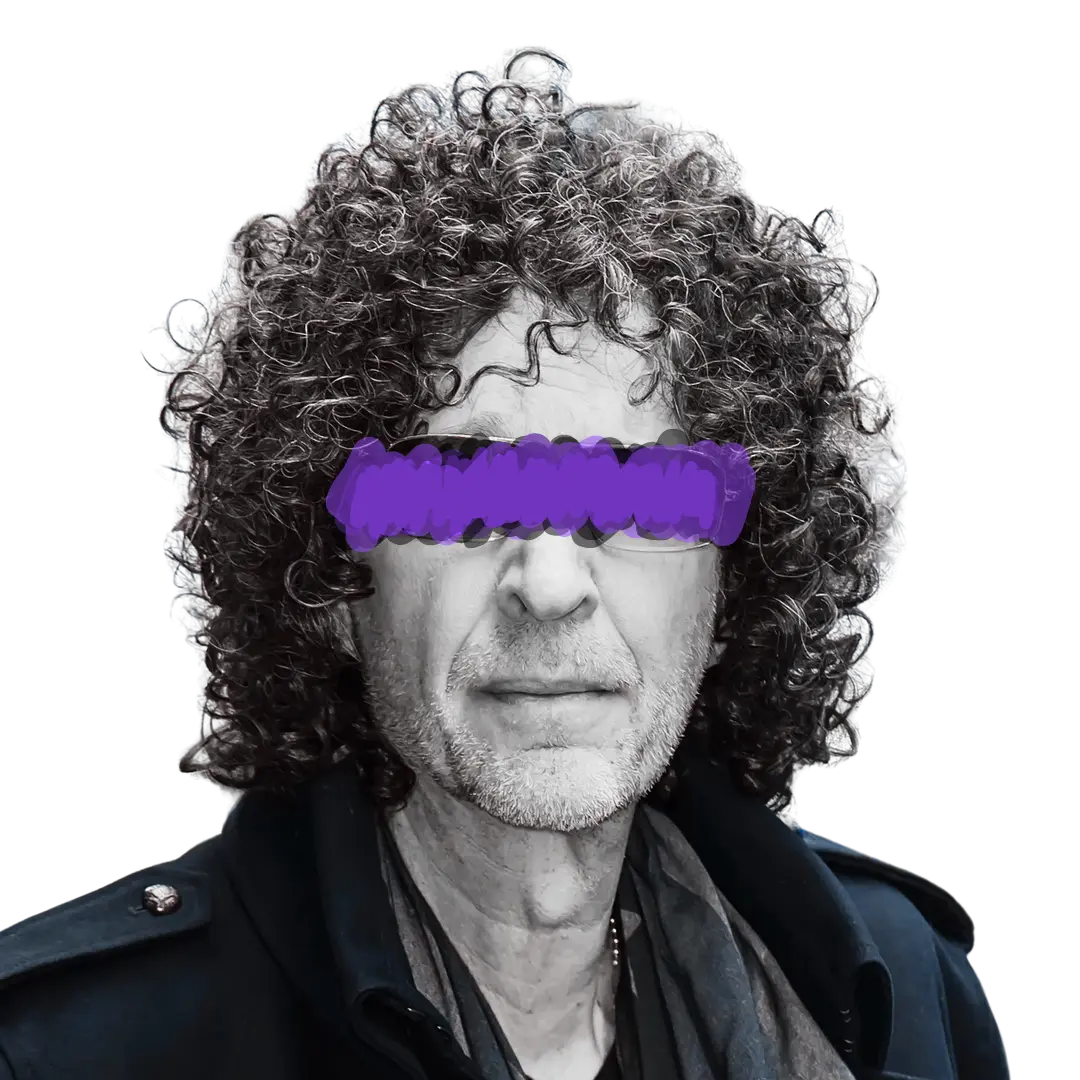
"I pushed myself into psychotherapy, and I've gotta tell you — I'm the poster boy for psychotherapy. I think it's terrific, and I got in touch with a lot of things I didn't like."
Howard Stern taps the radio three times above the speaker before every broadcast. Right hand. Three taps. He has done this for decades. It's his attempt (his word) to be better than the competition. Not preparation. Not talent. Three taps on a piece of equipment, a ritual so compulsive he once described it as "my attempt to control the world."
The man who built the most confrontational show in broadcast history — who told 20 million listeners exactly what they were afraid to hear, who made the FCC fine his employers $2.5 million, who turned vulnerability into a weapon and silence into dead air. That man taps a radio three times because he's terrified it won't work otherwise.
This is the tension that explains everything about Howard Stern. Not the shock jock persona. Not the evolution into "the best interviewer in media." Not the cat rescue or the watercolor paintings or the quiet marriage to Beth. The tension is simpler and older than any of it: Howard Stern has been afraid his entire life, and his genius was learning to attack the fear before it attacked him.
His fans call this the difference between "Old Howard" and "New Howard." They're wrong. There's only ever been one Howard. A frightened kid from Roosevelt, Long Island, who discovered that if you're loud enough, no one can hear you shaking.
TL;DR: Why Howard Stern is an Enneagram Type 6
- Fear as fuel: His entire shock jock persona was a counterphobic response, attacking the things that scared him before they could attack him.
- Obsessive loyalty: Robin Quivers for 40+ years. Fred Norris for 45+. He said he'd quit radio entirely if he lost Robin.
- Anxiety rituals: OCD behaviors (entering rooms right foot forward, counting, tapping) reveal a mind constantly trying to control an unsafe world.
- The therapy transformation: His evolution from rage to empathy maps perfectly to a Type 6 integrating toward Type 9, finding inner peace after a lifetime of vigilance.
The Basement in Roosevelt
Ben Stern worked as a radio engineer at WHOM in Manhattan. He set up a microphone, a tape machine, and a turntable in the family basement. Young Howard used it to record make-believe radio shows: characters, prank calls, mock commercials. He visited his father's studio and watched voice actors like Don Adams record cartoons. The equipment was the gift. What came with it was the price.
"Shut up, sit down, you moron!"
Ben Stern's signature phrase. Howard originally wanted to title his first book after it. Ben would quiz his children on current events, and when Howard got sarcastic, when the kid tried to perform instead of answer, Ben would erupt. Recordings of Ben yelling this became one of the most iconic soundbites in American radio, played thousands of times. Howard turned his father's voice into content. He turned the wound into the show.
His mother, Ray, carried a different kind of damage. Her mother died when Ray was nine years old. She was sent to live with a distant relative, not even informed of her mother's death. This loss haunted her for decades. She threatened suicide. Howard came home from school to find her sobbing.
"I'd come home from school, and my mother was just distraught," he told Terry Gross on NPR's Fresh Air in 2019. "She'd be sobbing. 'I'm going to go upstairs; I'm going to kill myself.' This is a terrible burden on a kid — to have to cheer up a mother."
So the kid learned to perform. He did elaborate impressions of all the mothers in the neighborhood, not just impressions but eviscerations, and his mother loved it. "What it meant was: She was the best mother." The applause didn't mean he was talented. It meant he was safe. It meant she wouldn't go upstairs.
"My mother was very involved with me. And we had a dialogue constantly. And it was like an umbilical cord. As long as the words were flowing back and forth we were connected and feeding each other. And I probably grew up very afraid of losing that connection."
Words as survival. Performance as a tether to the one person who might not leave. This is the engine that powered everything that came after.
The Only White Kid
The Stern family lived in Roosevelt, Long Island, a neighborhood that underwent blockbusting, where real estate agents convinced white homeowners that incoming minority families would destroy property values. Most white families fled. Ben and Ray, staunch liberals, refused to move on philosophical grounds.
Howard became one of a handful of white kids in his school. He was frequently subjected to racial hazing and violence. He came to dread leaving his house. One of his best friends, who was Black, was beaten up simply for hanging out with him. In a 2006 60 Minutes profile, Stern revisited the neighborhood and said: "This town was a horrible place to live."
When the family moved to Rockville Centre in 1969, fifteen-year-old Howard transferred to a predominantly white Catholic school. Now he was bullied for being Jewish. He became, in his own words, "a total introvert."
"Our rap was that if girls could only look beyond the fact that we didn't have great looks and see that we have great personalities, they would fall in love with us," he wrote in Private Parts. "The truth of the matter was we had really bad personalities in addition to our ugly faces. Even the losers called us losers. And we were."
The kid who couldn't find safe ground anywhere — not at home with his volatile father and suicidal mother, not at school where he was the wrong race and then the wrong religion — that kid built a career out of making everyone else feel as unsafe as he felt. He'd humiliate guests, expose hypocrisies, strip away every pretense in the room. Not because he was fearless but because the chaos felt familiar. If the whole world is off-balance, at least you're not the only one standing on shaky ground.
What is Howard Stern's personality type?
Howard Stern is an Enneagram Type 6
Most people see Howard Stern as a power-hungry provocateur who mellowed with age. The common read: he was a wild shock jock, he got rich, he married a model, he went soft. "Hollywood Howard." "Hamptons Howard." Sellout.
But power-hungry people don't tap radios three times. They don't enter rooms right foot forward. They don't spend their first therapy session doing impressions because they're too frightened to say anything real. The pattern looks less like a Challenger and more like another famous Six, Peter Thiel, who kept a parachute in his office after 9/11. Not because he wanted to fly. Because he was afraid the building would fall.
The Enneagram framework for Type 6 — "The Loyalist" — reframes everything. Sixes are driven by a core fear of being without support or guidance in a dangerous world. They scan for threats. They test loyalty. They build alliances and then worry those alliances will fail. And in their counterphobic form, they don't run from what scares them. They charge directly at it.
This is the entire Howard Stern story.
The evidence:
- The OCD rituals: entering rooms right foot forward, tapping the radio three times, counting compulsively. The anxious mind trying to impose order on chaos.
- The counterphobic rage: "It would be pure id, total honesty, and I had a lot of rage," he told Letterman. Not power. Preemptive defense.
- The fierce loyalty: Robin Quivers for 43 years. Fred Norris for 46. Gary Dell'Abate for 41. He said he'd quit radio if he lost Robin.
- The self-doubt: "How could this person love me?" he's said about Beth, 19 years into their marriage. A man driven by power doesn't wonder if he deserves love.
- The financial fortress: Over $1.5 billion in career earnings from SiriusXM alone. A net worth estimated at $750 million. Real estate worth $137 million. For a Six, money isn't greed. It's a wall between you and the world that taught you nothing is safe.
- The integration toward peace: Sixes integrate toward Type 9. Stern's 25-year therapy arc, from "I was a selfish prick" to "the best interviewer in media," is textbook Six growth.
The transformation that fans call "selling out" is what the Enneagram calls growth.
The Weapon That Was a Shield
"I was just a young man full of rage. And I was angry."
He told Letterman this on Netflix in 2018. Then he said something that cracked the whole performance open:
"I was angry with you, that you were on television, that you had an audience. There was no rhyme or reason to it. I could not love anyone. I could not respect anyone."
This is the confession that separates Stern from every other shock jock who ever lived. Don Imus died without apologizing. Rush Limbaugh died without introspecting. Eminem channeled similar rage into bars but never sat across from his targets and named the fear underneath. Howard Stern sat across from the man he'd spent years attacking and said: the aggression wasn't strength. It was a wound wearing a microphone.
"I was so angry at the world. I love Robin Williams, and yet if he came into my studio, I had to act like I didn't love him."
His biggest regret. The Robin Williams interview. He had one of the greatest comedic minds of a generation sitting across from him, and instead of celebrating the man's genius, Stern went for the jugular. Williams died in 2014. Stern never apologized.
"It brings me to tears to imagine what that moment could have been like."
The rage was never about dominance. It was counterphobic defense, a Six attacking vulnerability before vulnerability could attack him. If you love Robin Williams, you might lose Robin Williams. If you mock him, you never had him to lose.
The $500 Million Bet Against the Known World
In October 2004, Howard Stern announced he was leaving terrestrial radio for Sirius Satellite Radio, a platform most industry analysts thought was a joke. Sirius had spent $2 billion building its network and hadn't turned a profit. The conventional wisdom: no one would pay for radio when free radio existed.
Stern signed for a reported $500 million over five years. But the calculus only looks irrational if you think it was about money.
The FCC had fined his employers $2.5 million over fourteen years. Clear Channel had dropped him from six stations in April 2004, mid-contract, after the post-"Nipplegate" indecency crackdown. The government he couldn't control was dismantling the platform he depended on. For a Six, this is the nightmare scenario: the authority structure has turned hostile, and the ground beneath you is disappearing.
"I left because I couldn't stand the censorship," he said. "You can't win against the government when the government wants you. They have endless resources, our taxpayer money to attack you."
So he did the most counterphobic thing imaginable: he abandoned 20 million free-radio listeners for an unproven subscription platform that required people to buy hardware and pay monthly fees. His first broadcast on Sirius, January 9, 2006, earned him 34.3 million shares of stock (worth $220 million) because subscriber targets had already been exceeded.
His terrestrial audience of 20 million shrank to roughly 1 million on satellite. But that million paid to be there. No advertiser boycotts. No FCC. No station owners who could pull the plug at the first complaint. He'd traded reach for control. A smaller fortress with thicker walls.
A 2020 Credit Suisse analysis found that 15% of SiriusXM's entire subscriber base, 2.7 million people, would cancel if Stern left. He didn't need 20 million passive listeners. He needed millions who couldn't imagine the service without him. That's not an audience. That's an alliance.
The Studio He Built to Be Alone In
Here's a detail that reveals more about Howard Stern than any interview clip: he designed his studio so he cannot see Fred Norris. Fred Norris, the man who has been with him since 1979, longer than anyone else on the show. Stern told Rolling Stone: "Fred is my biggest distraction. He doesn't really react to anything I do. I don't want to see Fred."
The man who commands the attention of millions designed the perfect workspace for not having to look at anyone.
"I'm the type of guy who will invite you to his home and then all of a sudden he'll be angry you're at his house, like 'When can I be by myself?'"
He barely left his basement for two years during COVID. He described his pre-pandemic life as already reclusive: "lots of prep-work for his shows, clean eating, vigorous workouts, favorite TV programs and few late nights." He and Beth go to bed at 8 o'clock, even on weekends. The King of All Media goes to sleep before most college students start studying.
This is the public/private gap that no one talks about. The on-air Stern is chaos, provocation, no filter. The off-air Stern practices Transcendental Meditation twice a day (he learned at 18, from his depressed mother, who saw Maharishi Mahesh Yogi on the Johnny Carson show). He paints watercolors of barns. He names foster kittens. He and Beth have rescued over 2,000 cats through North Shore Animal League America.
The shock jock names kittens. Every single one.
"None of This Is Funny"
When Stern first sat down with his therapist, he performed. He told stories about his parents the way he'd tell them on air: impressions, timing, punchlines. The therapist didn't laugh.
"There's nothing funny going on here," the therapist said. "Quite frankly, some of this stuff sounds pretty sad."
Then: "I take you seriously."
Stern has said this was the first time anyone ever told him that.
"It was really a very scary thing to me. I had never really opened up to someone. I never had conversations like that with another human being, let alone a man. And I never in a serious way thought about how I felt about anything. I was completely closed off from my feelings."
He started going once a week. Then twice. Then three times. Then four. More than 25 years later, he's still going.
"My narcissism was so strong that I was incapable of appreciating what somebody else might be feeling," he told NPR. "I didn't know what was up and what was down, and there was no room for anybody else on the planet."
What therapy did was rewire the interview. The man who used guests as targets started using them as mirrors. "Therapy opened me up and enabled me to appreciate how fulfilling it was to be truly heard. That led me to the thought: 'You know, somebody else might actually have something to say. Let's just sit here and listen and not make it all about you.'"
The interviews became legendary. Take Conan O'Brien in 2015, the interview Stern himself calls his best. He didn't warm up to the hard question. He opened with it: "Do you suffer from depression? Are you medicated?" O'Brien, disarmed, confirmed both. Then he described his lowest moment. After Charlie Rose read a brutal review of his work to his face on live television, O'Brien went back to his office and lay on the floor under his desk. "I said 'I'm fine, I just need to lie here under the desk for a while.'"
Stern didn't pivot to the next prepared question. He stayed in the wound. "I got the funny out of him, I got the seriousness of his depression," Stern said later. "There wasn't a question I left out. I really heard my guest."
The technique is always the same. He starts with childhood: "Was your early life enjoyable, or was it filled with angst? Did your parents get you as a kid?" And when a wound appears, he follows the wound instead of the script. Bill Murray, famously guarded, talked for 70 minutes and ended up admitting: "My problem is connecting with myself... What stops us from looking at ourselves is that we're kind of ugly if we look really hard." Steve Martin revealed his father once saw The Jerk and told a friend: "Well, he's no Charlie Chaplin."
"There is no one better than Stern at encouraging the most famous people in the world to speak candidly about not just their personal lives, but also their biggest fears, insecurities and regrets," The Week wrote.
The same nervous system that scanned every room for threats as a child now scans every interview for the real story. The vigilance didn't disappear. It found a better job.
The Marriage That Failed and the One That Didn't
He married Alison Berns, his college sweetheart, in 1978. Three daughters: Emily, Deborah, Ashley. Twenty-three years of marriage while the show consumed everything.
"I was totally neurotic and sort of consumed with work. I took work as the most important thing and the only thing."
They separated in 1999. Divorced in 2001. Emily, their eldest, told the New York Post: "I believed that my parents were very much in love. I felt like the divorce came out of nowhere."
"My marriage ending blew my mind. I was upset that I failed and let down my family, my kids, my ex-wife. It was all very painful."
A Six who couldn't keep his people together. The worst possible outcome for the type that builds its entire identity around loyalty. Therapy became his way back to his daughters. He went four days a week partly because he feared losing them entirely. "My daughters are the most important thing in the world to me," he said. "How do I, as a man, have a relationship with my daughters if my wife is no longer there to facilitate that?"
He stopped bringing the girls on his show, saying "it was more loving to let them have their separate identities and shine on their own." The repair was real but uneven. Ashley, his youngest, remained closest, and when she married in 2023, he called it one of the most "beautiful" and "special" moments of his life. Emily, the eldest, had a more complicated path, converting to Orthodox Judaism and once publicly questioning his transformation. Deborah, the middle daughter, earned a Ph.D. and kept her distance from the spotlight entirely.
He met Beth Ostrosky in 2000 at a dinner party where she was on a blind date with someone else. "I saw this light around her. She was just glowing." They dated for seven years before he proposed, on air, on Valentine's Day 2007.
"Sometimes I'll look at her and think, 'Is this really happening? How could this person love me?' I guess that's the definition of a dream girl, and 19 years in, I still feel that way about her."
Beth has said: "He really listens to everything I say. He is quite a catch, the perfect husband."
An insider reportedly said Beth played a role in convincing him to sign his most recent SiriusXM deal because she "didn't want him home all day." The world's most famous broadcaster, and his wife needs him out of the house.
The man whose rage made him millions needed a woman who could say no. Not a pushover. Not a fan. Someone who could stand in his storm without flinching. That's the Six looking for solid ground. And, for once, finding it.
"Hollywood Howard" and What the Fans Got Wrong
Former cast member Jackie "The Joke Man" Martling put it bluntly: "Howard has become a lot of the things that he always told people not to become."
The angry old fans call him "Hollywood Howard." "Hamptons Howard." They say he sold out, that he cares about being liked now, that the dangerous edge is gone. Donald Trump Jr. weighed in: the "blue-collar people that he now hates since he became Hollywood Howard would've probably been pretty big Trump supporters."
Stern's own response reveals the misunderstanding at the heart of it:
"There used to be two Howard Sterns: the on-air Howard and the off-air Howard. Now they feel much closer together."
The fans who loved "Old Howard" loved the attack dog. The fans who hate "New Howard" are watching a man who stopped performing terror and started being honest. The contradiction: the guy famous for honesty was lying the entire time — not about what he said, but about why he said it.
The hardest part of the reckoning is the Wack Pack, the rotating cast of people with disabilities, addiction, and cognitive limitations who became recurring characters on the show. Beetlejuice. Eric the Actor. High Pitch Erik. The show gave them income and visibility they'd never have found otherwise. It also built entertainment on their vulnerability. Stern has never issued a direct apology for this chapter, but the evidence of discomfort is everywhere: "Gary the Retard" was quietly renamed "Gary the Conqueror." "Wendy the Retard" became "Wendy the Slow Adult." The word vanished from his vocabulary. The Wack Pack was phased out by 2015. When Eric Lynch died in 2014, Stern opened the show saying "I loved Eric. I truly, truly loved him." The love was genuine. Whether it was enough is a question he hasn't answered.
"Rather than say to Robin Williams, 'My God, you're here,' and celebrate an amazing talent and the beauty of that guy's career, he walks in and I start in, 'Hey, you're f---ing your nanny.' I want to take that guy and shake him."
His politics shifted along the same fault line. Trump had been a regular guest with over 20 appearances, a genuine friendship. Trump attended his wedding. When Trump ran for president, Stern declined to speak at the convention and told him he was voting for Clinton. "I haven't heard from him since. We don't talk at all." By 2020, Stern was calling Trump's pandemic response "treasonous." By 2024, he endorsed Kamala Harris on air. His analysis was characteristically blunt: "The people Trump despises most, love him the most. The people who are voting for Trump, for the most part... He wouldn't even let them in a f---ing hotel." The transformation wasn't ideological. It was the same pattern as everything else: therapy taught him to see people, and what he saw in his old friend after 2015 was someone operating from the same unexamined rage Stern had spent decades learning to put down.
The Paintings of Things Already Gone
When Ben Stern died in July 2022 at age 99, Howard didn't give interviews. He didn't do an emotional on-air tribute. He wrote a brief notice in Dan's Papers, a local Hamptons newsletter: "I lost my father recently, he was 99 years old."
Then he started painting barns.
Specifically, the Corwith Barns, old Hamptons structures that no longer exist. Howard had photographed them many times. Now he was working from those photographs, trying to capture "every broken board on that fading structure." He described the project as "honoring him and all those growing older and then gone."
Painting what's already disappeared to honor what's already disappeared. Processing absence through the careful reproduction of absence. It's the most revealing thing Howard Stern has ever done — quieter than any confession, louder than any broadcast.
"Some are successful, and the others are learning experiences," he said about his painting. "You can't learn this language without a bunch of failures."
He could be talking about the canvases. He could be talking about the marriages, the friendships, the interviews, the years of rage that cost him things he can't get back.
In 2017, doctors found a growth on his kidney. Ninety percent chance it was cancer. After hours of surgery, it turned out to be a benign cyst. But the hours before the results came back changed him. "I'm at a place now where I'm trying to figure out how to spend the rest of my life, however long that might be."
He signed a new three-year deal with SiriusXM in December 2025, at age 71. The show airs Monday through Wednesday now. More time for painting. More time for kittens. More time with Beth.
"I'm happy to announce that I figured out a way to have it all," he said. "More free time and continuing to be on the radio."
Robin Quivers called him "a little boy" once. Meant affectionately. Meant as a description of the emotional neediness that sits beneath all that control, all that rage, all those years of performing strength. The little boy who did impressions to keep his mother from going upstairs. The little boy who tapped the radio three times so the world would hold together for one more day.
He's still tapping. He's just quieter about it now. And somewhere in a Hamptons studio, surrounded by paintings of structures that no longer exist, the most afraid man in every room he ever dominated is finally learning to sit with the silence.

What would you add?