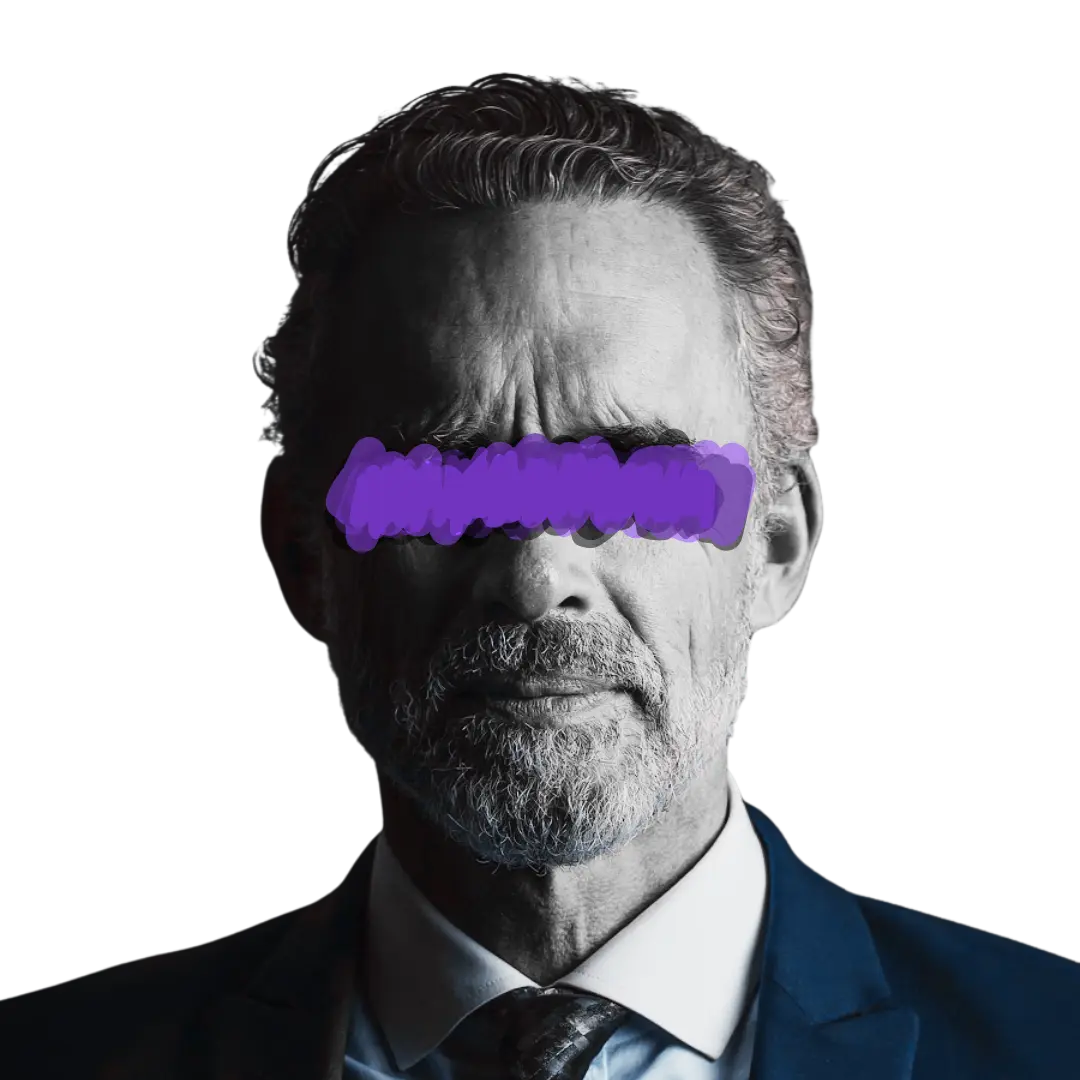
"You're morally obligated to do remarkable things. Why? Well, partly because life is so difficult and challenging that unless you give it everything you have, the chances are very high that it will embitter you. And then you'll be a force for darkness."
That's not advice. It's an ultimatum. The man believes you're obligated to fight chaos with everything you have, or you'll become part of the problem.
Whether you love Peterson or find him insufferable, the intensity is undeniable. But where does it come from? How does a clinical psychologist from small-town Alberta become the most divisive intellectual of his generation? Once you understand his personality type, the pattern becomes clear.
TL;DR: Why Jordan Peterson is an Enneagram Type 1
- Everything runs through a moral filter. Not curiosity (Type 5), not dominance (Type 8), but moral obligation. Every argument, every lecture, every rule frames life as a duty to get right.
- That inner critic never sleeps. He calls himself "a bit much" and "hard on people around me." That's not false modesty. It's the Type 1 internal auditor reporting its findings.
- His anger isn't political. It's moral. Compelled speech. Postmodern ideology. Professional persecution. Each triggers righteous fury because each violates a principle.
- 99th percentile orderliness. His own Big Five scores confirm it. His entire philosophy (impose structure on chaos, 12 numbered rules, fix yourself first) is organized around order as a supreme value.
- He'll sacrifice his license before his principles. He fought the College of Psychologists to the Supreme Court. Type 1s don't bend on what they believe is right, even when bending would be easier.
What is Jordan Peterson's Personality Type?
Jordan Peterson is an Enneagram Type 1 (The Reformer)
Type 1s carry an internal compass that won't stop pointing toward what should be. They see the gap between reality and the ideal, and they cannot leave it alone.
What drives them? The need to be good, to have integrity, to fix what's broken. And underneath that drive? A terror of being corrupt, defective, or evil.
Look at "12 Rules for Life." It's not self-help. It's a moral framework. "Stand up straight with your shoulders back." "Tell the truth, or, at least, don't lie." These aren't suggestions. They're imperatives issued from the Reformer's internal courtroom. Millions of people were starving for someone to tell them how to live, and mean it.
Why Type 1 and Not Type 5 or Type 8?
This deserves direct engagement because reasonable people disagree.
The case for Type 5 (The Investigator): Peterson spent 13 years writing "Maps of Meaning." He synthesizes psychology, mythology, neuroscience, and philosophy. He's a lifelong researcher, a deep reader, a professor. The dominant online typing across personality databases is actually 5w4, the Philosopher. The argument: his knowledge accumulation is his security blanket.
The case for Type 8 (The Challenger): Peterson thrives in intellectual combat. The Cathy Newman interview, the Sam Harris debates, his institutional battles. He does not back down. His 99th percentile assertiveness fits the Type 8 profile. An 8 sees what others call a fight as a friendly exchange.
Why Type 1 is the better fit: Three things distinguish Peterson from 5s and 8s.
First, the moral framing of everything. A Type 5 would say "this is intellectually interesting." A Type 8 would say "I'll make it happen." Peterson says "you should do this because it's right." His organizing principle isn't knowledge or power. It's obligation.
Second, his relationship with vulnerability. An 8 would never describe himself as "a bit much" and "hard on people around me" with the tone of regret Peterson uses. An 8 would say that's other people's problem. Peterson treats his intensity as something he needs to manage and improve, classic self-correction.
Third, 99th percentile orderliness. This is the single most diagnostic Big Five trait for Enneagram Type 1. Type 5s are typically low in orderliness; they care about intellectual complexity, not systematic order. A Type 5 writes dense, sprawling, associative books, which "Maps of Meaning" was. A Type 1 translates that into 12 numbered rules, which "12 Rules for Life" is.
A necessary acknowledgment: Peterson is a personality psychologist who co-authored the Big Five Aspects Scale. He considers the Big Five the only framework with serious scientific backing and would almost certainly view the Enneagram as lacking psychometric rigor. Fair enough. What the Enneagram offers is a lens for examining motivational patterns and internal fears, the dynamics that factor-analytic models measure from the outside but that typological systems attempt to describe from the inside.
The Inner World: What Drives Peterson
The Man Who Cries on Camera
This is the thing people can't figure out. A man who preaches responsibility, toughness, and order, weeping in front of millions.
It happens often. Especially when he discusses what his followers mean to him.
"I was in contact with thousands of people and they talked to me, and I could see this demoralization," he told Piers Morgan in 2025, his voice breaking. "It's a great privilege to serve that role... but it's also overwhelming." When Morgan suggested Peterson had become "a surrogate dad" to millions, Peterson couldn't hold it together.
He identified what triggers it: "It's that paradoxical combination of depth of suffering and ease of rectification." People are in pain. The solution is often simple. That gap between suffering and remedy undoes him.
Multiple factors converge. His 96th percentile compassion means he feels others' pain acutely. His chronic inflammatory condition (CIRS, present since 2017) and the neurological aftermath of his benzodiazepine crisis and medically-induced coma have affected emotional regulation. Joe Rogan defended it simply: "That's because he really feels that way. If you look at him crying in the context of the conversation, it's because he really feels that."
But there's a deeper dynamic at work. A man who preaches responsibility and self-improvement, weeping because he can't control his own emotional responses? The inner critic says: hold it together. The body says: I can't. The tears represent a man failing to meet his own impossible standards: in real time, on camera, in front of millions.
The Inner Critic Made External
Type 1s are haunted by an inner critic, a voice constantly evaluating, judging, demanding better. Peterson built a career externalizing that voice.
"Clean your room." Start with the smallest domain you can control. Make it right. Expand from there. It became a meme for a reason. The philosophy sounds simple. Living it isn't.
But here's what people miss: the critique he aims outward is a fraction of what he aims inward. When asked the worst thing about being Jordan Peterson, he answered: "I'm a bit much, you might say. I'm running in all directions very rapidly, so that can be a bit much. It's hard on people around me."
He's equally unsparing about fame. Asked by Lex Fridman whether celebrity had corrupted him, Peterson answered: "No doubt. In some regard." Then he explained why: "People are much more likely to do what you ask... one of the things that keeps you dying properly is that people push back against you optimally." When asked what he worries about most, the answer wasn't political enemies or health: "I think I worry about it more than anything else. I hope. I hope I do. I better."
That last line — I better — is the inner critic in three syllables.
Righteous Anger and the Suppression Cycle
Type 1s suppress anger because they see it as "wrong." But it doesn't disappear. It emerges as resentment, criticism, or righteous indignation when moral lines get crossed.
Peterson's emotional responses to perceived injustice aren't calculated. When he confronts ideological corruption or attacks on free speech, the anger is palpable. Critics call it instability. But consider: his Big Five scores show 95th percentile agreeableness and 85th percentile politeness. This is a man who naturally avoids conflict. The eruptions come because he suppresses, until a moral line forces him to stop.
He's aware of the pattern. On the Lex Fridman podcast, he described being "tempted to draw on anger as a motivating energy to help me overcome the resistance" to tackling difficult public issues. But he knows the cost: "That makes me more harsh and judgmental in my tone... then might be optimal." Friends tell him anger is justified. Others warn it alienates people who'd otherwise listen. "That's a hard balance to get right."
The Bill C-16 moment in 2016 was the eruption that made him famous. The Canadian government proposed adding gender identity and expression to human rights protections. Peterson saw compelled speech: the government telling citizens what they must say.
"I'm not going to cede the linguistic territory to radical leftists. I'm not using their words."
Not everyone agreed with his reading. The Canadian Bar Association endorsed C-16, and since it passed in June 2017, no one has been criminally prosecuted for misusing pronouns. Whether Peterson was prophetically early or fundamentally wrong about the law's reach remains genuinely debated. But the mechanism is what matters: a suppressed reformer erupting when a principle got violated.
How Peterson Argues: The Cathy Newman Moment
If the C-16 eruption showed why Peterson fights, the Channel 4 interview showed how.
In January 2018, journalist Cathy Newman interviewed Peterson for about 30 minutes on the gender pay gap, free speech, and campus politics. Her strategy was aggressive restatement. She used the phrase "So you're saying..." roughly 35 times, each time rephrasing Peterson's position in a more extreme form. Peterson's counter-technique was Type 1 discipline made visible:
Calm correction. He restated his actual position without escalating. When she distorted, he didn't match her energy; he lowered his. The contrast made her overreach obvious to viewers without him having to point it out.
The pivotal exchange: Newman asked why his right to free speech should trump a trans person's right not to be offended. Peterson replied: "In order to be able to think, you have to risk being offensive. Look at the conversation we're having right now. You're certainly willing to risk offending me in the pursuit of truth." Newman paused. Peterson said: "Ha! Gotcha!" She acknowledged: "You have caught me."
The interview hit 45 million views. David Brooks called Newman out for "not listening to Peterson" and "distorting his views to make them appear cartoonish." The clip became a template for how Peterson's rhetorical style works: precise, controlled, moral authority delivered without raising his voice. It's the inner critic turned outward, not as anger, but as patient, relentless correction.
The House Covered in Soviet Propaganda
Want to see the inner world made literal?
For nearly two decades, Peterson amassed over 250 pieces of Soviet-era propaganda art: original Socialist Realist paintings of Lenin and early Communist leaders. He didn't keep them in a closet. He covered his Toronto home with them. Every room. Every wall. The ceilings. Even the bathrooms.
Peterson explained the deeper impulse: "My house was and will soon be again, completely covered with paintings inside." He connected it to beauty as a moral force: a painting is like a burning bush, a structure with transformation inside it. "I would rather live in a museum than anywhere else in some real sense."
Norman Doidge, who wrote the foreword to "12 Rules for Life," offered the darker explanation: the paintings were there because Peterson wanted to remind himself of something everyone would rather forget: that hundreds of millions were murdered in the name of utopia.
His daughter Mikhaila's take: she didn't find it strange until university. "It wasn't a house of horror." There were also Native masks everywhere and about 32 different paint colors. It was just... her dad's house.
What Peterson Actually Teaches
Most coverage reduces Peterson's philosophy to "clean your room" and some culture war slogans. That misses what made millions of people listen.
The core argument runs across four books and hundreds of lectures: human perception is goal-saturated: you see what you're aiming at, and your values structure what you notice. This means orientation matters more than information. Point yourself at the wrong thing, and no amount of intelligence saves you. From there: voluntary responsibility transforms suffering. Not eliminates it (the attempt produces utopian horror) but gives it meaning through choosing to bear a burden that matters.
His philosophy orbits the boundary between order and chaos. Too much order produces tyranny. Too much chaos produces disintegration. It's why his rules swing between the orderly ("Stand up straight," "Be precise in your speech") and the open ("Pet a cat when you encounter one on the street," "Do not bother children when they are skateboarding"). His biblical lecture series applied this framework to Genesis: Cain and Abel as a lesson in resentment versus sacrifice, the flood as the catastrophe that follows when a civilization ignores corruption. Millions watched because Peterson treated the stories as distilled psychological wisdom, not history or dogma.
In his more recent work, he's gone further. "Love is the highest ideal and truth is its handmaiden," he told Lex Fridman. The progression he describes: naive and trusting, then hurt and cynical, then cynical and trusting, a more durable engagement with the world. Getting to the third stage is the actual work. This is his answer to the accusation that he's merely a culture warrior. The political stuff, in his framing, is downstream of a deeper project about what happens when civilizations lose their orienting hierarchy of values.
How Type 1 Shows Up in Peterson's Relationships
The Marriage
Peterson and his wife Tammy publicly discussed their Big Five personality scores on his podcast, and the results reveal a fascinating dynamic.
Remember Peterson's extreme agreeableness scores? Tammy scored 29th percentile agreeableness, 48th percentile compassion, and 16th percentile politeness. He is the agreeable one.
Peterson on Tammy's directness: "I'll try to do something nice for her and she'll say something curt or blunt and then... that hurts my feelings." He also learned the hard way that "conflict avoided is conflict delayed and magnified", so he pushes himself into necessary disagreements despite his natural avoidance.
They met as neighbors in Fairview, Alberta, when they were eight. He told his father at eleven he intended to marry her. They dated, drifted apart, reconnected during holidays where he'd propose and she'd decline, then reunited for good during his PhD. They married in 1989 and schedule as many as three date nights per week.
During Tammy's cancer crisis, Peterson described what he learned about the depth of their family bonds: "What really gave her hope and played at least a role in saving her was the realization of the depth of love that her son in particular had for her." He added: "There's no difference between ourselves and the people that we love."
The Father
Peterson and Tammy have two children: daughter Mikhaila and son Julian.
Mikhaila described growing up with Peterson: "Imagine if your entire childhood you spent watching Jordan Peterson YouTube videos." Her father is "really a lot like he is on YouTube". The public persona isn't an act.
Debate was a household norm. If Mikhaila wanted to do something her parents disagreed with, "we'd have to have a deep negotiation about it." When she brought home her first serious boyfriend at fifteen, both parents questioned him directly, including whether he was in love with their daughter.
Mikhaila became a public figure in her own right: podcast host, CEO of Peterson Academy, and the face of the Lion Diet. She suffered from severe autoimmune and mood disorders from childhood, and it was her elimination diet experiments that Peterson eventually adopted. Their dynamic is one of the more scrutinized aspects of his public life. She was the one who drove the Russia decision during his benzo crisis, the one who served as family spokesperson, and increasingly, the one managing the business side of Peterson's brand. Whether that represents a daughter stepping up in crisis or an increasingly blurred boundary between family and enterprise depends on who you ask.
Julian has remained largely out of the public eye. During Tammy's illness, it was Julian's love that Peterson credits as playing a pivotal role in her survival.
The Therapist and Professor
Peterson maintained a private clinical practice for most of his career, seeing roughly 20 patients per week before pausing in June 2017 as his fame grew.
His description of his style reveals warmth constrained by standards: "My clients and I face each other. We make eye contact. They can observe the effects of their words on me, and I can observe the effects of mine on them." And: "A good therapist will tell you the truth about what he thinks."
As a professor, the impact was remarkable. Harvard colleague Shelley Carson described it: "Taking a course from him was like taking psychedelic drugs without the drugs... I remember students crying on the last day of class because they wouldn't get to hear him anymore." He was rated "life changing" in the University of Toronto's underground student handbook and nominated for five consecutive years as one of Ontario's Best University Lecturers.
But fame strained his practice. A patient pseudonymously named "Samantha" filed a misconduct complaint as his celebrity grew in 2017, alleging boundary issues: cancelled sessions while appearing on television, auto-reply emails directing patients toward political activism, his wife accessing patient emails for administrative purposes. Peterson entered an agreement with the College of Psychologists to prioritize clinical work. The therapist who preaches responsibility was struggling to meet his responsibilities.
The Daily Structure
The Type 1 shows up in the mundane. Peterson claims a 100-hour workweek maintained since 1985, roughly 14 hours a day. He protects the 8-to-10 AM window for demanding cognitive work: writing, research, content creation. His preferred editing time is 5 to 7 AM, "after the cats are fed and the caffeine is circulating."
On writing: "You will never get big chunks of free time ever in your life, so don't make your success dependent on their non-existence. The most effective writers write every day, at least a bit." He treats production and editing as separate functions: first drafts are thinking on the page, don't worry about quality, success happens in revision. He stops work around 6 PM to help prepare dinner and takes breaks every two to three hours to spend time with Tammy.
It's an aggressively ordered life. Even the diet (beef, salt, water, nothing else) eliminates the daily decisions most people make about food. For a man who preaches imposing structure on chaos, the schedule is the sermon made flesh.
The Origin Story: Fairview, Alberta
Peterson was born June 12, 1962, in Edmonton, Alberta, raised in Fairview, the "frigid wastelands of Northern Alberta." His father was a schoolteacher, his mother a librarian. Rural Alberta in the 1960s meant long winters and prairie stoicism.
The pivotal influence: Sandy Notley, his school librarian, who introduced young Jordan to Solzhenitsyn, Huxley, Orwell, and Rand, writers grappling with totalitarianism and the corruption of ideology. "I developed a profound concern about the Cold War and the looming threat of nuclear catastrophe," Peterson has said about his teenage years. The obsession shaped everything that followed.
Pattern worth noting: Peterson worked for Canada's left-wing NDP party throughout his teens. At 18, he quit, disillusioned. Passionate commitment followed by principled departure when his values were violated. This would repeat throughout his life.
He earned his PhD in clinical psychology from McGill, taught at Harvard (1993-1998), then moved to the University of Toronto. His 1999 book "Maps of Meaning" explored how belief systems structure behavior. Dense. Scholarly. Mostly ignored.
Rise to Fame
Peterson wasn't entirely obscure before C-16. He'd been uploading university lectures to YouTube since 2013, unpolished recordings of his "Personality and Its Transformations" and "Maps of Meaning" courses. No production value, no audience strategy. Just a professor with a camera. The content was magnetic enough that he was building a quiet following of students and autodidacts years before the controversy hit.
But the C-16 moment described above was the eruption. His first C-16 video gained 400,000 views in a single month. Protests followed. Media attacks. Threats to his position. But also: millions of people, particularly young men, who finally heard someone articulating a moral framework they'd been desperate for.
His biblical lecture series accelerated it. "12 Rules for Life" dropped in January 2018 and sold over 10 million copies. The professor with the YouTube archive became inescapable.
Why Young Men Specifically?
The data reveals a genuine crisis. Around 25% of American children grow up without a father in the home. Men reporting no close friends jumped from 3% in 1990 to 15% by 2021. Suicide rates among young men have climbed while college completion has dropped.
Peterson walked into this vacuum offering a father's voice.
Academic research on his followers identified four narrative themes: "The Attentive Acolyte," "The Angry Brother," "The Abandoned Son," and "The Admiring Student." The "Abandoned Son" narrative appears consistently: young men seeking paternal guidance they didn't receive.
Where the culture offers young men either toxic masculinity or an undefined "be yourself," Peterson presents a third option: become competent, take responsibility, build something meaningful. The initial draw isn't ideology. It's a man looking at lost young men and saying, "You matter. You have a responsibility. You can be better."
That also explains why Peterson can function as a fork in the road. Some followers move toward responsibility and meaning. Others keep moving toward harsher, more performative versions of masculinity embodied by figures like Andrew Tate.
A necessary caveat: Peterson himself noted in 2017 that 91% of his YouTube viewers were male, and the skew persists across platforms. But his clinical practice was roughly half women, and his biblical lectures and personality content draw a more mixed audience. He has a following among young professional women who respond to his message about career-family tension and personal responsibility. The narrative that his audience is exclusively disaffected young men is incomplete, though they remain the core.
Critics worry he serves as a gateway to more extreme ideologies. There's evidence some followers do move toward darker corners of the internet. Whether his message ultimately helps or harms depends on what else they encounter along the way.
Controversies and What They Reveal
The Health Crises and the All-Meat Diet
Peterson has suffered from Chronic Inflammatory Response Syndrome since 2017, though it wasn't identified until much later. The condition underlies almost everything that followed.
Before the CIRS diagnosis, Peterson and his daughter Mikhaila adopted an extreme elimination diet, eventually narrowing to nothing but beef, salt, and water. The "Lion Diet," as Mikhaila branded it, became its own controversy. Peterson claimed it resolved his depression, anxiety, psoriasis, and gum disease. He reportedly lost 60 pounds on it. Medical professionals were skeptical to alarmed. No controlled studies support it. Peterson's response: it worked for him, and he wasn't going to stop because experts disapproved.
In 2019, his wife Tammy was diagnosed with a rare kidney cancer. She was given 10 months to live with a 0% chance of survival. Her weight dropped to 90 pounds. Her hair fell out. Simultaneously, Peterson developed severe benzodiazepine dependence from anxiety medication prescribed in 2017. He discovered he was experiencing a "paradoxical reaction" where the drug amplified his symptoms.
The withdrawal produced what he described as "anxiety far beyond what I had ever experienced, an uncontrollable restlessness and need to move, overwhelming thoughts of self-destruction, and the complete absence of any happiness whatsoever."
It was Mikhaila who drove the decision that came next. After multiple failed tapering attempts in North American hospitals, she pushed for an experimental treatment in Russia: a medically induced coma. "The decision to bring him to Russia was made in extreme desperation, when we couldn't find any better option," she said. She was the family spokesperson throughout. Her video broke the news, her framing shaped the narrative, and her advocacy drove the unconventional choice. Addiction medicine specialists criticized the approach. Peterson spent four weeks in the ICU. He nearly died. He had to relearn basic motor functions. His struggles illustrate a pattern: people with this personality type often internalize stress until their bodies break down.
Then in August 2025, everything collapsed again. Pneumonia and sepsis led to five months of hospitalization, three in intensive care, triggered by mold exposure while cleaning out his deceased parents' house. As of January 2026, he's home in Arizona, recovering slowly. His 45-city arena tour was cancelled entirely.
The Controversial Statements
Peterson's critics don't just disagree with his philosophy. They find specific statements genuinely harmful. These deserve direct engagement.
The Elliot Page tweets. In June 2022, Peterson tweeted about Elliot Page's gender-affirming surgery, calling Page's surgeon a "criminal" and deadnaming Page. Twitter suspended his account. Peterson refused to delete the tweet, calling the suspension a test case for free speech. This was one of the incidents cited by the College of Psychologists in their social media training order. For supporters, this was Peterson doing what he always does: refusing to bend under institutional pressure, regardless of cost. For critics, including many who respected his earlier work, this was cruelty masquerading as principle, a man weaponizing "free speech" to target a vulnerable person. The gap between those readings is the gap that defines his entire public career.
"Enforced monogamy." In a 2018 New York Times profile, Peterson used this phrase while discussing the Toronto van attack. The phrase, drawn from anthropological literature where it describes social norms favoring monogamy (not state coercion), was widely read as endorsing government-assigned partners. Peterson spent months clarifying. The damage was done.
Climate skepticism. Peterson has described climate models as unreliable and climate activism as a vehicle for Marxist ideology. Climate scientists have called his statements misinformed. Whether he's applying principled skepticism or straying outside his competence is the question that divides even sympathetic observers.
The College of Psychologists
The College of Psychologists of Ontario ordered Peterson to undergo social media training over tweets they deemed unprofessional, including calling a city councillor "an appalling, self-righteous, moralizing thing."
Peterson fought it to the Supreme Court of Canada. They declined to hear his appeal. He complied on his own terms. Conservative leader Pierre Poilievre publicly backed him.
The Intellectual Debates
Peterson's most revealing public moments aren't the media ambushes. They're the debates with genuine intellectual peers.
The Sam Harris debates (2017-2018, plus a live tour with moderator Bret Weinstein) exposed Peterson's deepest commitment: he repeatedly refused to separate truth from moral consequence. Harris insisted on objective, verifiable truth. Peterson kept folding truth back into a framework of values. It frustrated Harris's audience but revealed the operating system: for Peterson, truth divorced from ethics isn't just incomplete. It's dangerous.
The Slavoj Žižek debate (April 2019, titled "Happiness: Capitalism vs. Marxism") was less adversarial than anticipated. Peterson came prepared to demolish Marxism; Žižek doesn't defend orthodox Marxism. What emerged was two thinkers with overlapping concerns about ideology and surprisingly little genuine disagreement. Critics noted Peterson's preparation on the Marxist side seemed thin. He'd read the Communist Manifesto but not much of the broader tradition. For a man who spent decades warning about Marxist ideology, the gap was conspicuous.
The Algorithm and the Drift
In June 2022, Peterson signed a multi-year deal with the Daily Wire, Ben Shapiro's conservative media company, which took over ad sales, distribution, and development of exclusive content. The stated logic: legacy media is dying, the Daily Wire is the future.
But the partnership raised a question his earlier work didn't: what happens when a Type 1's moral certainty meets the incentive structure of partisan media? Peterson attended a Turning Point USA event celebrating Donald Trump's return to power, spent time at Mar-a-Lago, and his December 2024 interview with Pierre Poilievre garnered over 40 million views after Elon Musk reposted it.
Observers who followed his earlier work have noticed the shift. One analysis in Persuasion argued that Peterson transitioned from "interesting professor" to "culture war savior," that his post-illness output became increasingly messy, and that the algorithm rewards his most inflammatory takes rather than his most thoughtful ones. He himself acknowledged the dynamic in the Righteous Anger section: the temptation to "draw on anger as a motivating energy" and the awareness that it makes him "more harsh and judgmental in tone."
The most interesting counter-move is Peterson Academy. Launched in 2024, it reached 41,000 students with 78 courses by April 2025. The premise: existing universities are ideologically captured, so build the correct alternative. Peterson's Nietzsche lectures for the Academy were widely praised, a return to the patient, scholarly mode that built his original audience.
It's the Type 1 tension in its purest form: the institutions are corrupt, but the Reformer's response can either be to build the thing the way it should be done (Peterson Academy) or to ally with whoever shares his enemies (the political drift). Whether moral certainty leads toward truth or toward the people who validate your anger is the question his trajectory raises, and it's one without a clean answer.
The Type 1 Question
What makes Peterson compelling and controversial is the same thing: the intensity of his moral conviction. The inner critic that demands perfection. The reformer's drive to fix what's broken. The righteous anger when principles get violated. The willingness to suffer for what's right. The tears when the gap between suffering and remedy becomes too much to bear.
He's not calculating advantage. He's not performing controversy. He believes what he says and feels compelled to say it. Whether that conviction serves truth or has become its own blindness is the question every person with this psychology must confront.
But after the benzodiazepine coma, the pneumonia, and the five months in intensive care, something may have shifted. On the Lex Fridman podcast, Peterson described standing in a pharmacy waiting for a prescription, not being efficient about it, stuck in an aisle for twenty minutes:
"I thought, I'm not on fire. I could just stand here for like the rest of my life, just not being in pain and enjoying that... If you're just standing there and you're not on fire, things are a lot better than they might be."
He called it "the miracle of the mundane." A man who spent his career preaching the heroic confrontation of chaos, discovering that ordinary stillness without pain is itself a form of grace. The Reformer, for a moment, at rest.
What moral line would you refuse to cross, even if it cost you everything? Peterson has shown us his answer. What's yours?
Disclaimer: This analysis of Jordan Peterson's Enneagram type is speculative, based on publicly available information, and may not reflect his actual personality type.
What would you add?