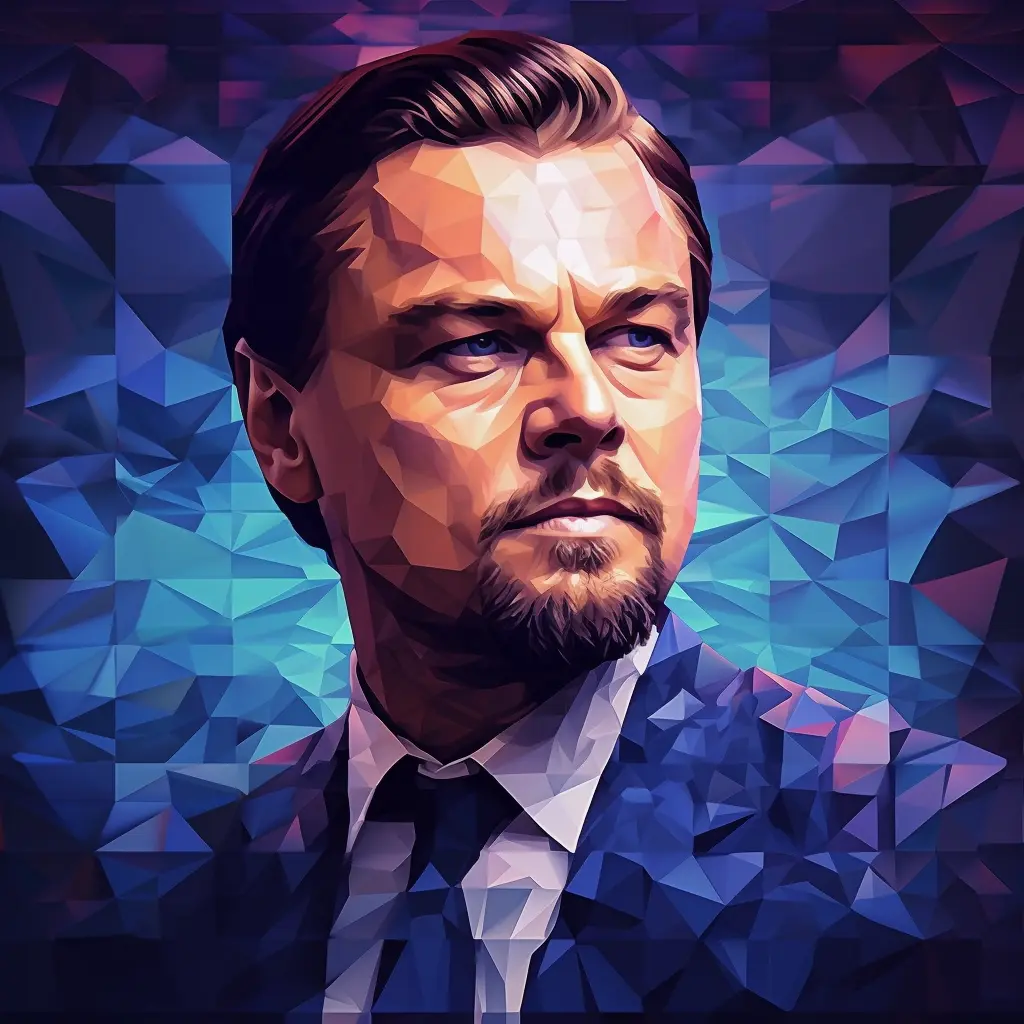
"I've always been wild... I can't say it any more simply than that. But acting is the only time when I truly maintain the spontaneity that I want to be present at all times."
Disclaimer: This analysis of Leonardo DiCaprio's Enneagram type is speculative, based on publicly available information, and may not reflect his actual personality type.
Leonardo DiCaprio's father hung a reproduction of Hieronymus Bosch's The Garden of Earthly Delights above his infant son's crib.
The triptych shows three panels: paradise, human excess, and a hellscape of ruin. DiCaprio stared at it every night before sleep. He couldn't have understood the imagery then. But decades later, when he opened his climate documentary Before the Flood sitting across from Pope Francis, he returned to that painting as the organizing metaphor for his entire worldview. Paradise. Indulgence. Collapse.
That painting above the crib tells you something essential about Leonardo DiCaprio — not because of what it means, but because of who put it there. His father, George, an underground comix distributor who collaborated with Robert Crumb and co-wrote Timothy Leary's Neurocomics. His mother, Irmelin, a German immigrant born in a World War II bomb shelter. They raised their only son in one of the roughest neighborhoods in Los Angeles, surrounded by prostitution and heroin, and somehow gave him both a terror of the world and an insatiable appetite for it.
That combination — the terror and the appetite — is the engine of everything Leonardo DiCaprio has ever done.
TL;DR: Why Leonardo DiCaprio is an Enneagram Type 7
- The restless escape artist: Turned down Batman, Spider-Man, and Star Wars — not for bigger paychecks, but because franchise work felt like a cage. Every career decision protects freedom of movement.
- Hunger born from confinement: Grew up in poverty on a drug-dealer corner, got robbed at five, survived childhood OCD. The relentless pursuit of experience is the flip side of a childhood spent feeling trapped.
- The seven who does the work: Ate raw bison liver, spent a week with disabled children at 18, crushed a glass and kept acting. His preparation is obsessive, his commitment absolute — as long as he chose the project.
- Nine lives, all spent voluntarily: Survived a shark in his diving cage, two parachute failures, and a plane engine explosion. His friends named him "the person they least want to do extreme adventures with." He keeps going.
The Corner of Hollywood and Western
DiCaprio was born November 11, 1974, in Los Angeles. His parents divorced when he was roughly a year old — but they did something unusual. They rented adjacent bungalows with a shared backyard in Echo Park so their son could move freely between both homes. Even when the marriage was over, the connective space remained.
His mother, who worked multiple jobs as a legal secretary, could only afford housing on one of the worst blocks in Hollywood.
"My mother and I lived at Hollywood and Western — a drug dealer and prostitute corner," he told Rolling Stone. "It was pretty terrifying. I got beat up a lot. I saw people having sex in the alleys."
He was five years old when a man in a trenchcoat, carrying needles and crack, cornered him on the street. He was robbed around the same age. For the first decade of his life, his playground was, in his words, "like a junkyard with crack addicts around the corner."
These are not the stories most movie stars tell. Celebrities from difficult backgrounds usually frame their childhood as something they overcame. DiCaprio frames his as something that shaped him.
"Seeing the devastation on my block, seeing heroin addicts, made me think twice about ever getting involved in drugs." The drugs were everywhere later — in the Hollywood party scene of his twenties, they were inescapable. He never touched them. The boy on the corner had already seen what they do.
But the poverty and the danger did something else, something less obvious. His parents — separated, bohemian, broke — insulated him emotionally even when they couldn't insulate him physically.
"My parents, who were split up, were so good at keeping my environment strong and keeping everything around me not focused on the fact that we were poor. They got me culture."
His mother drove him up to four hours round-trip every day to attend a better school on the other side of the city. She took him to museums. She made sure that even if they were broke, his world was bigger than the block.
That tension — brutal environment, protected inner life — is the template for everything that follows.
George DiCaprio's Son
George DiCaprio was a figure from another century. An Italian-American from Flushing, Queens, he became an underground comix writer, editor, and distributor, working with artists like Robert Crumb, Harvey Pekar, and Gilbert Shelton. His titles included Greaser Comics, Forbidden Knowledge, and Cocaine Comix. He co-wrote Timothy Leary's 1979 comic Neurocomics. Leary later presided over George's second wedding.
Leonardo has described his parents as "bohemians in every sense of the word."
"In my youth, I was exposed to the wildest hippie subculture, along with the comics Fabulous Freak Brothers, Zap and Weirdo," he told USA Weekend in 2010. George took him to poetry readings, comic fairs, and hippie parades where they'd cover themselves in mud. At about three years old, George put Leonardo on stage at a hippie concert, where the boy tap-danced for hundreds of people.
George's most lasting piece of advice: "Go out there, son, and whatever you do, I don't care if you're successful or not, just have an interesting life. Just be happy to put your pants on in the morning."
That advice imprinted. DiCaprio built his career around exactly that philosophy: choosing interesting over safe, turning down franchise blockbusters, seeking out the most demanding directors alive. George's fingerprints are everywhere.
Even the name. Irmelin was pregnant and visiting the Uffizi Gallery in Florence when she felt the baby kick for the first time while looking at a Leonardo da Vinci painting. George declared: "His name must be Leonardo."
Years later, when a thirteen-year-old Leonardo was struggling to find representation, an agent told him his name was "too ethnic" and would never get him hired. The agent created a stage name: "Lenny Williams." When George DiCaprio saw a headshot with "Lenny Williams" printed on it, he tore it up. "Over my dead body."
The name stayed Leonardo DiCaprio.
"The Noodle"
The performing instinct showed up before he could read. At two, Leonardo walked onstage at a performance festival and danced for the crowd unprompted. At five, he appeared on the children's show Romper Room and got removed from the set for running up to the camera, smacking it, doing flips.
He was also a serious breakdancer, earning the nickname "The Noodle" for his pop-locking. Placed second in a breakdancing competition in Germany at eleven. Nearly quit acting to go pro. Performed during lunchtime at his grade school. The kid couldn't hold still, and that restless energy never left him. It just found bigger stages.
What pivoted him toward acting was money. His stepbrother Adam Farrar landed a television commercial that earned $50,000. For a kid from Hollywood and Western, that was transformative. He asked his parents if he could try. He did about twenty commercials — Matchbox cars, Kraft Singles, Bubble Yum, Apple Jacks — and then started going on auditions for film and television work.
He went on roughly a hundred auditions before getting a break.
At twelve, riding in his mother's car, he spotted Tobey Maguire on the street — another kid actor he vaguely knew. "I literally jumped out of the car," he told Esquire. "I was like, 'Tobey! Tobey! Hey! Hey!' And he was like, 'Oh, yeah — I know you. You're... that guy.' But I just made him my pal. When I want someone to be my friend, I just make them my friend."
That friendship has lasted over thirty-five years. Years later, when DiCaprio was offered the role of Spider-Man, he turned it down and recommended Maguire instead.
A Hundred Little Attributes
At eighteen, DiCaprio got the role of Arnie Grape in What's Eating Gilbert Grape — a young man with an intellectual disability. He prepared by spending a week at a center for children with special needs, watching them for hours, taking notes on every gesture, speech pattern, and habit.
"I remember coming to him with this checklist," he said of his first meeting with director Lasse Hallström, "and it was like a hundred different little attributes that I learned from hanging out with these kids, and I said, 'Will you just show me what you want me to do?'"
Hallström didn't need to show him much. The performance earned DiCaprio his first Oscar nomination at nineteen and revealed the method he'd use for the next three decades: obsessive preparation, then total spontaneity. "It was incredibly freeing because... we paid attention to the script, but it was so loose. Everything was so incredibly loose and so improvisational, and I really just lived in my own world."
That pattern, meticulous research followed by absolute freedom on set, repeats in every major role.
For Django Unchained, he accidentally crushed a small stemmed glass with his palm during the dinner table scene. His hand was bleeding profusely. He stayed in character. "My hand started really pouring blood all over the table. I wanted to keep going. It was more interesting to watch Quentin's and Jamie's reaction off-camera than to look at my hand." Tarantino used the take. When he called cut, the room erupted in a standing ovation.
For The Revenant, he ate raw bison liver even though he was vegetarian. The props department had made a faux liver from jelly, but DiCaprio worried it didn't look real enough. "Kind of like a balloon," he described it, "it's got a membrane and then you bite into it and then something horrific bursts into your mouth." He nearly vomited. Director Alejandro González Iñárritu said: "Without it, he may not have gotten to the truth."
What drives this level of commitment? Not ambition in the conventional sense. DiCaprio doesn't take roles to prove himself superior. He takes roles that terrify him. He avoids scripts where he immediately knows how to play the character and gravitates toward the ones where he has no idea how to begin.
What is Leonardo DiCaprio's personality type?
Leonardo DiCaprio is an Enneagram Type 7
Enneagram Type 7, sometimes called "The Enthusiast," runs on a core fear of being trapped in pain, deprivation, or limitation. Sevens learned early, usually from a childhood experience of loss or confinement, that the world can take away what you love without warning. They responded by becoming insatiable: seeking variety, experience, freedom, and stimulation as a hedge against suffering. The underlying logic: if I keep moving, the pain can't catch me.
The evidence for DiCaprio as a Type 7 is structural, not anecdotal:
Turned down every franchise. Batman. Spider-Man. Star Wars. Each time, he said the same thing: "I didn't feel ready." He chose Gangs of New York with Scorsese over Spider-Man. The pattern isn't about quality — it's about freedom. Franchises lock you in. Multi-picture deals are cages.
The strategic disappearance. After Titanic made him the most famous person on Earth at twenty-two, he deliberately vanished. "The best way to have a long career is to get out of people's face." A Seven doesn't run from fame itself — they run from the constraint fame imposes on their options.
OCD as the Seven's shadow. DiCaprio was diagnosed with obsessive-compulsive disorder as a child. His compulsions included stepping on sidewalk cracks and walking through doorways multiple times. "Sometimes it took me 10 minutes to get to the set because I'd be pacing back and forth, stepping on gum stains." He'd walk twenty feet back to step on a piece of old chewing gum, then talk himself down: "OK, you're being ridiculous. Nothing bad is going to happen."
The OCD reveals the anxiety engine underneath the Seven's pursuit of experience. Under stress, Sevens move toward the rigid, critical patterns of Type 1. DiCaprio's compulsions, his obsessive role preparation, and his hatred of phoniness all carry that fingerprint. At nineteen, he told Interview Magazine: "Whenever I notice myself doing something just to please somebody else, I try to stop it."
A man who keeps almost dying. He told Wired: "If a cat has nine lives, I think I've used a few." A great white shark broke into his diving cage in South Africa, snapping "five or six times an arm's length away from my head." On a tandem skydive, both parachutes failed. "You're probably going to break your legs on the way down, because we're going too fast now." On a flight to Russia, an engine exploded into a fireball, and the pilots shut everything down: "You're just sitting there gliding with absolutely no sound." In the Galapagos, he ran out of oxygen chasing spotted eagle rays and had to be rescued by Edward Norton.
His friends have named him "the person they least want to do extreme adventures with." He keeps going. A Seven doesn't stop because the danger got real. He stops when the experience gets boring.
In growth, Sevens integrate toward Type 5, becoming more focused, observant, and capable of sustained depth. DiCaprio's arc from wild childhood breakdancer to an actor who spends months in preparation, who debates cinema with Scorsese for weeks before a single camera rolls, who has built a $100 million environmental infrastructure: this is a Seven who learned to channel the restless energy rather than scatter it.
"Oh, I Don't Read"
James Cameron agreed to meet with DiCaprio for Titanic. Before the actor even walked in, Cameron noticed "all the women in the entire office were in the meeting. They all wanted to meet Leo. It was hysterical."
Days later, DiCaprio showed up for the screen test and told Cameron: "Oh, I don't read."
Cameron shook his hand, thanked him for coming, and started to show him out. When DiCaprio realized the role was slipping away, he said: "Wait, wait, wait. You mean, if I don't read, I don't get the part just like that?"
Cameron told him the film was "like a giant movie that is going to take two years of my life" and he wasn't going to mess up the casting. DiCaprio would have to read or leave.
Then something shifted. Cameron:
"Every ounce of his entire being was just so negative — right up until I said, 'Action.' Then he turned into Jack. Kate lit up, and dark clouds had opened up with a ray of sun coming down and lighting up Jack. I'm like, 'All right. He's the guy.'"
Titanic made him the biggest movie star on the planet. "Leomania" rivaled Beatlemania; teenage girls screamed at him in the streets. He described it to Newsweek as "both life-changing and disheartening."
His response was strategic and immediate. He stopped making conventional movies. He chose characters who are con men, mentally ill billionaires, undercover cops, slave owners, corrupt stockbrokers, frontiersmen left for dead, and complicit murderers. Not once, in nearly thirty years since Titanic, has he played a romantic lead.
"My simple philosophy is only get out there and do something when you have something to say, or you have something to show for it. Otherwise, just disappear as much as you possibly can."
The Prince of the City
But before the disappearance came the explosion.
In the summer of 1998, journalist Nancy Jo Sales followed DiCaprio and his crew through New York's nightclub circuit for a New York Magazine cover story called "Leo, Prince of the City." The piece introduced the world to the group tabloids would call the "Pussy Posse" — DiCaprio, Tobey Maguire, David Blaine, Lukas Haas, Kevin Connolly, and a rotating cast of others. They dominated clubs like Jet 19, Shine, and Veruka. They set off stink bombs at Sky Bar. They threw garbage off the Brooklyn Promenade.
This was DiCaprio at twenty-three: the most famous person alive, running through New York like a kid who'd just discovered the city had no walls. Strip clubs, nightclubs, models. But the energy was recognizably Seven: more about volume of experience than any particular vice.
He didn't drink to excess. He never touched drugs. He just wanted to be everywhere, with everyone, doing everything — the opposite of the boy stuck on the corner of Hollywood and Western.
The era produced one genuine scandal. In 1996, director R.D. Robb had assembled several of DiCaprio's friends to shoot what was pitched as a short improvisational film. Robb eventually cut the footage into a feature called Don's Plum. The improvised dialogue was reportedly so raw that DiCaprio and Maguire sued to block its release. The case settled: the film was banned in the United States and Canada, where it remains unavailable.
By his early thirties, the Posse had quietly dissolved into adult life. Maguire married. Others had children. DiCaprio channeled the restless energy into environmental advocacy and increasingly serious film work. The transformation wasn't dramatic — it was more like a river finding its proper channel. The impulse to consume experience didn't change. The venue did.
The Scorsese Education
Robert De Niro made the introduction. After working with eighteen-year-old DiCaprio on This Boy's Life, he called Scorsese: "He's very good, you gotta do work with him someday." Scorsese noted that De Niro rarely made such recommendations.
Seven films and two decades later, the partnership defines both their careers.
"Leo has a similar sensibility to me," Scorsese has said. "I'm 30 years older than him, but I think we see the world the same way."
Their pre-production process reveals how a Seven operates at his best. DiCaprio described it as a "cinema education": they "debate for months" about films and screenplays, with Scorsese sharing reference films, discussing silent film acting techniques, building a shared vocabulary before cameras roll. The opposite of impulsive. A Seven who learned that depth is its own kind of freedom.
On The Wolf of Wall Street, something broke open. DiCaprio described it as "the most free and exciting and spontaneous and hilarious film production I've ever been a part of." Scorsese described a creative escalation: "He came up with wonderful stuff that was outrageous. I pushed him, he pushed me. Then I pushed him more, then he pushed me, and suddenly everything was wild." DiCaprio's verdict: "I've never seen Martin Scorsese that happy on a set in my life."
The audition for Margot Robbie's role in that film is one of Hollywood's great stories. When the scene called for her to kiss DiCaprio, she slapped him instead. Dead silence for what Robbie described as "an eternity, but was probably three seconds." Then DiCaprio and Scorsese burst out laughing. She got the part.
Then came Killers of the Flower Moon (2023). DiCaprio was originally cast as FBI agent Tom White, the hero investigator. He told Scorsese it wasn't working: "It just didn't feel like it got to the heart of it. We weren't immersed in the Osage story." He asked to play Ernest Burkhart instead — a dim, manipulable man complicit in the systematic murder of Osage people for their oil wealth. The entire script was overhauled.
Ernest Burkhart is DiCaprio's least glamorous, least sympathetic role. He wore prosthetic teeth, a false nose, and scleral lenses to make his eyes look bloodshot. He described the character as "incredibly unredeemable" and spoke of the challenge of playing a man who might have loved his Osage wife even as he participated in killing her family: "They still loved each other."
In every previous Scorsese collaboration, DiCaprio played magnetic men, even when they were monsters. Jordan Belfort was repulsive but electric. Calvin Candie was evil but charismatic. Ernest Burkhart is neither. He's a moral idiot. A man being used. For a Seven, a type that thrives on charisma and forward momentum, choosing to play a character defined by passivity and stupidity is a remarkable act of integration. The restless energy turned inward.
The Third Panel
The Bosch painting above the crib was not a coincidence. It was a blueprint.
In 2014, standing before the United Nations as a newly appointed Messenger of Peace, DiCaprio opened with a disarming admission: "I stand before you not as an expert but as a concerned citizen." Then he pivoted: "As an actor, I pretend for a living. I play fictitious characters, often solving fictitious problems. I believe that mankind has looked at climate change in that same way, as if it were fiction."
A pause. "All that I have seen and learned on this journey has absolutely terrified me."
Then the line that cut through the room: "I pretend for a living but you do not."
Two years later, he finally won the Oscar. Five acting nominations, twenty-two years, an internet's worth of memes about his losses. The moment arrived. He thanked Tom Hardy and Inarritu, then used the most-watched seconds of his career to say: "Climate change is real. It is happening right now. It's the most urgent threat facing our entire species and we need to work collectively together and stop procrastinating."
Researchers at San Diego State University later determined that this single speech resulted in the largest increase in public engagement with climate change ever measured — more impact than the Paris climate negotiations or Earth Day.
The environmental record is not a side project. He founded his foundation at twenty-four. It has distributed over $100 million in grants across 46 countries and 200 projects. He sits on the boards of WWF, the Natural Resources Defense Council, and Re:wild. The infrastructure is real.
So is the contradiction. Six roundtrip private jet flights in six weeks. A mega-yacht chartered from a UAE oil tycoon. Brazilian President Jair Bolsonaro delivered the most cutting public response: "I could tell you, again, to give up your yacht before lecturing the world, but I know progressives: you want to change the entire world but never yourselves."
DiCaprio's defense was half acknowledgment, half deflection: "I undoubtedly agreed that we have to practice what we preach."
The contradiction is not ignorance. It is compartmentalization, and compartmentalization is what Sevens do best. They hold two contradictory realities simultaneously because their operating system was built to avoid pain, not to resolve it. The boy who grew up staring at Bosch's vision of earthly ruin now lives inside the middle panel, the garden of human excess. He knows it. He keeps working to prevent the third.
Emotionally Thirty-Two
The same compartmentalization runs his personal life.
In his 2025 Esquire interview, Paul Thomas Anderson asked DiCaprio how old he feels.
"Thirty-two," he said immediately.
Anderson's response: "Your age is 50, but your emotional maturity is 32."
DiCaprio didn't push back.
Then there is the dating pattern, the most discussed fact about his private life. The data is public: Gisele Bundchen at 20, Bar Refaeli at 20, Toni Garrn at 20, Camila Morrone at 20. Nearly every relationship ended when the woman approached her mid-twenties. When Morrone turned 25 in June 2022 and the split followed weeks later, a Reddit infographic mapping his partners' ages against his own went viral. The pattern became a punchline, but the psychology behind it is worth examining.
DiCaprio has never publicly addressed it. He doesn't have to. Whatever psychological architecture produces the pattern, it maps cleanly onto the Type 7 fear of limitation. Each new relationship is a clean slate. Each ending prevents the thing Sevens fear most: being locked in.
His current partner, Italian model Vittoria Ceretti, is 27 — the oldest known partner he's dated. Whether this represents a shift or an exception remains to be seen.
But what's more revealing than the dating pattern is what DiCaprio said about his emotional range.
"I don't have emotions about a lot of things. I rarely get angry, I rarely cry. I guess I do get excited a lot, but I don't get sad and enormously happy." Then: "I think a lot of people who talk about all that crap are lying."
Consider what that means. One of the most expressive actors alive, a man who made millions weep in Titanic, who channeled Howard Hughes's psychological collapse with terrifying precision, who ate raw bison liver because the prop didn't feel true enough, says he doesn't really feel most emotions. He feels excitement. The rest is kept narrow.
That is the Seven's operating system in its purest form. Excitement is the acceptable channel. Joy, grief, rage, tenderness: those frequencies carry risk. Feel deeply, get hurt deeply. Better to stay in the register that keeps things moving.
And yet. He has maintained a friendship with Tobey Maguire for over thirty-five years. He has worked with Martin Scorsese across seven films and two decades. Kate Winslet has been a close friend for nearly thirty years: "He's my friend, my really close friend. We're bonded for life." He brings his mother to nearly every major ceremony. At the 2015 BAFTAs, he said: "I would not be standing up here if it wasn't for this person... I didn't grow up in a life of privilege. I grew up in a very rough neighborhood in East Los Angeles. This woman drove me three hours a day to a different school to show me a different opportunity."
The man who avoids romantic permanence is capable of profound, lifelong loyalty. Just not in the domain where the world watches closest.
Hidden in Plain Sight
Off-set, DiCaprio reads "anything and everything he can get his hands on," according to Scorsese. He collects Basquiats, Banksys, Picassos, and Dalis, alongside dinosaur fossils, vintage action figures, and rare comics. He rides a Citi Bike around New York. He surfs. Every Halloween, he arrives at parties around 2 AM wearing not a costume but a mask: sometimes a wolf, sometimes a monster, sometimes the face of a hundred-year-old man. He stays until dawn, hidden among people who know exactly who he is.
A journalist from The Guardian who spent time with him observed that DiCaprio is "polite, charming, makes jokes, engages eye contact" but "manages to give almost no hint whatsoever of his actual personality."
He has never married. Never had children. When asked about fatherhood, his answer was bleak: "Do you mean do I want to bring children into a world like this?"
He grew up on a corner where everybody showed you exactly who they were. He decided, very early, never to return the favor. And the painting his father hung above his crib, paradise, excess, ruin, still hangs somewhere in his memory. Every garden has a third panel.

What would you add?