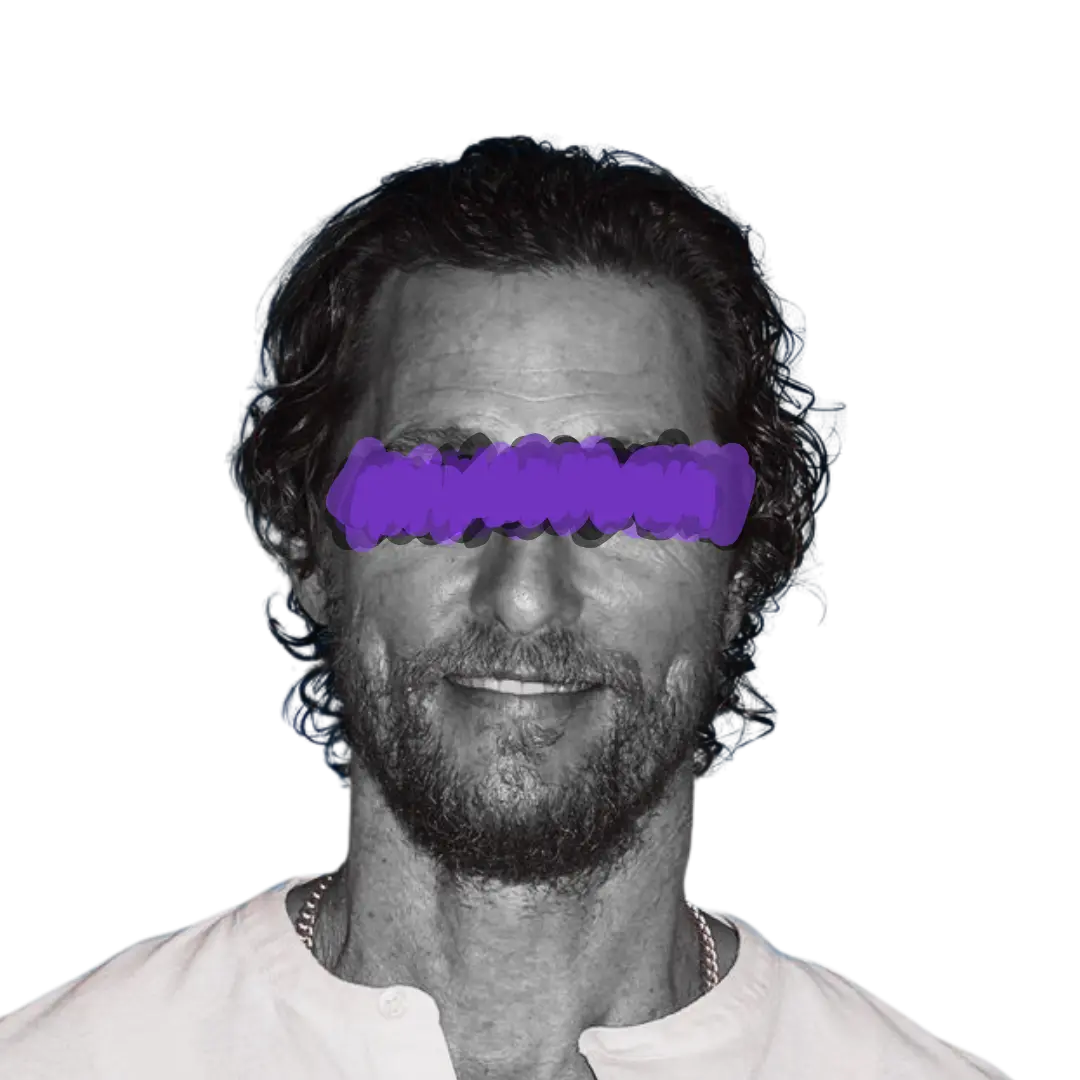
"It's always been obvious to me that I do not have a laissez-faire attitude. It's a state of being that I work at, continuously, daily, and I break a sweat to get it."
In 2011, Matthew McConaughey's agent called with an offer: $8 million for a romantic comedy. McConaughey said no. The offer rose to $10 million. No. $12 million. No. Then $14.5 million, nearly double what he'd been paid for previous rom-coms. He read the script again and laughed: "It's the same words that were in the $8 million offer I said no to, but it was better written." He turned it down.
For twenty months after that, his phone didn't ring. His agent would call with the same update: "Buddy, no one is even mentioning your name. I bring up your name, they say, 'Don't even want to talk about it.'" His brothers were furious: "Little brother, what is your major mal-fucking-function?" He considered quitting acting entirely: becoming a school teacher, a wildlife guide, or going back to law school.
This is not how Hollywood reinvention stories usually go. A-listers don't disappear for two years. They don't turn down eight figures to sit in silence. They don't genuinely consider becoming orchestra conductors.
But McConaughey didn't do what ambitious people do. He didn't hustle his way into dramatic roles or campaign for prestige projects. He just stopped. He withdrew from the game entirely and waited for the world to forget what it thought it knew about him. And that choice (the withdrawal, the patience, the willingness to vanish rather than fight) reveals more about who Matthew McConaughey actually is than any Oscar speech ever could.
TL;DR: Why Matthew McConaughey is an Enneagram Type 9
- The calm is earned, not natural: McConaughey admits he breaks a sweat daily to maintain his inner peace, a distinction that separates the genuine Peacemaker from someone who's simply laid-back.
- A decade of going along: His rom-com years reveal the Nine's signature pattern: merging with what the world expects until you can't hear your own voice anymore.
- Withdrawal over confrontation: When he finally woke up, he didn't fight Hollywood. He disappeared for twenty months. The Nine's instinctive response.
- Philosophical absorption of trauma: His response to childhood sexual abuse (no therapy, no activism, no victim identity) shows the Nine's capacity to metabolize pain without being defined by it.
- The walkabouts: His practice of solo retreats to places where nobody speaks his language is the Nine's deepest need: separating from others' expectations to rediscover his own voice.
What is Matthew McConaughey's Personality Type?
Matthew McConaughey is an Enneagram Type 9 (The Peacemaker)
The popular read on McConaughey is that he's a natural, effortlessly cool, inherently easygoing, a man born with his feet in the sand and a margarita in his hand. But that read is wrong, and he's said so himself.
His admission to The New York Times, the one that opens this piece, about working at his calm daily and breaking a sweat to get it, is the key to everything. The ease is real, but it's not free. It's a practice, as deliberate as his daily two hundred pushups or his nine-and-a-half hours of sleep.
A Type 3 performs with ease; they make achievement look effortless because the performance IS the achievement. A Type 7 is genuinely restless; they chase stimulation and reframe pain as adventure because standing still feels like dying. McConaughey is neither. He is a man whose deepest need is internal equilibrium, and who has built his entire life (the rituals, the walkabouts, the philosophy) around protecting it.
The counter-arguments are fair. His brand management looks Three-ish: he coined the term "unbranding," and he strategically withdrew from Hollywood to control his image arc. His adventure-seeking looks Seven-ish: solo trips to the Amazon, eighteen-day hikes through Mali, three years living in an Airstream trailer he named "Cosmo."
But here's the distinction. A Three who turns down $14.5 million negotiates a better deal. McConaughey disappeared for twenty months and considered becoming a wildlife guide. A Seven who's bored with rom-coms pivots immediately to the next exciting thing. McConaughey sat in the discomfort of nothing for almost two years, waiting. That patience, that willingness to sit in the void rather than fill it, is the Nine's signature move.
And the deepest tell: his relationship with conflict. He didn't confront his mother, Kay, during their eight-year estrangement; he simply went quiet. He didn't crusade after disclosing childhood sexual abuse; he absorbed it philosophically. He refused to take sides when the entire country wanted him to run for governor. This is not a type that craves achievement or stimulation. This is a man who finds division genuinely painful and whose default is to withdraw until the waters calm.
"I've never been a fan of taking on the world," he has said. "I'm more of a listener to the world."
Three Weddings, Two Divorces, One Family
Jim and Kay McConaughey married each other three times, having divorced twice. The math isn't wrong. They kept coming back.
Kay broke Jim's nose with a telephone in 1974 while he brandished a ketchup bottle. Jim broke Kay's middle finger four separate times, "to get it out of his face." This was the household where Matthew grew up: passionate, volatile, loud.
His mother, known as "MaMac," was a force. Her philosophy was built on tough-love one-liners: "If you're scared about not having shoes, let me introduce you to the person with no feet." She didn't carry stress because she forgave herself immediately. She tested people constantly. Years later, she would call Matthew's future wife Camila Alves by his ex-girlfriend's names just to see if Camila would fight back. Camila eventually told her: "I'm not asking your permission anymore." Kay looked at her and said, "Okay, now you're in." All she had wanted was proof that Camila would stand her ground.
Matthew was the youngest of three brothers in Longview, Texas. Voted "Most Handsome Student" at Longview High. Built a treehouse the summer they moved: twelve-hour days, stolen lumber, a secret project nobody asked him to do, and nobody knew about until it was finished. He described it later as learning "the importance of finding freedom by building your own structure."
His father, Jim, a former college football player drafted by the Green Bay Packers who never played in the NFL, ran an oil pipe supply business. Jim died of a heart attack in 1992, when Matthew was twenty-three.
"When my father moved on, it was obviously hard because I didn't even think he was killable, you know?" he told Interview Magazine. In Greenlights, he wrote: "I got a call from my mum: 'Your dad died.' My knees buckled. I couldn't believe it. He was my dad. Nobody or nothing could kill him."
He called it "the biggest moment of becoming a man." The safety net was gone.
A few days later, still processing the grief while shooting Dazed and Confused, three words landed in his mind that he'd carry for the rest of his life: just keep livin.
The Book That Found Him
Before his father died, before Hollywood, McConaughey was studying law at the University of Texas at Austin. He'd been going along with expectations (study law, become a lawyer, follow the path) until Og Mandino's The Greatest Salesman in the World arrived like an interruption.
"I got so engrossed in it that I was almost late for my exam," he later said. He called it "the book that I wouldn't be sitting here talking to you with the life I have if it didn't find me."
The book found him. He didn't seek it out. He was studying law because that's what you study. The book arrived and rerouted his life. He switched to film school.
His breakout came almost immediately, a small role in Richard Linklater's Dazed and Confused (1993). On his first night of shooting, he'd been listening to a live Doors recording where Jim Morrison repeated "alright" four times between tracks. Standing on the set, he thought, "What is Wooderson about? He's about four things: his car, getting high, rock n' roll, and picking up chicks." Three of those were already handled. The fourth was about to be.
"Alright, alright, alright."
The line was improvised. "I had no idea that line would precede me for the rest of my life."
A Decade of Pleasant Drifting
Through the late '90s and 2000s, McConaughey became Hollywood's go-to romantic comedy leading man. The Wedding Planner. How to Lose a Guy in 10 Days. Failure to Launch. Fool's Gold. Film after film, where he played variations of the same sun-kissed charmer.
He was successful. He was comfortable. And he was losing himself.
"My lifestyle, living on the beach, running with my shirt off, doing romantic comedies," that was how he described the years that had caused him to be typecast. But the typecast wasn't just professional. It was personal. He had merged with the world's expectation of him until the expectation and the man were indistinguishable.
"I was good at something I wasn't loving."
The gap between who he was at home and who he was on screen had grown so wide that the on-screen version was winning. His career, he later said, lacked the vitality he was experiencing in his personal life.
This is the Nine's trap in its purest form. The path of least resistance isn't always laziness; sometimes it's a $14.5 million paycheck doing exactly what everyone expects you to do. The comfort is genuine. The drift is painless. And that's what makes it dangerous.
$14.5 Million to Keep Sleeping
The story has been told so many times, it has a name: the McConaissance. But what's usually framed as a savvy career move was something stranger and more personal.
In Greenlights, McConaughey wrote: "For 20 months I did not give the public or the industry any more of what they had banked on me to give them. No more of what they expected and even assumed to know. For 20 months, I removed myself from the public eye."
He called it becoming "unbranded."
His wife Camila was the one who held the line. "If we're going to do this, we're not going to half-ass it," she told him. They cried together. They prayed together. But they held.
During the drought, McConaughey genuinely considered alternative careers. Teaching. Conducting. Wildlife photography. Law school again. "It was scary," he admitted. But two months after turning down $14.5 million, the phone rang with a different kind of call. Dramatic offers arrived: The Lincoln Lawyer. Then Mud. Magic Mike. Killer Joe. Each role pushed him further from the beach-body image.
Then came Dallas Buyers Club. He lost 47 pounds to play Ron Woodroof, a rodeo rider diagnosed with AIDS. Film critic David Denby wrote: "It's McConaughey's spiritual transformation that is most remarkable. His gaze is at once desperate and challenging."
The twenty-month silence wasn't peace — it was a Nine disintegrating toward Type 6. His agent's updates ("No one is even mentioning your name") weren't just career news. They were confirmation of a Nine's deepest dread: that the self he'd been protecting by going along might not exist without the system he'd been going along with. He described that period as "scary." He didn't sleep well. He wasn't meditating on the beach; he was genuinely unsure if he'd ever work again. The certainty that usually anchors him was gone. Nines under stress don't become aggressive; they become anxious, vigilant, their normally trusting worldview replaced by doubt. He ran through contingency plans (teaching, conducting, law school) not out of curiosity but out of fear. That's Six territory: catastrophizing quietly, finding the exits.
The integration toward Type 3 came differently. When the dramatic roles arrived, McConaughey didn't coast into them — he attacked. Losing 47 pounds for Dallas Buyers Club wasn't the Nine's typical approach to anything. It was deliberate, physical, extreme. He campaigned for the Oscar. He took control of his image with the precision of a brand strategist. These are not the moves of a man simply going with the flow; they're the moves of a Nine who has remembered how to want something badly enough to work for it specifically. The McConaissance wasn't accidental reinvention. It was what happens when a Nine finally stops merging with the world's expectations and starts pursuing his own.
He won the Oscar. In his acceptance speech, he shared a philosophy he'd been refining since he was fifteen:
"When someone once asked me: who's your hero? I realized: It's me in 10 years. I turned 25. That same person asked: 'So are you a hero?' 'Not even close,' I said. 'Because my hero's me at 35.' My hero is always 10 years away. I'm never gonna be my hero. I'm not gonna attain that. I know I'm not, and that's just fine with me because that keeps me with somebody to keep on chasing."
That's not an achiever's hunger. It's not an adventurer's restlessness. It's a man who has made peace with forward movement without arrival, a chase he knows will never end, and that's exactly the point.
21 Days Where Nobody Speaks His Language
After A Time to Kill made him famous overnight in 1996, McConaughey didn't do press tours or party circuits. He flew to Peru and spent weeks on the Amazon.
He'd been having a recurring dream: standing on the Amazon River, but the banks were lined with African tribesmen. The geography was impossible. So he went to resolve it.
Years later, after learning his favorite musician, Ali Farka Toure, was from Niafunke, Mali, McConaughey flew into Bamako, hitchhiked to a trading post, took a boat upriver, and found Ali four days later. Then he went further north and hiked through the Bandiagara Escarpment for eighteen days. Five and a half years later, he returned to Mali unannounced, showed up at his guide's door, and did the same trip again for twenty-two days.
"We all need a walkabout," he has said. "We need to put ourselves in places of decreased sensory input so we can hear the background signals of our psychological processes."
He spent three years of his life traveling the country in an Airstream trailer he named "Cosmo." He gets nine-and-a-half hours of sleep every night. He drops and does twenty pushups at intervals throughout the day, ten times, two hundred total. He hasn't eaten a main meal after 6:30 PM in years. He drinks kombucha every morning. He's journaled since he was fifteen, thirty-five years of notebooks that became the raw material for Greenlights.
And then there are the bongo drums.
In October 1999, police found McConaughey playing congas naked at 2:45 AM after neighbors complained about the noise. "'Ohhh no!' I'm not putting shit on!" he told the officers. "My naked ass is proof I was mindin' my own business." He paid a $50 fine and pleaded guilty to disturbing the peace.
He's never apologized. When asked in 2013 if he still plays naked, he said: "Of course I still play the congas naked." In 2025, he revealed that it had happened forty-five more times since the arrest. His only takeaway: "Shut the window that has the beautiful scent of jasmine blowing in because it's two in the morning and you might wake a neighbor."
The walkabouts and the bongos are two versions of the same impulse, a man periodically stripping away everything (expectations, clothing, language, identity) to find out who's underneath.
"I've Never Felt Like a Victim"
In Greenlights, McConaughey disclosed two experiences he'd carried privately for decades. "I was blackmailed into having sex for the first time when I was fifteen." At eighteen, he was knocked unconscious and molested by a man in the back of a van.
He chose not to share details. "I thought the details would be exploited in the press as a dramatized event for fans to look up."
What he did share was his framework for processing it: "When they happened to me, it was very clear to me that they were wrong, that they were not ideal, that they were not how it's supposed to be. So I think having that clarity means that it's probably why it didn't stick with me and confuse me later on."
He never sought therapy for these experiences. Instead, he relied on "very good friends, good mentors, elder men, elder women, married couples." He has said, "I've never felt like a victim. I have a lot of proof that the world is conspiring to make me happy."
There is no rage in this response. No activism. No crusade. He doesn't use the experiences for sympathy or as an origin story for his resilience. He acknowledges them, classifies them as aberrations rather than defining wounds, and moves on.
This is how Nines metabolize trauma. They don't deny it happened. They absorb it into a larger framework where pain is real but not sovereign, where red lights turn green in the rearview mirror. The risk is minimized. The gift is that the wound doesn't metastasize into identity. McConaughey's response isn't suppression. It's something closer to radical acceptance, the conviction that the self can remain whole even after it's been violated.
Whether that's wisdom or a defense mechanism, it's not a paradox he needs to resolve. He's already moved on.
Vague on Purpose
When McConaughey flirted with running for Texas governor, the political world couldn't place him. He criticized the state's abortion law without condemning it outright. He met with President Biden on gun reform after the Uvalde shooting, in his hometown, the town where he was born, and delivered an emotional speech at the White House podium, holding up the green Converse shoes of a ten-year-old victim who could only be identified by her footwear. He called for raising the minimum age for assault rifle purchases. He refused to endorse candidates.
His explanation: taking sides "precedes the discussion of something larger and much more important." He admitted being vague "on purpose."
"Gets along. Is agreeable."
"Has ideas he stands for. And when they're tested, a good man is not a nice guy."
Nines don't experience anger the way other types do — it doesn't come out as heat, it comes out as withdrawal, or as eruption when the pressure finally exceeds the capacity to smooth things over. McConaughey's pattern fits. He didn't confront his mother Kay during the eight-year estrangement; he went quiet and stayed quiet. For nearly a decade, he processed whatever drove that split without naming it publicly, without making it a story about grievance, without letting Kay know it had cost him anything. That's not forgiveness — that's suppression so complete it looks like serenity. And the Uvalde podium speech was the other version: a gut-center type finally letting the anger through, not as rage but as grief weaponized into demand. He held up a ten-year-old girl's green Converse sneakers and told the room and the cameras and the senators that a child could only be identified by her shoes. He didn't yell. He didn't cry in the way the moment might have permitted. He was controlled and precise and visibly furious in the way Nines are when the peace they've been protecting at enormous cost turns out to have been someone else's peace all along.
He ultimately decided not to run. The political arena, built on division and polarization, may simply be incompatible with a man whose instinct is to listen to the world, not take it on.
But standing at the White House podium with a dead child's shoes in his hands — that wasn't vague. That wasn't nice. That was a good man.
Today, McConaughey lives in Austin with Camila and their three children. He teaches "Script to Screen" at UT Austin, where he has a perfect 5.0 on Rate My Professors and a student who described his classroom style as "he just drops those wisdom bombs all the time. That's just how he talks normally." He returned to film in 2025 with The Lost Bus, playing a school bus driver who saves children during a California wildfire, his first live-action role in six years, another emergence from another long silence.
His friend Woody Harrelson, who may literally be his half-brother, once described the boundary between them: "Where I start and where he ends, and where he starts and I end, has always been like a murky line."
That murky line is the Nine's native habitat. The place where self and other blur. The place where peace lives, but identity gets lost. McConaughey has spent his whole life learning to draw that line a little sharper, not to build walls, but to know where the world ends and he begins.
He's been chasing his hero for thirty years now. The gap never closes. It's not supposed to. Because for a man who spent a decade saying "alright" to everything, the most radical act wasn't learning to say no. It was learning to say I want — and then sitting with the terrifying silence that followed.
Disclaimer This analysis of Matthew McConaughey's Enneagram type is speculative, based on publicly available information, and may not reflect the actual personality type of Matthew McConaughey.
What would you add?