"Middle school, I would cry myself to sleep every f**kin' day. High school, the same thing. I tried to drink some beers to get rid of that sh*t, but it just never goes away."
When Austin Post was nine years old, his father took a job managing concessions for the Dallas Cowboys. The family moved from Syracuse to Grapevine, Texas, and the kid started sleeping on a cot at Texas Stadium while his dad worked late into the night. Just a boy on a fold-out bed in an empty stadium, waiting for someone to finish.
Twenty years later, Post Malone headlined the halftime show at AT&T Stadium — the building that replaced the one where he used to sleep. His father was in the stands. Jerry Jones, the Cowboys' owner, remembered the cot: "He used to come over every night and sleep in Texas Stadium. Probably four or five years. Had a cot for him, and he slept."
It's a perfect full-circle story. Except the circle isn't really about success. Both moments are about the same thing: Austin Post following someone else's momentum, fitting himself into whatever space was available, and hoping that if he stayed quiet enough, things would work out.
That pattern — disappearing into other people's worlds rather than building his own — is the key to understanding everything about Post Malone. The genre-hopping. The face tattoos. The years of drinking himself unconscious. The fact that one of the biggest artists alive still seems genuinely confused about why anyone would want to talk to him.
TL;DR: Why Post Malone is an Enneagram Type 9
- The Disappearing Act: A lifelong pattern of merging with others' expectations rather than asserting his own identity — from sleeping on his dad's cot to blending into every genre that would have him.
- Armor Over Absence: The face tattoos aren't bravado. He says they cover a face he can't stand to look at. The "chill guy" image covers something darker.
- The Anger Nobody Sees: His public persona is all warmth. But his own admission of a "quick temper," jealousy, and the rare explosive moments tell a different story.
- Fatherhood as Awakening: His daughter gave him what he'd never had — a reason to stop disappearing and actually be present.
What is Post Malone's personality type?
Post Malone is an Enneagram Type 9
Enneagram Type 9s are called The Peacemakers, but the name is misleading. The peace they keep isn't the heroic kind. It's the survival kind. Nines learn early that the safest way to exist is to not take up too much space. They merge. They accommodate. They become whatever the room needs them to be. And over time, they can lose track of who they actually are underneath all that accommodation.
The core fear is separation — being cut off, fragmented, pushed out. The core desire is inner peace and wholeness. But the tragic irony is that the strategy Nines use to avoid separation (erasing themselves to keep the peace) is the very thing that separates them from themselves.
Most people see Post Malone and think: laid-back guy, genre-fluid, good vibes. But what looks like chill is something else entirely. And the evidence is everywhere — if you know where to look.
The Cot at Texas Stadium
Austin's parents, Rich Post and Nicole Frazier, separated when he was young. He lived with his mother in Syracuse before moving to Texas with his father and stepmother Jodie. His biological mother later relocated to Texas to stay close — a detail Post has never publicly elaborated on. The silence itself is telling. Nines don't process family fractures by talking about them. They smooth over the crack and keep moving. The message was already forming: don't be the problem.
Rich Post was a wedding DJ before he became a stadium concessions manager. The house was full of music — AC/DC, Mötley Crüe, Guns N' Roses, country, funk, hip-hop. Austin absorbed all of it. Not one genre. Everything. No flag planted. No allegiance declared.
Then Guitar Hero happened. Austin five-starred everything on Expert mode, got obsessed, and taught himself real guitar through YouTube tutorials. By eighth grade, he was performing a metalcore cover of Rihanna's "Umbrella" at a school talent show — a genre collision that would become his entire career in miniature.
He auditioned for the Texas metalcore band Crown the Empire. His guitar strings broke during the tryout. He didn't get the spot.
He formed a hardcore band in high school. It went nowhere. He worked the fryer at Chicken Express. His classmates voted him "Most Likely to Become Famous" and "Best Dressed." He described himself as "a genuine class clown."
But that's the surface version.
On the Theo Von podcast in 2024, Post called himself a "loner" before fame. On Call Her Daddy, he revealed he was bullied after the move to Texas — picked on for wearing skinny jeans, for being different. And on Howard Stern, he put it plainly: "I felt like I didn't have the natural tact or ability or intuition to socialize."
Class clown. Loner. Most Likely to Become Famous. The kid who couldn't figure out how to talk to people but could make an entire auditorium laugh.
The contradiction was already there.
"White Iverson" and the Art of Not Trying
In 2014, Post moved to LA with a friend, crashed on couches, and found a beat by producer FKi 1st on YouTube. He'd just gotten braids. He felt like "White Iverson." Several people around him advised against releasing the song.
He put it on SoundCloud anyway. A million plays in a month. Praise from Wiz Khalifa and Mac Miller. A record deal followed.
What's remarkable about the "White Iverson" story isn't the virality — it's the passivity. Post didn't strategize. He didn't network. He didn't pick a lane. He found a beat, followed the vibe, and let the current carry him. When people told him not to release it, he didn't fight. He just... released it anyway.
This is how Nines build careers. Not through assertion but through momentum. The expected path felt dead ("I wasn't feeling the vibe" is how he described dropping out of community college), so he followed the next open door. And the next one. And the next one.
The doors kept opening. The kid who couldn't socialize became a streaming-era juggernaut in conversation with Drake and Taylor Swift. But the success didn't change the internal math. If anything, it made it worse.
The Face He Couldn't Look At
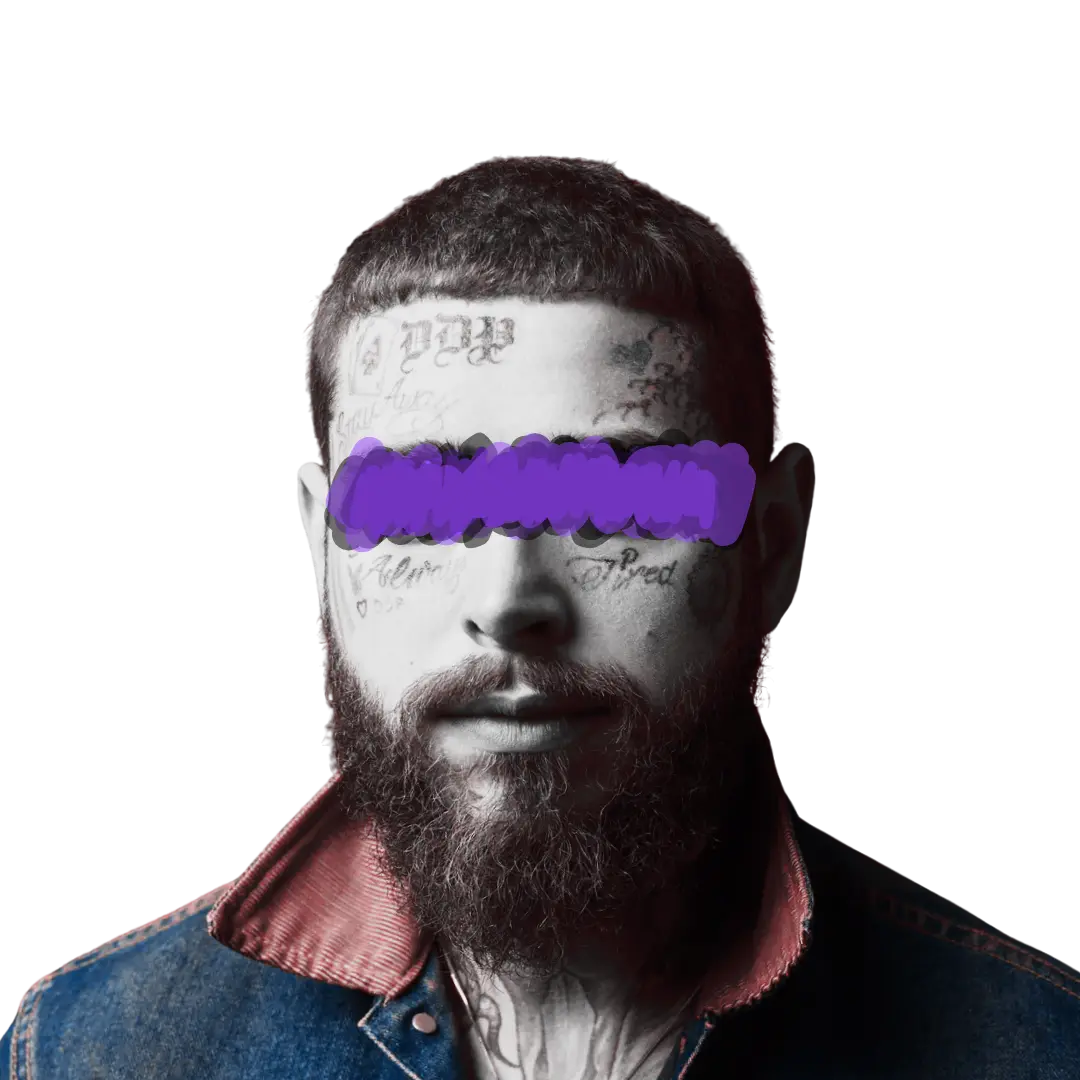
"I'm a ugly-ass motherf**ker," he told GQ. "My face tattoos maybe come from a place of insecurity, to where I don't like how I look, so I'm going to put something cool on there so I can look at myself and say, 'You look cool, kid,' and have a modicum of self-confidence."
There it is. Not swagger. Not rebellion. Cover.
A heavily tattooed rock star whose face is one of the most recognizable in music — bold, distinctive, impossible to miss.
"I'm a ugly-ass motherf**ker." The tattoos are there because he can't stand to look at his own face without them.
The tattoos are paradoxical in a way that's specific to how Nines operate. They make him stand out while functioning as a place to hide. They give him a self to present to the world — one he designed — so he never has to present the one underneath. When asked about them at London's Wireless Festival in 2018, he joked: "Anything to piss my mom off." Deflection. Humor. Anything to avoid sitting with the real answer.
His father's reaction was gentler, more revealing: "If you look at Austin, he's not the normal representation of a lot of things. But he is who he is. He is genuine, and that's what makes him happy."
But was he happy? At the time of that GQ interview, Post was describing years of crying himself to sleep, heavy drinking, and a mental state he called "f**king crazy" that had "exacerbated over the past years." When asked if he was getting help: "I am, now — I'm trying. It's difficult. Through my songs, I can talk about whatever I want. But sitting here, face-to-face, it's difficult."
Through his songs. Not face-to-face. The armor works in one direction.
The "Culture Vulture" and Where the Anger Lives
Type 9 sits in the body triad of the Enneagram — the anger center. This surprises people who know Nines, because Nines seem like the least angry people alive. That's because the anger doesn't disappear. It goes underground. It becomes numbness, passive-aggressiveness, sudden eruptions that shock everyone including the Nine, and a quiet, grinding resentment that the Nine might not even recognize as anger.
Post Malone's anger is hard to find. That's the point.
In 2017, during what he described as a "beer-tasting interview" in Poland, Post said: "If you're looking for lyrics, if you're looking to cry, if you're looking to think about life, don't listen to hip-hop."
The internet erupted. Complex ran "Here's Why Post Malone Is a Problem." The culture vulture accusations that had been simmering since "White Iverson" went nuclear.
Most artists would issue a polished apology or double down with confidence. Post's response on Twitter was neither. It was raw: "It's crazy that after all this time I'm still being questioned" and "suck my f**king d*ck I don't have to explain sh*t."
Then it disappeared. He posted a conciliatory video. He smoothed things over. He went back to being the chillest guy in the room.
Years later, on CBS News in 2024, the wound was still there: "It sucked. I was a kid." Did he take it personally? "Absolutely. It's hard not to." But then: "It's not for people who hate you. It's for the people who love you, and for yourself."
The anger surfaced again at Voodoo Fest in 2017, when he introduced a song by saying: "This is dedicated to the stupid bitch who broke my heart." On Call Her Daddy, he admitted his toxic traits: "drinking and sometimes jealousy" and "a quick temper" he attributed to insecurities.
I'm not angry. I'm fine. I'm chill. I just need another beer and I'll be fine.
This is the Nine pattern at its most dangerous: the anger doesn't get processed. It gets numbed. It gets swallowed. And then it erupts sideways — in a Twitter rant at 2 a.m., in a dedication to an ex from a stage, in months of not being able to get off the floor.
The Floor
"Just loneliness."
That was his answer when CBS News asked what was troubling him around 2020. When pressed: "Everything. It was terrible."
He described the daily cycle: "Gettin' up, havin' a good cry, drinkin', and then goin' living your life... And whenever you go lay down, drinking some more and having a good cry, and just like, I got to wake up tomorrow and do this again."
On Theo Von's podcast: "I wondered for a long time why I was so sad and it was because I wasn't able to do what I like to do in my current circumstance."
That line is more psychologically significant than it sounds. He isn't saying he was sad because of fame or pressure or criticism. He's saying he was sad because he'd lost access to himself — to what he actually wanted, to what actually made him feel alive. He'd merged so completely with everyone else's expectations that the person inside had gone quiet.
His label didn't just worry about his mood — they wanted to reshape his art. Republic Records allegedly delayed his fourth album, Twelve Carat Toothache, pressuring him to add more tracks to boost streaming numbers. The 45-minute project was too short, too dark, too honest. Post's manager Dre London went public on Instagram: "Album has been done!! We Ready!! But seems @republicrecords isn't." London fought the battle. Post stayed quiet — until a Billboard cover story where something shifted:
"Trying to shove 20 to 25 songs, it doesn't work. I've made a lot of compromises, especially musically, but now I don't feel like I want to anymore. I don't need a No. 1; that doesn't matter to me no more."
It was a rare moment of a Nine drawing a line. The system wanted him to merge with its expectations — write happier songs, pad the tracklist, be the product — and for once, he refused. On the album's standout track "Euthanasia," you can hear exactly what the label was afraid of: "Behold, a sober moment / Too short, and far between / I should crack one open / To celebrate bein' clean." That's not a radio single. That's a man looking at his own numbness and naming it.
The floor is where Nines go when the numbness stops working. When the drinking stops numbing. When the chill persona can't hold. Type 9s under extreme stress move toward the negative qualities of Type 6 — they become anxious, reactive, paralyzed by worst-case scenarios. Post's plane incident in 2018 captured this: "I'm terrified of flying in the first place... just the f**king anxiety of like, 'This is f**ked.' That was the worst part."
He wasn't performing fear. He was drowning in it.
The Genre Diplomat (Or: How to Be Everyone and No One)
Post Malone's discography reads like a type experiment in merging. He can make a rap hit with 21 Savage, then jump to rock with Ozzy Osbourne, then deliver pop with Swae Lee, then record a country album with Nashville's songwriting elite.
Each time, he doesn't conquer the genre. He absorbs it. He becomes it. And each time, the result sounds effortless — which is exactly why people get suspicious.
Ozzy Osbourne's first reaction when his daughter Kelly suggested the collaboration: "Who the f*ck is Post Malone?" After working together: "He was cool, and it felt good to be doing something again."
Post's response to meeting Ozzy: "I was nervous meeting him. Not as much performing, but meeting him is terrifying because what the f**k do you say to Ozzy Osbourne, 'I like your pants?'"
ERNEST, a Nashville songwriter who worked on F-1 Trillion, described it this way: "The way Post did it is the way I would hope any artist coming to make a country record would do it. Where it's like, come baptize yourself in the culture of Nashville and get to know the heartbeat of Nashville, the songwriters, the producers and make friends with the artists."
Come. Baptize yourself. Get to know. Make friends. Not: arrive with a vision, impose your style, stake your claim. The language is all absorption. All merging.
Post's own description of his creative process: "We just have fun. We just sit and f**king talk and make songs."
The genre-hopping isn't strategy. It's personality. Post Malone didn't become famous by asserting himself. He became famous by being so good at absorption that the seams never showed.
"You Changed My Life"
The "nicest guy in the industry" reputation isn't PR. The evidence is relentless. He spent hours after concerts meeting every fan who waited. He surprised a group at an Arizona dive bar, chatting like old friends and leaving a big tip. He stopped to talk with an autistic boy celebrating his 21st birthday. During the F-1 Trillion tour, he pulled a 5-year-old girl battling brain cancer onstage after spotting her Make-A-Wish T-shirt.
His producer Louis Bell: "As far as Post Malone goes, it's much deeper than music."
His sound engineer Nick Mac: "He is so involved in things, and he really cares about things to the highest degree."
During their Big Ass Stadium Tour in 2025, Jelly Roll stopped the show to address Post directly: "You've changed my life. Our friendship means more to me than you'll ever know." Then: "I see a mother, a father, a daughter... somebody in your family every night backstage. You're a great human." Then: "Everybody who works for you loves you, Post. There is a backstage crew of people who love you."
The crowd chanted "We love you, Postie." The two shared a hug.
This is what a healthy Nine looks like. Not the absence of self — the fullness of it. When Nines finally show up, the warmth they've been radiating at half-power becomes the most powerful thing in the room. People don't just like Post Malone. They love him in a way that's specific and personal, as if his presence makes them feel permission to be themselves.
The Daughter on the Floor
In June 2022, Post casually announced his daughter's birth on Howard Stern: "I woke up at 2:30 in the afternoon, I went and I kissed my baby girl and then I went to play some video games."
Even the announcement was Nine-coded — buried inside a list of routine activities, as if the most important event of his life was just another thing that happened.
But the change was seismic.
When CBS News told him his daughter saved his life: "That's true. Her and her mom."
On the rough period before: "Four years ago, I was on a rough path." And: "I needed to go through that for myself, to figure out who I am."
To figure out who I am. After a decade of accommodation — every genre, every collaborator, every crowd, every bottle — the fundamental question was never about music or fame. It was about whether there was still a person underneath.
His biggest fear, on Call Her Daddy: "Not being able to be there for my baby."
The woman who made fatherhood possible was Hee Sung "Jamie" Park. They'd gotten engaged in 2021 — though Post's first attempt was rejected because he was drunk. "She said no," he told Howard Stern. She told him to ask again the next day, sober. He did. She said yes. Even the proposal was a Nine story: he couldn't show up clearly the first time, had to be nudged back into the moment. They split in late 2024, navigated a custody dispute across two states, and settled it privately. He's never said a public word against her. His daughter's initials are tattooed on his forehead.
He lost 55 pounds — from 240 to 185 — primarily by cutting out soda. No trainer. No fad diet. Just a man who wanted to keep up with his daughter. A doctor had warned him about his liver. But the alcohol story is more complicated than a clean break. Post hasn't declared sobriety. On Call Her Daddy, asked if he's working on his drinking: "I am working on it." The honest version: "I used to drink because I was sad. Now I drink for shows and because I'm happy. I get so shy and timid. So I just drink a little bit to cope with that and get my liquid courage." The numbing agent changed forms — from drowning sadness to managing stage fright — but it didn't fully disappear. He calls it a work in progress. For a man who spent years unable to name what was wrong, naming it as a problem he's actively working on is itself a shift.
He opened a six-bar, three-stage venue called Posty's on Nashville's Broadway. At the grand opening, he personally covered the food and drinks for 30,000 fans. He forges swords as a hobby. He spent $2 million on a single Magic: The Gathering card.
The hobbies aren't random. They're the first evidence of genuine desire — not merged desire, not borrowed taste, but things Austin Post wants for no reason other than that he wants them. A man who spent decades not knowing what he wanted is starting to want things.
The Halftime Show
In November 2025, Post Malone performed the Cowboys' Thanksgiving halftime show. His father was in the crowd. Jerry Jones was watching from the owner's suite — the same Jerry Jones who remembered the kid sleeping on a cot in the old stadium.
Rich Post, reflecting on his son's rise: "I still see that kid that would dress up in his Ninja costume for Halloween. Or the goofy kid that was performing at the family talent shows."
A month later, Post fronted a Nirvana reunion at SNL's 50th anniversary — the band's first major televised performance with a male singer since Kurt Cobain died. He has a tattoo of Cobain on his hand. He'd been preparing for this moment for years without knowing it: in 2020, during COVID, he performed a full 15-song Nirvana cover set on livestream, wearing a flower dress to honor Kurt, raising over $500,000 for coronavirus relief. Before that stream, he went to Cobain's daughter Frances Bean for permission. "It's important to me because I loved Kurt so much," he told Howard Stern. "I could never want to offend anybody by trying to show support."
That instinct — to merge with someone else's legacy while being terrified of overstepping — is Nine to the core. But the SNL performance was different. When Dave Grohl gave him a hug after they tore through "Smells Like Teen Spirit" at Radio City Music Hall, Post wasn't borrowing someone's sound anymore. He was standing in it. He is the most-nominated artist in Grammy history without a solo win. He has two albums planned for 2026, a 25-stadium tour with Jelly Roll, and a Nashville venue bearing his name.
He told CBS News recently: "I don't feel like that anymore. And it's the most amazing thing."
That being the floor. The daily cycle of crying, drinking, and forcing himself to wake up and do it again. He doesn't feel like that anymore. But he remembers it. You can hear it in the way he talks about his daughter, the way he describes happiness with the slight bewilderment of someone who didn't think it was available to him.
The same man who tattooed his face because he couldn't stand to look at it became one of the most recognizable faces in music. The face tattoos aren't going anywhere. The question now is whether the man behind them is finally, after thirty years of disappearing, learning to stay.
Disclaimer: This analysis of Post Malone's Enneagram type is speculative, based on publicly available information, and may not reflect the actual personality type of Post Malone.
What would you add?