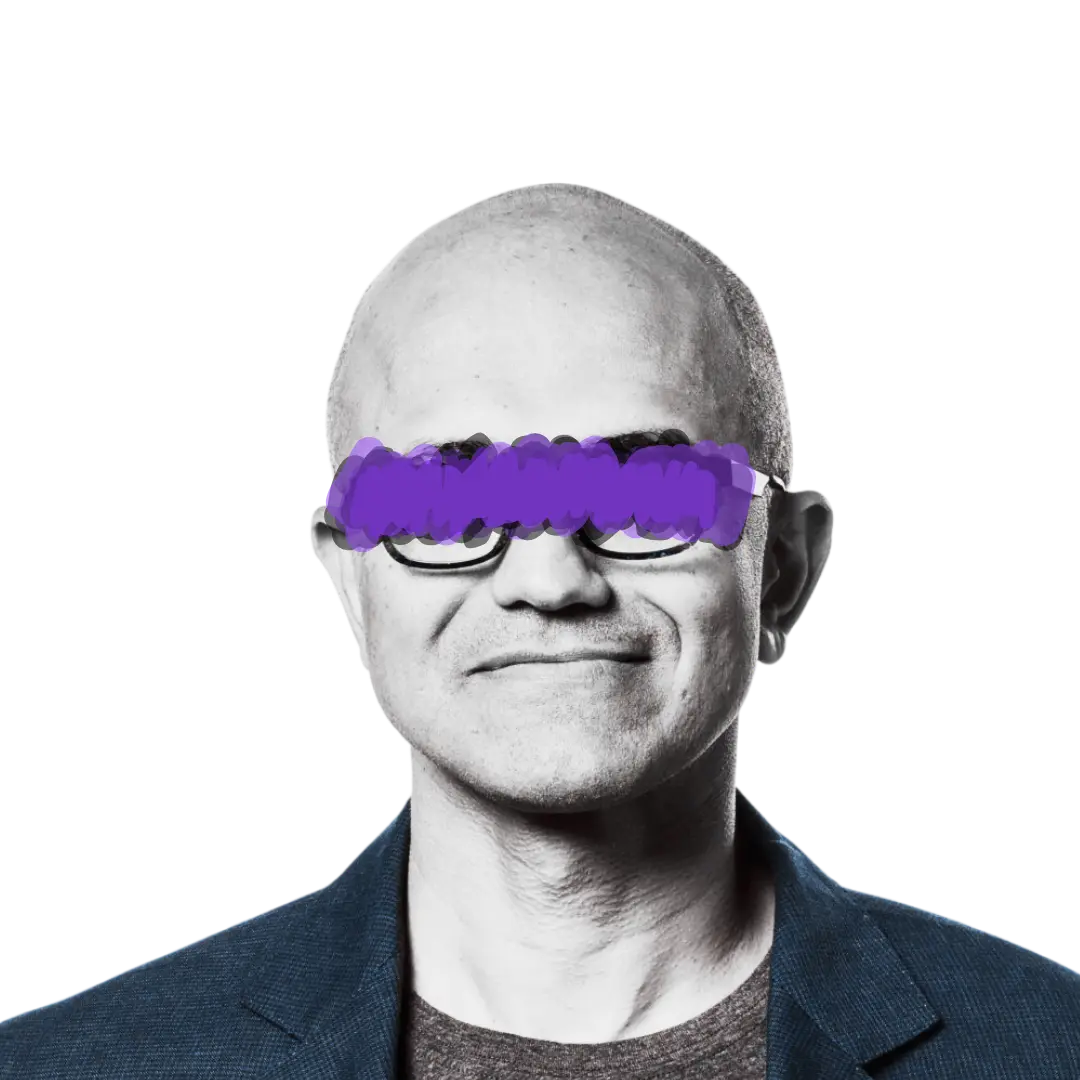
"I learned that only through living life's ups and downs can you develop empathy; that in order not to suffer so much, one must become comfortable with impermanence."
In June 1994, Satya Nadella walked into a US embassy in Delhi and told a clerk he wanted to give back his green card. The clerk was confused. People don't return green cards. A green card is permanent residency, a path to citizenship, the thing thousands of immigrants spend years waiting for. Nadella had one, and he was handing it back.
The reason was simple: his wife Anu's visa had been rejected because of processing backlogs for spouses of green card holders. If he downgraded himself to an H-1B temporary work visa, she could join him in Seattle on an H-4 dependent visa. He chose a less secure immigration status so the woman he loved wouldn't have to stay behind.
Back in Redmond, people talked. "Hey, there goes the guy who gave up his Green card."
It was, by any rational calculation, a bad trade. He gave up security for uncertainty, stability for risk, the individual advantage for someone else's need. And that pattern — the man who retreats into systems and strategy but keeps getting pulled toward other people's pain — would define everything that followed. The company revival. The culture that nearly died. The son who couldn't speak. The poetry he reads alone at night.
Satya Nadella is the quietest consequential CEO of his generation. He doesn't pound tables. He doesn't tweet manifestos. He turned the most culturally adrift tech company in Silicon Valley into the most valuable, and he did it by asking a question no one at Microsoft had asked in years: "What would be lost if we disappeared?"
The answer required something Nadella had spent most of his life avoiding. Not strategy. Not intelligence. Feeling.
TL;DR: Why Satya Nadella is an Enneagram Type 5
- The Observer Who Had to Feel: Nadella's natural mode is absorbing, studying, and systematizing — from cricket strategy to computer science to Buddhist philosophy
- Empathy as Learned Skill: His son's disability forced the most important lesson of his life: empathy can't be intellectualized, it has to be lived
- The Quiet Transformation: He took over a company warring with itself and healed it by doing something no previous Microsoft CEO had tried — listening
- Mind vs. Heart: A man wired to retreat into ideas who keeps choosing to step toward people
The Household of Opposites
Satya Nadella was born in 1967 in Hyderabad, India, into a family that couldn't agree on anything — which may have been the best possible training for a future CEO.
His father, Bukkapuram Nadella Yugandhar, was an Indian Administrative Service officer, an economist, and a committed Marxist. His mother, Prabhavati, was a Sanskrit lecturer who filled the house with ancient Indian literature and philosophy. One parent dealt in policy and systems. The other in language and meaning.
Nadella has said his parents "were exact opposites of each other in some sense. They could not agree on anything, except giving me lots of room and a lot of confidence to become my own person, pursue my own passions."
A Marxist father and a Sanskrit scholar mother. One analyzed power structures. The other excavated stories. The boy who grew up between them learned to do both.
He attended Hyderabad Public School, where he was an above-average student who played cricket, football, and debate. But it was computers that captured him. "It was the malleability of software that got me hooked," he later said. The moment he touched a computer, he found the thing he'd been looking for: a system that responded to thought. A world that could be understood, then reshaped, entirely through the mind.
Cricket, Code, and Crossing Oceans
Cricket shaped Nadella in ways that wouldn't become visible for decades. The sport rewards patience, systems thinking, and the ability to read a complex situation before acting. A batsman doesn't swing at everything. He watches. He calculates. He waits for the ball that's his.
One match crystallized a lesson he'd carry into every boardroom. Bowling poorly for his high school team, Nadella was pulled from the attack by his captain. The captain took a wicket himself — then handed the ball back to Nadella. He went on to bowl the best spell of his life. "He could have just broken all my confidence and thrown me off the team," Nadella recalled, "but for some reason, he decided to give me the ball back. That ability, that sensibility of what leaders can do to bring teams along to do their best work — that's what we can learn from team sport."
In another match, facing a visiting Australian batsman who was destroying their bowling, Nadella's PE teacher pulled the team aside: You play to compete. You must always have respect for your competitor, but don't be in awe. Twenty years later, Nadella would repeat those words almost verbatim when describing how Microsoft should approach Google and Amazon.
After earning an electrical engineering degree from the Manipal Institute of Technology, Nadella came to the United States for a master's in computer science at the University of Wisconsin-Milwaukee, and later earned an MBA from the University of Chicago Booth School of Business. He joined Microsoft in 1992 and married Anupama Priyadarshini — Anu — that same year. They had met at Hyderabad Public School years before, the same place that forged his love of cricket and code.
Then came the green card.
In 1994, less than two years into their marriage, Anu's spousal visa application was rejected. The immigration system made it nearly impossible for green card holders' spouses to join them quickly. Nadella did the math — not the immigration math, the emotional math — and went to the US embassy in Delhi to hand back the most valuable piece of paper an immigrant in America can hold.
He switched to an H-1B visa. Anu joined him in Seattle on an H-4. They would start a family. They would build a life. And the man who people thought made a terrible trade would, three decades later, be running the company that made the tools a billion people use every day.
What is Satya Nadella's Personality Type?
Satya Nadella is an Enneagram Type 5
Enneagram Type Fives — the Investigators — share a core need to understand the world before engaging with it. They observe. They absorb. They build internal models of how things work. The outside world can feel overwhelming, draining, even threatening. So Fives retreat into the mind, where they feel competent and safe. They hoard knowledge like other types hoard approval or control.
The fear that drives a Five is the fear of being useless, incapable, or overwhelmed by the world's demands. So they prepare. They study. They master. And only when they feel sufficiently equipped do they act.
You can see this architecture in Nadella's life at every turn. His first instinct as CEO was to go on a "listening tour," absorbing information from every level of the company before making a single major decision. He lurks in Microsoft Teams channels daily — not to manage, but to learn, picking up context and asking questions that formal meetings never surface. Colleagues consistently describe him as "a great listener," "low-key," and "thoughtful" — the opposite of the stereotypical commanding CEO.
But couldn't he be a Nine? Or a One?
A reader familiar with the Enneagram will pause here. Nadella's quietness could look like Type 9, the peacemaker who abolishes stack ranking to keep the room calm. His systems-level thinking could look like Type 1, the reformer with strong opinions about how things should work. The difference is in the engine.
Nines merge with the group to keep the peace; their goal is harmony, even at the cost of self. Nadella doesn't merge. He observes from a slight remove, then intervenes from the model he's built in his head. A Nine would have soothed the warring fiefdoms at Microsoft. Nadella restructured them. Ones lead from the gut, from a felt sense of right and wrong; their native language is should. Nadella leads from the head, from what can be tested; his native language is let's find out. Ones get angry. Nines get accommodating. Fives get quiet and curious — and curiosity is the Five's tell.
The Enneagram also says Fives behave differently under stress and in growth. Under stress they slide toward Type 8 — the Challenger — and become territorial, defensive, sometimes aggressive. In growth they integrate toward Type 7 — the Enthusiast — and become more open, more willing to bet on possibility they can't fully model. Both arrows show up in Nadella's story. The Microsoft he inherited was a building full of Fives at 8: hoarding turf, defending fiefdoms, treating colleagues as intruders. The Microsoft he built — and the bets he placed once he had it — is the work of a Five learning to move toward 7.
But there's a trap in living this way. The preparation can become the purpose. The observation can become a substitute for participation. The mind can become a fortress that keeps the world at a comfortable distance.
For Nadella, the fortress was breached on August 13, 1996.
"Nothing Happened to Me"
The night it happened, Satya Nadella was annoyed by the wait times.
Anu had gone into labor weeks early. They drove to a hospital in Bellevue and sat in the emergency room, and the clock moved slowly, and he was irritated the way any tired husband would be irritated — except that on the other side of a door he couldn't see, doctors were growing alarmed enough to call an emergency cesarean section. At 11:29 p.m. on August 13, 1996, Zain Nadella was born blue and silent. Three pounds. He had suffered in utero asphyxiation. He would be legally blind, quadriplegic, severely affected by cerebral palsy. Within hours, he was in an ambulance crossing Lake Washington to the NICU at Seattle Children's Hospital, and his father was trying to find a framework for something his head had no framework for.
I was annoyed by the wait times. That is the detail Nadella keeps returning to in his own telling of that night. It's the most Five-shaped fact in his biography. A man whose whole operating system is built on knowing what's coming — scanning, modeling, absorbing data until he feels equipped enough to act — irritated by a minor inconvenience while the single most important fact of his life was being decided in a room he wasn't allowed to enter. That irritation is what fear sounds like for a Five. Not panic. Not a scream. Just a low background static of I don't have enough information, I am not prepared for this, something is happening that I cannot get in front of.
And then came the thing he could not outstudy. His son would not speak. His son would not walk. There was no paper to read, no model to build, no spell of concentration that would turn the situation into something the mind could hold. For the most prepared man in any room, Zain was a problem with no reading list.
Nadella was devastated. And his first response was exactly what you'd expect from a Five: he tried to intellectualize it.
"Why did this happen to me?" he asked. "What happened to us?" Years later, on Microsoft's accessibility blog, he'd be blunt about his own small-heartedness in those early months: "I was devastated. But mostly I was sad for how things turned out for me and Anu."
Notice the framing. Not: what happened to Zain. What happened to me. The reflex of a mind that processes experience through its own interpretive framework, that makes the event about the observer rather than the observed.
It took him two years.
Two years of watching his wife Anu do what he couldn't — set aside her own experience entirely and focus on what Zain needed. She assembled a team of doctors and therapists. She reorganized their entire life around their son's care. She never asked "why us?" She asked "what does Zain need?"
"Without schooling me I got schooled," Nadella later wrote. "Nothing happened to me. Something happened to my son. And it was time for me to see life through his eyes and do my duty as a father."
That sentence is the hinge of Satya Nadella's entire life. Everything before it is a man operating in the comfort zone of the mind. Everything after it is a man learning, painfully, to live in the discomfort of the heart.
Through Buddhism, he found a framework for this new terrain. He discovered that "Buddha did not set out to found a world religion. He set out to understand why one suffers." For Nadella, that distinction mattered — suffering not as theology but as a problem to investigate. Even his path to empathy ran through the intellect. He didn't just feel his way there. He studied his way to the edge and then, finally, jumped.
He wrote about all of this in his 2017 memoir Hit Refresh, whose core argument is that empathy isn't a soft skill — it's the hardest skill, and the one that decides whether technology serves people or simply replaces them.
In May 2021, the Nadella family donated $15 million to Seattle Children's Hospital and established the Zain Nadella Endowed Chair in Pediatric Neurosciences. Zain died in February 2022 at age 26. He was remembered for his love of music and his bright smile — things that can't be systematized, that exist only in the present moment, that a father has to learn to see.
The Listening Tour That Saved Microsoft
When Satya Nadella was named CEO in February 2014, he inherited a company at war with itself.
Under Steve Ballmer — famous for once screaming "Windows!" with such force at a 1991 meeting in Japan that he appeared to damage his vocal cords — Microsoft had calcified into a confederation of fiefdoms. The "stack ranking" system forced managers to rank employees against each other, creating what one former employee called "a culture of survival." Teams didn't collaborate. They competed. Knowledge was hoarded, not shared. Innovation was punished if it threatened another group's territory.
The company's market cap had stagnated at around $300 billion. The word most commonly associated with Microsoft in Silicon Valley was "irrelevant."
Nadella's first move wasn't a strategy memo or a product announcement. It was a question. In his first email to the company, he wrote: "Over the past year, we've challenged ourselves to think about our core mission, our soul — what would be lost if we disappeared."
Then he went on a listening tour — and he ran it the way a cricket captain reads the field. He met with managers at every level, quietly, and asked what needed to change. When feedback surfaced that internal policies were blocking talent movement between teams, he had his assistant take a note and changed the policies company-wide. He abolished stack ranking. At his very first senior leadership meeting, he handed out copies of Nonviolent Communication — the book his wife Anu had recommended — to executives who had spent years treating each other as competitors.
"We are one company, one Microsoft," he declared. "Not a confederation of fiefdoms."
The culture shifted from what Nadella called a "know-it-all" company to a "learn-it-all" company — language borrowed from Stanford psychologist Carol Dweck's work on growth mindset. Each product move that followed was a signal of the same thing: a Five who'd decided that hoarding territory was killing them. Putting Office on iOS and Android in 2014 meant giving up the Windows-or-nothing doctrine that had calcified the company for years. Paying $7.5 billion for GitHub said: we'd rather own where developers live than insist they come to us. Betting the company on Azure meant admitting that the platform that mattered next wasn't the one Microsoft already owned.
Like fellow quiet tech leader Sundar Pichai at Google, Nadella brought a listening-first approach to leadership that Silicon Valley didn't know it needed. "Invite everyone into the conversation," he wrote. "If you are on a conference call, ask the people on the phone to share their thoughts first." It was leadership designed by an introvert who knew what it felt like to have something to say and no opening to say it.
The Billion-Dollar Bet Nobody Wanted
The results of the culture shift were staggering — Microsoft's market cap began climbing from $300 billion toward what would eventually surpass $3 trillion. But the defining strategic bet of Nadella's tenure started with a four-page email he never wrote.
In June 2019, Microsoft CTO Kevin Scott sent Nadella and Bill Gates a memo with the subject line "thoughts on OpenAI." Scott's message was blunt: "We are multiple years behind the competition in terms of ML scale." He described what OpenAI and Google's DeepMind were building and warned that Microsoft couldn't replicate it alone.
Nadella's response was immediate. He cc'ed CFO Amy Hood and replied: "This is why I want us to do this."
The initial investment was $1 billion. Gates told him directly: "Yeah, you're going to burn this billion dollars." But Nadella had been tracking OpenAI since its founding in 2015 — on the very day the organization was announced, he'd written to his team asking, "Did we get called to participate?" He'd been watching for four years.
"It was not that hard to convince anyone that this is an important area and it's going to be risky," Nadella later said. "We kind of had a little bit of high risk tolerance, and we said, 'We want to go and give this a shot.'"
The bet grew: $1 billion in 2019, then a multibillion-dollar extension in 2023, totaling over $13 billion. When ChatGPT launched and the world realized what AI could do, Microsoft was already there — the infrastructure partner, the distribution channel, the company that had placed its chips years before the table got crowded.
"In retrospect, who would have thought?" Nadella reflected. "I didn't put in a billion dollars saying, 'Oh yeah, this is going to be a hundred bagger.'"
The OpenAI bet was the "learn-it-all" philosophy made literal. The old Microsoft — the "know-it-all" Microsoft — would have insisted its internal AI efforts were sufficient. Nadella's Microsoft admitted it was behind and partnered with the people who were ahead. That's not how know-it-alls operate. That's how students operate.
It's also the cleanest example in his career of a Five moving toward Type 7. The Fivish move would have been to keep studying, to keep gathering, to wait until Microsoft had its own model trained and proved before showing the world anything. Nadella didn't wait. He wrote a billion-dollar check on a frontier no one had mapped yet, knowing he might be burning the money — and then wrote twelve billion more. The fortress decided to fund the expedition.
The Karma Gaffe
In October 2014, less than a year into his tenure as CEO, Nadella appeared at the Grace Hopper Celebration of Women in Computing. Moderator Maria Klawe asked what advice he'd give women who aren't comfortable asking for a raise.
Nadella said women should trust that the system will reward them. That not asking for a raise could be "good karma." That women who don't ask might have "superpowers."
The audience gasped. An attendee later recalled: "There was this audible intake of breath."
For a man who preaches empathy, it was a spectacular failure of it. He had reached for a framework when a feeling was required — retreating into the comfort of abstraction (karma, trust in systems) instead of meeting the question where it was actually being asked.
What happened next is what matters. Within hours, Nadella posted a public apology: "I answered that question completely wrong." He didn't hedge. He didn't explain. He met with women in tech groups to learn more. Maria Klawe, who had corrected him on stage, later called the incident "one of the best things that ever happened for Microsoft" — because Nadella's response modeled exactly the growth mindset he was trying to instill in the company.
Fail publicly. Learn publicly. Don't protect the ego.
For anyone whose entire defense structure is built around not being exposed as incompetent or uninformed, that public vulnerability is the hardest thing. Nadella walked straight into the exposure and used it.
The Poet at the Helm
Here is what Satya Nadella does when he isn't running Microsoft: he reads 18th- and 19th-century Urdu poetry. He writes his own verse. He takes online neuroscience courses — not because his job requires it, but because the brain is another system to map. He watches cricket with the intensity of a student studying game film, not a fan watching sport.
"Despite his love for English and American poets," one profile noted, "the haunting words and imagery of Indian Urdu poetry inspires Nadella the most."
His poet of poets is Mirza Ghalib, the 19th-century master whose ghazals he's been returning to since boyhood. Onstage at a Microsoft event in Delhi in 2016, asked about his hopes for India, Nadella answered with a couplet:
Hazaaron khwaishein aisi, ke har khwaish pe dum nikle. Bohot nikle mere armaan, fir bhi kam nikle.
A thousand desires, each one worth dying for. Many of mine have come true — and still they were not enough. "My interpretation of that Ghalib she'r changes every year," Nadella said. "I learn something new. There are so many layers and labyrinths in there." That is a Five's relationship to art: not consumption but excavation. He doesn't read the poem. He studies it across decades, pulling new meaning out each time the man doing the reading has changed.
He quotes poetry in meetings. He references impermanence in strategy sessions. Nobody else in that building is thinking about that. In a company full of engineers optimizing for efficiency, the CEO is sitting with the relationship between suffering and creativity, between loss and compassion, between the mind's desire for permanence and the universe's insistence that nothing lasts.
"My passion is to put empathy at the center of everything I pursue," he has said. "From the products we launch, to the new markets we enter, to the employees, customers, and partners we work with."
From a man who took two years to feel empathy for his own son, that isn't a platitude. It's a confession disguised as a mission statement.
His parents' opposing worldviews — the economist's systems and the scholar's stories — still echo in how he leads. He runs a company through systems-level thinking while reading verse that insists the systems don't matter, that impermanence will take everything, that the only thing worth preserving is the capacity to feel another person's pain.
He has been reading that poetry for forty years and running Microsoft for more than a decade. The stock price suggests the strategy works. But the poetry suggests he knows the stock price isn't the point. And holding both of those truths — the spreadsheet and the verse, the strategy and the grief — is what it looks like when the fortress finally has windows.
What would you add?