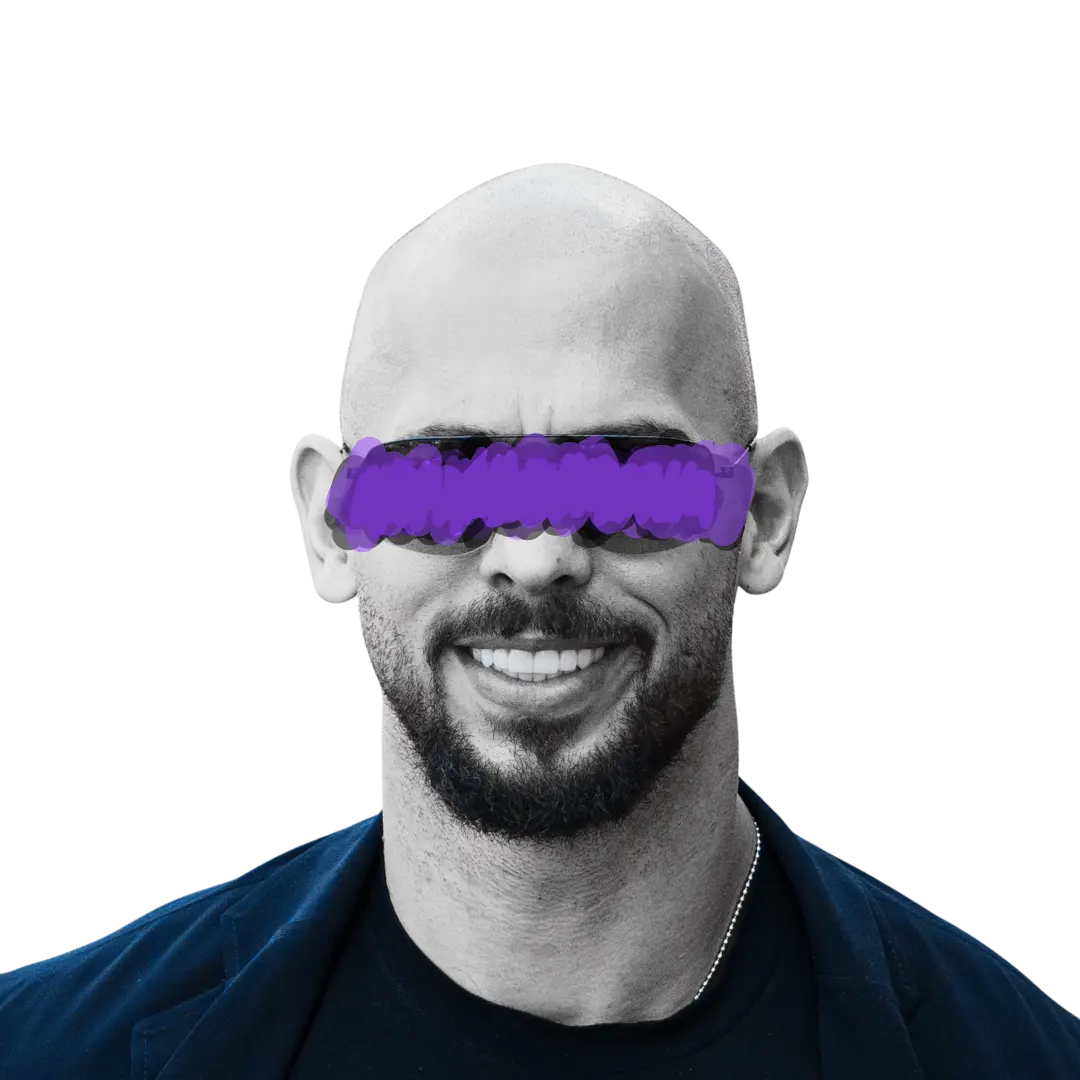
"My unmatched perspicacity, coupled with my sheer indefatigability, combine to make me a feared opponent in any realm of human endeavor."
This wasn't Andrew Tate's quote. It was his father's. The man who taught him chess at five. The man who died mid-game at a tournament in 2015. The man whose shadow still shapes every confrontation Andrew picks.
Most people who quote their dead father don't realize they're doing it. Andrew does — and does it anyway, like a man pressing a bruise to make sure it still hurts. Strip away the Bugattis, the cigar smoke, the viral clips, and you'll find a psychology that explains why he can't stop fighting. Why backing down feels like death. Why control isn't a preference for him. It's survival.
TL;DR: Why Andrew Tate is an Enneagram Type 8
- Fear of weakness: Type 8s are driven by a core fear of being controlled, vulnerable, or harmed. Tate's entire persona—the wealth displays, the dominance rhetoric, the refusal to apologize—is a fortress against vulnerability.
- Childhood wound: Raised by an absent but brilliant father who taught him that attack is the only defense. His father's death left an emotional void he fills with conquest and control.
- All-offense mentality: His kickboxing style mirrors his father's chess style—hands down, pure aggression. He applies this to business, relationships, and public discourse.
- Protective instinct: Beneath the controversy, Type 8s often see themselves as protectors. Tate frames his platform as protecting young men from a society he believes has weakened them.
- Stress response: Under pressure, 8s can become paranoid and secretive (moving to Type 5). Tate's rhetoric about "The Matrix" and coordinated attacks against him reflects this pattern.
What is Andrew Tate's Personality Type?
Andrew Tate is an Enneagram Type 8
Enneagram Type 8 is called "The Challenger" or "The Protector." At their core, 8s are driven by a deep fear of being controlled, manipulated, or harmed. This fear creates a compensatory drive for strength, control, and self-reliance.
Type 8s believe the world is harsh and only the strong survive. They learned early that vulnerability gets you hurt. So they armor up. They become the biggest presence in any room. They'd rather be hated than weak.
The healthy 8 defends the underdog, using power to protect those who can't protect themselves. The unhealthy 8 becomes domineering, aggressive, willing to destroy anyone who threatens their control.
Andrew Tate embodies this pattern with unusual intensity. His public persona is a masterclass in Type 8 behavior: the refusal to apologize, the embrace of controversy, the obsession with dominance hierarchies, the framing of all life as combat.
A reasonable objection: couldn't this be Type 3? The Bugattis, the mansion tours, the constant display of wealth markers — that looks like a 3's "image equals identity" fixation. He was even "playing a character" by his own sponsor's admission. Type 3s perform success.
The distinction is in his relationship to conflict. Type 3s avoid conflict because it threatens their image. They manage perception. They adapt to what the room wants. Tate does none of this. He runs toward conflict, escalates rather than retreats, and genuinely doesn't care if he's liked — only if he's feared. A Type 3 Andrew Tate would have apologized strategically when it served his image. He never does. His wealth displays aren't saying "look how successful I am." They're saying "look how untouchable I am." That's the difference between accumulating admiration (3) and accumulating power (8).
To understand why, we need to go back to a chess tournament in Indiana. And a six-year-old boy watching his father play.
Andrew Tate's Upbringing: The Making of a Challenger
Emory Andrew Tate III was born on December 1, 1986, at Walter Reed Army Medical Center in Washington, D.C. His father, Emory Tate Jr., was an International Chess Master—one of the most creative and aggressive players on the American circuit. His mother, Eileen, was English.
The family dynamic was unconventional.
Andrew's father was brilliant but peripatetic. He won the U.S. Armed Forces Chess Championship five times. Beat grandmasters with unorthodox, attacking play. Fellow players nicknamed him "Extraterrestrial" because his moves seemed from another world.
Emory also served eleven years in the U.S. Air Force as an intelligence linguist, specializing in Russian translation. He was stationed at Fort Meade — NSA headquarters — and Field Station Berlin, where he monitored intercepted Soviet communications during the Cold War. He won an Outstanding Service distinction from the NSA. Andrew calls him a "CIA operative." The reality was signals intelligence, not covert ops, but the mythology mattered more than the distinction. His father's world was surveillance, hidden enemies, codes within codes.
That world also broke him. Colleagues described Emory as paranoid — believing the Russians were specifically targeting him, detecting conspiracies in intercepted data that no one else could see. His security clearance was revoked. He was reassigned to the base post office before being discharged for "conditions that interfere with military service." Andrew has confirmed his father was diagnosed with narcissistic personality disorder.
Chess genius. Intelligence operative. A man who saw enemies everywhere. When Andrew later built his worldview around "The Matrix" — shadowy forces coordinating to suppress free thinkers — he wasn't inventing a philosophy. He was inheriting one.
He was also frequently absent. Andrew recalls:
"He came down to me and said, 'Son, give me a hug.' I gave him a hug. He goes, 'Alright. See you in a few weeks.' I said, 'Where are you going?' He goes, 'When you're older, you'll understand. Mother won't shut up.' Walked out the door. I didn't see him for two weeks. This is who he was."
Classic Type 8 modeling. The father demonstrates that emotional expression is weakness. The response to conflict is departure, not discussion. Men don't explain themselves. They act.
At six years old, Andrew won a chess tournament by defeating adults. When he later lost three games in a row and asked his father if he'd ever be able to beat them, Emory replied:
"Son, once you're grown up, you'll beat anyone at anything."
That statement became prophecy and prison. It gave Andrew boundless confidence. It also meant that losing at anything was unacceptable. The phrase Andrew now uses as his calling card, "unmatched perspicacity, coupled with sheer indefatigability," wasn't his invention. It was his father's.
The Mother Who Disappeared from His Story
After his parents divorced in 1997, Andrew moved to Luton, England with his mother Eileen and brother Tristan. Here's what Andrew rarely discusses: Eileen raised him. She was a dinner lady, cooking meals, washing dishes at school cafeterias, while his brilliant father chased chess tournaments.
Luton wasn't gentle. They lived on Marsh Farm, which Tate has called "the worst area of the worst town." Eileen worked multiple jobs to keep them fed. Andrew recalls her being "mean and hard," but credits that hardness for shaping him. Tristan specifically credits their mother, not their father, for getting them into martial arts: "I was taken to karate lessons every Sunday as an 8, 9, 10-year-old. That's not my father's doing. That was my mother's doing."
The irony is thick. The man who built an empire on masculine dominance was raised primarily by a single mother who scrubbed dishes.
When Andrew first made real money, his first major financial decision was retiring her. "She was still a dinner lady, washing dishes," he said. The protector instinct. Pure Type 8.
But Eileen isn't proud of what her son has become. A family friend told media: "I don't think she is happy with what Andrew says, the misogyny. She says he says these things for the response he gets, for the number of hits on the internet... Eileen didn't raise him like that."
She still lives quietly in England. Refuses all media contact. The woman who actually raised him wants nothing to do with what he's become.
Rise to Fame: From Kickboxing Champion to Internet's Most Banned Man
Andrew Tate's path to notoriety came in two phases.
The Fighter
He started kickboxing in 2005 and proved his father's prediction accurate. By 2014, he had accumulated a 76-9-1 record and won four world titles across ISKA and Enfusion organizations. His fighting style directly reflected his father's chess philosophy.
Andrew told Chess.com:
"My dad taught me everything. Absolutely everything. And my fighting style in the ring mimics his on the board. When I was first learning to kickbox he would get mad at me for having my hands up. He would say I'm not a turtle and I have nothing to hide from. We focused on offense. I still fight with my hands down and head movement. All out attack."
Hands down. Pure aggression. No defense, because defense implies you might get hit. Type 8s don't accept that they can be hurt. They become the threat.
The Influencer
Most people's first exposure to Andrew Tate wasn't a viral clip. It was Big Brother UK.
He entered Series 17 in June 2016 and lasted six days. On Day 5 he won a public vote and was moved into the main house. On Day 7 he was removed after The Sun published a video showing him hitting a woman with a belt. Tate posted now-deleted videos claiming the footage was edited and consensual: "They cut all the laughing." Channel 5 said his "position as a housemate had become untenable." Vice later reported that producers were also informed by Hertfordshire Police that Tate was under investigation for rape — two women who worked as his webcam models had filed complaints in 2015. That investigation closed in 2019 with no charges.
The Big Brother incident established the pattern that would define his career: provocative behavior, public exposure, controversy, removal, and a narrative that the system was against him. It was also the first public collision between the character and the consequences.
After retiring from professional fighting, Tate built a business empire — but the nature of that business reveals the Type 8's shadow with unusual clarity.
Healthy 8s protect. They use their strength to shield people who can't shield themselves. But the line between protecting someone and owning them is thinner than any 8 wants to admit. When the protector instinct curdles, "I'll take care of you" becomes "you belong to me."
In a June 2022 interview with the Mirror, Andrew and Tristan admitted they ran what Andrew himself called a "total scam" — a webcam operation. A now-deleted page from Tate's own website described his recruitment method: "Get her to fall in love with me to where she'd do anything I say, and then get her on webcam so we could become rich together."
Read that sentence through the Type 8 lens. First, make her feel safe. Then, leverage that safety into compliance. Trafficking literature calls this the "loverboy" or "romeo pimp" method. But psychologically it's the 8's protector instinct inverted — strength used not to shield but to enclose. The business employed 75 women across four countries and earned him $600,000 per month at its peak. Leaked financial documents show approximately $2.6 million flowing through associated accounts from the webcam platform MFCXY.
Wiretap transcripts obtained by investigators show how total the control became. When Tristan complained that one woman demanded 40% of her own earnings, Andrew allegedly told him to "falsify" account statements or "give her 30 and tell her it's 40." The women weren't partners. They were resources inside the fortress.
This isn't background trivia. It's the dark architecture of the Type 8 wound: if vulnerability is dangerous, then anyone who becomes vulnerable to you becomes yours to control. The trafficking charges he now faces are the legal consequence of that psychology taken to its endpoint.
He later pivoted to "Hustlers University" (now "The Real World"), a $49.99/month online education platform. But the courses weren't the product. The affiliate army was.
Any subscriber could become an affiliate, earning a 48% commission on the first month's payment of anyone they recruited. Tate kept the remaining 52% plus all recurring subscription revenue. The courses explicitly taught members to cut up clips of Andrew making extreme statements and repost them across TikTok, YouTube Shorts, and Instagram Reels with their referral links attached. Affiliates were instructed to add minor modifications — zoom effects, different subtitles, color adjustments — to circumvent platform duplicate-content detection.
The math was brutal in its effectiveness. Each affiliate account might get only a few thousand views per video. But multiplied across thousands of accounts posting constantly, the organic reach was staggering. By August 2022, TikTok videos tagged #AndrewTate had been viewed over 11.6 billion times. In July 2022, more people Googled "Andrew Tate" than Donald Trump or Kim Kardashian. At its peak in October 2022, the platform had over 200,000 paying subscribers — estimated revenue of $11 million that month alone.
This is the Type 8 "control everything" mentality extended to fame itself. He didn't just court controversy organically. He built a financial engine that incentivized thousands of people to spread his most provocative content. Every viral clip was also an advertisement. Every outraged reaction was also a recruitment tool.
He was banned from virtually every major social media platform for content deemed to promote misogyny and toxic masculinity. Schools in multiple countries reported concerns about his influence on male students.
For a Type 8, this is almost ideal. The whole world became his opponent. Every ban proved his thesis: the system fears strong men. The more they attacked, the more his followers believed he was over the target.
Andrew Tate's Personality: The Psychology of Dominance
What drives someone to court this much controversy? Let's examine the psychological patterns.
The Brother Bond: Andrew and Tristan
You can't understand Andrew without understanding Tristan. They share everything—literally. Same houses, same cars, same businesses, same bank account. They train together, live together, got arrested together, and face charges together.
Tristan is 18 months younger and temperamentally different. Andrew is "Top G" — the explosive frontman. Tristan is "The Talisman" — charming, polished, diplomatic. Where Andrew provokes, Tristan networks. Where Andrew leads with aggression, Tristan leads with sophistication. Interviewers describe him as the "good cop," using a soft-spoken approach to explain their shared philosophy. He has a considerably smaller social media following and prefers to operate behind the scenes.
This matters for the personality analysis. Same absent father. Same single mother in Luton. Same martial arts training. Same Marsh Farm estate. Yet they developed different temperaments — Andrew as the volatile challenger, Tristan as the calculating strategist. Same environment, different wiring. The Type 8 pattern in Andrew isn't just a product of circumstance. It's who he is.
When asked about disagreements, Tristan claims: "We agree on everything. Our interests and the way we live are ever so slightly different, of course, but there's nothing we disagree on." That claim of total alignment is itself revealing. Tristan never publicly challenges Andrew's dominance. A fratriarchy with a clear hierarchy.
They also have a sister, Janine, whom they don't speak to. Tristan dismisses her as "full left wing" and "crazy." She's reportedly a lawyer living in America. The Type 8 pattern: those who don't submit to the family hierarchy get excommunicated.
The "Top G" Self-Mythology
The phrase "Top G" now dominates internet culture, but its origin reveals something important about Andrew's psychology.
"Top G" means someone capable in all realms. Andrew defines it: "When you are a Top G, you are dangerous at everything—whether it's racing supercars, fighting in the ring, debating, or any competition."
But here's the reveal: the core phrase, "unmatched perspicacity coupled with sheer indefatigability," came from his father. Andrew didn't create this identity. He inherited it. He's still trying to become the man his father told him he would be.
The Top G mythology also contains an admission. His former kickboxing sponsor Daniel Knight told The News Movement that Tate was "playing a character" to boost his online presence, something that developed from his fighting days. Knight said Tate noticed that making controversial statements drew attention even while he was still competing.
His own lawyer, Tina Glandian, admitted during a Times Radio interview: "There are certainly interviews I've seen where Andrew himself has said 'You know I say a lot of things, it's satire.'"
Here's the psychological trap: if you play a character long enough, you become it. One source who knew Tate as a young man observed: "He has been playing this character for so long that he has actually become worse than the character he portrays."
Type 8s wear armor until the armor becomes the skin.
The Father Wound
In a roughly two-hour therapy session with David Sutcliffe, a former actor turned therapist, something rare happened.
Sutcliffe discovered that Andrew had "a huge emotional gap in his life, especially when it came to his dad. It was like a missing puzzle piece in his life."
Emory Tate died on October 17, 2015, suffering a heart attack during a chess tournament in California. He died mid-game. The same way he lived: in combat.
Andrew's tribute was revealing:
"He is the smartest man I have ever met bar none. People called him crazy. But I understood him. And regardless of his abnormal thinking he turned me into a brilliant person... It is impossible to replace a man like him."
The moment the walls dropped: In the final ten minutes of the session, Sutcliffe invited Andrew to break down those walls he'd built. For a brief moment, observers described it as awkward and uncomfortable, Andrew actually connected. No performance. No dominance. Just a man sitting with his grief.
Then he ended the session with a handshake. The walls went back up immediately. One viewer noted: "If Andrew had allowed himself to stay in that moment for another few minutes, he might have broken into tears."
That moment of connection was too dangerous to sustain. The vulnerability that might have been healing became something to escape.
Emotional Control as Identity
Tate has stated:
"SHOWING the most emotion doesn't mean you FEEL the most emotion. And showing less emotion doesn't mean you feel less. Stone-faced men feel pain. Very often more pain than the crying and screaming. Emotional control isn't lack of emotion. It's a sign of maturity."
This is the Type 8 cope. They feel deeply — possibly more deeply than other types — but have decided that showing it is dangerous. So they become stone.
He's also said: "I think emotional vulnerability nearly at every form at every level is basically a form of manipulation." If vulnerability is manipulation, then Andrew can never be vulnerable — that would make him a manipulator. And Type 8s despise manipulation above almost everything else. It's a psychological trap with no exit.
Discipline as Religion
Andrew's daily routine is essentially military:
- Wake at 4 AM
- Immediate ice-cold shower
- Intense boxing training
- One meal per day (mostly meat)
- 4-5 hours of sleep
His philosophy: "I don't believe in motivation. I believe in discipline! I am a disciplined person!"
For Type 8s, discipline is how you ensure no one can ever weaken you. Comfort is the enemy. Softness is death. Every day is training for a war that never ends. Fellow Type 8 Jocko Willink operates from the same psychological foundation with his "discipline equals freedom" philosophy.
Relationships with Women: The Pattern
Andrew Tate talks about women constantly, but what do his actual relationships reveal?
He's never been married. He claims to have fathered 10-12 children with different women and has stated his intention to have 20. He publicly admits he only dates women aged 18 or 19.
The women linked to him tell a consistent story. Naghel Georgiana Manuela, a Romanian model, was the woman he posted in 2021 with the caption: "I take flight with the one woman I trust." She was later arrested alongside him on trafficking charges.
Bri Stern, an ex-girlfriend now suing him, describes the pattern precisely: "I thought he was so kind, so sweet, so warm and loving. Everything was great in the beginning." Then the relationship "took a dark turn."
This is how unhealthy 8s operate in romance. The initial intensity feels like passion. The protectiveness feels like care. Over time, protection becomes possession. Control disguises itself as love. The partner becomes territory to defend, not a person to partner with.
The Stress Pattern: When 8 Goes to 5
Under stress, Type 8s don't get louder. They get quieter and more paranoid. They withdraw into research, conspiracy thinking, strategic planning. They start seeing enemies everywhere.
His "Matrix" rhetoric — already seeded by a father who genuinely saw conspiracies in intelligence data — intensifies under pressure. Whether the threats are real or imagined, the pattern is classic 8-to-5 disintegration: the fighter becomes the investigator, gathering evidence of persecution. Other Type 8s like Joe Rogan show similar patterns, framing mainstream institutions as adversaries to independent thought.
The Void He Fills
Here's the Enneagram detail that explains Tate's reach better than any sociological theory: Type 8s at their healthiest are protectors. They stand between the vulnerable and whatever threatens them. They don't ask permission. They don't wait for consensus. They act. That instinct — someone strong who has your back — is exactly what millions of young men are missing.
Prison Reform Trust data show that 76% of young offenders grew up with absent fathers. Sociologists describe modern young men as "wandering in a fog of confusion, searching for something, anything, that makes them feel valuable and respected." Economic shifts have disrupted the traditional breadwinner role. Dating apps have transformed romantic dynamics. Cultural messaging often treats masculinity itself as problematic.
These young men aren't looking for a guru. They're looking for the healthy 8 — the protector, the person who demonstrates that strength can serve something beyond itself. What they're getting instead is the unhealthy 8: strength as domination, protection as control, vulnerability as weakness.
Into this void steps Andrew Tate, offering a clear answer: "Reject passivity, embrace discipline, take control of your life." Author Michael Kimmel describes a state of "aggrieved entitlement," young men feeling "emasculated, disposable, disrespected, discarded, or even totally forgotten." Tate's message is "perfectly calibrated" for boys from broken homes: emotional numbness as strength, self-reliance as virtue, contempt for vulnerability. That's also why younger figures in the same ecosystem, like Clavicular, can inherit so much of Tate's audience — dominance as salvation, repackaged for the next generation.
The tragedy is that Tate understands the wound because he has it. He grew up fatherless in the same way his followers did. He knows what it feels like to need a protector and not have one. But instead of healing that wound, he monetized it — teaching young men to build the same armor he built, without mentioning that it never made him whole either.
Critics describe his vision as "counterfeit masculinity," "all about power without purpose, wealth without wisdom, dominance without love." He "taps into men's God-given desire to be strong but twists it into a self-serving caricature." Dismissing his followers as dupes misses the point. They recognized a real 8 when they saw one. They just couldn't tell the difference between a healthy one and a broken one. Most of them had never seen the healthy version.
Controversies and Legal Challenges
Any honest analysis must address the serious allegations Tate faces.
Romanian Criminal Charges
In December 2022, Andrew and his brother Tristan were arrested in Romania on charges including human trafficking and forming an organized crime group. Prosecutors allege women were coerced into creating pornographic content through "physical violence and mental coercion."
A second investigation in August 2024 expanded charges to include trafficking minors, sex with a minor, and money laundering—involving 35 alleged victims.
As of early 2025, the cases remain active. A Romanian court ruled the first case couldn't proceed due to prosecutorial errors, but charges weren't dropped. The Tates deny all allegations.
UK Charges
In May 2025, the Crown Prosecution Service brought 21 charges against the brothers including rape, actual bodily harm, and human trafficking. The Tates deny these charges as well.
The Type 8 Response to Accusations
Notice how Tate handles allegations: complete denial, attack on accusers' motives, claims of persecution. The Type 8 pattern under threat. They cannot admit weakness or wrongdoing because that would prove they're not invulnerable. Whether innocent or guilty, the psychological response would look identical.
Andrew Tate's Current Chapter
As of early 2025, Tate continues to maintain his innocence while facing multiple legal proceedings across Romania and the UK. His travel restrictions were lifted, allowing a return to the United States, though he remains obligated to appear for Romanian court dates.
The Conversion Question
He converted to Islam in late 2022, claiming it's "the last true religion" where adherents actually follow their sacred texts. The conversion raises questions about the intersection of faith and his dominance psychology.
Islam requires submission. The word itself means "submission to God." For a Type 8 whose entire identity is built on refusing to submit to anyone, this creates tension. Andrew has resolved it by framing Islam as a weapon in a cultural war rather than a path to spiritual surrender. He uses religious language to sanctify his existing views on male dominance and female submission.
Muslim women online have pushed back, arguing Tate is "indoctrinating Muslim men and boys with sexist rhetoric while promoting a distorted version of Islam." Writer Mariya Rehan told BuzzFeed News: "I don't see anything in Islamic scripture that is compatible with anything that Andrew Tate says."
Some within the Muslim community who initially celebrated his conversion have grown disappointed. As one critic wrote in 2025: "There has been very little visible reflection of Islam in his behaviour... Instead of embracing Islamic values, he continues to flaunt his jahil [ignorant] way of living."
The Type 8 converted to a faith of submission and somehow made it about dominance. That's the pattern: everything gets absorbed into the existing power framework.
His platform continues operating, though legal pressures have complicated his business operations. Supporters frame him as a target of coordinated persecution. Critics see accountability arriving for alleged crimes.
The Type 8's story rarely ends quietly. They either triumph completely or go down swinging. Middle ground isn't in the vocabulary.
Understanding Andrew Tate Through the Enneagram
Here's what the Enneagram reveals that surface analysis misses:
Understanding psychology doesn't excuse harm. The charges he faces — trafficking, coercion, violence — aren't legal abstractions. They represent real people. But understanding why someone operates the way they do is different from excusing it, and the "why" here matters because millions of young men are modeling their lives after this man.
Andrew Tate inherited a worldview from a father who was brilliant, paranoid, and absent. A chess genius who saw enemies everywhere and died mid-game. A man whose intelligence career blurred the line between vigilance and delusion. Andrew took that inheritance — attack is survival, vulnerability is death, the world is rigged against free thinkers — and built an empire on it. He industrialized it through an affiliate army. He sanctified it through religious conversion. He monetized it through courses that teach young men to armor up the same way he did.
But Tate offers his followers armor instead of healing. He teaches them to become dangerous when they need to learn to become whole.
His followers are learning to dominate. But the man they're learning from can't sit in a therapy session without fleeing. He preaches emotional control while running from his own emotions. He built the biggest fortress he could, and it still wasn't enough to sit with his grief for ten minutes.
Andrew Tate is not a mystery. He is a pattern — visible, predictable, and repeating across every domain of his life. His appeal tells you exactly what young men today are missing: not dominance, not discipline, not wealth. A father who stayed. The young men watching him will either recognize the pattern or repeat it. And the armor will become their skin too.
Disclaimer: This analysis of Andrew Tate's Enneagram type is speculative, based on publicly available information, and may not reflect the actual personality type of Andrew Tate.
What would you add?