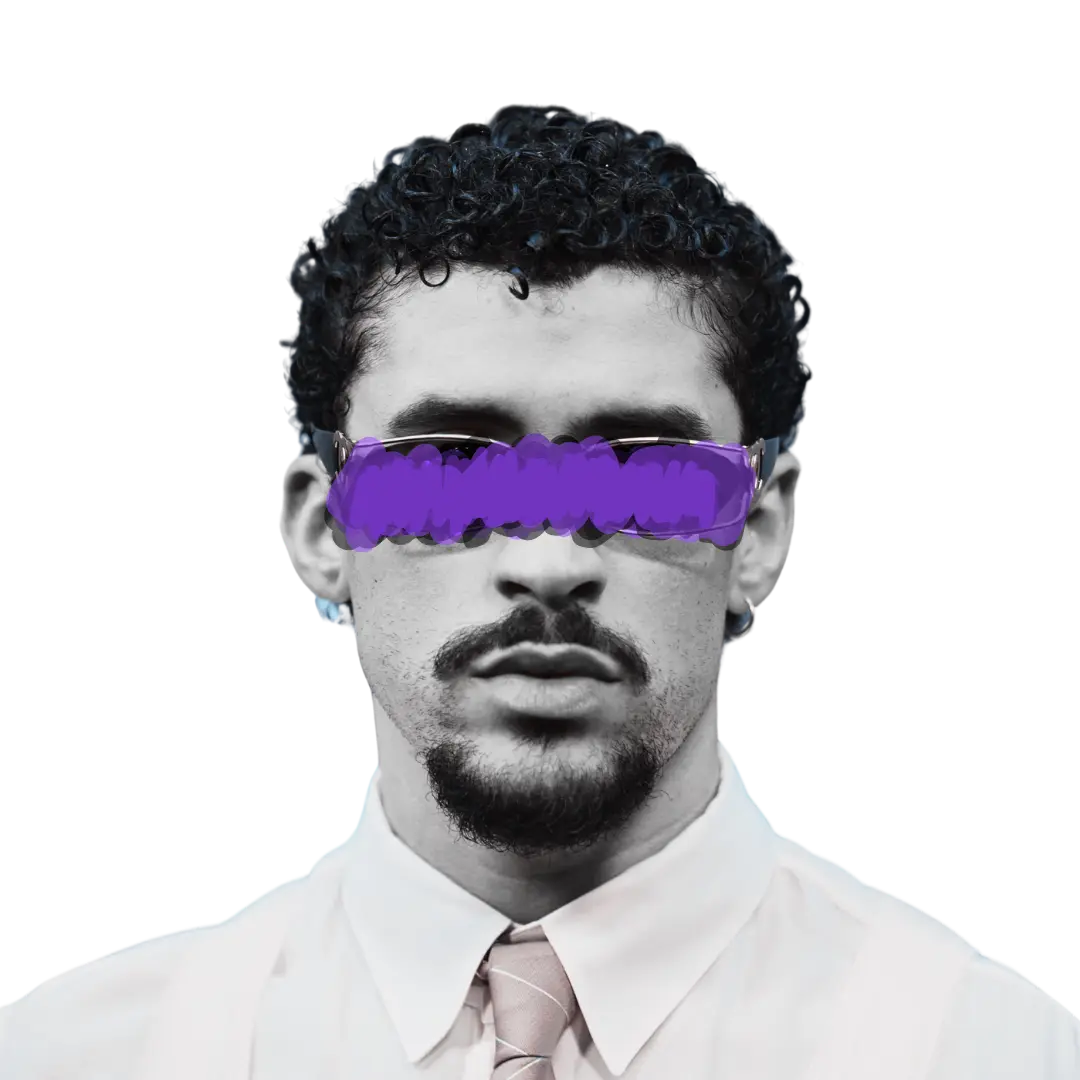
"This is for my people, my culture, and our history."
In two weeks, Bad Bunny will take the stage at Super Bowl LX—the first Latino to headline the halftime show solo. Days later, he could become the first Spanish-language artist to win Album of the Year at the Grammys. From bagging groceries at a Puerto Rican supermarket to this moment, Benito Antonio Martínez Ocasio has lived a story that rewrites what's possible.
But map his psychology, and the meteoric rise makes perfect sense.
What drives someone to dominate Latin trap, reggaeton, pop, merengue, and bachata, then pivot to WWE wrestling, Hollywood films, and hosting Saturday Night Live? Why refuse to stay in one lane when that lane made him a billionaire?
The answer unlocks when you decode how Bad Bunny's mind actually works.
TL;DR: Why Bad Bunny is an Enneagram Type 7
- Relentless Variety-Seeking: Bad Bunny has never made the same album twice. From Latin trap to reggaeton to full Puerto Rican folk music, his refusal to repeat himself screams Type 7's core fear of limitation and boredom.
- Fearless Experience Collector: WWE wrestler, Met Gala co-chair, Hollywood actor, Calvin Klein model, SNL host—Type 7s need to taste everything life offers. Bad Bunny doesn't just dabble; he commits fully to each new adventure.
- Optimistic Reframing: His stage name came from being forced to wear a bunny costume as a child and hating it. Instead of burying that memory, he transformed it into his brand. Classic Type 7 alchemy of pain into possibility.
- Avoidance of Constraint: He refuses to sing in English despite massive pressure, won't fit into industry boxes, and designs his own fashion. Type 7s feel suffocated by anything that limits their freedom.
- Growth Through Depth: His 2025 album "Debí Tirar Más Fotos" shows Type 7 integration toward Type 5—going deep into Puerto Rican identity rather than chasing the next shiny trend.
What is Bad Bunny's Personality Type?
Bad Bunny is an Enneagram Type 7
Enneagram Type 7s are called "The Enthusiast" for good reason. Their minds are wired to seek stimulation, variety, and possibility. They're the people with seventeen tabs open in their brain at once, always planning the next adventure before the current one ends.
The core fear driving Type 7s? Being trapped, deprived, or stuck in emotional pain. They cope by staying in motion, mentally and physically. New experiences, new ideas, new projects become their oxygen.
Bad Bunny embodies this pattern, but in a uniquely grounded way. Most Type 7s scatter their energy across too many pursuits. Benito channels his into becoming world-class at each thing he attempts.
"I'm taking advantage of this moment in my life when I can do whatever I want and wear what I want, so I get to live life more authentically," he told Harper's Bazaar.
That's Type 7 philosophy distilled: seize the moment, reject artificial limits, live fully now.
The Puerto Rico Childhood That Shaped Him
The Almirante Sur neighborhood of Vega Baja, Puerto Rico shaped everything. His father Tito drove trucks. His mother Lysaurie taught school. Every Sunday, mass.
Young Benito sang in the church choir until age 13. Some kids rebel against religious upbringing by abandoning it entirely. Benito absorbed its emotional expressiveness while finding new vessels for it. The choir didn't leave him — it just started sounding different.
"I wasn't the kid who got involved in the streets," he later reflected. "I liked to be at home with my family."
This is the quieter side of Type 7 that people miss. They crave external stimulation, yes. But many build a fixed point to launch from. Family became Benito's anchor — stable enough that he could keep moving without losing himself.
His stage name carries childhood pain transformed. As a young boy, he was forced to wear a bunny costume for school and was photographed looking furious about it. That angry bunny face became iconic.
A Type 7's superpower is this exact alchemy: taking uncomfortable experiences and reframing them as fuel rather than trauma.
From Bagging Groceries to Breaking the Internet
While studying audiovisual communications at the University of Puerto Rico in Arecibo, Benito worked as a bagger at the Econo supermarket. Most people with creative dreams would see this job as a dead end. Benito saw it as time.
Late nights after his shifts, he uploaded tracks to SoundCloud. "Diles" caught fire online. DJ Luian discovered him and signed him to Hear This Music.
The supermarket worker was about to become the biggest Latin artist alive. Fast.
What happened next defied every industry prediction. Instead of riding one sound to fame and milking it, Bad Bunny kept shapeshifting. Latin trap became reggaeton became pop became rock became traditional Puerto Rican music. Never the same move twice.
"People can feel me," he told Trevor Noah. "I'm Latino; I'm Puerto Rican... This is my music. This is my culture. If you don't like it, don't listen to me."
That confidence didn't come from arrogance. It came from the Type 7's inability to sustain anything that feels false. The psychological cost is too high.
How He Builds a Sound Nobody Else Can Copy
Understanding Bad Bunny's creative process reveals the Type 7 mind in action.
Producer Tommy Torres described their sessions: "We'd get to the studio, talk about a million things, eat sushi and then sit and play the piano and boom, in less than an hour and a half, we'd write an entire song... because Benito comes up with ideas so fast, it's out of this world. He doesn't even write things; he just memorizes everything, and he does like a puzzle in his mind like Rain Man."
Bad Bunny himself distinguishes between two creative modes: "I have a mechanical process that I call mecánico, and it's the one that I like the least. And then there is the real process, the one with the muse, with the creativity, that comes on suddenly, when you weren't expecting it. Your subconscious is talking to you about what you are feeling without you knowing."
Quintessential Type 7 cognition. The preference for inspiration over grinding, for flow states over forced output.
He writes sad songs at night, happy songs during the day after working out. "I'd rather wait for the muse than force myself to write a hit."
The results speak for themselves: in 2020 alone, he released three full albums. YHLQMDLG, Las Que No Iban a Salir, and El Ultimo Tour Del Mundo. That's not scattered energy. That's Type 7 productivity when passion and purpose align.
Collaboration Without Surrender
How does the world's most-streamed artist choose who to work with? His answer reveals something deeper than professional calculation.
"For me, a collaboration is almost like, I don't want to sound like an a**hole, but it's almost like having sex with someone," he told Billboard. "Making a song is a serious matter. You're saying things, and you're with someone, and it's not going to go away. It's there forever."
When he made his first song with J Balvin, he was so overwhelmed he had to leave the studio and cry. When collaborating with Drake on "Mia," he insisted Drake perform entirely in Spanish, making it the first song ever to feature Drake rapping solo en espanol.
That's a Type 7 who can't make music with someone he doesn't feel, even when that someone is Drake.
But here's the counterintuitive pattern: as Bad Bunny got bigger, he started collaborating more with unknowns than with hit-makers.
"To be able to collaborate in that way, and give space to new people instead of looking for those who are established in the industry, was something that for me was part of the purpose."
He's criticized the industry mentality of collaborating for algorithm boosts. "The bigger you get, the more you should collaborate with artists outside the box," he's argued. His collaborators on Debi Tirar Mas Fotos were largely young Puerto Rican musicians from Escuela Libre de Musica.
Type 7s need novelty. But mature Type 7s find novelty in depth rather than celebrity. Bad Bunny finds more excitement working with a 19-year-old from Vega Baja than chasing another Drake feature.
The Restless Mind Behind the Persona
What makes someone pursue global music domination AND professional wrestling AND film acting AND fashion revolution AND late-night TV hosting?
Here's what's actually happening in Bad Bunny's head.
The Impossibility of Boredom
Type 7s describe their inner experience as being on a mental treadmill that never stops. The moment they master something, their brain starts craving the next challenge.
Bad Bunny didn't just appear at WWE WrestleMania for a publicity stunt. He'd been obsessed with wrestling since childhood, idolizing Booker T and dreaming of being in the ring. When he finally got there, the entire WWE roster came to his locker room afterward to pay respects.
"That was very special to me; it was a dream come true," he said.
Then he mentioned casually considering leaving music to pursue wrestling full-time. He was probably half-joking. But Type 7s don't fully joke about these things.
The SNL Moment
When Bad Bunny hosted Saturday Night Live's Season 51 premiere in October 2025, he used his monologue to address the Super Bowl controversy head-on.
"I'm very happy and I think everyone is happy about it, even Fox News," he joked.
Then he switched to Spanish, delivering an emotional message to Latino viewers: "Especially all the Latinos and Latinas across the world, and here, in the United States, all those who have worked to open doors... It's more than an achievement for myself, it's an achievement for all of us."
His punchline? "If you didn't understand what I just said, you have four months to learn."
That's Type 7 energy crystallized. Taking a tense political moment and transforming it into celebration, humor, and cultural pride simultaneously.
The Identity Filter
"I learned that that's the way artists lose themselves," Bad Bunny explained about industry pressure. "It's because they forgot about themselves, them as a person, and invented a fictitious personality."
This insight reflects how clearly Bad Bunny understands his own psychology. The same drive that pushes him toward endless novelty becomes destructive when it's serving external expectations rather than genuine curiosity. He's watched other artists make that trade. He won't.
Bad Bunny wears nail polish, skirts, and drag not for shock value but because he actually wants to. His fashion choices directly challenge traditional masculinity in Latin culture.
For Type 7s, any artificial constraint on self-expression feels like a prison sentence.
Challenging Machismo from the Inside
When a nail salon in Oviedo, Spain refused to serve Bad Bunny because of his gender, he didn't just walk away. He called them out publicly. When reggaeton artist Don Omar made homophobic comments using the slur pato, Bad Bunny tweeted: "Homophobia in this day and age? How embarrassing, loco."
But his most powerful statement came on The Tonight Show in February 2020.
That same week, Alexa Negron Luciano, a homeless transgender woman, had been murdered in Puerto Rico. Police reports misgendered her as "a man dressed in a black skirt." Bad Bunny wore a skirt that night and revealed a white T-shirt reading: "Mataron a Alexa, no a un hombre con falda" ("They killed Alexa, not a man in a skirt").
At the 2022 VMAs, he kissed both a female and male backup dancer during his performance, days after Puerto Rican artists Tokischa and Villano Antillano received death threats for doing the same thing at a San Juan concert.
In 2023, he took a role in Cassandro, a biopic about a gay lucha libre wrestler, including an on-screen kiss with Gael Garcia Bernal. "My first kiss for a movie, and it was with a man," he said. "I think it was very cool; I didn't feel uncomfortable."
Asked about masculinity, he's been characteristically direct: "I don't know if in 20 years I will like a man. One never knows in life."
And: "I have always felt there was a part of me that is very feminine. But I never felt as masculine as I did the day I dressed up like a drag queen."
This isn't queerbaiting. It's Type 7's refusal to accept artificial boundaries. Any identity that feels like a cage gets dismantled.
Bad Bunny received the 2023 GLAAD Vanguard Award for his advocacy. Ricky Martin, presenting the honor, called him "an icon for the Latin queer community."
The Crowd Paradox
Despite commanding stadium audiences of hundreds of thousands, Bad Bunny lives what he describes as "a calm life." He leaves venues immediately after performing to avoid crowds. He disappeared from social media when fame became overwhelming.
This isn't contradiction. It's Type 7 energy management.
They can be intensely social and charismatic when engaged, but require serious recharge time afterward. Their internal world is always buzzing. External stimulation needs careful dosing.
YHLQMDLG: The Pandemic Album That Couldn't Be Danced To
On February 29, 2020, Leap Day, because why release music on a normal day, Bad Bunny dropped YHLQMDLG ("Yo Hago Lo Que Me Da La Gana" / "I Do Whatever I Want"). Two weeks later, the world locked down.
The album became Spotify's most-streamed album of 2020 with 3.3 billion streams. Bad Bunny became the first non-English language artist to top Spotify's year-end most-streamed list. The Guardian called him "the world's biggest pop star."
The cruel irony? YHLQMDLG was pure old-school reggaeton designed for the marquesina, Puerto Rico's legendary garage parties. "It's happier than my first one," Bad Bunny said. "It's for having fun, dancing, forget your problems."
Instead, fans blasted it in quarantine apartments, unable to dance with anyone.
"Safaera," a five-minute chaos bomb modeled after classic DJ Playero garage party megamixes, spawned the "Abuela Challenge" on TikTok, where fans filmed their grandmothers' scandalized reactions to explicit lyrics.
"Yo Perreo Sola" became a feminist anthem celebrating women dancing without needing a man, its music video featuring Bad Bunny in full drag with phrases from feminist protests like "Ni Una Menos."
A Type 7 creating the ultimate party album right before the world's biggest party got cancelled? That's either cosmic joke or cosmic timing.
Bad Bunny responded by releasing two more albums that same year.
What the Numbers Reveal About the Pattern
The Ceiling That Kept Moving
No Latin artist had achieved what Bad Bunny has achieved. But the numbers matter less than the pattern behind them.
Three Grammy Awards. Seventeen Latin Grammy Awards, with five more won in November 2025, including his first Album of the Year for "Debi Tirar Mas Fotos." Billboard named him the Top Latin Artist of the 21st Century.
His album "Un Verano Sin Ti" became the most-streamed album ever on Spotify. Four consecutive albums debuted at number one on the Billboard 200, an all-genre chart dominated by English-language artists.
Every one of those records was set while refusing to sing in English. That's not stubbornness. That's a Type 7 who found a constraint worth keeping — the one that makes everything he does distinctly his. What the industry called genre-defying, he experienced as boredom avoidance. What Billboard called record-breaking, he experienced as following his curiosity. The chart positions are just what happens when a Type 7's appetite is bigger than the categories built to contain it.
The 2026 Grammy Nominations
Bad Bunny made history in late 2025 when he became the first Latino, Hispanic, and Spanish-language artist to be nominated in the same year for Album of the Year, Record of the Year, and Song of the Year, the three most prestigious categories at the Grammy Awards. The ceremony takes place February 2, 2026.
If "Debi Tirar Mas Fotos" wins Album of the Year, it would be the first all-Spanish-language album to ever take the prize.
Six nominations total put him alongside Sabrina Carpenter as one of the most-nominated artists of the year.
The Puerto Rico Residency: $713 Million Impact
At the peak of his popularity, Bad Bunny did something unexpected: he skipped the typical North American arena tour to center his homeland.
The "No Me Quiero Ir de Aqui" (I Don't Want to Leave Here) residency consisted of 31 sold-out shows at San Juan's Coliseo de Puerto Rico between July and September 2025.
Nearly 600,000 people attended. The first nine shows were reserved exclusively for Puerto Rico residents, with ticket prices ranging from just $35 to $250. A deliberate rejection of Ticketmaster-era price gouging.
The economic impact? $713 million injected into Puerto Rico's economy, according to Gaither International. Hotel occupancy surged 25%. Over half of the international attendees cited the concerts as their primary reason for visiting, staying an average of 8.7 nights. Moody's raised Puerto Rico's 2025 economic forecast partly because of the residency.
"This residency is more than a concert series, it's a defining moment for our island," the Coliseo's general manager said.
Hollywood Arrival
Bad Bunny's 2025 wasn't just about music. He appeared in two major films:
Caught Stealing (August 2025): Directed by Darren Aronofsky, this crime thriller stars Austin Butler and Zoë Kravitz. Bad Bunny plays Colorado, a Puerto Rican gang member navigating New York's criminal underworld. Aronofsky called him "the sweetest guy in the world" on set.
Happy Gilmore 2 (July 2025): Adam Sandler's Netflix sequel cast Bad Bunny as Oscar Mejías, Happy's caddy and a former busboy dreaming of owning a restaurant. The film debuted at #1 on Netflix with 46.7 million views in three days—the biggest US Netflix film debut of 2025.
The Super Bowl Moment
When the NFL announced Bad Bunny would headline the Super Bowl LX halftime show, scheduled for February 8, 2026, at Levi's Stadium, it triggered predictable backlash from conservative commentators. Donald Trump called it "absolutely ridiculous."
NFL Commissioner Roger Goodell defended the selection: "He's one of the leading and most popular entertainers in the world... this was carefully thought through."
The performance will make Bad Bunny the first Latino and Spanish-speaking artist to lead the Super Bowl halftime show as a solo act.
A new trailer, shot in Puerto Rico featuring the flamboyan tree (an important island symbol), carries the message: "The world will dance."
The Controversies That Exposed the Pattern
The Multiples Problem
Bad Bunny's lyrical content has drawn criticism for misogyny and explicit sexuality, the same critique leveled at much of reggaeton. His defenders point out that he's also created feminist anthems like "Yo Perreo Sola" and consistently advocated for LGBTQ+ rights.
When he appeared in drag for that video, some called it queerbaiting. Others saw genuine allyship. The critique lands differently depending on whether you've watched him put on a skirt to honor a murdered trans woman on The Tonight Show.
Type 7s attract this tension because they genuinely contain multitudes. The same person who makes a party anthem and a political anthem isn't performing contradiction — they're just not limiting themselves to one. Consistency isn't the goal. Fullness is.
Political Lightning Rod
After a comedian at a Trump rally called Puerto Rico "a floating island of garbage," Bad Bunny endorsed Kamala Harris and encouraged Puerto Ricans to vote. Conservative media exploded.
His support for Puerto Rican independence and criticism of gentrification has made him a political figure whether he wanted that role or not.
His 2022 documentary-length music video for "El Apagon" directly addressed American investors buying up the island post-Hurricane Maria. "This is my culture," he said simply. "If you don't like it, don't listen to me."
How Bad Bunny Handles Criticism
Type 7s are supposed to avoid pain. So how does Bad Bunny handle the constant backlash?
With defiant humor, mostly. When conservative commentators called him a "demonic Marxist" after the Super Bowl announcement, he used his SNL monologue to address it directly. He delivered an emotional message to Latinos in Spanish, then told English-speaking critics: "If you didn't understand what I just said, you have four months to learn."
When he threw a fan's phone after she shoved it in his face, he didn't apologize: "Anyone who comes up to me to say hello will always receive my attention and respect. Those who come to put a damn phone in my face, I'll consider that what it is: a lack of respect."
His broader philosophy on criticism reveals Type 7 perspective-taking: "If you take Google Maps... we're nothing. My album is nothing, I'm nothing. So, who the hell is listening? And what's the pressure I'm giving myself? You learn from things."
Mental Health Reality
Bad Bunny has spoken openly about battling depression, a disclosure that surprised fans who saw only his energetic public persona. Type 7s often mask internal struggles with external enthusiasm. It's their default coping mechanism.
From 2016-2018, at the start of his rise, he put his career on hold: "I didn't feel well, I wasn't happy with what I was doing, I was feeling unhappy, you know, with all the success: achieving so many things, my dreams coming true, etc... but I wasn't enjoying any of it, so I decided to distance myself from everything."
In 2023, he announced another break: "2023 is for me, for my physical health, my emotional health to breathe, enjoy my achievements... Remember yourself, cabron. You've worked your ass off."
The Enneagram offers a clear lens: Type 7s feel everything intensely. Their constant motion is partly genuine enthusiasm and partly avoiding the stillness where difficult emotions catch up.
Bad Bunny's willingness to stop, publicly, shows unusual self-awareness for a 7.
The Kendall Chapter
Bad Bunny's on-again, off-again relationship with Kendall Jenner played out publicly from 2023 to 2024. They reconciled briefly in mid-2024 before splitting again in September. Their 2025 Met Gala run-in made headlines.
In July 2025, Bad Bunny posted a photo featuring a hat reading "Stop dating people who don't get your music." Widely interpreted as a subtle dig at his ex.
For a Type 7 who values being understood over being admired, the incompatibility makes sense.
The Legacy He's Building in Real Time
What Triggered "Debí Tirar Más Fotos"
The 2025 album "Debi Tirar Mas Fotos" (I Should Have Taken More Photos) marked a shift in Bad Bunny's artistic direction. Instead of genre-hopping outward, he turned inward. A love letter to Puerto Rican musical traditions, from plena to salsa to jibaro folk music to bomba.
What triggered it?
Last summer, Bad Bunny was driving through San Juan, crying. "Tourists come here to enjoy the beautiful places, and then they leave and they don't have to deal with the problems that Puerto Ricans have to deal with day-to-day," he told TIME.
Since Act 60's enactment in 2019, over 4,500 wealthy non-native individuals and businesses have relocated to Puerto Rico for tax advantages, forcing thousands of local families out of their neighborhoods. The album's accompanying short film features Puerto Rican filmmaker Jacobo Morales wandering his gentrified neighborhood in shock, realizing Americans have made it unrecognizable.
Was it also about Kendall? Bad Bunny stayed vague: "I have written songs inspired by people that people don't have a f***ing clue who they are. The meaning can vary, the absence of a person who is no longer with you, or a love. But it can be many other things too."
The album title itself carries his philosophy: "You should appreciate more the moments and the people. I have a good memory, but I know there's going to be a time where I'm not going to remember really incredible times."
This represents what Enneagram practitioners call "integration to Type 5," the growth direction for Type 7s. Instead of endlessly seeking new external stimulation, the healthy Type 7 develops depth, focus, and expertise in what truly matters to them.
"At the peak of my career and popularity, I want to show the world who I am, who Benito Antonio is, and who Puerto Rico is," he said. "This is an album of Puerto Rican music, and a completely different vibe from what any other artist has done. I found what my roots are: the sound that represents me."
For Bad Bunny, that's Puerto Rico itself.
The island's colonial history, its hurricane recovery, its cultural survival, its people's resilience. The man who seemed to want everything has discovered what actually matters most.
His acting career continues expanding. His fashion influence grows. His advocacy deepens. The Super Bowl awaits. The Grammys could make history.
But the story has shifted. The supermarket bagger who wanted to experience everything has become a cultural ambassador choosing his experiences deliberately.
What Makes His Type 7 Different
The question isn't what Bad Bunny has in common with other Type 7 artists. It's what makes his version of 7 work differently than theirs.
Miley Cyrus channels variety-seeking through image reinvention — the self becomes the project. Robin Williams expressed it through improvisational overflow — the performance became the escape. The comparison reveals something about what each artist was fleeing. Miley fled the good-girl box. Robin fled the silence.
Bad Bunny isn't fleeing anything. He's moving toward something.
His 2020 trilogy — three albums in one year — wasn't scattered output. It was a Type 7 responding to a chaotic moment by making the most party music possible, then releasing it into a world under lockdown. The irony wasn't lost on him. He just kept going.
The decisive difference is what he does with his curiosity. Most Type 7s accumulate stimulation. Bad Bunny has increasingly narrowed toward Puerto Rico itself — its music, its neighborhoods, its people being priced out of their own island. That's not the work of someone running from stillness.
Debi Tirar Mas Fotos is what happens when a Type 7 finally finds something worth slowing down for.
Why He Still Can't Stand Still
Here's what casual observers miss about Bad Bunny: the constant reinvention isn't chaos. It's a coherent philosophy expressed through action.
Type 7s at their best understand that freedom isn't about doing everything. It's about doing what genuinely matters without artificial constraint.
Bad Bunny sings in Spanish because that's who he is. He wears what he wants because performance extends beyond music. He advocates for Puerto Rico because home is the anchor that makes adventure possible.
The angry kid in the bunny costume became the most-streamed artist on the planet. The supermarket bagger became a Super Bowl headliner.
The pattern isn't luck. It's what happens when a Type 7's need for stimulation finds a purpose large enough to contain it — and Bad Bunny found his in the island he kept almost leaving.
Disclaimer: This analysis of Bad Bunny's Enneagram type is speculative, based on publicly available information, and may not reflect the actual personality type of Bad Bunny.
What would you add?