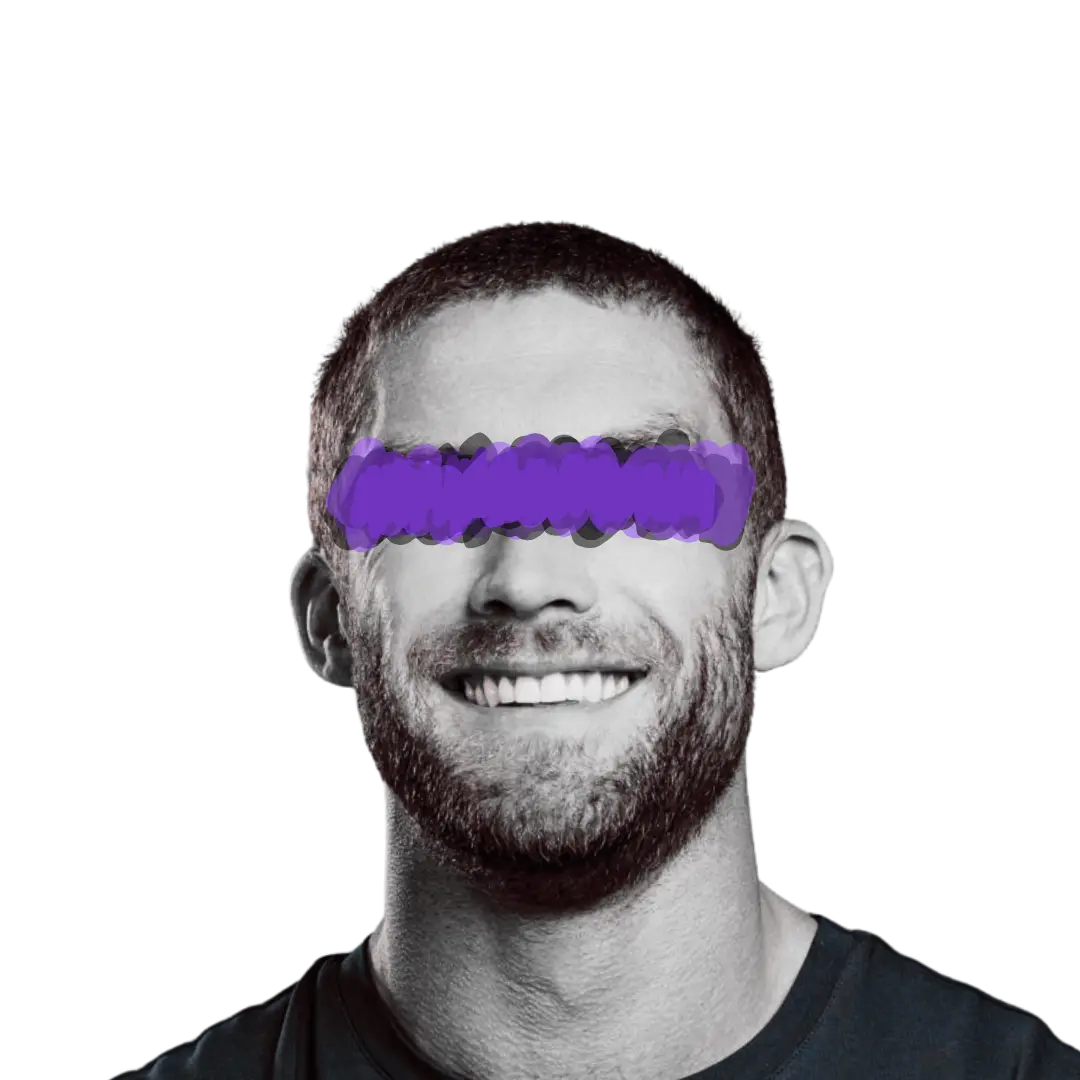
"I'm constantly trying to strip away the persona of a competent, regular podcaster and allowing myself to sit with questions rather than trying to broadcast a version of myself."
Chris Williamson built one of the world's biggest podcasts. But his deepest struggle has nothing to do with download numbers. It's about whether the person behind the microphone is real.
Most people see the polished interviewer. The guy who went from Love Island contestant to interviewing Jordan Peterson, Andrew Huberman, and over 100 New York Times bestselling authors. What they miss is the war between achievement and authenticity that shaped his entire trajectory.
TL;DR: Why Chris Williamson is an Enneagram Type 3
- Relentless reinvention: From nightclub promoter to reality TV contestant to podcast mogul, Chris constantly sheds old identities to prove his worth. That's the hallmark of Type 3.
- Image vs. authenticity tension: He admits to "broadcasting a version of himself" and struggling with vulnerability, the core Type 3 conflict between persona and real self.
- Achievement as identity: His obsession with metrics and milestones reveals a Type 3's tendency to measure personal value through accomplishments.
- Stress withdrawal: When overwhelmed, Chris isolates and disengages, mirroring the Type 3 stress move toward Type 9 numbness and avoidance.
- Depth beneath the drive: His 3w4 wing gives him unusual introspection for an achiever. He openly discusses depression, shame, and the "problem with self-improvement," showing the Four wing's pull toward emotional honesty.
What is Chris Williamson's Personality Type?
Chris Williamson is an Enneagram Type 3 (The Achiever)
Enneagram Type 3s run on a core need to feel valuable and worthwhile. They adapt, perform, and achieve, often becoming exactly what their environment rewards. Their superpower is efficiency and goal execution. Their blind spot is losing themselves in the performance.
He frequently references a psychology experiment where starving rats sit in a tube with a spring attached to their tail. Researchers waft the smell of cheese from the front, and the rats pull hard. Then they waft the smell of a cat from behind AND cheese from the front. The rats pull harder. His lesson: you're not running toward what you want. You're running from what you fear. And the fear and the desire are the same engine:
"A lot of striving and a desire for success comes from a sense of insufficiency. Like if only the world recognized my brilliance, then I will be validated. And it takes a long time to realize that you don't fix internal voids with external accolades."
Chris has been candid that most of his drive, and most high performers he's interviewed across 800+ episodes, is fueled by that same fear. The cheese and the cat, ambition and inadequacy, pulling in the same direction.
But he's not a typical Three. His 3w4 (Three with a Four wing) adds introspection and emotional depth that most achievement-oriented personalities lack. This wing drives him to talk openly about sadness and shame, topics that pure Threes dodge.
The result: someone simultaneously driven to succeed in the world's eyes AND haunted by the question of whether that success means anything real.
Chris Williamson's Upbringing
Chris was born in 1988 in Stockton-on-Tees, a market town in North East England. His father Kevin founded an engineering service provider, KW Competencies. His mother Kathy managed the household. He was an only child. Both parents were introverted, which meant socialization at home was limited.
That detail matters more than it sounds. Any only child struggles to be socialized the way a kid with siblings is. The arguing, the competing for bathroom time, the constant negotiating: he had none of it. When he arrived at school, he was socially ungainly. He didn't know how to relate to other kids.
So he studied the game from the outside:
"I used to obsess over things like the kind of hairstyle that other kids had, or the way that they tied their tie in school, the type of shoes that they wore, the way that they carried their bag, which shoulder their bag was on. Because I was adamant, I would fixate on that and that would be the reason that they had friends and I didn't."
He was trying to decode the formula. If he could crack the code, the right shoes, the right bag angle, people would accept him. A lonely kid running forensic analysis on popularity instead of playing.
He was badly bullied. Alone most of the time. He played cricket for the Durham Academy and had a team, but not a tight group of friends.
Years later, he looks back on that boy with a specific kind of grief:
"I feel sad for that little boy. I think I wish I could pick him up and say that he's worthy of love and he doesn't need to do these things and he doesn't need to fear, because in the future everything is going to be okay."
During a small dose of mushrooms, Chris saw a version of himself as that lonely kid, sitting on the ground, alone. He picked him up and held him and said, "You're doing great, Chris." The wound never fully closed. But he learned to carry it differently.
He studied Business Management at Newcastle University and later earned a master's in International Marketing, paying the 8,100 pound tuition in cash from nightclub earnings, which overwhelmed the university safe's 5,000 pound rating. He chose "safe" business degrees over the philosophy and psychology that fascinated him. That decision ate at him for years.
While studying, he discovered nightclub promotion. And everything changed, at least on the surface. He built one of the UK's biggest events companies, Voodoo Events, putting over a million people through club doors across 14 years. He was the guy with the VIP wristbands, the one who knew everyone at the door. But he'd replaced people wanting him with people needing him. Transactional proximity dressed up as belonging.
"I met about a million people in my life and I only had a handful of friends. My exposure-to-friend conversion seemed to be off."
The Years in the Dark
Chris's 20s were marked by intense sadness, low energy, isolation, and shame. He described not wanting to interact with people or even let sunlight into his bedroom. He made excuses at work to cover for his low performance.
In his phone journal, in his mid-20s, he wrote: "I think I'm lonely."
On the surface, he looked like he was thriving. Voodoo Events was booming. But the performance was hollowing him out:
"I was world class at playing Chris Williamson on the front door of a nightclub. Like, literally Oscar-winning performance. But it wasn't me."
Drowning in people and completely alone. The move to Type 9 under stress, numbness, withdrawal, disconnection, is exactly what Chris describes from this period.
Rise to Fame
Love Island and the Identity Crisis
In 2015, at 27, Chris appeared on the first season of Love Island as a model and nightclub promoter. He was the first person through the doors. He'd read Paulo Coelho's The Alchemist right before going in, a book about a boy who goes on a massive journey only to discover the treasure was back home all along.
He lasted three weeks. And what happened inside that villa cracked him open.
Chris has called it a "fatal dose of contrast." He was deposited into an inescapable bunker of genuine party boys and party girls, the actual versions of the person he'd been pretending to be. Within days, the mask started slipping.
One moment from the first night still sticks with him. He was sitting with his date, looking out across the landscape, and someone commented on something in the distance. Chris dropped a nerdy fact about the Coriolis effect. The girl turned to him and said, "Oh, that's really clever. Say some more clever things."
He felt fear. Not excitement. Fear.
"That's not, you're not supposed to show that side of you. That side of you is not safe because it's not popular."
He swallowed his intellectual self. Buried it. Kept playing the party-boy role. But in a villa with no phones, no TV, no books, no podcasts, no friends or family, there was nowhere to hide.
Ten years later, that nerdy intellectual curiosity is all he does. The thing he hid on Love Island became the foundation of his career. But at the time, it triggered what he calls a "pebble at the top of an avalanche," an existential crisis that would take years to fully unfold.
The Wilderness Years
After leaving the villa, Chris stepped outside alone for the first time in a month, into the southern Mallorca night. He looked up and saw the full Milky Way. That moment became the starting point of an 18-month journey of self-discovery.
But he didn't make a clean break. He went back to promoting nightclubs. He still ran Voodoo Events. Except now the disconnect had become unbearable:
"I can't have a conversation about the deeper sense of human nature or the existential pain of being alive or status from Will Storr's brand new book when someone's desperately trying to get a VIP wristband off me so that they can go and see the hot girls downstairs. It's not quite the right environment for that."
What followed was years of grinding through personal development with no guarantee it would lead anywhere. A thousand days sober. Nine gratitude meditation journals. 1,500 meditation sessions. Years of daily journaling. All done in solitude, with no idea if any of it would work.
"Your entire journey of personal growth is just steeped in doubt and self-pity and uncertainty. 'This is supposed to be my Rocky montage. It's three and a half minutes in the movies, but it's been four years for me.' There's not even the promise that there's any glory on the other side."
He calls this "the lonely chapter": the painful gap where you're too developed to resonate with your old community but not yet far enough along to have built a new one. Your friends make digs at you for not drinking. You don't speak the same language anymore. The faster you grow, the fewer people match your speed.
The isolation that had traumatized him as a boy became the competitive advantage that let him grind in silence as a man. He'd spent a childhood learning to work alone without external reward. Now that skill had a purpose.
Building Modern Wisdom
In 2018, Chris channeled the crisis into action. He launched the Modern Wisdom podcast.
"Modern Wisdom, the tagline from the very beginning was 'Understand yourself and the world around you' -- because I didn't have either of those."
The first episode was filmed in his old nightclub office in Newcastle. A single iPhone. A Blue Yeti USB mic bought secondhand from a guy on eBay in Gateshead. Him and his friend Stu Morton talking about rowing the Atlantic. No strategy. Just two mates and a conversation.
What made Modern Wisdom break through wasn't a formula. It was instinct. Chris picks guests based on curiosity rather than algorithm optimization. He's described his approach as being a museum curator, walking the listener through exhibits, following fascination rather than niching down. He thinks of great conversations as sports matches where both teams work together to get the ball in the goal.
What separates him from hundreds of other curiosity-driven interviewers is his willingness to make the conversation emotional. He creates space for guests to be vulnerable in ways that more adversarial shows don't. He asks questions he doesn't know the answer to. And when a moment lands, he doesn't move past it.
No single episode changed everything. The transformation was cumulative, 800+ conversations slowly reshaping him. But certain moments stand out. A man approached him at a fitness expo, emotionally overwhelmed, and told Chris how a Modern Wisdom conversation had helped him reconnect with his wife and daughter after his father's death. Chris has pointed to that moment as proof the pivot was worthwhile. As he put it: "Getting people drunk never really felt like I was transcending the suffering of day-to-day existence."
Then came the Rogan call. In July 2022, Joe Rogan messaged Chris directly about appearing on JRE. The episode aired weeks before Chris moved to Austin. He's now appeared three times. The moment validated what years of silent grinding hadn't: that the nerdy kid from Stockton-on-Tees belonged in the room.
His quality obsession reveals the achiever underneath. The internal motto for his team: "Make the most beautiful podcast in the world." His creative director Dean Hindmarch helped build a world-first LED volume video-wall studio using the same Unreal Engine 5 technology as The Mandalorian. Chris describes himself as a nightmare to work with, someone who notices every mismatched color grade, every imprecise thumbnail, every sentence that isn't right. "Control freak is a word that people with low standards use to describe people with high standards."
The trajectory: over a billion YouTube views. 4 million subscribers. 400 million downloads. The eighth biggest podcast in the world on the 2025 Spotify charts. A newsletter, "3 Minute Monday," with over 300,000 subscribers. His 2023 Spotify Wrapped revealed that 84% of his audience had discovered the show that year, after five years of building.
He'd recreated the education he'd been too afraid to pursue at Newcastle. The exact professors he wanted, talking about the specific sliver of their work he cared about, on his schedule.
The Sobriety Decision
One of the most concrete examples of Chris shedding his old identity gets surprisingly little attention: he stopped drinking at 30.
For a man whose entire adult identity had been built around nightclub promotion, selling the night, being the center of the party, going sober was a quiet demolition of his former self. It wasn't dramatic. It was methodical. And the data convinced him.
About a year in, he tested it. A couple glasses of wine. Not enough to get drunk. It ruined three days, cascading into worse sleep, worse eating, worse podcasting, a skipped gym session. He never went back. By 2023, he was over a thousand days sober.
But the real revelation wasn't physiological. It was social:
"If you can only bear to be around your friends when you're drinking, that's probably not a good indication. And if your friends only want you to be around them when you're drinking, they're not friends, they're drinking partners."
For Chris, quitting alcohol wasn't health optimization. It was a filter that separated the people who needed him from the people who knew him.
The Austin Reinvention
In September 2022, Chris made what he's called the biggest decision of his adult life: he moved from Newcastle, England to Austin, Texas. Alone. Knowing almost no one.
He frames the decision through Christopher Hitchens via Douglas Murray: "In life we must choose our regrets." He could live with the regret of trying and failing. He couldn't live with the regret of "what if."
Austin wasn't just a new city. It was proximity to the center of gravity. Joe Rogan had already invited him on JRE weeks earlier. The broader Texas podcast and creator ecosystem gave him access to guests, collaborators, and an American audience that didn't flinch at ambition.
Chris has talked openly about what he calls the UK's "tall poppy syndrome," the tendency to cut down anyone who grows beyond the acceptable height. When the 2025 Spotify Wrapped revealed three Brits in the top 10 podcasts globally (Chris, Steven Bartlett, and Jay Shetty), a prominent British journalist wrote that their success was "a rejection of our patriotic inheritance." Chris's response:
"Americans want you to succeed in case you take them with you on the journey. And the worst parts of British culture don't want you to succeed in case you leave them behind."
The move also continued a pattern: reinventing himself in a new environment where no one knows the old version. Newcastle student becomes club promoter. Club promoter becomes Love Island contestant. Podcaster leaves the country entirely. Each time, he sheds the skin and starts fresh, outrunning the person he used to be.
Chris Williamson's Personality
The People-Pleaser Beneath the Performer
After nine months of psychotherapy, Chris's biggest revelation wasn't what you'd expect. He's a compulsive people-pleaser. Not in the surface-level "I'm too nice" sense, but in the childhood-rooted, automatic sense.
If he drops a question to a guest and sees it makes them uncomfortable, he feels compelled to throw them a life buoy. Not because he chooses to, but because if he doesn't, he feels worse.
"Am I choosing to do this because I want to make this other person feel better? Or am I compelled to do this because if I don't, I feel worse?"
He takes responsibility for other people's emotional states at all times. If a friend misinterprets something he did, he makes it his fault, even when it wasn't.
He calls this the Atlas Complex, named after the Greek titan condemned to hold up the sky forever. "Why is it that when I mess up, it's my fault, but when other people mess up, it's also my fault?" If your peace at home as a child depended on keeping everyone else happy, you learned that the fastest route to calm was to accept fault. The problem: the world will happily accept this bargain.
Love and the Achiever's Trap
The pattern extends into his relationships, and this is where the Type 3 wound cuts deepest.
He's admitted to a "degree of fragility around support in relationships and friendships," an ability to make himself the villain even when the situation wasn't his fault. And he's identified the paradox driving it:
"We want the world to love us for who we are, not for what we do. However, we love ourselves for what we do, not who we are. So we're asking the world to do something that we don't do ourselves."
Chris has traced this to his upbringing: parents who praise success and criticize failure teach children that admiration is contingent on results. That lesson, he says, "metastasises through early adulthood into 'I am only worthy of love, acceptance and belonging if I succeed.'" For a Type 3, love becomes another performance review.
At 37, Chris is in a relationship he's approaching with the same intentionality he brings to everything: taking his girlfriend on a week-long trip through Jamaica, navigating chaotic traffic and visa renewals, because extended travel stress reveals compatibility better than any conversation. He keeps his partner's identity private. What he shares publicly is the struggle itself, the difficulty of being seen without the armor when you've spent a lifetime perfecting it.
He's pushed back directly against the manosphere advice to never be vulnerable with a partner, citing a world champion athlete who "sobbed on the bathroom floor in his girlfriend's arms when the pressure became too much, then dusted himself off and went out to become a world champion." His point: a relationship where you can't fall apart isn't a relationship.
"True intimacy is being radically unedited and still accepted. The rest is set design."
For someone whose core pattern is performing to earn love, learning to be loved without performing may be the hardest project of all.
What He's Arguing For
Chris has positioned himself unusually for someone with a predominantly male, self-improvement-oriented audience. He argues against the emotional control most men in his space preach.
He calls our culture "obsessed with authenticity but terrified of sincerity." There's an "emotional Overton window" where we claim to want openness, but when someone steps outside the narrow band of acceptable emotional expression, everyone panics.
He gets teary on stage every night during live tours. He doesn't hide it.
"Suppression isn't the same thing as strength. I think it's a good thing for guys who feel their emotions to show that they feel their emotions."
Chris Williamson's Personal Struggles
The Health Crisis
In 2025, Chris went public with a serious health battle. What started as brain fog and exhaustion turned out to be toxic mold poisoning from his house in Austin, compounded by Lyme disease, Epstein-Barr virus, cytomegalovirus, candida, H. pylori, and parasitic infections.
The symptoms targeted the three pillars of his identity, energy, mood, and cognition, with surgical precision. He described it as a "personal curse," as though someone had designed a pathology to destroy the exact things he derived his self-worth from.
He went to bed at 7 PM for six months. His cortisol was inverted, higher at night than in the morning, meaning no matter how long he slept, he never felt rested. Wired but tired.
He forgot how to tie his shoes. He forgot words, forgot the names of people he'd known for years, forgot the names of friends' dogs. He described his mood as "swimming in melancholy."
"It felt so unfair, so comically unfair, like a literally personal curse."
His initial response was pure Type 3: try to outwork the problem. When that failed, he was forced into a different relationship with his body and his identity. He couldn't perform his way through this. His only two goals for the year became simple: don't let the show drop, and fix the health.
But something broke open in the stripping-away. When Steven Bartlett asked him what remained when everything he valued was taken away, Chris answered quietly: "Somebody who's kind. Somebody who's genuinely kind and sensitive. And I always thought that sensitivity was a weakness, but it's not."
He learned to take pleasure in "boring victories": a walk, being kind to someone at the supermarket, being gentle with himself when frustrated. He had to get over the shame that feeling proud about something small was a comment on the smallness of his life.
"I realized that denying myself the opportunity to be happy about something small is basically me holding my happiness hostage. Like until the bank deposit is sufficiently large, the ledger doesn't kick in."
Being forced to stop is terrifying when your value is tied to what you produce. Chris found his answer at 37, in a dark room, unable to remember how shoes work: kindness, sensitivity, ordinary resilience. The answer most achievers spend their whole lives avoiding.
By late 2025, he rated himself at a seven or eight, up from a three. His closing line on his year-end podcast:
"If I can do what I've done over the last 12 months feeling the way that I've felt, God help the world if I get back to full capacity. Don't bet against me."
The Masculinity Question
Chris frequently discusses modern masculinity, and the topic draws both praise and serious criticism.
The data motivating him is stark: men reporting zero close friends jumped from 3% in 1990 to 15% by 2020. One in three men aged 18-30 hasn't had sex in the last year. He frames it as a crisis affecting both sexes:
"For the first time in our four-million-year history, we have large cohorts of both men and women who want relationships and can't get into them."
What's distinctive about his framing: he refuses to make it adversarial. He explicitly argues against rolling back women's education or employment. He insists there needs to be a way to raise men up "without bringing women down."
Critics have been vocal. Chris acknowledges that discussing masculine topics at all gets him labeled right-wing by default. He describes "criticism capture" as his personal vulnerability: the way negative feedback warps you over time, either hardening you into aggression or softening you into meaningless caveats.
"I think that criticism killed more dreams than a lack of competence ever did."
Where Chris differs from most masculinity commentators is the personal stake. He's someone who spent his childhood unable to connect, his 20s performing a character, and his 30s dismantling the whole thing in public. His commentary reads as partly social analysis and partly autobiography: the kid who couldn't figure out which shoulder to put his bag on, extending that question to an entire generation.
Chris Williamson's Legacy and Current Work
Chris continues to run Modern Wisdom from Austin, Texas. His current theme is a question only a recovering workaholic would ask: "Can you be world class and have fun at the same time?"
He knows the world-class part has been achieved. The fun hasn't. He sacrificed it deliberately. Now he's trying to learn something no self-improvement book teaches: how to enjoy what you've built.
"You're already doing enough. Stop whipping yourself into submission, thinking that your happiness sits on the other side of the next set of goals that you're going to achieve. You've already achieved goals that you said would make you happy. So if you haven't made it now, if this isn't when life is going to begin, then when are you going to start?"
His parents, by his account, have supported every reinvention:
"They have a lot of faith in me. They've never stepped in and said that I should or shouldn't do anything, which is a real testament to them overcoming their -- you know, everyone's child is like this precious little ball of genetics. And they've been really phenomenal at just sort of letting me do my own thing."
And now Chris is preparing to become a parent himself. At 37, he's getting fertility testing done and being characteristically honest about the absence of any emotional pull toward fatherhood.
"I think I'll be a dad within the next 12 months. And I have to say this again because it's so important: there's no part of me in this moment of time that's like, 'Oh, I really really want to be a dad.' I can see the cost, but the benefit is unknown. I have to take other people's words for it."
No warm feeling tells him it's a good idea. Instead, there's what he calls his "meta brain," the one that lives 50 years in the future and tells him it's the most meaningful thing he can do. And there's a motivation rooted in something deeper than logic: breaking cycles. Taking all the patterns from his first 21 years, the loneliness, the performing, the fear of insufficiency, the ones he's spent the next 16 unwinding, and refusing to pass them to the next generation.
The lonely boy from Stockton-on-Tees, the one who obsessed over which shoulder other kids carried their bags on, is trying to make sure his child never has to decode the formula for belonging. That's not a career milestone. It's the kind of quiet ambition that can't be measured, which is exactly why, for a Type 3, it might be the bravest thing he's ever done.
How Chris Williamson's Personality Connects to Yours
Chris Williamson's journey raises a question most of us avoid: are you building a life or performing one?
He talks about intentionalism, doing what you mean to do and wanting what you want to want. Not what society tells you to want, not what your past traumas tell you to chase, but what you would choose if you could design your own desires.
We all have a version of this dilemma. We all curate, optimize, and present carefully edited versions of ourselves. We all mistake the applause for love.
As Chris put it: "You can be surrounded by people and yet feel alone in a crowd and hollow in victory. Because if you're only playing a role, any love that people give to you won't feel like it hits you existentially. You'll feel praise, but you won't feel love."
If you're curious about your own patterns, the drives you don't question, the performances you don't notice, exploring your Enneagram type might reveal more than you expect.
Disclaimer: This analysis of Chris Williamson's Enneagram type is speculative, based on publicly available information, and may not reflect his actual personality type.
What would you add?