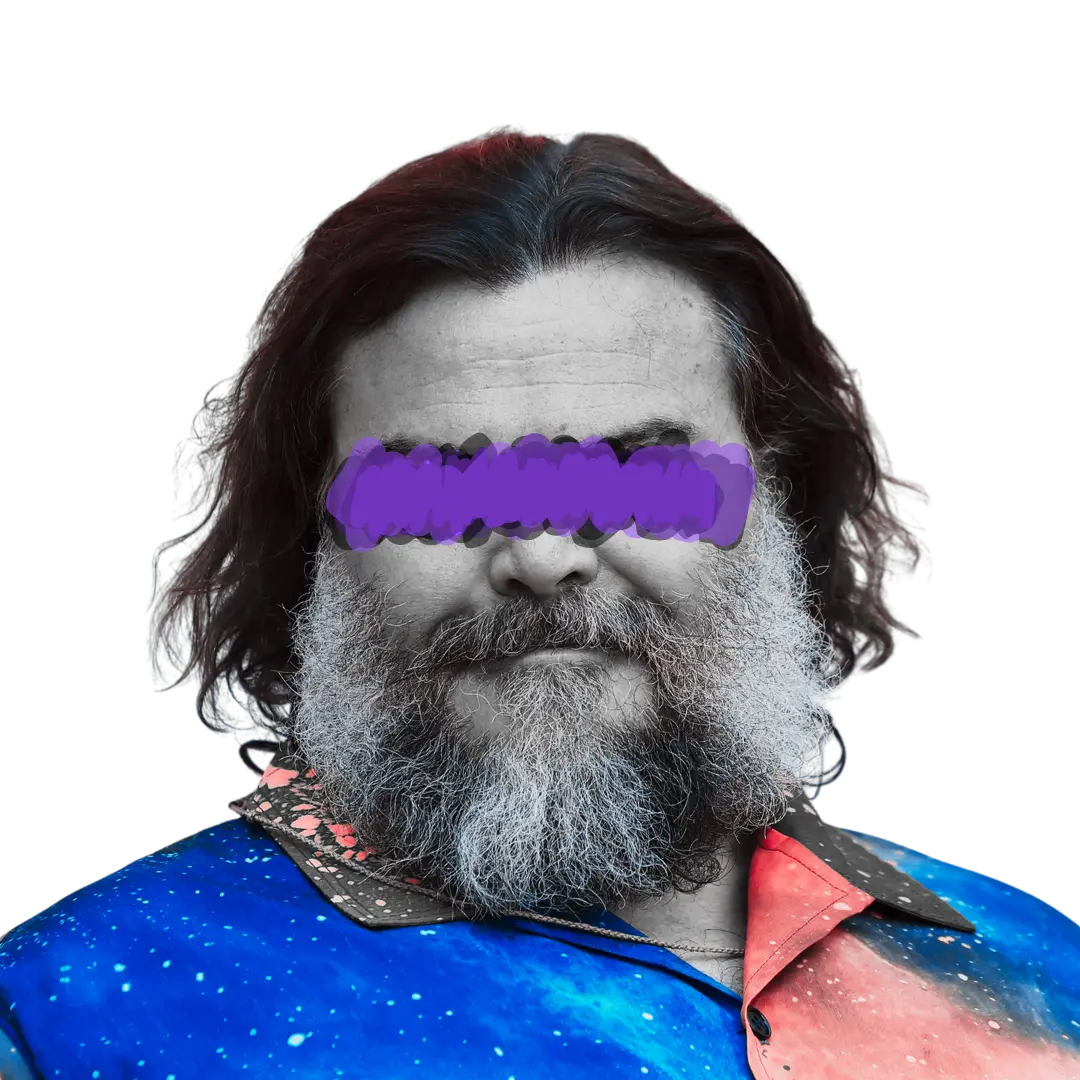
On August 28, 1969, Judith Love Cohen went into labor with her fourth child. She was one of the only female aerospace engineers in the country. She'd helped design the Abort-Guidance System for the Apollo Lunar Module — the backup navigation computer that, eight months later, would guide the crippled Apollo 13 spacecraft through two critical mid-course corrections on its way home. On her way to the hospital that morning, Judith stopped at her office, picked up a computer printout of an engineering problem she'd been working on, solved it during labor, and called her boss to share the solution.
Oh, and somewhere in there, she had a baby. Thomas Jacob Black. The world would come to know him as Jack.
"It's true... my mom was a bad-ass aerospace engineer... and also a loving mother," Jack shared after her passing in 2016. "I miss you mama!"
This origin story matters because it sets up the central question of Jack Black's psychology: Where does that extraordinary energy come from? And what happens when the man who seems incapable of sitting still is forced to?
TL;DR: Why Jack Black is an Enneagram Type 7
- Boundless energy as survival: Jack's manic, larger-than-life performances aren't manufactured. They emerged from a childhood where staying positive was the only way to cope — parents' divorce at 10, brother's death from AIDS, cocaine addiction at 15.
- The non-obvious tell: What makes Jack fascinating isn't the chaos. It's the moments he chooses restraint. Insisting on playing the straight man in Anaconda. Requesting 32 takes for a love scene in Shallow Hal. Delivering a subdued, devastating performance in Bernie. An Enthusiast who can voluntarily rein in his energy has done real inner work.
- Under stress, the showman vanishes: When crisis hits, Jack's playfulness is replaced by something rigid and principled — canceling an entire world tour overnight over Kyle Gass's Trump comment. No hedging, no humor. Just moral clarity.
- In growth, he goes inward: The self-proclaimed "hermit" who meditates, contemplates moral complexity, and chose acting because he "felt like he connected to something emotional and real." Not the man you'd expect from the TikTok videos.
- The edge underneath: Jack doesn't avoid conflict the way softer performers do. The bold stage presence and the backbone to set boundaries are his signature, not a glitch.
What Is Jack Black's Personality Type?
Jack Black Is an Enneagram Type 7 (The Enthusiast)
Enneagram Type 7s are called "The Enthusiast" for a reason. They're driven by a need to experience life's pleasures and avoid pain at all costs. Their minds race with possibilities, plans, and ideas. They're the life of the party, the ones who make everything feel like an adventure.
But here's what most people get wrong about analyzing comedian Type 7s: they stop at "humor masks pain." That's true, but it's the obvious reading. The more interesting question is what happens when a 7 chooses to stop being funny.
Jack Black has done this multiple times in his career — and those moments reveal more about his psychology than any manic performance ever could.
Jack's childhood wound? His parents divorced when he was 10. His father, Thomas Black, was a satellite engineer. Jack grew up in a household where dinner conversation might literally involve space exploration. That intellectual curiosity was real. But so was the fracture.
"There's something about a divorce that even if your parents still love you, the fact that they can't live with each other makes you feel there's something wrong with you," he once reflected.
That feeling of something being wrong, and the desperate need to escape it through fun, through music, through making people laugh — that's the core of the Type 7 experience. But Jack's story gets darker before it gets better.
The Dark Years Jack Rarely Discusses
When Jack's parents divorced, something broke. When his older brother Howard died of AIDS, the pain became unbearable. Howard "was a big influence on me," Jack has said. He "shaped my taste in music" and took Jack to his first rock concert at age 11. Losing him was devastating.
"Losing a family member is the worst thing I could imagine... We were robbed of something precious. It was hardest for my mom when we lost Howard. She's never really recovered."
Jack turned to cocaine as a teenager.
"I was having a lot of troubles with cocaine," he admitted. "I was hanging out with some pretty rough characters. I was scared to go to school because one of them wanted to kill me."
He described his teenage years with unflinching honesty: "I should have been put in jail. I got into drugs and I stole money from my mum. It was a bad time."
When the pain became too much, Jack didn't just avoid it. He numbed it. He chased any sensation that would keep the darkness at bay. The kid who'd lost his brother to AIDS and watched his family fracture was doing cocaine at fifteen — not to get high, but to get somewhere, anywhere, that wasn't where he was.
What saved Jack? A school counselor. And the moment was more profound than a simple pep talk:
"I spilled my guts, telling him I felt guilty about stealing from my mom to get money for cocaine. I cried like a baby. It was a huge release and a huge relief... It changed me."
That moment — sitting with painful truth rather than fleeing it — was the first time Jack accessed the depth that would later define his best work. It was his first time going inward instead of outward, processing instead of performing.
Early in his career, people told Jack he was "the next John Belushi or Chris Farley." He understood the compliment came with a sting — both died young from substance abuse. Jack described wanting Belushi's "hangability quotient" and acknowledged they shared "a similar raunchy energy." But he consciously diverged from the self-destructive template. He doesn't like getting drunk, hates big parties, and feels self-conscious dancing in public. The explosive comedy doesn't require a destructive lifestyle. That distinction may have saved his life.
Rise to Fame: From Tenacious D to Stealing Every Scene
Jack started in theater, joining the Actors' Gang in Los Angeles where he met Kyle Gass. The two didn't like each other at first. Gass was the main musician and felt "threatened" by Jack. But during a trip to Edinburgh, they became friends and eventually formed Tenacious D.
"I'd go over there with Jack In the Box tacos and seasoned curlies," Jack recalled about their early songwriting sessions at Kyle's apartment (which they called "The Cockroach Hotel" because it was on Cochran Street). "We'd smoke pot, write songs and hang out. For years, it seemed like."
That creative partnership caught the attention of John Cusack, who cast Jack in High Fidelity (2000) after seeing Tenacious D perform.
The High Fidelity Breakthrough
High Fidelity was the movie that turned Jack Black into an undeniable screen presence.
Director Stephen Frears insisted Jack stay in the role of Barry Judd, the loud, opinionated record store clerk. Black had initially passed on the part. But Frears convinced him to take the plunge, and he threw everything he had into it.
The result? "Let's be honest, the film belongs to Jack Black," critics noted. "As Barry, Rob's loud, opinionated employee, Black is a force of nature, stealing every scene with his manic energy." The Washington Post's Desson Howe praised him as "a bundle of verbally ferocious energy."
His performance was so good it arguably disrupted the film's balance, making John Cusack's brooding lead feel indulgent by comparison. In an interview with GQ, Black called it his "big breakthrough role."
What happened next reveals something important. After High Fidelity, Jack "rose too fast and got what you would call celebrity sickness." But unlike many who ride that wave until it crashes, he self-corrected: "I got my bearings after a couple of years." That capacity for self-correction — recognizing excess and pulling back — is a pattern that would repeat throughout his career.
Why "School of Rock" Matters to Jack
Here's something that might surprise you: Jack Black, the manic comedian known for his wild energy, considers working with children the highlight of his career.
"My best memories are just that group of kids, and how funny and great they were," he told Entertainment Tonight. "It's definitely the highlight of my career, I can say that. Honestly."
Parents on set were initially nervous about Jack's influence. Jordan-Claire Green, who played Michelle, remembers: "You see him in things like Orange County and Tenacious D, and he's just so wild and out of control, and I think my mum was just terrified that he was gonna be a terrible influence on me."
Instead, Jack was "amazing" behind the scenes. Miranda Cosgrove said he was "the best" and would play games with the young cast members between takes.
This reveals the protective instinct running underneath the chaos: Jack is often unexpectedly generous with the people he cares about. The character of Dewey Finn — an underestimated rebel who inspires everyone around him — wasn't far from the man playing him. Jack's favorite film is One Flew Over the Cuckoo's Nest, and Jack Nicholson's Randle McMurphy haunts every role Jack plays. Wild, rebellious, ignoring social conventions, but ultimately fighting for the people the system has failed.
The Nacho Libre Cult
Then came Nacho Libre (2006). Mixed reviews upon release. Now one of the most quotable cult classics of the 2000s.
Jack plays Ignacio, a monk who secretly becomes a luchador wrestler to support the orphans at his monastery. The premise is absurd. The execution is absurder. Nearly two decades later, people still walk around quoting it:
"Chancho, when you are a man, sometimes you wear stretchy pants in your room. Just for fun."
Like many of his characters (Po in Kung Fu Panda, Dewey Finn in School of Rock), Ignacio is an underdog who refuses to accept his limitations. Ridiculous. Earnest. Ultimately inspirational. Jack plays these characters from the inside — the guy who genuinely cannot conceive of a ceiling, who looks at "no" and hears a question instead of an answer.
TikTok and meme culture have only expanded the film's reach. A new generation discovered Nacho Libre through viral sounds and quotes, proving that genuine weirdness ages better than calculated cool.
When the Showman Goes Quiet
There are two Jack Blacks that almost nobody talks about, and both live underneath the TikTok dances and the power ballads.
The first is the Jack who snaps rigid and principled under pressure — the one who canceled a tour overnight. The second is the Jack who goes quiet and inward when he's healthy — the hermit who meditates, studies a convicted murderer for a role, comes back with questions instead of answers.
Both patterns are far more psychologically interesting than his onstage manic energy.
Under Stress: The Sudden Perfectionist
When pressure hits, Jack's anything-goes playfulness vanishes. He becomes exacting, principled, almost severe.
On filming a love scene in Shallow Hal: "It was just strictly professional. It was like a doctor or a carpenter plying his trade. I received no pleasure whatsoever... I requested 32 takes for the perfection of the craft."
This is not the man you see doing shirtless TikTok dances. This is the same person approaching work with clinical precision rather than spontaneous joy — the playfulness replaced by something far more exacting.
Fatherhood triggered the same shift. "What surprised me is how much I worry," he said. "I've had to be responsible now. I've got to figure out the right thing to do in all these different situations that I had never really paid attention to before."
The language is telling. "The right thing to do." Not "the fun thing" or "the exciting thing." Rule-following. Anxious about correctness. Suddenly concerned with moral duty. That's the same snap-to-principle pattern that runs through every one of Jack's high-stakes moments.
The most dramatic example came in July 2024.
The Kyle Gass Incident
During a Tenacious D concert in Sydney — the day after the Trump rally shooting in Butler, Pennsylvania — Jack presented Kyle Gass with a birthday cake and asked him to make a wish. Gass responded: "Don't miss Trump next time."
Jack's response was unlike anything in his public history. Gone was the humor. Gone was the improvisation. In its place: rigid, formal, morally absolute language.
"I was blindsided by what was said at the show on Sunday. I would never condone hate speech or encourage political violence in any form. After much reflection, I no longer feel it is appropriate to continue the Tenacious D tour, and all future creative plans are on hold."
He canceled the entire remaining world tour. Overnight.
No nuance, no hedging, no reframing. The man who built a career on improvisation issued language that sounded like it had been reviewed by a lawyer and a priest. Black-and-white moral clarity. He destroyed his own touring income and creative partnership because it was "the right thing to do." The statement was measured, serious, and devoid of his usual voice. The opposite of every public appearance he'd ever made.
Kyle Gass later revealed: "We hashed it out. And it was hard." He compared their dynamic to a marriage: "It is like a marriage. You go through these ups and downs, and try to understand your partner." Gass understood Jack's position: "Jack has this magnificent career; I can't even count the franchises now. I totally understood what he needed to protect. I didn't begrudge him any of that."
But here's where Jack's underlying 7 nature resurfaced. He maintained the friendship. He expressed optimism. "Yeah, we're friends. That hasn't changed. These things take time sometimes... And we'll be back when it feels right." By 2025, they'd released new music together — an REO Speedwagon cover on a charity record.
Address it directly. Set the boundary. Then move forward. That's a showman who's learned to use the severity constructively rather than being consumed by it.
In Growth: The Hermit and the Philosopher
The other side of the coin is quieter and rarely discussed.
Despite his larger-than-life public persona, Jack describes himself as a "hermit" in private. His favorite pastimes? Sleeping late, all-night movie marathons, and playing video games on his Xbox. He doesn't like getting drunk. He hates big parties.
He meditates. He practices visualization. He uses stretching and sleep as deliberate anxiety-coping tools. "You don't want to focus on what can go wrong," he's said. "You've got to focus on what could go right."
A man whose career runs on chaotic improvisation building an intentional mental-discipline practice is significant. The scattershot enthusiasm that defines his public self has a quieter twin that appears when the cameras go off.
The deepest expression of this growth came in Bernie (2011). Richard Linklater cast Jack as Bernie Tiede, a small-town mortician who murders a wealthy widow. Jack spent time with the real Tiede in prison, studying his mannerisms, his "very soft and sweet" personality. He suppressed every instinct that had made him famous — the manic energy, the blustery confidence, the lovable lunacy.
Roger Ebert called it "one of the performances of the year." He noted that Jack "creates this character out of thin air... it's like nothing he's ever done before."
Jack acknowledged the pressure: "There's a lot of pressure... it's a tricky spot to be in when you want to be funny, but this is a person's life you're playing with."
This is Jack at his healthiest. Not chasing stimulation. Not fleeing pain. Sitting with a complex, morally ambiguous character and giving him depth. Jack once told Parade that acting attracted him most when he "felt like he connected to something emotional and real." That's not the statement of someone who's just performing chaos. That's someone reaching toward meaning.
Perhaps the most revealing quote: "Before we snap to judge someone who's done a horrible crime, is it possible that all of us in the worst possible circumstances could be capable of something like that? So it's about not judging people before really considering what the circumstance was."
That's not the Kung Fu Panda guy talking. That's someone who spent real time with a convicted murderer, sat with what he found, and came back with questions instead of answers. The man who plays the loudest character in every movie quietly contemplates moral nuance when no one's watching.
Enneagram Rabbit Hole: Wings, Subtypes & Connecting Lines for Jack Black
For the Enneagram nerds. Skip if you're not deep into the system — the rest of the analysis stands on its own.
Jack Black's Wing: 7w8
Jack reads as 7w8 — the Enthusiast with a Challenger wing. A 7w6 is softer, more anxious, more dependent on the group's approval for safety. Jack has visible 8-wing edge: the bombastic stage presence, the backbone to cancel a world tour over a political comment, the protective instinct that kept the School of Rock kids safe on set. When a 7w8 commits, the commitment lands with weight. 7w6s apologize their way through conflict; 7w8s draw the line and walk away.
The 8-wing is what makes Tenacious D work as a performance mode. Pure 7s don't scream operatic metal. They need the 8's body-level intensity to push the voice past speaker-cone levels. Same wing shows up in the three-octave range he built without classical training and in the willingness to be publicly ridiculous without flinching.
Jack Black's Instinctual Subtype: sp/so
Jack reads as self-preservation-dominant with social secondary. The sp-7 signature is the hermit baseline. "I don't like getting drunk, hate big parties, feel self-conscious dancing in public." Sleep late. All-night movie marathons. Video games on Xbox. Sp-7s chase appetite at home, not in crowds. The instinct runs on securing the comfortable base — which is why the TikTok shirtless-in-a-speedo videos work: they're performed from a place of private self-acceptance, not exhibitionist need.
Social sits second and carries the principled public work. 21 charities, 16 causes. The tour-cancellation statement sounding "reviewed by a lawyer and a priest." The long steady partnership with Tanya. The protectiveness over the School of Rock kids. Sexual sits last. A 15-year shy crush you never act on is not an sx-first move; neither is a career almost entirely free of relationship drama.
Stress and Growth Arrows
Under pressure, Jack reaches toward Type 1. The Kyle Gass cancellation is the clearest case — no hedging, no humor, formal language that sounds "reviewed by a lawyer and a priest." The Shallow Hal 32-takes ("strictly professional… I received no pleasure whatsoever") is the same mechanism in a smaller frame. Fatherhood language: "I've got to figure out the right thing to do." 7-in-stress borrows the Reformer's rigidity without the Reformer's usual framework to hold it.
In growth he moves toward Type 5. The school counselor breakthrough at 15 — spilling his guts, crying, actually sitting with the guilt — was his first time going inward. The Bernie performance came from prison visits and studying a convicted murderer's soft voice. Meditation, visualization, stretching as anxiety tools. See the connecting lines for how 7s borrow 5's depth when they stop running.
Counterarguments: Why Jack Might Not Be Type 7
The strongest alternate read is Type 3. The career success, the range across comedy, music, voice acting, TikTok, the capacity to charm any audience. 3s and 7s both look energetic from the outside and both know how to land a performance.
The rebuttal: 3s curate their image carefully, adapting presentation to the audience's reward signals. Jack is the opposite shape — un-curated, anti-image. Shirtless in a red speedo getting hosed down for TikTok. Shirtless in a green tracksuit with a red mohawk rising from under the Barclays Center stage. These aren't 3-calibrated image moves; they're 7s following the next fun thing without filtering for status. The 7's appetite signature shows up in the variety itself: Jack doesn't pick one arena and optimize it. He goes wide because narrowing feels like cage.
Jack Black's Mind: Quirks, Habits, and Hidden Depths
The Digital Reinvention: TikTok and Jablinski Games
In his 50s, Jack became a Gen Z icon.
TikTok (@jackblack): 19 million followers. 115 million likes. The content? Shirtless dancing, silly challenges, pure unfiltered joy. In November 2020, he posted a video of himself doing the "WAP" challenge in nothing but a red speedo while someone hosed him down.
It shouldn't work. A 50-something actor doing TikTok dances? Recipe for cringe. But Jack approaches it with such genuine, childlike enthusiasm that it transcends embarrassment. He's unashamed of the figure he cuts, proving that grace and athleticism have nothing to do with conforming to Hollywood body standards.
For a generation raised on irony and internet cynicism, Jack's earnest absurdity feels refreshing. He's not trying to be cool. He's not in on some joke at his own expense. He's just being. That authenticity resonates.
Jablinski Games (YouTube): In December 2018, Jack launched a gaming channel with his son Sam. The stated goal? "Bigger than Ninja... bigger than PewDiePie!" Within one week, he had one million subscribers before posting a real video. Within two weeks, 2.5 million.
The catch? He barely played games.
A running joke emerged: Jack would start videos apologizing, "No gaming videos this week," then proceed to do whatever he wanted. Pinball tours. Random vlogs. The channel became a charming anti-gaming-channel, shot with home-movie quality that set it apart from polished celebrity content.
That's pure Type 7: starting something, immediately deviating from the expected path, following whatever captures his attention in the moment.
The 15-Year Crush
Jack met his wife Tanya Haden at Crossroads School in Santa Monica. He was immediately smitten.
But did he ask her out? No.
"I didn't date Tanya or talk to her or anything in high school," he admitted to Parade. "I was pretty shy. I just watched her from afar."
For fifteen years.
Then, at a mutual friend's birthday party, Tanya approached him: "Hey, do you ever wanna go get dinner? I should give you my number."
Jack's response? "Heaven opened up above my head."
They married in 2006 in Big Sur, California. They have two sons, Samuel and Thomas.
"It's a lonely existence just floating around without a life partner," Jack told The Guardian. "When I'm with Tanya I have this great feeling of sharing experiences, of not feeling alone in the universe because I've got her beside me. I'm a bit of a romantic."
Major Accomplishments
The Musical Talent People Underestimate
Here's what the comedy sometimes obscures: Jack Black is a legitimately skilled vocalist.
His vocal range spans E2 to C5, over three octaves, with extended falsetto reaching E5. Voice experts classify him as a "baritenor" — a flexible baritone with tenor extension that's ideal for rock, metal, and the theatrical operatics that define Tenacious D.
The surprising part? He's not classically trained. Just high school choir. Everything else came from instinct, practice, and what vocal coaches call "theatrical intuition."
His technique involves mix voice, falsetto, controlled distortion, and what's called "false fold" technique — the raspy, powerful sound that makes his singing feel impossibly huge.
Beyond Tenacious D, Jack has collaborated with serious musicians: he sang "Burn the Witch" with Queens of the Stone Age, contributed vocals to Eagles of Death Metal's Death by Sexy album, and recorded a duet on Meat Loaf's Hang Cool Teddy Bear.
The comedy works because the musicianship is real. You can't parody something you can't do. Jack's operatic screams and power ballads land because they're technically proficient. The joke isn't that he can't sing. It's that he's singing this way about this subject. That approach — genuine mastery filtered through absurdist comedy — owes a clear debt to "Weird Al" Yankovic and to Led Zeppelin, whose bombastic style Tenacious D lovingly satirizes while actually performing at a high level.
He's been Po the panda across four Kung Fu Panda films and voiced Bowser in The Super Mario Bros. Movie — both franchises worth hundreds of millions at the box office. None of it is accidental. Jack has named Robin Williams' performances in Aladdin and Jumanji as "the most powerful one-two punch, pound for pound," and recognized early that the recording booth gives a performer like him room to run. He followed Williams' exact path. What that career actually reveals, psychologically: Jack is most himself when he can be everything at once — voice, character, absurdity, genuine emotion — without a camera catching his face.
On the Jumanji films, working alongside Kevin Hart and Dwayne Johnson, Jack admitted he "raised my game a couple of notches out of the intimidation factor. He's a king of the industry. I've done a lot of movies, but when someone is on fire, at the peak of their powers, you feel like you have to earn your spot." A man with his filmography feeling like he needs to prove himself. That's not false modesty. That's a real gap between the persona and the internal experience.
The most psychologically revealing detail in his recent work came from Anaconda (2025). Jack and Paul Rudd first met as kids at an audition; both got their starts in video game commercials — Jack for Atari, Rudd for Nintendo. Decades later, when Jack joined the project, he insisted they swap roles. Jack plays the straight man. The frustrated, grounded one. Rudd gets the chaos. The restraint is harder than the explosion. He knows that now.
On set, director Tom Gormican couldn't keep them focused between takes: "Jack is belting out a song and then Paul is coming in and Steve is singing." Jack sings constantly on set. Not for cameras. As a way of existing in the world — keeping the silence at bay, filling whatever space opens up between actions.
"Peaches": A Cultural Moment
"Peaches," a villain's love ballad to Princess Peach, debuted at #83 on the Billboard Hot 100 with 5.8 million U.S. streams in its first week. It was nominated for a Golden Globe for Best Original Song.
Critics compared it to Meat Loaf's Bat Out of Hell. Comic Book Resources called it "the best part of the film," noting that "Jack Black sounds like he's giving the performance of his life as the love-struck Koopa King."
The song was eligible for an Oscar nomination. When it wasn't even shortlisted, fans were furious. Jack responded with characteristic humor, writing a mock song about being snubbed and joking that the sequel could feature Bowser on a warpath for losing the nomination.
He performed "Peaches" live at the Game Awards 10-Year Concert and surprised audiences by rising from beneath the stage at the Jonas Brothers' final tour stop at Barclays Center, dressed in a green tracksuit with a red mohawk as Bowser.
A villain's love song charting, getting nominated for a Golden Globe, becoming a genuine meme phenomenon? That's the Jack Black paradox: simultaneously ridiculous and undeniably talented.
Co-star Thandiwe Newton compared Jack and Rudd on the Anaconda set to "Laurel and Hardy" — "they make each other laugh so much. And that is all in the movie!"
Philanthropic Work
Jack supports 21 charities and 16 different causes, including UNICEF, Comic Relief, Make-A-Wish Foundation, and Stand Up To Cancer.
He's traveled to Uganda for Red Nose Day, hosted galas for homeless youth organizations, participated in the Starlight Children's Foundation's Upside-Down Challenge for childhood cancer awareness, and donated autographed merchandise to Games for Love (a nonprofit bringing video games to hospitalized children).
Jack Black's Legacy
At 56, Jack shows no signs of slowing down. More importantly, no signs of trying to be something he's not.
He continues touring with Tenacious D. His TikTok presence has made him a genuine icon to Gen Z. Kids who weren't born when "School of Rock" hit theaters now dance along to his shirtless videos. The through-line across all of it? The same energy that nearly destroyed him as a teenager now sustains him in his fifties.
The difference is channel. Cocaine became comedy. Self-destruction became performance. A 15-year-old stealing from his mother to stay numb became an adult who can walk into a prison, sit with a murderer, and come back with questions instead of verdicts.
"When you connect with a character it's worth all the hard work and cold sweats at night," he once said about acting.
When Kevin Hart suffered a serious car accident in 2019, Jack visited him in the hospital. He came back with this: "He kept on saying that he was going to take this opportunity to breathe and slow down and appreciate his family."
Disclaimer: This analysis of Jack Black's Enneagram type is speculative, based on publicly available information, and may not reflect the actual personality type of Jack Black.
What would you add?