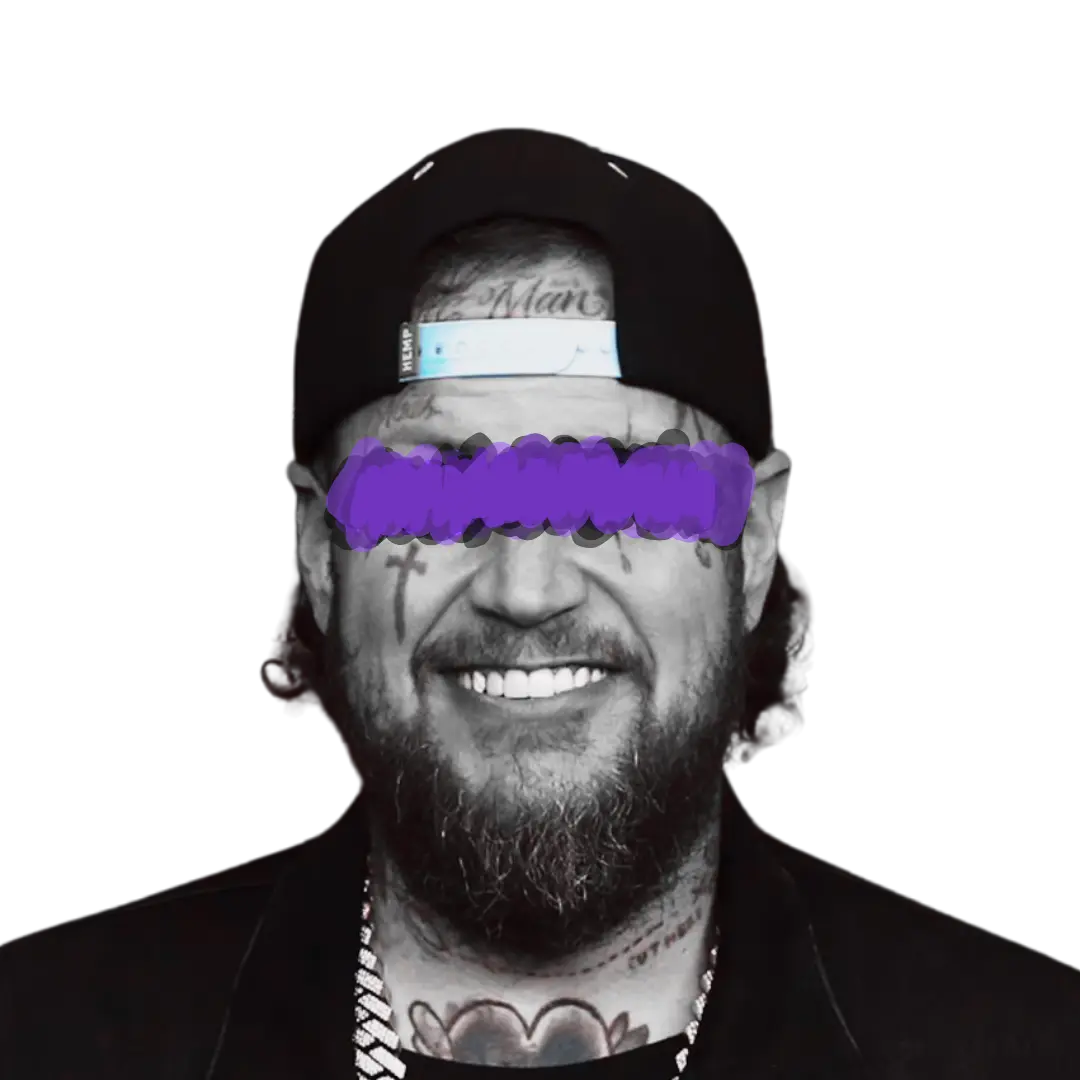
"I just never thought this was the journey, dude. I thought I'd die young or I thought I'd kill myself. I didn't think I was going to be able to figure it out."
A guard walked up to the cell and said six words: "DeFord, you had a kid today." Jason DeFord was twenty-three years old, sitting in prison on a crack cocaine charge. His daughter Bailee had just been born. He wasn't there. He wasn't there for any of it — not the pregnancy, not the delivery, not the first cry. He'd spent the last decade not being there for anything. Forty arrests between the ages of thirteen and twenty-five. In and out of juvenile detention, county jail, state prison. Always in a cell or on his way to one.
But here's what's strange about Jelly Roll's story, and what most people miss beneath the redemption narrative: the crime wasn't the rebellion. The crime was the numbing. The drugs weren't about getting high. They were about getting gone. The food wasn't about hunger. The four hundred, then five hundred pounds weren't about appetite. Everything — the dealing, the using, the eating, the disappearing into a body so large it became its own kind of prison — was the same act repeated in different forms.
A man trying not to feel his own life.
That's the tension that makes Jelly Roll one of the most psychologically fascinating figures in American music. Not the ex-con-to-country-star arc — that's the surface story, the one you already know. The deeper question: how does a man who spent thirty years building elaborate systems to avoid being present become the artist who makes millions of people feel more alive? How does the person who couldn't stand to be in his own body become the person who stands in front of Congress and weeps on purpose?
TL;DR: Why Jelly Roll is an Enneagram Type 9
- The numbing pattern: Drugs, food, crime — all serving the same function of checking out while technically still being there.
- The slow awakening: Not a single dramatic turning point but a gradual, decade-long process of deciding to exist — with real setbacks along the way.
- The merging: He didn't find his own voice first — he found his mother's. She put records on. He spent his whole life writing songs for her.
- The 8 wing: Won't fight for himself, will go to war for others. Congressional testimony, detention center studios, fentanyl advocacy.
- The contradiction: A man whose pattern was disappearing, who covered himself in permanent ink that guaranteed he could never blend in.
The House That Went From Dreary to a Nightclub
Jason Bradley DeFord was born December 4, 1984, in the Antioch neighborhood of Nashville, Tennessee. His father Buddy sold wholesale meat and ran a gambling book on the side. His mother Donna fought what Jelly Roll has called "extreme anxiety and depression," and because of that, she struggled with drugs.
He could count on one hand the number of times as a child he saw his mother dressed and outside the house.
But there was a ritual. A moment when the house changed. "She would come downstairs and she'd throw a record on, and she'd light a cigarette at the table," Jelly Roll told The Today Show. "I just knew that this lady never fuckin' leaves that room, and when she does, it seems like the music does it."
He watched the house go "from kind of dreary to a nightclub, as soon as you could snap your fingers."
That image — a woman who can't participate in her own life until a record starts playing — became the blueprint for everything Jelly Roll would eventually build. Not because he chose it consciously. Because he absorbed it. The way a child absorbs the weather of their household and mistakes it for the weather of the world.
"So I spent my whole life writing songs for her."
One sentence. The entire career explained. He didn't start making music to express himself. He started making music to reach the one person who couldn't be reached any other way. His voice was always, first, a bridge to someone who had disappeared.
"I Was in My 20s Before I Realized It Wasn't Normal"
"I just remember everybody doing drugs," he told GQ about growing up in Antioch. "I was in my 20s before I realized that having a drug addict in your family wasn't normal."
That sentence is worth sitting with. Not because it's shocking — because it's the opposite. It's the sound of a child who accepted chaos as baseline reality. Who never questioned whether things could be different because the question never occurred to him.
"I knew my father booked bets. I knew my mother struggled with drugs. So, to me, this was just what you did."
He started selling drugs young. First arrest at fourteen — marijuana possession. At sixteen, he was charged with aggravated robbery and marijuana possession with intent to sell. Though he was a minor, he was tried as an adult. A year behind bars, seven years of probation.
His father, Buddy, was an alcoholic during those years. His mother was unreachable. And young Jason did what made sense in a household where expressing needs created problems: he trained himself not to have any.
"I guess we grew up poor, but I didn't feel like it because I never wanted," he said on the Flagrant podcast.
Because I never wanted. Not "because we had enough." Because he had trained himself not to want.
Forty Arrests and the Architecture of Absence
Between thirteen and twenty-five, Jason DeFord cycled through juvenile detention and adult prison. Drug possession. Drug dealing. Other offenses. The pattern had a rhythm: arrest, incarceration, release, repeat.
What's revealing isn't the crime. It's the passivity. This wasn't a man raging against the system or scheming his way to the top of an empire. He wasn't a Type 8 brawling his way through life or a Type 3 gaming the angles. He was drifting. Letting the current take him. Using whatever was available to stay numb and letting the consequences accumulate like weather.
"The darkest moments of my life were being that 15-year-old scared kid spending Thanksgiving away from his family," he said on the People Every Day podcast.
At twenty-three, in prison on a crack cocaine charge, the guard delivered the news about Bailee.
"DeFord, you had a kid today."
Something cracked. Not broke — cracked. The kind of hairline fracture that takes years to widen enough for light to get through. He decided to get his GED. He didn't decide to transform his life. That would come later, in pieces, over a decade. He decided to do one small thing.
That's how Nines wake up. Not in a blinding flash. In a slow, stubborn dawn.
Ink on the Invisible Man
At fourteen, Jelly Roll got his first tattoo — a cross on his arm, in honor of a woman in his neighborhood who died of AIDS. At seventeen, serving time in state prison, he got his first face tattoos: a cross and a teardrop, done simultaneously. "I had the cross and the teardrop at the same time when I was on one of my stints, on a state-funded vacation," he said.
Once he had prison ink on his face, professional tattoo artists who had previously refused him changed their tune: "You've already f---ed your face up, we'll do it." More tattoos followed. Then more. His son Noah's name above an eyebrow. An apple core on his left cheek for his fanbase, "The Bad Apples." A broken chain on his arm — "breaking chains in life, anything that is bounding us, any bondage that we have, any addiction."
Here's the thing that matters: he says he regrets "98 percent" of them. "Almost all of my tattoos represent who I was. Almost none of them represent who I am."
And when people say the ink is a cry for attention, he corrects them: it's "actually the polar opposite." Behind the covered skin was "a deeply insecure man" who "didn't care what people thought" because he was "already written off by society."
That's the contradiction worth sitting with. A man whose entire psychological pattern was about disappearing — who covered himself in permanent, visible marks that guaranteed he could never blend in again. The tattoos weren't about being seen. They were about already being invisible. When you believe you're nothing, what does it matter what you look like?
Selling Mixtapes Out of His Car
Jelly Roll's music career didn't begin on a stage. It began in a parking lot. He sold mixtapes out of his car, starting with The Plain Shmear Tape in 2003, then the four-part Gamblin' on the White Boy series from 2004 to 2011.
He was a rapper first. Inspired by Three 6 Mafia, UGK, 8Ball & MJG — the Southern hip-hop underground that lived in the same Nashville most people forget exists. His 2010 collaboration "Pop Another Pill" with Memphis rapper Lil Wyte hit 6.3 million YouTube views. Real numbers for an unsigned artist working out of his car.
But the music was still running on the same fuel as everything else. A better escape route, a legal one — but still a way to channel everything outward so he didn't have to sit with what was inside.
The Rapper Who Walked Into Country Music
The shift came with "Save Me."
He wrote it in 2020, during the pandemic, a year after his father Buddy died of cancer. "I was in the thick of it," he said. "I was in a dark space." The song was inspired by Bette Midler's "The Rose" — because he and his mother used to listen to it together. Another thread back to the woman in the room who only came alive when music played.
"To me, it was like a therapy session publicly," he said. "That was the biggest thing for me — letting those emotions out in a public way."
"Save Me" wasn't a rap song. It was an acoustic ballad. And it did something none of his mixtapes had done — it crossed over. Two hundred million YouTube views and counting. The song didn't just shift his audience. It revealed what had been underneath the entire time: a voice that belonged in country music.
In 2021, he signed with BBR Music Group and released Ballads of the Broken. Jon Loba, president of BMG Nashville, had seen what most gatekeepers would have missed: "I saw that pain, vulnerability, that tenderness. I loved his vocal. I just said, 'That's a country song.' I was convinced his storytelling, his heart, and his brand would be accepted by our genre."
An ex-con rapper with face tattoos and a body that barely fit through a tour bus door — walking into the most tradition-bound genre in American music. He debuted at the Grand Ole Opry on November 9, 2021. His first number-one country single, "Son of a Sinner," hit the top of the charts in January 2023. He won CMA New Artist of the Year that same year.
The rapper from Antioch hadn't switched genres. He'd finally found the one that matched what he was actually saying.
What Is Jelly Roll's Personality Type?
Jelly Roll Is an Enneagram Type 9
The Enneagram describes Type 9 as the pattern of self-forgetting — not laziness, not passivity, but a deep, early-learned habit of turning down the volume on your own needs, desires, and anger to maintain peace. The core fear is loss, fragmentation, disconnection. The core desire is wholeness and inner stability.
Evidence of this pattern runs through every chapter of Jelly Roll's life, mapping closely to the addiction patterns and depression patterns that Type 9s are most vulnerable to:
- The childhood adaptation: A mother who couldn't leave her room. A father running side hustles. A boy who learned that not wanting things was the safest way to exist in a home that couldn't handle more need.
- The merging: He didn't find his own voice first. He found his mother's — writing songs to reach the one person who couldn't be reached any other way. Nines often discover their identity through someone else's.
- The body: At over 540 pounds, his physical self had become the most visible evidence of decades of self-forgetting.
- The ink: Permanent marks on a man who believed he was already invisible. The tattoos didn't contradict the disappearing — they confirmed it. He marked himself because he didn't think it mattered.
- The gradual awakening: Not a single epiphany but a slow, fifteen-year process of beginning to want things, beginning to show up, beginning to take up space on purpose.
What makes Jelly Roll specifically a 9w8 — a Nine with an Eight wing — is the fire that emerges when it's not about him. He won't fight for himself. He will go to war for someone else. Testifying before Congress about fentanyl. Building a $250,000 recording studio in the detention center that once held him. Donating his Grammy to that same facility. The 8 wing gives him protective ferocity — but only on behalf of others.
Under stress, Nines pick up the anxious, self-doubting energy of Type 6. "I still have to fight the, like, 'Do I want to get up?' some days," Jelly Roll has said. "I dread going to sleep every night." The anxiety, the imposter syndrome, the dread — that's the Nine under pressure.
In health, Nines access the effective, visible energy of Type 3. The Grammy wins. The 275-pound weight loss. The sold-out stadium tours. The man who couldn't be present now shows up in front of millions — and stays.
The Friction in the Middle
The redemption arc, as people usually tell it, is too clean. Prison. GED. Music. Success. But Jason DeFord's actual path had years of friction that the highlight reel skips.
He has been honest about this in ways most people miss. He's never been fully sober in the traditional sense. He still drinks. He still smokes marijuana. His reasoning is blunt: "I think a world without weed, Jelly Roll's drinking codeine and popping Xanax and snorting cocaine again, but a world with weed, I'll be alright."
He's shared an admission he said he'd never made before: "I had to learn that you could drink alcohol without doing cocaine. It took me a long time to learn that. There was a long time where I just assumed, when people told me they drank without doing cocaine, I was like, I thought we only drank to do cocaine."
And the past doesn't sit still: "I've made a lot of peace with my past. I mean, it still haunts me like the ghosts I know. But I don't think about doing no drugs today. As far as today goes, I don't know about tomorrow, but I can tell you, today, right now, I'm happy."
Because he still drinks and smokes, he attends meetings occasionally. "If I'm really struggling with thinking of my behavioral pattern, I'll go to a meeting."
Meanwhile, Bailee's biological mother has struggled with relapse — and Jelly Roll has had to watch his daughter "go through it all over again." He's built the tools to cope with that pain: therapy, faith, a support system. His daughter, he said, "don't have any of those tools" yet.
This is the part the redemption story usually leaves out. The man who woke up didn't wake up once. He wakes up every day and decides again.
Bunnie, Bailee, Noah, and the Art of Finally Showing Up
He met Bunnie XO in Las Vegas in August 2015 when he performed at the Las Vegas Country Saloon. He was living out of a van at the time. Maybe twenty people were at the show. She was still in an abusive relationship. They eloped at a Little White Wedding Chapel in 2016.
Here's the Bunnie story that matters: the first time she advanced toward him physically, he wouldn't reciprocate. Instead, he asked her about her five-year plan. She later said: "It was the first relationship where my boyfriend didn't want to change me — and I didn't want to change him either. We just let each other evolve, and ended up wanting to be better humans for each other."
When Jelly Roll told Bunnie he was homeless and needed a place where his daughter could have a bedroom, Bunnie said, "Let's just go get a condo so you have a bedroom for her." She helped him find one — difficult because his robbery and drug charges made landlords refuse him. She paid for a custody lawyer. She invested in his 2017 album Addiction Kills. At the time, she was making more money than he was. She bankrolled the custody battle that brought Bailee home.
It hasn't been frictionless. Bunnie revealed in her 2026 memoir Stripped Down that Jelly Roll had an affair lasting close to a year. She gave him a second chance: "I gave it to him, and it is the best decision I've ever made." But on a third: "Absolutely f---ing not."
Both got sober together around 2018 — Bunnie's main motivation being custody of Bailee.
Then there's Noah. His son Noah Buddy DeFord was born in August 2016 to Jelly Roll and a woman named Melisa. Noah lives primarily with his mother. Jelly Roll has been careful to respect that boundary, saying he supports Melisa and the decisions she makes. When Noah was born, Jelly Roll wrote: "God Bless this Child to be everything I am not! I pray he nor Bailee ever have to pay for their father's sins."
Bailee, now a teenager, has appeared on Bunnie's podcast discussing body image and emotional trauma. She plans to attend Columbia University to study law, with an eye on becoming a criminal defense attorney.
His father Buddy had to come back around too. Jelly Roll describes Buddy as his best friend later in life — the man who taught him to "hate racism" and "how to carry myself as a man." But when Jason was a teenager cycling through detention centers, Buddy was an alcoholic and the closeness wasn't there. It had to be rebuilt, brick by brick, over years.
Then Buddy died of cancer in March 2019. A week later, Jelly Roll visited an abandoned hospice facility looking for a sign from his father. He found one. His dad's real name — Horace — was on one of the rooms.
"My dad was called Buddy since he was a baby, but his government name was Horace, and despite being alive over 30 years, I had never once seen his name or met another person named Horace."
Sometimes signs are subtle. But for a man who spent most of his life not looking, the fact that he was looking at all was the real sign.
The Body Wakes Up
Jelly Roll weighed 540 pounds. His doctor told him to visit a "meat processor or truck stop" to find a scale — typical ones only go to 500. His blood panels read like a warning label: extremely high insulin levels, testosterone lower than a preteen boy's, high cholesterol, elevated A1C.
Around his 39th birthday, he started walking. Just walking. Not a dramatic fitness transformation. Not a surgical intervention. Walking.
"The battle was with the food addiction," he said in November 2024. "Changing the way I've looked at food for the last 39 years."
He trained for and completed a 5K in 2024. He changed his diet. He cut back on alcohol. He started boxing, running stairs at arenas, doing push-ups. He lost 70 pounds, then 120, then 200. No GLP-1 drugs — "Never did the GLP-1, but I don't judge nobody who does it." By January 2026, he was on the cover of Men's Health at 265 pounds — 275 pounds lighter than his peak — with skin removal surgery planned for later that year.
For a Nine whose primary coping mechanism was accumulation — adding layers between himself and his own feelings — the act of removing that padding is the most literal possible metaphor for waking up. He spent thirty years building a body that could contain all the feelings he refused to have. Then he spent three years dismantling it.
"I Was Part of the Problem"
On January 11, 2024, Jelly Roll sat before the Senate Banking, Housing, and Urban Affairs Committee and testified about fentanyl.
"I was the uneducated man in the kitchen playing chemists with drugs I knew absolutely nothing about," he said, "just like these drug dealers are doing right now when they're mixing every drug on the market with fentanyl. And they're killing the people we love."
He told the committee that during the five minutes he'd be speaking, somebody in the United States would die of a drug overdose, and there was a 72% chance it would be fentanyl-related.
He urged them to pass the FEND Off Fentanyl Act. The bill had 67 cosponsors — 34 Republicans, 33 Democrats. Sixty-seven senators who could agree on this even when they couldn't agree on much else.
The man who spent a decade drifting through a system now sat in front of that system and demanded it do better. Not for himself. For the people still drifting.
This is the 9w8 in its fullest expression: a person who won't raise their voice for their own needs but will shake the walls of Congress for someone else's.
Whitsitt Chapel and the God Question
Jelly Roll was baptized at Whitsitt Chapel at fourteen. The same year, he was arrested for the first time. The faith and the fall happened simultaneously, and for years the fall won.
He was bitter about it. "I was so bitter and hurt by the church and their dogma," he said. He criticized organized religion's "Americanization" and "weaponization" of God: "He's not what y'all have turned Him into."
But in prison, something stayed with him. "There was a moment in my life that all I had was a Bible this big and a radio the same size in a 6x8 foot cell," he said in his 2026 Grammy speech. "And I believed that those two things could change my life."
The faith didn't come back all at once. It came back through his daughter. In 2023, Bailee chose to be baptized — and Jelly Roll followed her into church. "Watching her faith made me want to find mine again." The album Whitsitt Chapel traces the arc: "A 14-year-old kid getting baptized at Whitsitt Chapel to the 39-year-old man that just watched his 14-year-old get baptized."
"I'm really, really, really kind of against religion," he said. "I'm not very religious at all. I definitely believe in spirituality." And: "Ultimately, I have a heart for God, and I have a heart for Jesus. I try to follow what I think Jesus would do in general."
Then at the 2026 Grammys — where he won three awards, including Best Contemporary Country Album for Beautifully Broken and Best Contemporary Christian Music Performance for "Hard Fought Hallelujah" — he stood at the podium with a broken collarbone from an ATV crash and said: "Jesus is for everybody. Jesus is not owned by one political party. Jesus is not owned by no musical label. Jesus is Jesus, and anybody can have a relationship with Him."
Every time someone hugged him that week, he wanted to scream from the collarbone. He said nothing. A man who learned to absorb pain silently, now choosing to absorb it for a different reason. Not because his needs don't matter. Because the moment mattered more.
The Studio in the Cell
In 2022, Jelly Roll donated $250,000 to build a recording studio inside the Davidson County Juvenile Detention Center in Nashville — the same facility where he once served time. The studio opened in 2024, offering equipment, instruments, and music programs to incarcerated youth.
"It's important that we give back, especially our kids," he said. "Our youth are so impressionable and the old quote goes, 'None of them asked to be here.' They were born into just whatever situation it was, and sometimes they can't see past that situation or that neighborhood or that environment. I just hope to bring hope to that and kind of be a beacon and a light for those kids."
After winning his first Grammy, he donated the trophy to that same detention center.
"This isn't about a trophy," he said. "It's about showing kids that where you start doesn't have to determine where you end."
He put the physical evidence of his arrival — the golden proof that he had made it — back in the place where he was most absent. The gesture only makes sense if you understand the man isn't performing generosity. He's trying to send something back through time to the boy who sat in that cell and believed that numbing out was the only option.
"Almost Home"
During his second appearance on The Joe Rogan Experience in December 2025, country artist Craig Morgan appeared in a pre-taped video message to invite Jelly Roll to become a member of the Grand Ole Opry.
Jelly Roll broke down instantly. Buried his face in his hands. Sobbed.
The Opry invitation meant something specific to him. Years earlier, as a struggling underground rapper just out of prison, he'd bought a ticket to the Opry to see Craig Morgan perform. Morgan's song "Almost Home" had helped him survive incarceration.
"I cried and cried," he told Rogan. "I cried like I'm crying here now, and I just remember thinking, 'Man, I wanna make people feel the way he makes me feel.'"
He didn't want to be famous. He didn't want awards. He wanted to do for someone else what a song did for him in a cell — make them feel less alone. Make them feel almost home.
That's been the engine the entire time. Not ambition. Not redemption. Connection. A boy who watched music wake his mother up, who let a song carry him through prison, who now fills stadiums with people who need to hear that it's okay to not be okay.
"I wrote 'I Am Not OK' because a lot of people in the world are not OK. Mental health is real. I have prided myself on being someone who makes real music for real people with real problems, and it's OK to not be OK."
And somewhere inside all of that presence, all of that undeniable thereness — the boy from Antioch is still learning that it's safe to want things. Still practicing, every day, the terrifying act of not disappearing.
He'll tell you he's figuring it out. But figuring it out was never the hard part. The hard part was deciding to stay in the room long enough to try.
What would you add?