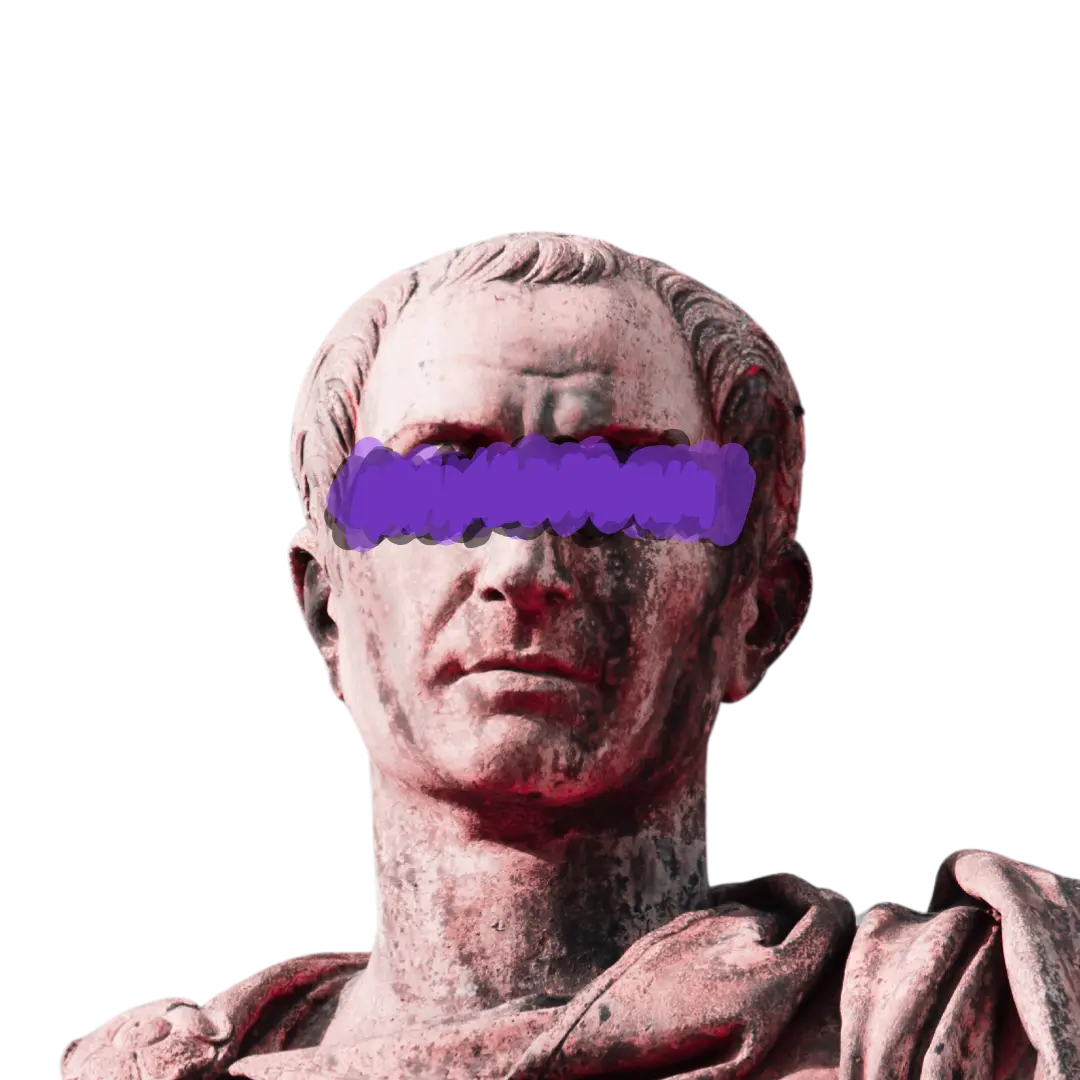
"Do you not think it is matter for sorrow that while Alexander, at my age, was already king of so many peoples, I have as yet achieved no brilliant success?"
A 33-year-old Roman politician stands before a statue of Alexander the Great in a temple in Spain and weeps. Not because someone died. Not because he lost a battle. Because he hasn't accomplished enough.
At 33, Alexander had conquered the known world. Caesar was a mid-level official drowning in debt so deep that only the richest man in Rome would bail him out. He had a distinguished bloodline, a sharp tongue, a few political wins, and absolutely nothing that would make history remember his name.
He would go on to conquer Gaul, cross the Rubicon, defeat Pompey, reform the calendar, reshape the Roman Republic into something that would endure for centuries, get stabbed 23 times by men he'd personally pardoned, and become the first Roman in history to be declared a god.
But that moment in Spain tells you more about Julius Caesar than any military triumph. A man motivated purely by power doesn't weep at someone else's statue. A man terrified of insignificance does.
TL;DR: Why Julius Caesar is an Enneagram Type 3
- Achievement as identity: Caesar's "dignitas" (personal honor) was, by his own admission, more important than his life. He crossed the Rubicon and started a civil war rather than let the Senate strip it from him.
- The shape-shifter: Aristocrat who became a populist. Military commander who was also Rome's finest prose stylist. Conqueror who branded himself as merciful. He adapted to every arena and dominated them all.
- Image as strategy: Wrote his own wars in the third person. Claimed divine descent from Venus. Controlled every detail of his public persona. Even his mercy was calculated dominance.
- Never enough: Consul wasn't enough. Gaul wasn't enough. Dictator wasn't enough. He became dictator perpetuo and accepted a month named after him, and was planning to conquer Parthia three days before the knives found him.
The Boy Who Outran Sulla
Caesar was born into the Julian clan, Roman patricians who claimed descent from the goddess Venus through Aeneas, the Trojan hero. Noble bloodline, but not wealthy. Not powerful. The name carried weight that the family bank account couldn't cash.
His father died when Caesar was about 16, leaving him the head of a household with expectations but no resources. His mother Aurelia raised him, a woman historian Tacitus considered an ideal Roman matron. Learned. Disciplined. Formidable. Decades later, at a religious festival in Caesar's own home, it was Aurelia who spotted an intruder disguised as a woman and raised the alarm. She ran her son's household long after he became Rome's most powerful man.
But the event that forged Caesar's operating system happened when he was 18. The dictator Sulla had won Rome's civil war and was systematically murdering his political enemies. Caesar, connected to Sulla's defeated rival Marius through his aunt Julia's marriage, was ordered to divorce his wife Cornelia, daughter of another enemy.
He refused.
An 18-year-old, facing a dictator who was killing people by the hundreds, told him no. Caesar fled Rome, hid in the Sabine hills, contracted malaria, got captured by one of Sulla's soldiers, and bribed his way to survival. His mother's family and the Vestal Virgins eventually intervened to save his life.
Sulla relented. But he left a warning for the Roman elite: "Keep an eye on the ill-girt boy, for in him there are many Mariuses."
The boy who nearly died for refusing to betray his wife learned two things. First, the world will try to destroy you for your loyalties. Second, if you survive, you can use that defiance as currency forever.
How Caesar Turned Bankruptcy Into an Empire
By the time Caesar held his first major office, he owed enough money to fund an army of 110,000 soldiers for a full year. Roughly the annual military budget of a mid-sized Roman province. He didn't stumble into debt. He engineered it.
Caesar spent money like a man who knew he'd either conquer the world or be crushed by his creditors. He funded political campaigns, staged spectacular gladiatorial shows, distributed free grain, and bribed entire juries. He built alliances with Rome's richest man, Marcus Licinius Crassus, who bailed him out in exchange for political leverage.
In 60 BC, Caesar brokered a secret pact between himself, Crassus, and Pompey (Rome's greatest general, who had conquered the East but couldn't get the Senate to ratify his settlements or grant land to his veterans). The three men didn't like each other. Caesar reconciled them, channeled their combined power, and emerged as the coalition's driving force. Plutarch's assessment: Pompey was "ostensibly at the head of the league, but Caesar was its ruling spirit."
He married his daughter Julia to the much older Pompey to seal the deal, and despite the arrangement, the two fell genuinely in love. When Julia died in childbirth in 54 BC, the last personal bond between the two men died with her. When Crassus died at Carrhae a year later, the Triumvirate was finished. Within five years, Caesar and Pompey were at war.
Every sesterce was an investment in Caesar's rising legend. Every spectacle was calculated to make the Roman people love him and the Roman Senate fear him. He carried tessellated mosaic floors on military campaigns. He once demolished an expensive country villa because it displeased him, while still mired in debt.
This wasn't recklessness. It was a bet. The debt created the need for a military command that would generate plunder. The plunder funded the political ascent. The political ascent generated more need for achievement. The machine fed itself.
"His dignitas had always been his first consideration," Caesar wrote about himself, "more important than his life."
Dignitas. Not power. Not wealth. Not territory. The word means something closer to "earned standing" — the accumulated weight of a man's reputation, his achievements, his right to be taken seriously. When the Senate tried to strip his command in Gaul and recall him for prosecution, they weren't threatening his freedom. They were threatening his identity.
So he crossed the Rubicon. On the night of January 10, 49 BC, Caesar slipped away from a public banquet, traveling by mule cart in darkness with a small escort. He got lost on back roads and wandered on foot until dawn. At the river, a shallow stream marking the legal boundary between his province and Roman Italy, he hesitated. Suetonius records him telling his companions: "Even yet we may draw back; but once cross yon little bridge, and the whole issue is with the sword."
Then he quoted the Greek playwright Menander — anerrhiphtho kybos, "let the die be cast" — and waded across with a single legion. Five thousand men against the entire Roman Republic. Cities evacuated ahead of him. Pompey fled the capital without a fight. The most famous decision in Western history was made by a man who couldn't accept having his dignitas diminished.
The Pirate Who Raised His Own Ransom
In 75 BC, 25-year-old Caesar was captured by Cilician pirates. They set his ransom at 20 talents. Caesar laughed at them.
"He insisted they demand 50," Plutarch records.
For 38 days of captivity, he treated the pirates as his personal audience. He made them listen to his speeches and poems. When they weren't sufficiently impressed, he called them illiterates. He participated in their games and exercises while behaving as though he were their commander, not their prisoner. He repeatedly told them he would come back and crucify them.
They thought it was a joke.
After the ransom was paid, Caesar raised a naval force (despite holding no military office), hunted the pirates down, captured them, and crucified every one. But in a final gesture, he ordered their throats cut first. Even his revenge carried a message.
Look at the psychology: a 25-year-old captive, with no power and no leverage, instinctively performed as though he were in charge. The audience was pirates and the venue was a hostage situation, but the performance never stopped.
What is Julius Caesar's Personality Type?
Julius Caesar is an Enneagram Type 3
The Enneagram Three is driven by a core need: to be valued for their accomplishments. Their deepest fear is worthlessness, not failure in the abstract, but the specific terror that without their achievements, they are nothing. They adapt, perform, and shape-shift to become whatever their environment rewards.
The tears at Alexander's statue are the Three's moving finish line. No achievement satisfies permanently. The moment one goal is reached, the emptiness returns and demands a bigger goal.
The strategic debt is the Three's willingness to bet everything on their ability to perform. Not recklessness, but an absolute certainty that they will find a way to win.
The third-person memoirs: Caesar wrote his Commentarii de Bello Gallico as though he were a neutral observer recording someone else's genius. "Caesar did this. Caesar decided that." Cicero praised the prose as having "naked simplicity" and being "elegant as well as transparent, even grand and in a sense noble." But the objectivity was calculated. He was writing his own legend while it was still happening.
The vanity about baldness: Suetonius records that "his baldness was a disfigurement which troubled him greatly." The man who commanded the most powerful military force on earth combed his thinning hair forward from the crown and "gladly wore a laurel wreath" because it covered the bald spots. For a Three, image isn't vanity. It's survival infrastructure.
The epilepsy makes this even more striking. Suetonius records that Caesar was "subject to sudden fainting fits" and was "twice attacked by the falling sickness during his campaigns." At the Battle of Thapsus in 46 BC, Plutarch describes how "his usual sickness laid hold of him"; he was carried to a nearby tower before losing consciousness and stayed hidden while his officers won the battle without him. A man whose entire identity rested on performing competence and control, ambushed by a body that could betray him without warning. The Romans called epilepsy morbus comitialis ("the assembly sickness") and some considered seizures a mark of divine possession. Caesar may have found that interpretation useful, but the episodes reveal a vulnerability the public image never acknowledged.
The clementia, his famous mercy. Caesar pardoned nearly every enemy who surrendered during the civil war. The Romans built a temple to his clemency. But clemency as practiced by Caesar was a form of dominance: every pardoned enemy owed him their life and their position. They became his clients, permanently subordinate. He was constructing a mythology in which generosity was the ultimate expression of power.
The elder Curio called Caesar "every woman's man and every man's woman." Cato said he was "the only man who undertook to overthrow the state when sober." His own soldiers sang mocking songs during his triumphs: "Caesar laid the Gauls low, Nicomedes laid Caesar low." He endured all of it. A Three can tolerate mockery as long as the mocking comes with recognition. Being talked about is always better than being ignored.
What makes Caesar specifically a Three, rather than just ambitious, becomes clearer when you compare him to Pompey. Pompey was also ambitious. He wanted glory, triumph, supreme command. But Pompey received his title "Magnus" from his soldiers and waited for Sulla to confirm it. He sought his extraordinary commands through legal channels (the lex Gabinia, the lex Manilia), needing assemblies to grant him authority. He styled his hair like Alexander the Great and waited for people to notice the resemblance. He worked within the system until the system rewarded him.
Caesar didn't wait. He manufactured his own authority. When the Senate wouldn't give him what he wanted, he crossed a river with one legion and took it. Pompey believed power was conferred by institutions. Caesar believed power was performed into existence, that if you acted like the most important man in the room, the room would eventually agree.
That instinct makes him a useful contrast with Napoleon Bonaparte. Both men seized legitimacy instead of waiting for it. Caesar did it through the Three's mythmaking instinct; Napoleon did it through the Eight's demand for sovereignty.
The Mutiny He Ended With One Word
Caesar's Tenth Legion mutinied in Rome. These were hardened veterans demanding discharge and rewards after years of brutal campaigning. Other generals might have negotiated. Threatened. Bribed.
Caesar appeared before them and spoke a single word: "Citizens."
Not "Soldiers." Not "Comrades," the term he'd used for a decade, the word that bound them to him as family. Citizens. Civilians. Nobodies.
The psychological effect was instantaneous. By addressing them as civilians, he implied he had already discharged them. They were no longer his soldiers. They were no longer part of the story.
The hardened veterans who had followed him across Gaul, Britain, and the civil war begged to be reinstated. They followed him to Africa, despite his feigned reluctance to accept them.
He gave them no money. No promises. No threats. One word shifted their identity from essential to irrelevant, and they couldn't bear it. People will fight harder to keep their place in a story than they will for gold. (Compare this to how Winston Churchill rallied Britain through sheer rhetorical force, a similar instinct with entirely different psychology.)
The Women Who Saw Through the Performance
Caesar's public life was all strategy. His private attachments reveal the gaps.
Cornelia, his first wife, the one he nearly died for as a teenager. When she died in 68 BC, Caesar delivered a moving funeral oration. This was unusual for a young Roman woman. The gesture was both genuine grief and political theater: the oration for his aunt Julia at the same time displayed the image of Marius for the first time in 18 years, declaring his political allegiance to the populares. The public and private were already fused.
Servilia, the mother of Marcus Brutus. This was Caesar's deepest, most enduring romantic attachment. Cicero described it as "an open secret at Rome." Caesar bought her a pearl worth six million sesterces. He gifted her fine estates at prices so low that Cicero cracked the joke that "there is a third off," a pun suggesting Servilia's daughter Tertia was part of the arrangement. The woman Caesar loved most was the mother of his assassin.
Cleopatra, the most famous relationship, and perhaps the most revealing. She was 21. He was 52. She smuggled herself into his quarters wrapped in a linen sack, carried on the back of a single servant past hostile guards. Plutarch records that "Caesar was first captivated by this proof of Cleopatra's bold wit."
Plutarch is explicit elsewhere that her looks were "not altogether incomparable," but her conversation had "an irresistible charm." She spoke at least nine languages, the only Ptolemaic ruler who ever bothered to learn Egyptian. She was politically ruthless, intellectually formidable, and playing a game as large as Caesar's own. She may have been the only person in his life who matched his ambition without being subordinate to it.
Caesar feasted with her until dawn. He would have sailed the length of the Nile with her (400 ships, a floating palace) but his own soldiers refused to follow. He summoned her to Rome and installed her in a villa across the Tiber with their son Caesarion. He placed a golden statue of her in the temple of Venus Genetrix, his family's divine ancestor. He allegedly had a tribune draft a law permitting him to marry multiple wives, likely to legitimize the boy. For a man who turned every relationship into a transaction, Cleopatra was the one alliance that looked like recognition between equals.
Calpurnia, his wife at the end. Faithful despite Caesar's rampant infidelity. On the morning of March 15, 44 BC, she begged him not to go to the Senate. She had dreamed of his death.
He went anyway.
Gaul: The Achievement That Stains
Between 58 and 50 BC, Caesar conquered all of modern France, Belgium, parts of Switzerland, Germany, and the Netherlands. He invaded Britain twice. He built a bridge across the Rhine as a demonstration of engineering power. He wrote the most famous Latin prose ever composed about his own campaigns.
The prose is elegant. The reality it describes is not. Caesar also committed what scholars now describe as genocide.
Caesar's own numbers claim over one million enemy casualties in Gaul. He explicitly stated a desire to destroy "the stock and name" of the Eburones tribe. He sold entire populations into slavery. He cut off the hands of defenders at Uxellodunum.
And then, when the civil war began against Pompey and the Senate, he performed the exact opposite strategy: systematic mercy for Roman enemies. Pardoning generals. Restoring statues. Inviting opponents back to government.
The contradiction is stark.
In Gaul (Foreign Enemy)
1,000,000+ casualties by his own count. Entire tribes destroyed. Mass enslavement. Hands cut off at Uxellodunum.
In the Civil War (Roman Enemy)
Systematic pardons. Restored enemy statues. Cried "Spare your fellow citizens." Built a temple to his own clemency.
Scholars note that "whereas Caesar pursued harsh retributions and subjugation of the Gallic peoples, bordering on the genocidal, he operated in the Civil War in precisely the opposite manner."
The Enneagram framework illuminates the logic. The Gauls were an audience that didn't matter for Roman political reputation, foreign peoples to be conquered, raw material for the achievement. The Romans were the audience Caesar needed to impress, reconcile, and dominate through generosity. The mercy wasn't moral consistency. It was image management adjusted for different markets. (For more on how personality shapes leadership, see our Enneagram leadership styles guide.)
The same man wept for Pompey's severed head. "He turned away with loathing, as from an assassin," Plutarch writes. On receiving Pompey's seal-ring (a lion holding a sword) he burst into tears. He ordered the head properly buried with honors.
Was the grief real? Ancient historians debated it. Cassius Dio thought it was performance. Plutarch seemed to believe it. The Three's answer: both. The grief was genuine because Pompey was his former son-in-law, once his closest ally. The display was calculated because every Roman alive was watching how Caesar would treat his fallen rival. Feeling deeply and performing the feeling simultaneously is not hypocrisy. It's how a Three operates.
The Calendar, the Cipher, and the Horse With Human Feet
Caesar's accomplishments extend far beyond military conquest.
The Julian Calendar, introduced in 46 BC, replacing Rome's dysfunctional lunisolar system with a solar calendar of 365.25 days. It remained the standard across Europe for over 1,600 years until the Gregorian reform of 1582. The structure of your calendar year comes from Caesar.
The Caesar Cipher, one of the earliest known encryption systems. He substituted each letter with the one three positions later in the alphabet. A small detail that reveals a mind obsessed with control, systems, and maintaining strategic advantage even in routine correspondence. It's still taught in cryptography courses.
The social reforms: he reduced Rome's grain dole from 320,000 recipients to 150,000, settled veterans in overseas colonies, extended Roman citizenship broadly to Gauls and Spaniards, rebuilt Carthage and Corinth, and drained marshes. He wrote a treatise on Latin grammar during an Alpine crossing, dictating to two secretaries at once on horseback.
The horse with human feet: Suetonius records that Caesar bred a horse whose hooves were cloven "in such a way as to look like toes." Soothsayers predicted this meant its owner would rule the world. Caesar erected a statue of it before the temple of Venus Genetrix. Only he could ride it.
The pattern with omens is revealing. He took favorable signs seriously, but when a soothsayer reported animal entrails without a heart (a terrible sign), Caesar dismissed it: "They will be more favorable when I wish it." When he stumbled upon disembarking in Africa, he clutched the ground and declared: "I hold thee fast, Africa!" A Three doesn't ignore omens. A Three edits them until the narrative works in their favor.
The Dictator Who Couldn't Sit Still
Caesar achieved supreme power in 46 BC. By early 44 BC, barely two years later, he was planning to leave Rome for a three-year military expedition.
The target was Parthia, Rome's only remaining rival. Crassus had died trying to conquer it. Caesar was assembling sixteen legions and ten thousand cavalry, a force larger than any he'd commanded in Gaul. The planned route avoided Crassus's fatal mistake of marching through open desert, approaching instead through friendly Armenia. Plutarch claims even grander ambitions: after Parthia, the army would sweep through the Caucasus, cross Germania, and return to Italy, essentially circumnavigating the known world.
He was scheduled to depart on March 18, 44 BC. Three days before his departure date, the Senate met on the Ides of March.
The restlessness matters. He had everything: dictator in perpetuity, a month renamed in his honor, a temple to his mercy. And his response to having achieved everything was to immediately plan the next conquest. The title escalation tells the story: dictator for eleven days in 49 BC. Dictator for one year in 48 BC. Dictator for ten years in 46 BC. Dictator perpetuo in February 44 BC. Each rung reached became the floor for the next climb.
How the Ides Found Him
The conspirators who killed Julius Caesar on March 15, 44 BC were led by Marcus Brutus and Gaius Cassius, both men Caesar had personally pardoned after the civil war. Brutus had fought against Caesar at Pharsalus. Caesar not only forgave him but elevated him to praetor, one of Rome's highest offices.
This is the paradox the Enneagram illuminates most clearly. Caesar's mercy, his greatest political weapon, created the conditions for his assassination. He pardoned men who hated what he represented. He promoted them to positions where they could organize against him. He trusted that the debt of clemency would bind them to him.
It didn't.
Twenty-three stab wounds. In the Senate. From the men he'd saved.
Calpurnia had begged him to stay home. The soothsayer had warned him. He went anyway. Not because he was reckless or fatalistic, but because a Three cannot accept that their greatest performance might have a fatal flaw in its design.
"Sulla did not know his A.B.C. when he laid down his dictatorship," Caesar once said about the previous dictator's resignation. Sulla gave up power voluntarily. Caesar thought that was stupid. But Sulla died in his bed. Caesar died on the Senate floor, reaching toward the men he'd forgiven, wearing the laurel wreath that covered his bald spot.
The God Who Couldn't Stop
When Brutus stepped forward to address the Senate, the senators had already fled. Caesar's body lay on the floor until three household slaves put him on a litter and carried him home, one arm hanging down.
The conspirators marched to the Capitoline with drawn swords, calling on the people to "resume their liberty." The people shut their doors. The next day, Plutarch records, Brutus spoke to a crowd that "listened without expressing either any pleasure or resentment, but showed by their silence that they pitied Caesar, and respected Brutus."
The silence didn't last. Five days later, Mark Antony raised Caesar's bloodstained toga on a pole and displayed a wax effigy rotated on a mechanical device to show all twenty-three wounds. The crowd built a pyre in the Forum and burned the body on the spot. They hunted for the assassins, killed Cinna the poet by mistake (confusing him with Cinna the conspirator) and paraded his head on a spear. The men Caesar had pardoned fled Rome and never returned.
Caesar was declared Divus Julius — the first historical Roman to be officially deified. His adopted heir Octavian became Augustus, the first true Emperor. Every subsequent Roman ruler claimed Caesar's name. The words "Kaiser" and "Tsar" are both corruptions of "Caesar."
Dante placed Brutus and Cassius in the lowest circle of Hell, alongside Judas. (For another leader whose psychology shaped a nation's destiny, see Abraham Lincoln's personality analysis.)
The month of July bears his name.
His Commentarii remain a cornerstone of Latin education, propaganda so elegant it became literature.
He achieved everything. He became a god. His name became synonymous with supreme power itself. And it still wasn't enough to keep him alive, because the one thing a Three can never achieve is the thing they need most: to be valued for who they are, not what they've done.
He covered a hundred miles a day in a hired carriage, swimming rivers or crossing them on inflated skins, arriving before the messengers sent to announce him. He was always running ahead. He ran so fast that nobody could keep up: not his soldiers, not his enemies, not the soothsayers, not the woman who dreamed of his death.
At some point you have to ask whether a man who owed 1,300 talents, conquered a million square miles, reformed a calendar, invented an encryption system, wrote the most famous Latin prose in history, got declared a god, and still wasn't satisfied — whether that man was running toward something, or whether the running itself had become the only thing keeping him alive.

What would you add?