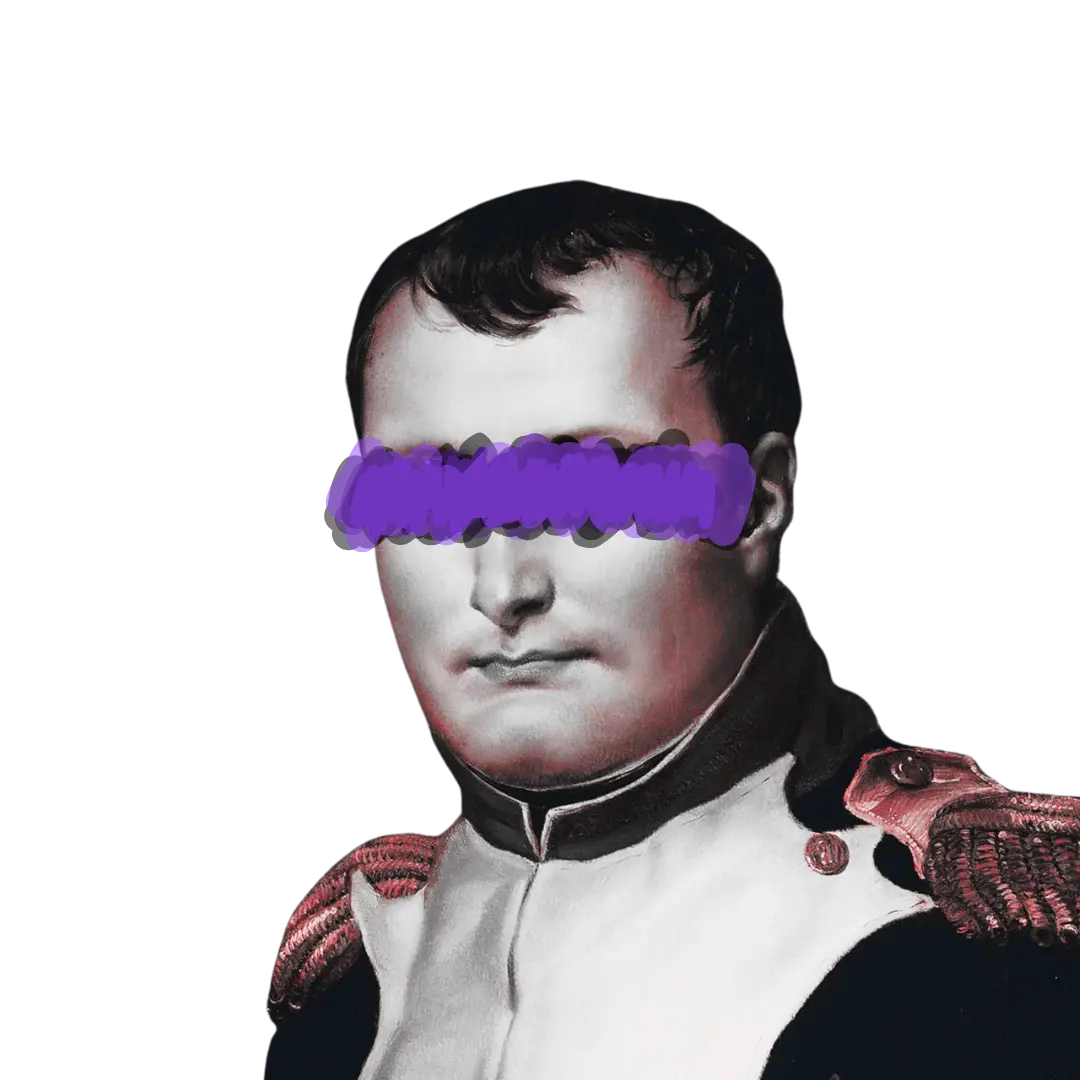
"I have not spent a day without loving you; I have not spent a night without clasping you in my arms; I have not drunk a cup of tea without cursing the glory and ambition which keep me from the heart of my very being."
In 1795, a twenty-six-year-old artillery officer with a thick Corsican accent and no money sat down and wrote a romance novel.
Not a military treatise. Not a political manifesto. A love story.
Clisson et Eugénie tells the tale of a military genius who finds love, loses it to infidelity, and rides back to the battlefield to die. The woman destroys the soldier not through force but through betrayal. The hero doesn't lose in combat. He loses at home.
Napoleon Bonaparte wrote this before Austerlitz. Before Egypt. Before he crowned himself Emperor. Before Josephine. Before any of it.
The man history remembers as a war machine — the conqueror who redrew Europe, the megalomaniac who fed a million soldiers into the Russian winter — sat down before all of that and told you exactly who he was. A man who already knew that love would be the thing he couldn't conquer.
TL;DR: Why Napoleon is an Enneagram Type 8
- The Armor: A Corsican outsider bullied at French military school, Napoleon forged an identity around never being vulnerable again — then spent the rest of his life proving no one could touch him.
- The Crack: His private letters reveal a man consumed by love, jealousy, and a desperate fear of abandonment that no amount of conquest could fix.
- The Overreach: The same drive that won Italy and Austerlitz demanded one more campaign, then one more — until it demanded Russia.
- The Collapse: When the empire fell, so did his defenses — attempted suicide, public weeping, and six years dictating his mythology from a rock in the Atlantic.
The Corsican at Brienne
At nine years old, Napoleon was shipped from Corsica to a military academy in Brienne-le-Château. He spoke almost no French. He was short, poor, and foreign. The other boys — sons of aristocrats — made sure he knew it.
"The Corsican." That's what they called him. Not his name. His origin, weaponized.
He was mocked for his accent, excluded from games, bullied for his stature and his family's modest means. One account describes classmates building a snow fort and pelting him until he organized the smaller boys into a counter-attack — directing them with tactical precision that startled the teachers.
Years later, Napoleon wrote of Brienne: "It was there that I formulated my first opinions of mankind."
He didn't say he learned about strategy or artillery science, though he excelled at both. He said he learned about mankind. At nine. And what he learned was this: the world does not protect the vulnerable. It ridicules them. It excludes them. It organizes against them.
His mother, Letizia Bonaparte, had already taught the first lesson. When Corsica fell to France, Napoleon's father Carlo switched allegiance to the French occupiers — a pragmatic survival move that his wife never forgave and his son never forgot. Letizia raised her children with iron discipline, rationing food, demanding self-reliance, running the household like a general runs a regiment. Napoleon credited her with everything. "It is to my mother," he said later, "that I owe my fortune and all that I have done that is good."
A mother who modeled unbreakable strength. A schoolyard that punished weakness. The boy from Ajaccio learned to fight before he learned to speak French properly. And somewhere in those freezing dormitories at Brienne, the armor locked into place.
The Letters Napoleon Never Wanted You to Read
In March 1796, Napoleon married Josephine de Beauharnais — a widow six years his senior, well-connected, worldly, and not particularly in love with him. Two days after the wedding, he left for the Italian campaign.
What followed was one of the most revealing correspondences in history.
"I awaken full of you. Your image and the memory of last night's intoxicating pleasures has left no rest to my senses."
"I don't love you, not at all; on the contrary, I detest you. You're a naughty, gawky, foolish Cinderella. You never write me; you don't love your husband."
The tone lurches between adoration, jealousy, rage, and begging — sometimes within the same paragraph. The most powerful military commander in Italy was writing these while planning assaults on Austrian positions. He'd dictate orders for 30,000 men, then pick up a pen and beg Josephine to write him back.
She didn't write often. When she did, the letters were short and detached. His aides observed that a single letter from Josephine could plunge him into either ecstasy or darkness for days.
Cold, precise, decisive. Orders that moved 30,000 men across northern Italy with surgical efficiency.
"Without his Josephine, without the assurance of her love, what is left him upon earth? What is there left for him to do?"
Then came Egypt. Napoleon learned — through intercepted British newspapers — that Josephine was having an affair with a young lieutenant named Hippolyte Charles. His private agony became public humiliation when British agents intercepted one of his anguished letters and published it across Europe. Every court on the continent read the most powerful man in the Mediterranean begging his wife to love him.
"I need to be alone and isolated. Greatness bores me. Sentiment has dried up. Glory is stale at twenty-nine."
He was Napoleon. He could take Austria. He could take Egypt. He could not take betrayal from the woman he loved. The fortress he'd built since childhood had exactly one door — Josephine. And she walked through it whenever she wanted.
The Artist of Power
Strip away the love story and what remains is still staggering.
He conquered most of continental Europe before his fortieth birthday, reorganized French law into the Code Napoleon, and built a meritocratic system where a talented soldier could become a marshal regardless of birth — control exercised not just on battlefields but through institutions that would outlive every army he ever raised.
"I love power," he told the Comte de Las Cases on St. Helena. "But it is as an artist that I love it. I love it as a musician loves his violin, to draw out its sounds and chords and harmonies."
Napoleon experienced power the way a composer experiences an orchestra — as a medium for expression. His battlefield decisions had an aesthetic quality that even his enemies recognized. The Duke of Wellington, who defeated him at Waterloo, called it simply: "His presence on the field made the difference of forty thousand men."
His valet Constant recorded that Napoleon could fall asleep on a battlefield — cannons firing yards away — and wake four hours later fully alert. He described his own mind as having "different drawers." He could close one problem and open another with no emotional leakage between them. The compartmentalization that made him a genius at war was the same mechanism that sealed off his private life from everyone who watched him work.
His soldiers adored him. He slept among them. He knew their names. He ate their food. At the siege of Toulon, he personally manned a cannon while the crew lay dead around him. An Italian officer wrote afterward: "He was not loved, he was adored. The meanest soldier felt that Napoleon was his friend."
Goethe, after a single audience, said two words: "There is a man."
What is Napoleon's personality type?
Napoleon is an Enneagram Type 8
The popular reading of Napoleon is ambition — a man driven by achievement, glory, and legacy. That reading points toward Enneagram Type 3, the Achiever.
And that's exactly why he makes such a useful foil to Julius Caesar. Caesar turned conquest into personal mythmaking. Napoleon turned it into personal sovereignty.
But watch what happens at the coronation in 1804. The Pope traveled from Rome to Notre-Dame to crown the new Emperor. Protocol, precedent, and a thousand years of European tradition all demanded that the Pope place the crown on Napoleon's head. At the decisive moment, Napoleon turned, took the crown from Pius VII's hands, and placed it on his own head.
A Type 3 would have accepted the Pope's blessing. The approval of the most powerful religious authority in Europe is exactly the kind of validation a 3 craves. Napoleon didn't want validation. He wanted everyone in that cathedral to understand that no one — not the Pope, not God's representative on Earth — had authority over him. The gesture wasn't about glory. It was about sovereignty.
That distinction runs through everything he did. When the Pope later refused to cooperate with the Continental System, Napoleon imprisoned him. When his brothers governed their assigned kingdoms poorly, he replaced them without sentiment. When Talleyrand — his most brilliant minister — was caught negotiating behind his back, Napoleon called him "shit in a silk stocking" to his face in front of the entire court. A man managing his reputation would never say that in public. A man who experienced disloyalty as a physical threat would.
The deepest tell is what happened when things went wrong. Type 3s rebrand. They find a new angle, a new performance. When Napoleon's empire collapsed in 1814, he didn't rebrand. He tried to kill himself. He couldn't exist as anything less than what he was. That's not achievement addiction. That's an identity fused with dominance — and when the dominance was stripped away, the identity collapsed with it.
He said it plainly: "A King should sacrifice the best affections of his heart for the good of his country; no sacrifice should be above his determination." That's not a man describing ambition. That's a man describing the cost of control — and accepting it as the price of being who he is.
The 8w7 Wing: The Conqueror Who Couldn't Sit Still
The Type 8 with a 7 wing — sometimes called "The Maverick" — adds something specific to the 8's need for control: a horizon-scanning restlessness that makes consolidation feel like captivity.
You see it on Elba before you see it anywhere else. Napoleon arrived on the island in May 1814, ruler of nothing but a rock with 12,000 inhabitants. Within weeks he was issuing decrees, modernizing roads, revitalizing mines, draining marshes, redesigning the education system. A manager at the island's iron works noted that Napoleon "remembered perfectly all the work he had ordered and all the measures he had taken for the island of Elba, with the dates present in his memory as if he had never occupied himself with anything else."
He governed a flyspeck in the Mediterranean with the same intensity he'd governed France. Not because Elba mattered. Because the alternative — stillness, reflection, the absence of a problem to solve — was unbearable.
Under Stress: The Warrior Who Became a Spy
When an 8 moves toward Type 5 under stress, the pattern is withdrawal, isolation, and obsessive information-gathering. The fighter retreats into analysis.
On Elba, it was unmistakable. Napoleon had 695 books shipped from Fontainebleau to a private library adjoining his bedroom — a room he allowed no one else to enter. He carefully monitored French politics, tracking unemployment figures and food prices, assessing the growing discontent with Bourbon rule. Visitors arrived with intelligence from the mainland. He studied newspapers for any mention of plans to exile him further.
Meanwhile, he maintained a deliberate facade of contentment. He told the British commissioner Neil Campbell that he was "a dead man" — that his time of greatness had passed. Campbell believed him. Campbell was wrong.
Behind the gardening and the road-building and the claims of retirement, Napoleon was assembling a force of 2,000 soldiers, 600 Imperial Guardsmen, and a small navy. When Campbell left the island for Florence, Napoleon chose his moment. Seven ships slipped out of port on February 26, 1815, carrying the most dangerous man in Europe back to the mainland. Twenty days later he was in Paris. The king had fled.
The warrior who seemed to have surrendered had actually been gathering intelligence like a spy — the purest expression of an 8 disintegrating into 5.
The Woman He Married for Power (and Loved Anyway)
In December 1809, Napoleon divorced Josephine. He needed an heir. She couldn't provide one. He wept during the ceremony. She fainted.
Then he married Marie Louise of Austria — the eighteen-year-old daughter of Emperor Francis I. A political transaction: a Habsburg bride for dynastic legitimacy. Marie Louise herself, before learning she was the intended bride, had written to a friend: "I pity the poor princess he chooses, for I am sure it will not be me who becomes the victim of politics."
Napoleon initially told his inner circle he had "married a womb." But something shifted. His secretary noted the Emperor was "very much in love." He wrote to Marie Louise daily before they even met. He sent flowers with every letter. On meeting her, he later recalled: "She was fresh as a rose and without any coquetry; she differed in that respect from Josephine, who had much." He told his aides that Marie Louise was more honest than Josephine: "Never a lie, never a debt."
Then, on March 20, 1811, their son was born — the King of Rome. The delivery was terrifying; the physicians had to choose between saving the mother or the child. Napoleon ordered without hesitation: save the mother. When the infant was delivered by forceps and appeared lifeless, Napoleon watched in silence until the baby began to breathe. He ordered 101 cannon shots to announce the birth to all of France.
He played with the boy constantly. He held him at reviews. The man who treated most relationships as instruments of policy was seen by servants carrying his infant son through the halls of the Tuileries for no reason except affection.
On the eve of the Battle of Borodino — September 1812, deep inside Russia, the night before one of the bloodiest battles in history — Napoleon received a portrait of his son painted by François Gérard. It showed the boy playing with a globe and an imperial scepter. According to Philippe-Paul de Ségur, who was there, Napoleon's "soldier's heart was strangely softened." Rather than keep it private, he set the portrait outside his tent and called his officers and the Old Guard to view it. He wanted, Ségur wrote, "to show his private family to his military family, and display this symbol of hope in the presence of grave danger."
The next morning, tens of thousands of men would die. That night, the conqueror showed off his baby's picture.
The Campaign That Couldn't End
There is a moment in every military career where the smart move is to stop. Consolidate. Defend what you have. Napoleon reached that moment after Tilsit in 1807. He controlled France, Italy, the Low Countries, most of Germany, and held alliances with Austria, Prussia, and Russia. He could have governed for decades.
He couldn't stop.
Spain came first — a brutal guerrilla war that bled the Grande Armée for six years. Then Austria again. Then, in 1812, Russia.
Armand de Caulaincourt — Napoleon's former ambassador to St. Petersburg and one of his most trusted advisors — tried to stop it. In a conversation that lasted seven hours, Caulaincourt told Napoleon directly that he would find more terrible disaster in Russia than in Spain. That the Russian army would retreat into the vastness of the country rather than fight. That the iron climate would destroy the Grande Armée. That Tsar Alexander would withdraw to the farthest Asian provinces before accepting a dishonorable peace.
Napoleon listened. He was, by Caulaincourt's account, genuinely moved — showing "surprise and emotion" before falling "into a profound reflection." Then, having weighed it all, he dismissed the warning with a single sentence:
"Bah! A good battle will bring to reason the good determination of your friend Alexander."
He heard the prophecy. He felt its weight. And he overrode it through sheer force of will. On June 23, 1812, as the Grande Armée massed at the Niemen River, Napoleon told Caulaincourt: "In less than two months' time Russia will be suing for peace."
Six hundred thousand men marched east. Fewer than one hundred thousand came back. The campaign lasted five months, not two. Winston Churchill, who carried a similar compulsive intensity, once observed that the hardest thing in war was knowing when to stop — but Churchill operated within a democracy that forced compromise. Napoleon had no such constraint. He was the system. And the system had no brake.
"Alas, I have dared only too much already," he admitted after Waterloo. The closest he ever came to naming the pattern.
Fontainebleau
On April 12, 1814, Napoleon swallowed a pill of opium, hellebore, and belladonna that he'd carried since the retreat from Moscow — sewn into a pouch against his skin for two years.
The poison had degraded. He vomited for hours. He survived.
"Is it possible to be so unfortunate?" he said to his valet. "I cannot even die."
The man who commanded the deaths of hundreds of thousands couldn't command his own. The control that defined everything — armies, nations, the boundaries of Europe itself — failed at the most personal level.
Eight days later, he stood in the courtyard at Fontainebleau and said goodbye to the Old Guard. The soldiers who had marched with him since Italy. The men who slept in snow for him. Who charged cannon for him.
He embraced General Petit. He kissed the flag. He wept.
The Old Guard wept with him.
Then he got into a carriage and rode to Elba. And for ten months, the most dangerous man in Europe pretended to garden.
The Rock
St. Helena is a volcanic island in the middle of the South Atlantic. Sixteen hundred miles from the nearest continent. Napoleon arrived in October 1815 and never left.
No army to command. No court to dominate. No wife to write desperate letters to — Josephine had died during his first exile, and when he heard the news, he locked himself in his room for two days and spoke to no one. Marie Louise never came. Her father assigned an Austrian officer, Count Neipperg, to keep her away; Neipperg became her lover within months. Napoleon, who still defended her from St. Helena — "Marie Louise is virtue itself," he insisted — never learned the truth.
The defenses he'd carried since Brienne came off in pieces.
He arranged his bedroom at Longwood House as what Las Cases called "a family sanctuary." A small marble bust of his son stood on the mantelpiece, facing his bed — the first thing his eyes found each morning. Two portraits of the boy flanked the fireplace. At the foot of his couch, directly in his line of sight as he rested, hung Isabey's painting of Marie Louise holding their son. When a sculptor from Livorno sent another bust of the boy, Napoleon said: "For me, this bust is worth more than millions."
He dictated his memoirs to Las Cases, crafting the mythology that would outlast the empire. But between the mythmaking, something honest slipped through.
"Alexander, Caesar, Charlemagne, and I have founded empires. But on what did we rest the creations of our genius? Upon force. Jesus Christ alone founded his empire upon love; and at this hour millions of men would die for him."
The conqueror, in his final years, concluded that love was stronger than force. He just arrived at the conclusion too late to use it.
His health failed. Stomach cancer consumed him over years. He grew thin. He argued with his British jailer with decreasing energy and increasing bitterness. In his will, he instructed that his son should "never forget that he was born a French prince" and should never "allow himself to become an instrument in the hands of the triumvirs who oppress the nations of Europe." He bequeathed the boy the sword he'd worn at Austerlitz.
On May 5, 1821, Napoleon died at fifty-one. His first valet, Louis-Joseph Marchand, recorded the last words as a fragmented murmur:
"France... my son... head of the army..."
The conqueror's final inventory: his country, his child, and the men who followed him. Everything he'd built on force. Everything he'd loved in spite of it.

What would you add?