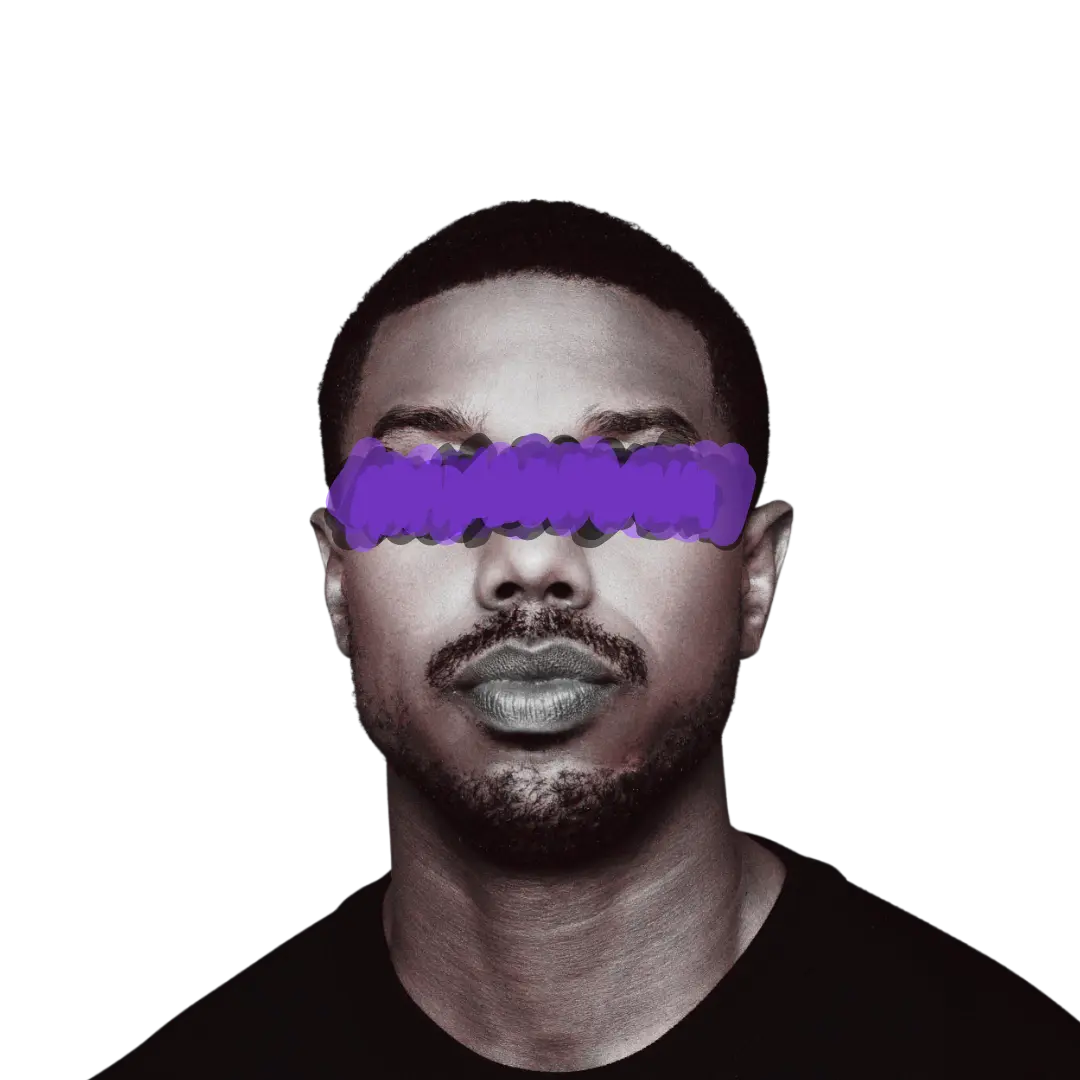
"It's always been about proving things to myself more than anything. What are my limits? Where's my ceiling at?"
After watching Sinners, Michael B. Jordan's mother couldn't recognize her own son on screen. She knew, intellectually, that her child was playing twins named Smoke and Stack in a vampire movie set in the Mississippi Delta. But watching the film, she couldn't see him. "She didn't see me, her child," Jordan said. "Which is the biggest compliment."
Stop and read that again. A man's highest praise for his own performance is that his mother couldn't find him in it.
That single detail tells you more about Michael B. Jordan than any profile about his workout routine or box-office numbers. Most actors want to be seen. Jordan wants to disappear — so completely that the person underneath vanishes and only the character remains. And that vanishing feels like victory.
This is the engine of an Enneagram Type 3. The Achiever doesn't just work hard. He becomes whatever the moment demands, rebuilding his identity from the ground up for each new chapter, until the question who am I without the role? becomes genuinely difficult to answer.
TL;DR: Why Michael B. Jordan is an Enneagram Type 3
- Born with someone else's name: Named Michael Jordan, teased so relentlessly he almost changed it. "I'm gonna be compared with Michael Jordan for the rest of my life? F--k that, I gotta figure this sh-t out!" The Type 3 wound — needing to prove your own identity is worth something — was built into his birth certificate.
- The disappearing act: He doesn't just play characters. He absorbs them so completely that his mother can't recognize him, co-stars can identify which twin he's playing from behind, and he needs therapy to find his way back. The Type 3's gift and prison: becoming anyone, at the cost of losing yourself.
- The Killmonger crash: Playing Erik Killmonger sent him into depression. He isolated from family, shut out love, and couldn't reconnect with himself afterward. This is the Type 3's stress arrow to Type 9 — under extreme pressure, they don't explode. They withdraw.
- The strategic builder: Actor → producer → director → production company with inclusion riders. Every career move expands his range of proof. The Type 3 doesn't just want to succeed in one dimension.
- The loneliness underneath: "There's a loneliness that I have. The responsibility that you have is isolating, and the weight is isolating." The cost of building a self out of achievements: every quiet moment becomes a question.
What is Michael B. Jordan's Personality Type?
Michael B. Jordan is an Enneagram Type 3 (The Achiever)
Enneagram Type 3s are driven by a core need to feel valuable and worthwhile. They learned early, usually in childhood, that love and acceptance come through performance — through being impressive, successful, visible. At their best, they're authentic leaders who inspire through genuine excellence. At their worst, they become shape-shifters who've performed so many versions of themselves that they've lost track of the original.
Jordan's Type 3 pattern starts with his name.
He was born Michael Bakari Jordan on February 9, 1987 — the same year Michael Jordan the basketball player won his first scoring title. The teasing was relentless. On the basketball court, every missed shot invited ridicule. In school, every introduction became a joke. "I got teased so much, to the point where I almost changed my name," he told CBS. He considered going by Bakari, his middle name, which means "noble promise" in Swahili.
He didn't change it. Instead, something happened that reveals the Type 3 engine with perfect clarity:
"It definitely made me want to be competitive. I wanted to be great at something, if not for nothing else at that time, just to feel like I had my own identity."
There it is. Not I want to be famous. Not I want to be rich. "I wanted to feel like I had my own identity." A Type 3's entire psychology compressed into one sentence: achievement as the vehicle for selfhood. If I'm not extraordinary at something, do I even exist?
"I'm gonna be compared with Michael Jordan for the rest of my life? F--k that, I gotta figure this sh-t out!"
He figured it out. But the figuring never stops.
The Deck Was Stacked
Michael Bakari Jordan was born in Santa Ana, California, but his formation happened in Newark, New Jersey, where his family moved when he was two.
Newark in the early '90s was, in Jordan's words, "one of the worst places in the country." His best friends were drug dealers. His best friend's dad was "that guy." He saw people lose their lives. For a kid with energy to burn — the kind who set toilet paper on fire as a prank — the line between mischief and a police record was thin.
"The deck was stacked against me at an early age."
What kept him grounded: parents who were, in his words, "compassionate yet strict." His father Michael A. Jordan, a former Marine, worked nights at JFK Airport before starting a catering business. His mother Donna, an artist-turned-guidance-counselor later diagnosed with lupus, made their home "the house" — the place where every kid on the block came for sleepovers and home-cooked meals and basketball in the driveway.
"There's nobody in my family that came from this," he told CBS. "Nobody that looked at it as a potential career."
The acting started by accident. A receptionist at a doctor's office noticed the boy and told his mother about modeling auditions in New York. He was cast in Toys "R" Us and Modell's Sporting Goods ads. He pivoted to acting. By twelve, he had his first TV roles.
This is where the Type 3 pattern locks in. Jordan didn't just stumble into acting. He recognized, young, that performance was the escape route. Newark showed him what failure looked like. His parents showed him that discipline could build something different. And the name — the name that belonged to someone else — showed him that identity itself was something you had to earn.
"Where's Wallace?"
Jordan's path to stardom wasn't the overnight success story Hollywood loves to tell. It was the Type 3's nightmare: achieving the same thing multiple times before the world noticed.
The Wire (2002): At fifteen, he played Wallace, a teenage drug dealer killed by his own friends. His death scene remains one of the most devastating moments in television history. Fans still shout "Where's Wallace?" at him in public. But The Wire was a cult show. Jordan delivered a career-making performance to an audience that barely existed.
All My Children (2003-2006): He replaced Chadwick Boseman as Reggie Montgomery — foreshadowing connected destinies neither could have imagined.
Friday Night Lights (2009-2011): As quarterback Vince Howard, he anchored two seasons of compelling dramatic work. Small audience. Again.
"Between The Wire and Sinners, there's been a lot of years — procedurals, soaps, waiting for the phone to ring. At one point I was only doing TV, and I was asking myself if I'll ever be in movies."
He also noticed something else: "There was a stretch of time when I might have gone out on an audition once a month, and I had white friends who were going out four times a week."
For a Type 3, this is excruciating. You're doing the work. You're getting the results. But the world hasn't decided you exist yet. And that question — am I enough? — gets louder every year the phone doesn't ring.
Then Ryan Coogler walked into a room.
"I Don't Think This Guy Knows Who He Is"
They met in 2012 near Forest Whitaker's production office in Hollywood. Coogler was 27, fresh from USC, casting his first film. Jordan was 26, grinding through years of TV work that hadn't broken through. They went to a Starbucks across the street.
Coogler took a risk:
"I'm gonna just take a risk right now. Hey, man, I think you're a star. Let's do this project together and show the world."
Jordan's response tells you everything:
"It was the first time anybody told me that, without a doubt. I would look at myself in the bathroom mirror and try to build up the belief that I was gonna be successful, but I never knew how directors or writers or filmmakers thought about me. But when Ryan said it in that Starbucks, that was the first."
A man who had been acting professionally for thirteen years — since he was twelve — had never once been told by a filmmaker that he was a star. He'd been building himself up alone, in bathroom mirrors.
Coogler saw something else entirely: "I don't think this guy knows who he is. I don't think he knows how big he is."
That perception — you don't know who you are yet — may be the most meaningful thing anyone has ever said to Michael B. Jordan. Because for a Type 3, whose identity is built on achievements, someone seeing past the achievements to the person is transformative.
Fruitvale Station (2013) won both the Grand Jury Prize and Audience Award at Sundance. Critics compared Jordan to "a young Denzel Washington." The partnership was born.
Over twelve years and five theatrical films, their dynamic deepened into something Coogler compares to Michael Jordan and Scottie Pippen. Jordan calls Coogler "unapologetically who he is," someone who "gives actors the space to breathe and to take creative swings in a safe space." Coogler calls Jordan "a gifted actor, a very sharp technician" whose instincts "disrupt the original plan in the best way possible."
"That type of reassurance and confidence helped build my own self-confidence over the years," Jordan has said.
Read that again. His self-confidence was built by someone else seeing him clearly. That's the Type 3's deepest need: not applause, but recognition. Not fans, but a witness.
When Coogler pitched Sinners — "It's twins, it's period, it's vampires" — Jordan went quiet for so long that Coogler thought he'd lost him. Then: "Man, you know what, that sound pretty interesting, man." That trust, the willingness to follow each other into territory neither can predict, is what twelve years of proving yourself to one person buys you.
"Finding a collaborator like him early in my career changed everything for me," Jordan said at his American Cinematheque Award ceremony, with Coogler presenting. "I may be running out of challenges for you one day," Coogler replied.
"I Shut Out Love"
Playing Erik Killmonger in Black Panther nearly broke him.
Jordan isolated himself for months. He cut off family. He cut off friends. He inhabited a character defined by abandonment, rage, and the conviction that the world owed him something it would never pay.
"I spent a lot of time alone. I figured Erik, his childhood growing up was pretty lonely. He didn't have a lot of people he could talk to about this place called Wakanda that didn't exist."
He had no exit strategy. No process for leaving the character behind when cameras stopped rolling.
"I didn't have a process for being Killmonger. I just did whatever I felt I needed to do or whatever I felt was right in the moment every step of the way."
The result was one of Marvel's greatest villains — and a depression that ambushed him.
"Coming out of that, it was hard to want love. During shooting I kept myself from family and children, and away from everything that Killmonger never had."
Then the sentence that cracks the whole analysis open:
"Readjusting to people caring about me, getting that love that I shut out — I shut out love. I didn't want love. I wanted to be in this lonely place as long as I could."
This is the Type 3's stress arrow to Type 9 made visible. Under extreme pressure, Threes don't rage or fight. They withdraw into a blank, detached place where nothing can reach them. Jordan didn't just play Killmonger's isolation. He became it. The same mechanism that makes him extraordinary — the ability to dissolve into a character — nearly swallowed him whole.
Recovery required something most Type 3s resist: asking for help.
"I went to therapy. I started talking to people, starting unpacking a little bit. Your mind is so powerful... As a man, you get a lot of slack for it. I don't really subscribe to that. Everyone needs to unpack and talk."
Years later, directing Creed III, he called the experience "my therapy session." Adonis Creed's struggle to face his demons mirrored what Jordan had been processing since Killmonger. "I had something to say. I had a unique opportunity to play a character going through similar things that I was personally, and finding ways to work through my own sh-t through a character."
The Type 3 finding a way to make healing itself an achievement. Even therapy gets channeled into work.
Two Sizes of Shoes
For Sinners, Jordan played identical twins — Smoke and Stack — and the lengths he went to differentiate them reveal the Type 3's relationship with identity at its most extreme.
He kept separate journals for each brother. He did chakra work to determine where in each twin's body their childhood trauma lived and how it shaped their posture and speech. He worked with twin consultants and actual identical twins to study the bond.
Then there were the shoes.
"I wore a half-size too-small shoe for Stack because I wanted him to feel a bit uneasy. And Smoke wore a half-size too big, because I wanted him to feel a bit planted and grounded."
A man who literally changes his physical foundation to become someone else. Stack's tight shoes made him antsy, unable to sit still. Smoke's loose shoes kept him heavy, planted. Two different people, built from the feet up.
On set, Jordan didn't just switch characters. He switched entire personalities: "When I'm Smoke, I'm really quiet but I observe a lot. I'm looking at everything, taking everything in. When I'm Stack, I'm much more in the mix — talking to the crew, talking to the cast, bouncing from one department to another."
He invented arguments between the twins that never appeared on camera, building an invisible history of rivalry and love that informed every glance. He wore gold caps for one twin that changed how his mouth sat and how he spoke. He created distinct vocal registers — Smoke's "lower octave, tired and raspy" versus Stack's "buoyant, more whimsical."
Co-star Wunmi Mosaku: "Even from my back, I could tell if he was Smoke or if he was Stack. His character was so detailed — his cadence, his rhythm, his energy, his spirit, his face."
And Chadwick Boseman was with him. Jordan had replaced Boseman on All My Children over a decade earlier. They'd become brothers in Black Panther. After Boseman's death, the loss lived in every frame of Sinners. "Chad was with me. Chad is always with me, but definitely on Sinners as well," Jordan said. "I love that guy so much, and it saddens me every time I think about it, that I won't get a chance to work with him again."
The film became the first horror movie to earn an A CinemaScore in the organization's 47-year history, earned 16 Oscar nominations — the most for any single film ever — and grossed over $368 million worldwide. Jordan received his first Golden Globe nomination for Best Actor.
Octavia Spencer once called him "a brilliant character actor with a beautiful, leading man's face." Sinners proved the point. And his mother couldn't see him at all.
This is where the Type 3 pattern becomes art. The same impulse that drives Jordan to rebuild his body for every role — boxer for Creed, warrior for Black Panther, leaner for Sinners — drives him to dissolve his identity so completely that the boundaries between self and performance thin to nothing. The body is one more variable to optimize. The identity is the whole project.
Heavy Is the Crown
"There's a loneliness that I have. The responsibility that you have is isolating, and the weight is isolating."
Jordan said this on Jay Shetty's podcast in 2024, and it's the most revealing thing he's ever admitted. Not because loneliness is unusual for celebrities. Because of why he's lonely.
"I think the worst part of that is the feeling like nobody really understands, and sometimes falling into the spaces of just being alone, feeling alone."
"Bringing them into my world, what I got going on, isn't easy. And it's not just, 'I love you, you love me, that should be enough,' right? It's not quite that simple."
His relationship with Lori Harvey (2020-2022) was notable because it was so public — unusual for someone who keeps everything else locked down. When it ended, Jordan processed the breakup on Saturday Night Live: "I went through my very first public breakup. Honestly, Michael B nervous, Michael B vulnerable, but don't worry — Michael B a'ight, because Michael B in therapy!"
The audience laughed. He meant it.
"I was lucky enough to have a lot of work," he told Gayle King afterward. When emotional pain surfaces, the Type 3 instinct is to return to the arena where they feel most capable.
Jordan lived with his parents until he was 33. He bought them a house in Sherman Oaks and stayed there himself, helping care for his mother through her lupus. "Who doesn't want to buy your parents a house?" he said, deflecting any suggestion it was unusual. When he finally moved out, his mother saged the entire place. He still drives twenty minutes back for Sunday dinner. "Mom and dad, they cook."
This is the 3w2 — the Three with a Two wing. He doesn't just want to succeed. He wants to succeed in a way that lifts others. He founded Outlier Society Productions with inclusion riders before they were fashionable. He launched #ChangeHollywood with Color Of Change. He cares for family. The helper instinct is real, and it's the thing that keeps his ambition from becoming cold.
But it doesn't fix the loneliness. Because the loneliness isn't about being alone. It's about the gap between the person everyone sees on screen and the person who drives twenty minutes for his mom's cooking. The Type 3 who has spent his entire life becoming other people doesn't always know what to do when there's no character to slip into.
"Heavy is the crown when you're in that position, I guess."
The Fantastic Four Test
Not everything has been victory laps.
The 2015 Fantastic Four reboot was a disaster — critically panned, commercially dead, nominated for Razzies. Jordan faced racist backlash before the film even released for playing Johnny Storm, a character traditionally depicted as white.
His response revealed the Type 3's resilience:
"Sometimes you have to be the person who stands up and says, 'I'll be the one to shoulder all this hate. I'll take the brunt for the next couple of generations.' I put that responsibility on myself."
For a Type 3, public failure is the nightmare scenario. Your worth is tied to your performance, and the performance just bombed in front of everyone. Jordan didn't deflect or hide. He absorbed the hit, stood by his work, and moved forward. Three years later, he'd become one of the most compelling villains in Marvel history.
Daniel Kaluuya recalled seeing Jordan's Fantastic Four billboard and what it meant to him and his friends: "A human torch in real life." Even the failure became fuel for someone else's fire.
But Could He Be a Different Type?
Some personality databases type Jordan as a Type 9, pointing to his emphasis on harmony and his laid-back off-screen demeanor. Others see Type 8 in his intensity. His twelve-year loyalty to Coogler could suggest Type 6 devotion.
But Type 3 explains what the others can't: the strategic transformation. Jordan doesn't just work hard — many types do that. He rebuilds his identity for each new chapter. His physique, his voice, his psychology, his shoes. His insecurities aren't about safety (Six) or control (Eight) or peace (Nine). They're about being enough. That's the Three's wound.
The loyalty to Coogler isn't just loyalty. It's a partnership with the one person who saw him before he had proof he was worth seeing. The loneliness isn't just celebrity isolation. It's the cost of building a self out of achievements. And the therapy isn't just self-care. It's a Type 3 doing the hardest work a Three can do: sitting still long enough to ask who he is when there's no role to play.
Noble Promise
At 38, Michael B. Jordan has 16 Oscar nominations for a vampire movie, a directorial career in motion, a production company that changed how Hollywood thinks about inclusion, and People's Sexiest Man Alive on his résumé — because Type 3s even achieve in categories they didn't pursue.
But the question that haunts every Type 3 still echoes.
Consider: a man named after the greatest athlete alive, who spent his childhood proving the name could mean something else. A man who transforms so completely that his own mother can't find him on screen — and calls that a compliment. A man who shut out love to play a villain, who describes his life as lonely even as the world won't stop watching, who still drives twenty minutes on Sundays for his mom's home cooking.
"I still feel like I have something to prove," he said during Creed III. "I still feel like I want to make people proud. I want to make myself proud."
Bakari means noble promise. He hasn't changed his name. He's still figuring out what it means.
Disclaimer: This analysis of Michael B. Jordan's Enneagram type is speculative, based on publicly available information, and may not reflect his actual personality type.

What would you add?