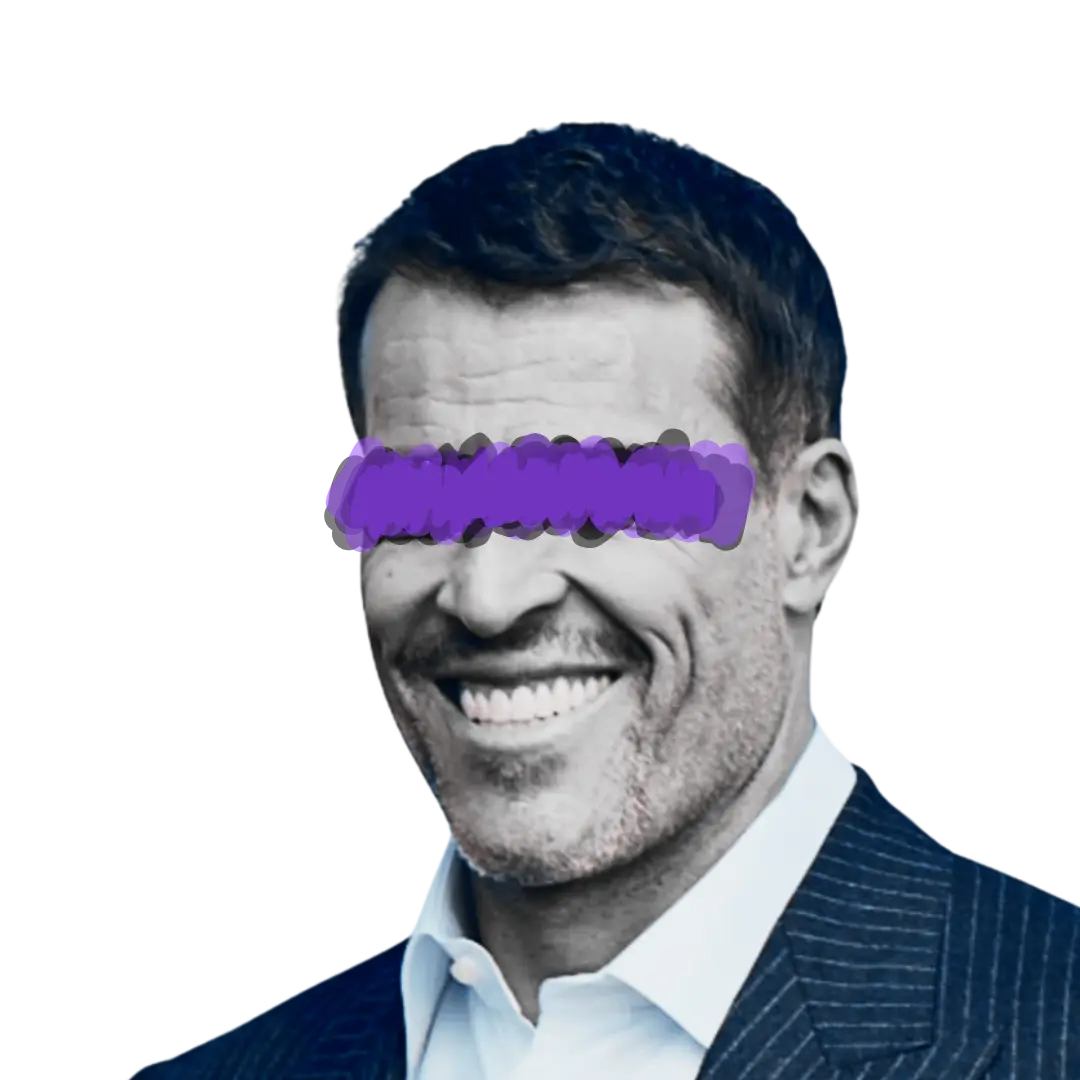
"If my mom had been the mother I thought I wanted, I wouldn't be as driven; I wouldn't have suffered, so I probably wouldn't have cared about other people's suffering as much as I do."
Before every event, the same ritual. Mini trampoline, one that barely accommodates his barrel-chested frame. A plunge into fifty-seven-degree water. Three rounds of breathing. Then a backstage sequence of fist-pumping and power-posing that Nancy Duarte, who has coached hundreds of executive speakers, called "one of the most involved pre-talk rituals I've ever seen, especially from a guy who claims he doesn't get nervous."
She described it as a modern war dance.
Then the 6'7" frame bounds onto the stage, commanding thousands for twelve hours straight: no notes, no slides, no breaks. Tony Robbins has built a billion-dollar empire on the promise that anyone can transform. Over four decades, he has coached presidents, athletes, and billionaires. He has fed a billion meals to the hungry. He has pulled people from the edge of suicide in front of live audiences.
The question is what the war dance is for.
TL;DR: Why Tony Robbins is an Enneagram Type 3
- The War Dance: The world's most confident speaker has the most elaborate pre-talk ritual in the business, because underneath the performance, a Type 3's core emotion is shame.
- The Wound: Four fathers, an abusive mother, poverty so deep they ate saltine crackers for Thanksgiving. He learned early that love had to be earned through performance.
- The Body: A pituitary tumor made him grow ten inches in one year. He turned a medical condition into a brand. Classic Three.
- Why Not Type 8: The anger is performative and strategic. Watch what happens when the image cracks: he apologizes and rebuilds. Eights double down. Threes protect the image.
- Duty vs. Devotion: In his Alex Hormozi podcast, Tony named the Type 3 growth journey out loud, from "I have to" to "I get to."
What is Tony Robbins' Personality Type?
Tony Robbins is an Enneagram Type 3 (The Achiever)
Type 3s sit in the heart triad. Their core emotion isn't anger. It isn't fear.
It's shame.
The belief that who you are, stripped of achievement, performance, and reputation, is not enough. That love must be earned. That if you stop producing, you disappear.
For Tony Robbins, that belief wasn't psychology. It was the first thing he learned.
The Wound That Created a Giant
Anthony J. Mahavorick was born on February 29, 1960, in Glendora, California. A leap-year birthday. A boy who technically existed one year in four.
His mother drank. In a 2026 conversation with Steven Bartlett, Robbins described what that meant: "We never had any money. We were very, very poor... under that stress, she drank alcohol and took prescription drugs. And when she did that, she became very violent."
The violence was specific. She held his mouth open and poured liquid dish soap down his throat until he vomited. She beat his head against a wall until it bled. By adolescence, he'd had four different fathers: his biological father left when he was seven, a man named Jim Robbins adopted him at twelve, and others rotated through after that. Each new marriage was another lesson: stability does not last.
He was the eldest of three. His brother Marcus was five years younger, his sister Tara seven. Tony became the primary caregiver, working odd jobs to feed his siblings while his mother cycled through men and substances.
At seventeen, she chased him through their house with a knife.
He left that night. He never went back.
This is not a climb-from-poverty story. This is a Type 3 origin story. When a child learns that home is dangerous and love is conditional, that who you are invites violence, but what you do might earn safety, they either collapse or become hyper-skilled at reading what others need.
Tony chose the latter. And he became extraordinary at it.
The Father He Found
After leaving home, Robbins worked as a janitor, making $40 a week. He was broke and overweight, washing dishes in a bathtub because he couldn't afford a proper kitchen.
Picture that for a moment. Seventeen years old. Alone. The bathtub.
Then someone told him about a Jim Rohn seminar. Robbins spent $35, nearly his entire week's wages, on three hours with the personal development legend.
"That man, that seminar, that day: what Jim Rohn did was put me back in control of my own future," he later wrote.
Consider the psychology. A seventeen-year-old who had cycled through four fathers, who had just fled his mother's knife, finds a stable older man willing to teach him how the world works. Rohn gave him a philosophy that replaced chaos with a system: "The secret to life is to find a way to do more for others than anyone else is doing."
The mentorship lasted years. Rohn taught Robbins it was fine to miss a meal, "but don't miss your reading." Robbins got hooked on thirty minutes of reading a day, a habit he told CNBC was the most valuable of his life. He promoted Rohn's seminars, absorbed his frameworks, and built on his foundations.
When Rohn died in 2009, Robbins spoke at his funeral: "He got me to realize that the secret to life was to work harder on myself than my job or anything else, because then I'd have something to give people."
A boy who never had a father found one. Then he became one of millions.
By twenty-four, Robbins had made his first million.
The Body
There's a detail most people don't know about Tony Robbins. In high school, he grew ten inches in a single year.
At thirty-one, he found out why: a pituitary tumor. Diagnosed as acromegaly, a condition that floods the body with growth hormone at several times the normal adult level. His doctors recommended brain surgery.
He refused.
The tumor eventually stabilized. But it had already done its work. It made him a physical giant. The 6'7" frame, the enormous hands, the commanding presence that fills stadiums. None of it was built in a gym. It was a medical condition.
Tony Robbins turned a pituitary tumor into a brand.
This is what Threes do. They don't just cope with circumstance; they perform it. What might have been a medical vulnerability became the foundation of the most recognizable physical presence in self-help. The body became the message: I am larger than my problems, and you can be too.
The Method: Performance as System
Robbins studied Neuro-Linguistic Programming with its creators, Richard Bandler and John Grinder. When Grinder asked for a project proving his commitment, Robbins suggested firewalking: walking across red-hot coals as visceral proof that people can do more than they believe. It became his signature.
His core insight: when any single behavior meets three or more human needs simultaneously, it becomes almost addictive. This explains why some people can't stop working, why others can't leave bad relationships, and why transformation requires rewiring, which needs to be met by certain behaviors.
In 2002, he partnered with Cloé Madanes, a pioneering family therapist and direct student of the legendary hypnotherapist Milton Erickson. Where Robbins brought scale and stage presence, Madanes brought psychological rigor. Together, they created Strategic Intervention and trained over 15,000 coaches worldwide. The partnership gave his intuitive methods the institutional structure they'd lacked.
The Live Intervention
Robbins' signature move is pulling someone from an audience of thousands and making a breakthrough in real time. The most documented example: tennis legend Andre Agassi.
When Agassi first worked with Robbins, he had fallen from world number one and was ranked outside the top 25, frustrated, injured, and close to quitting. In a session, Robbins later described on the Tim Ferriss podcast, he sat Agassi down and said: "Think of a time you hit the tennis ball perfectly."
He got Agassi into that peak state. Then he asked: "Are you thinking about your wrist?"
Agassi said no.
"How the hell did you think you'd ever get back to peak form by focusing on your wrist?"
Within four months, Agassi was back to number one. He went on to win multiple Grand Slams and called Robbins the "ultimate life coach."
This is the method in action: identify peak states, anchor them, create triggers, and install new patterns. Neuro-Linguistic Programming scaled to stadium size. The performance is the therapy.
Why Not Type 8?
The obvious objection: isn't Tony Robbins a Type 8?
The 6'7" frame. The commanding voice. The way he takes control of a room, of thousands of rooms. He looks like a Challenger.
But watch what happens when the image cracks.
In 2018, a woman stood up to him at a seminar about his #MeToo comments. He leaned into her space and pushed back verbally. Then he apologized. Then he reframed the entire incident as a learning opportunity.
A Type 8 doubles down. A Type 3 protects the image.
The distinction lives in the core emotion. Eights sit in the body triad; their fuel is anger. Threes sit in the heart triad; their fuel is shame. The question isn't "does he take control of a room?" It's what drives the control?
Robbins' anger is performative and strategic, deployed on stage for effect, then retired. True Eights sustain confrontation because the anger is genuine and constant. Robbins' constant isn't anger. It's the need to be seen as someone worth following.
"As Threes, it can be very hard to admit when actions are self-oriented," wrote the Enneagram analysts at Clear Impact. "They try to perfume the pig, scramble to cover up mistakes, reframe them as learning opportunities — anything to avoid directly touching the shame."
And the Type 7 objection? Sevens avoid pain by staying in motion and chasing novelty. Robbins runs toward pain, his own and others', in every live intervention. Sevens scatter energy across a hundred interests. Robbins has been laser-focused on a single mission for forty years.
The energy that looks like Eight dominance and Seven enthusiasm is actually Three performance at industrial scale.
The Shadow: What Stress Reveals
Every Enneagram type has a stress direction, the pattern they fall into when pressure overwhelms their usual coping. For Type 3s, that direction is Type 9: disengagement, apathy, numbness.
Robbins' entire morning priming ritual can be read as a daily defense against this. The trampoline, the ice water, the breathing exercises: every morning, he actively fights the disengagement that waits on the other side of performance. He's admitted he's "not much of a meditate-er" because "trying not to think doesn't work too well for me."
Stillness is where Type 3s meet their deepest fear: the possibility that without the performance, there's nothing underneath. So he keeps the war dance going, every single morning.
"I don't negotiate with my mind," he's said. His own words reveal the stakes.
But when a real crisis arrives, the unhealthy Three pattern surfaces.
The BuzzFeed Crisis
In 2019, BuzzFeed News published allegations of sexual misconduct against Robbins. His response followed a textbook Three stress sequence: denial, litigation, then image reconstruction through achievement.
Publisher Simon & Schuster dropped his book. His business partner, Peter Mallouk, ended their professional association. For a man whose identity is built on institutional validation, losing those relationships was existential.
Then came a study from Stanford's Snyder Lab reporting decreases in depression and anxiety among seminar attendees, though some Stanford colleagues questioned the methodology. For Robbins, the study served a purpose beyond science: academic validation to rebuild the damaged image.
Deny. Litigate. Achieve something new. Rebuild. This is how an unhealthy Three processes threat, not by confronting the pain, but by performing past it.
The #MeToo Comments
In 2018, a video surfaced of Robbins telling a seminar audience that the #MeToo movement was an excuse for some women to "get significance" by "attacking and destroying someone else."
He apologized. The comment still reveals the Three's blind spot: he ran a complex social issue through his own framework of human needs. When your operating system is built on image management, it's hard to see suffering that doesn't fit the model.
The Fire-Walking Injuries
People have been burned at Robbins' events. In 2012 and 2016, dozens required medical attention after firewalking gone wrong.
His response: he kept doing firewalks.
If your identity is built on making the impossible possible, admitting danger threatens the entire story. The show must go on — because the show is all there is.
The Effectiveness Question
No rigorous long-term studies exist on Robbins' methods. The Stanford research examined participants for a few weeks. One phenomenological study of eight attendees found a theme of "permanency of change," but the sample was tiny. The longest documented follow-up tracked effects for about eleven months.
Critics point to the "seminar high," the neurochemical rush from high-arousal rituals like firewalking. Endorphins and dopamine spike. People feel transformed. Then they go home.
A former mastery coach who worked with Robbins for four years wrote: "Tony's work helps temporarily, but NOT a permanent solution."
The Psychotherapy Networker, after observing Robbins at their symposium, offered a more measured assessment. His approach, they noted, deliberately avoids dwelling on past wounds: "My work isn't focused on healing past wounds," Robbins told the publication, "because you can spend your whole life doing that."
The honest answer: we don't know if the transformations last. The evidence either way is thin. But the approach itself, building forward instead of excavating backward, is revealing. That's what Threes do. They don't process the wound. They perform over it.
The Door
When Tony Robbins was eleven, his family had saltine crackers and peanut butter for Thanksgiving.
Then a stranger knocked on the door. Two bags of groceries. A frozen turkey. No name, no explanation.
"The idea that strangers cared about his family," he told CNN, "completely changed his experience of life."
At seventeen, the same year he fled his mother's knife, he used his janitor savings to buy groceries for two families. He wanted to double it each year. Within a few years, he was feeding hundreds.
In 2012, he became a Feeding America ambassador. By 2014, he'd launched the 100 Million Meals Challenge, which he achieved within two years. He escalated to a billion meals. During COVID, he donated an additional $10 million to the campaign. In January 2024, the billion-meal milestone was reached ahead of schedule.
The goal now: the next billion, by 2035.
This is what Type 3 integration looks like. When Threes grow, they move toward Type 6, building loyal systems, creating infrastructure, committing to something beyond personal achievement. The feeding program isn't a vanity project. It's a systems-level response to a childhood wound: infrastructure where there was once scarcity. Permanence where there was chaos.
His Cloé Madanes partnership follows the same arc, not performing alone, but building institutional structures that outlast him. His twenty-four-year marriage to Sage, whom he met when she was a phlebotomist drawing his blood at a routine appointment: "We do less doing," Sage told DuJour, "and experience more being together."
Loyalty. Systems. Commitment. A Three doing the quiet work of a Six.
Duty vs. Devotion
In January 2026, Tony sat down with Alex Hormozi for what was supposed to be a podcast about mindset and success. It became a raw coaching session, Hormozi as the client, Robbins as the practitioner.
Hormozi confessed he doesn't find joy in much of what he does. He works because he can't see himself doing anything else. At 37, identity is bound to output.
Tony's response cut to the core of the Three's journey:
"Willpower only goes so far. That's push-pull. Motivation is where there's something out there that you want to serve more than yourself."
Duty drains. Devotion sustains.
Working from duty means pushing against obligation: I have to do this. It's exhausting because the fuel is self-generated. Working from devotion means being pulled toward something larger. The fuel comes from outside yourself.
Then he said the thing that gave the wound a name:
"The stories you repeat about your life become the emotional wallpaper you live inside. Tell yourself I'm failing, I'm behind, I'm not enough on loop, and your nervous system eventually believes you, no matter what your bank account says."
I'm not enough.
There it was. The Three's core wound, spoken aloud by the most successful motivational speaker in history, to another high achiever drowning in the same belief.
Later in the conversation, Robbins visibly struggled to hold his composure. "I'm trying not to cry," he told Bartlett in a separate interview that same month. "I hate suffering. I have suffered myself, and so I hate to see anybody suffer."
At 65, Tony has shifted from I achieve to prove I'm worthy toward I achieve because it serves something larger. The shift isn't complete (for a Three, it never entirely is). But the direction is real. The question isn't whether to achieve. Tony Robbins will always achieve.
The question is what fuels it.
The Psychotherapy Networker once observed that "there remains something opaque and unknowable about Robbins, perhaps even to himself."
Every morning, the ritual. The trampoline. The ice water. The war dance no one sees. Then three minutes of silence where he sends energy to people he loves. Prayer without religious language, connection made efficient.
He is still performing.
The question, at sixty-five, is whether the audience has changed.
Disclaimer: This analysis of Tony Robbins' Enneagram type is speculative, based on publicly available information, and may not reflect the actual personality type of Tony Robbins.
What would you add?