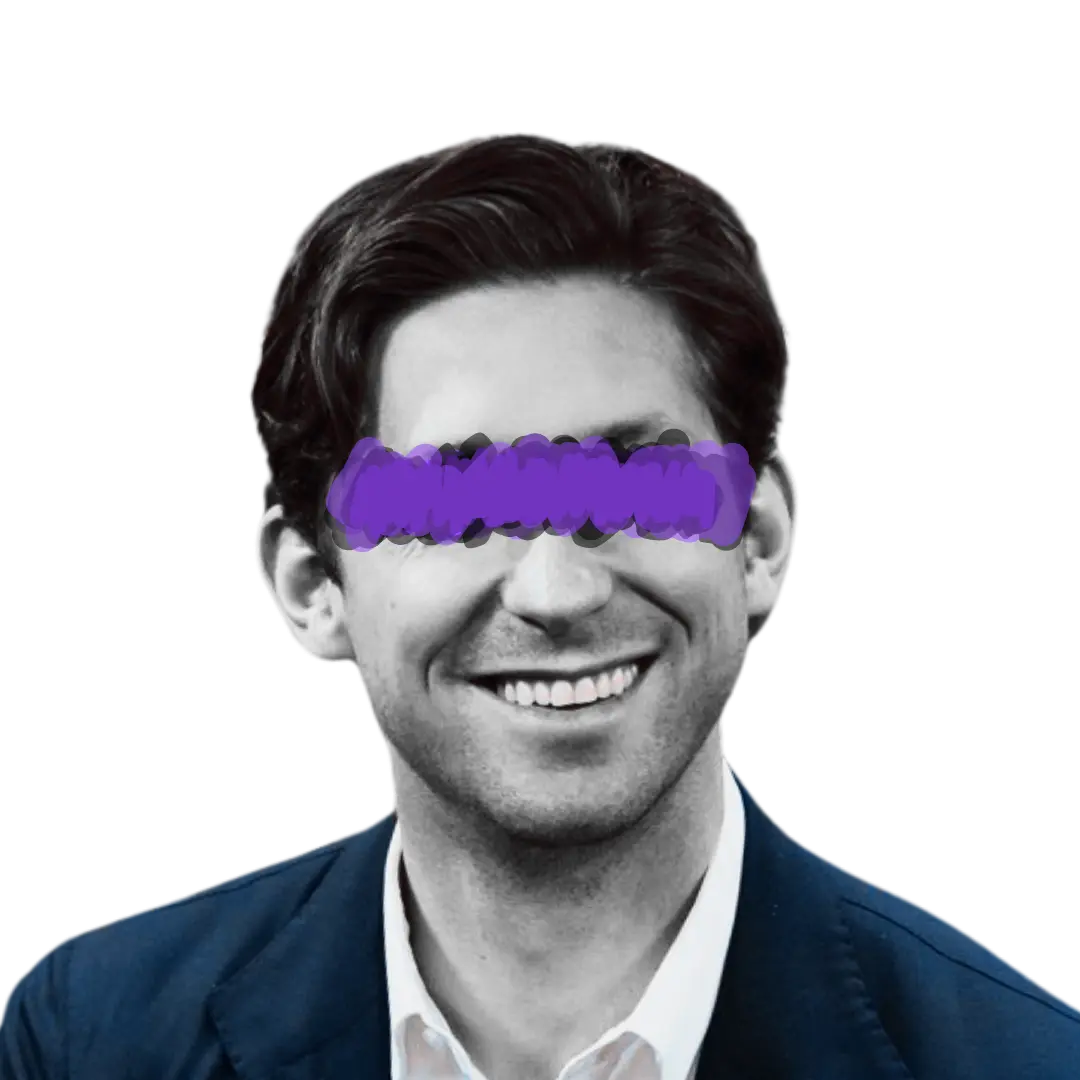

Asked which work of art had carried him through an important moment, John Coogan chose Koyaanisqatsi, Godfrey Reggio's wordless 1982 film about technology, speed, and a world knocked out of balance.
Jordi Hays chose Borat.
Two answers. The whole partnership.
John reaches for the strange object that opens another corridor of thought. Jordi reaches for the cultural object that lands before the room has time to get restless. One answer starts a rabbit hole. The other gets the laugh. The exchange appeared in a joint Cultured questionnaire published weeks after OpenAI bought their show.
TBPN is a live technology and business show that runs for three hours every weekday. It reaches roughly 70,000 unique viewers per episode, a modest general audience with an unusual concentration of founders, executives, investors, researchers, and people hoping to join them. That is “the room” throughout this analysis.
On camera, the differences between the hosts are easy to miss. Both men wear tailored suits. Both read the financial papers before most of Los Angeles is awake. Both speak fluent venture capital, know how to ride a live news cycle, and treat an executive changing his profile picture like a trade-deadline alert. They look like duplicate specimens of one success-maxing species.
Their reward circuits split underneath the uniform.
John Coogan’s best public fit is Enneagram Type 7, driven by curiosity, novelty, and freedom from confinement. Jordi Hays’s best public fit is Type 3, driven by achievement, distinction, and the need to create visible value. Their chemistry comes from precision. They run at the same speed while watching different dashboards.
The narrower hypotheses are John 7w6 and Jordi 3w4, with both appearing socially oriented. Their core types provide a solid base for analyzing the dynamic; the wings and instinct stacks remain tentative.
That is the real engine of TBPN.
The observable TBPN chemistry scorecard
These ratings summarize repeated public behavior. “Very strong” means several independent examples point in the same direction. “Mixed” marks a real strength with an attached weakness. “Unproven” identifies a question the public record cannot yet answer.
| Dimension | Read | What the public record shows |
|---|---|---|
| Tempo match | Very strong | A shared early workout, hours of preparation, and a three-hour live show every weekday |
| Skill complement | Very strong | Technical depth plus business judgment; production systems plus advertising and brand direction |
| Mutual revision | Very strong | Jordi says John improves ideas inside fields Jordi considers personal strengths |
| Format fit | Very strong | A fixed daily desk gives John changing territory and Jordi a public standard |
| Corrective friction | Mixed | They debate for hours before air, though both approach the industry from an openly pro-technology position |
| Institutional independence | Unproven | OpenAI promises editorial control, but its ownership is recent and the company remains one of the show’s main topics |
Chemistry, competence, and format fit are observable strengths. The unresolved question sits where an admiring audience is least likely to look: whether the partnership can challenge the industry that confers status and access on the show.
They match on speed and split the field of vision
Type 3 and Type 7 belong to the Enneagram’s assertive group. Both move toward what they want. Both default toward movement.
Their inner questions differ.
The Three scans for value: What matters here? How should this land? What would make the work undeniable? The Seven scans for possibility: What is interesting here? Where does this connect? Which unopened door changes the whole story?
In the working model, John’s attention goes first to mechanisms, connections, and possibilities. Technical curiosity is the public strength; confinement is the likely threat; opening more options is the likely stress reflex.
Jordi’s attention goes first to stakes, presentation, and audience response. Social compression is the public strength; an unimpressive result is the likely threat; raising the standard is the likely stress reflex.
Jordi described the division with unusual clarity in a 2025 joint interview on Dialectic: John loves technology more; Jordi loves business more. John goes deep enough to surprise technical guests. Jordi has more experience with deals, investing, advertising, and assembling companies.
That split shapes nearly every segment. John wants to know how the machine works, where it came from, and what odd second-order consequence everyone missed. Jordi wants to know what the machine means for the market, who wins, and whether the audience will care tomorrow morning.
These are centers of gravity rather than exclusive roles. John contributes business ideas; Jordi shapes editorial judgment. Their crossover matters because the partnership would feel mechanical if each man stayed inside a fixed lane.
The one-up rule is the relationship’s best evidence
Jordi gave the clearest explanation of their chemistry when he described getting “one-upped.”
He can bring John an advertising idea from a field he knows well and get back a revision that improves it. “When you have a partnership, you want to be getting one-upped all the time,” Jordi told Dialectic.
The respect here is specific. Jordi grants John revision authority inside his own competence. John often challenges with a possibility, which keeps the exchange focused on the idea’s next version. The competition points toward the product, and both hosts can claim the result.
Their disagreements usually happen before the audience sees them. From about 6:30 to 9:15 each morning, they work out, debate stories, test arguments, and narrow the day’s subjects. John later turns that conversation into a one-page newsletter and the spine of the opening monologue. After the show, they discuss what worked and adjust the next broadcast. The apparent spontaneity is the final pass through hours of friction.
One format decision shows how they revise. John’s original premise was a two-person show with no guests. Three episodes in, they were already entertaining exceptions. Within a year, TBPN had hosted roughly a thousand guests. Jordi described the larger plan as “hyper-calculated,” but the route stayed open to experiments. Their conflict style looks less like a public fight and more like a repeated question: Is this version better enough to abandon yesterday’s certainty?
John later said on The Social Radars that he and Jordi agree on enough to share a worldview and disagree enough to produce useful debate. The shared pro-technology baseline keeps their arguments friendly. It also means they usually dispute companies, tactics, and emphasis from inside the same larger frame.
Their first product was each other
Will Manidis introduced them. The first thing they made together was neither TBPN nor a podcast. It was a campaign for John’s nicotine company, Lucy.
Jordi had prepared a deck for an energy drink aimed at white-collar workers. The pair explored the idea, recognized that neither wanted the operational slog of another consumer packaged-goods company, and turned the concept into content. They filmed an hour while playing exaggerated business-world characters. The five-minute piece they released contained the seed of Technology Brothers.
The moment matters because it reveals how their minds already interlocked. Jordi arrived with the market category, positioning, and deck. John helped turn the commercial concept into a media format. Both knew enough about company-building to recognize the business they did not want. Their first win came from converting an abandoned product idea into a performance. The full origin appears in their Dialectic interview.
John later brought conviction around an in-person, two-person reaction show. Jordi texted the name Technology Brothers. Within weeks they recorded an episode. By October 2024, they were publishing from a dark conference room at the Jonathan Club in downtown Los Angeles. The second episode covered an energy drink and Meta’s Ray-Ban smart glasses.
Less than a year later, they sat at Meta’s campus interviewing Mark Zuckerberg about the next Ray-Bans. The tiny room had become a set. The speculative friendship had become an institution.
What John contributes: an endless supply of side doors
John’s curiosity is direct enough to sound like a mission statement. In a 2024 Audience of One interview, he called curiosity his “number one currency.” He ranked it above money, fame, health, and prestige. That hierarchy makes his Type 7 case stronger than the visible ambition surrounding TBPN.
Type 5 remains the serious alternative because John likes cameras, code, regulatory structures, product history, and questions that stay unresolved for years. The difference is motivational. His expertise keeps opening new territory; he stays energized by breadth, public improvisation, and the freedom to follow the next subject. A core Five is more likely to narrow life around mastery and protect energy from constant exposure.
TBPN needs that combination. Three hours of daily airtime punishes a host whose knowledge is all posture. John can pull a product into its technical lineage, connect a defense headset to gaming and anime, or size a breaking story by comparing how six television networks handled the same event. His curiosity gives the show inventory.
He also understands live continuity. During the Dialectic interview, John explained that he can take the camera when Jordi needs to message a guest, read from the Wall Street Journal, and keep the conversation moving. He described the handoff as easy. Anyone who has watched a co-hosted show die during one knows it describes a real skill.
John’s humor does a second job. Technology Brothers could launch with fake yacht sponsors and costumes because a joke lowers the social cost of an unfinished experiment. The bit gave them cover to try a version that ordinary business media would have rejected as unserious.
John’s weak side
Possibility can dissolve embarrassment, convention, and stale formats. It can also dissolve closure. The Type 7 risk is that another model or angle arrives precisely when a firm judgment is warranted. TBPN’s endless news cycle intensifies that risk because a new story can replace yesterday’s discomfort before it settles.
What Jordi contributes: the power to make a room agree that this matters
Jordi’s gift is social compression. He can take a sprawling idea and make it legible as a headline, a partnership, a visual, a guest pitch, or a moment people want to repeat.
His definition of brand is revealing. In the Dialectic interview, he described brand as the average feeling a company creates over time. The logo and set matter because they accumulate that feeling through repetition.
That is strong social Type 3 evidence. A healthy Three sees the invisible standard operating inside a group and can make work meet it. Jordi also described the year’s production plan as “hyper-calculated.” When the daily clock approaches zero, he says mood and personal feeling become irrelevant because the hosts promised to go live. Achievement here is a public obligation that outlasts inspiration.
Jordi brought the business half of YouTube to a partnership led by two performers. He had worked in advertising and built Branded Native. At TBPN, he pushed for yearlong, category-exclusive sponsorships, comparing each advertiser to a Formula One partner. Axios reported that the profitable company expected about $5 million in 2025 advertising revenue and had nearly sold its 2026 inventory.
He also supplies heat. The red flag enters the frame. The air horn lands. An executive hire gets promoted into a league transaction. He turns a loose conversation into an event with a deadline.
Jordi’s weak side
The Type 3 risk is that a public standard can absorb private judgment. Continuous audience response may make performance feel like proof that the direction itself is correct. Jordi’s willingness to be one-upped is important because it creates a revision mechanism inside that pressure.
The daily show solves a different problem for each host
The fixed desk and changing news are the partnership’s most elegant design choice.
John told Dialectic that repeating the same scripted show would feel like a waking nightmare. TBPN gives his Seven mind new territory every morning while preserving one commitment. Jordi gets the opposite benefit: a visible standard that arrives regardless of inspiration. “Your mood doesn’t matter,” he said of the countdown.
The format does psychological work for both men. It gives John novelty inside commitment and Jordi achievement without daily self-negotiation. John has called going live a consistency cheat code: the camera turns on at 11 a.m. every weekday, whatever either host happens to feel.
That arrangement also explains why neither can easily host the same show alone. John’s curiosity would have less pressure to compound into an institution. Jordi’s institution would have fewer strange inputs to keep it from becoming ordinary corporate television.
Why the old-money costume feels convincing
Matching suits. Polished shoes. Racing jackets covered in sponsors. Newspapers spread across the desk. Bronze horses, club rooms, gongs, tickers, and the visual grammar of 1980s finance.
The aesthetic gives off inherited refinement. Its authority is deliberately constructed. Both men understand that credibility has a set design.
Through an Enneagram lens, Jordi’s Three instinct reads status symbols as a language while John’s Seven instinct keeps turning the symbols into props. Both men participate in both sides. Together they borrow the authority of CNBC, the pacing of ESPN, the sponsor logic of Formula One, and the intimacy of a group chat.
The New York Times called the look “Patrick Bateman-core” and described techno-capitalism played like fantasy football. Peter Kafka supplied the social explanation: the show resembles what a viewer might discuss with a friend over lunch, close enough that the viewer can imagine occupying the chairs.
An early critic called their launch film a discount version of Succession. Jordi’s response was essentially: yes, that was the assignment. John thought the extravagant production also signaled that they took the young show seriously. The exchange captures the high-low mechanism. The suit raises the status of the conversation; the gong keeps the suit from becoming pompous.
In their Cultured questionnaire, they named their biggest cultural contribution: making tech people wear suits. The answer sounds silly. It is also accurate brand analysis.
The shared worldview is the missing brake
TBPN describes itself as openly pro-technology. That orientation creates warmth, access, and unusually fluent founder conversations. It also produces the partnership’s most important weakness.
The tradeoff becomes visible in the interviews. The New Yorker noted that they asked Palantir chief Alex Karp about kettlebells and celebrated Microsoft chief Satya Nadella’s OpenAI news with a gong. That friendliness helps executives relax and reveal how they think. It can also leave the audience with enthusiasm where scrutiny should sit.
The hosts have a coherent answer. They rarely try to break news. They prefer to comment on announcements after founders release them, acknowledge that original reporting has value, and consciously occupy a different lane. Their product is interpretation, access, and conversation.
That boundary does not erase the influence of their framing. Powerful builders come because the hosts understand them. Repeated access makes the hosts more fluent, and fluency draws more builders. The audience experiences proximity as insight. Sometimes proximity is the product.
The Enneagram risk is shared acceleration. The Three identifies what the chosen audience values; the Seven discovers another possibility inside that value system. Their morning debates generate genuine friction within the frame. They offer less evidence that either host regularly challenges the frame itself.
What OpenAI was buying
On April 2, 2026, OpenAI announced that it had acquired TBPN. The company promised that the hosts would retain control over programming, guests, and editorial decisions. It also praised their editorial judgment, audience understanding, and ability to convene influential people, then said the team would contribute to OpenAI’s communications and marketing beyond the show.
That last detail clarifies the asset. The roughly 70,000 regular viewers include a valuable concentration of decision-makers. John gives technical insiders the pleasure of being understood at depth. Jordi packages that understanding as an industry event. Together they created an interface between frontier technology companies and the people who fund, build, buy, and narrate them.
The deal also fulfills each host’s visible drive with unusual precision. Jordi gets institutional consequence: a show launched as a joke enters the strategy organization of the company at the center of the AI economy. John gets proximity to a frontier rich with unresolved technical questions.
The acquisition creates a structural conflict. It does not prove compromised coverage. Ownership can influence a show through gratitude, access, shared incentives, or the ordinary desire to keep a successful arrangement working, even when nobody issues an instruction.
Passing the independence test would be observable. TBPN could press an OpenAI leader on a failed launch, give a credible critic real airtime, disclose incentives when coverage touches its owner, or let a damaging story remain uncomfortable without converting it immediately into momentum. The show is too early in its ownership era for a verdict. Its credibility will depend on whether the hosts apply their one-up rule to the institution that now owns the desk.
The countdown will expose the answer
At 10:59 on a weekday morning, the set offers no visible psychology. Two men in suits sit behind a desk. The papers are stacked. The guest messages are open. The gong waits.
Then the clock reaches zero.
John finds the overlooked angle. Jordi makes its consequences legible. That exchange built TBPN from two founders riffing in a dark conference room into a media company OpenAI wanted to own.
The next phase asks one harder question: can the duo use the same appetite for revision against the company that validates both of their instincts?
The most revealing episode will be the one where the gong stays quiet, the countdown keeps moving, and neither host reaches for an easier story.
Frequently asked questions
What are John Coogan and Jordi Hays’s Enneagram types?
John Coogan’s best public fit is Type 7, with Type 5 as the strongest alternative. Jordi Hays’s best public fit is Type 3. The wing and instinct-stack hypotheses are less certain, and both typings remain speculative.
Why do John Coogan and Jordi Hays work so well together?
They share speed, ambition, humor, and social fluency while pursuing different rewards. John looks for the interesting mechanism or next possibility. Jordi identifies the stakes, sharpens the presentation, and makes the subject feel consequential.
How do John Coogan and Jordi Hays disagree?
Most of the visible evidence comes from their preparation and product decisions. They debate stories for hours before air, review the show afterward, and revise through experiments such as abandoning their original no-guests rule. Their shared pro-technology worldview keeps the disagreement friendly and places limits around it.
What did OpenAI buy when it acquired TBPN?
OpenAI bought access to a small, influential technology audience and a team with proven editorial, production, brand, and marketing skills. The acquisition’s effect on coverage remains a structural risk; the purchase alone cannot establish compromised editorial judgment.
What is the biggest weakness in their partnership?
They have abundant acceleration and less evidence of an internal brake. Both are assertive, adaptive to the same audience, openly pro-technology, and invested in access to the same ecosystem. Their hardest task is challenging the assumptions of the people who most value the show.
Disclaimer: This analysis of John Coogan’s and Jordi Hays’s Enneagram types is speculative, based on publicly available information, and may not reflect their actual personality types.